预测世界杯淘汰赛,不同AI水平差这么多?

Odaily星球日报Pubblicato 2026-07-02Pubblicato ultima volta 2026-07-02

Introduzione

文章对比了多个AI模型在预测世界杯淘汰赛时的表现。Gemini和DeepSeek因精准预测荷兰对摩洛哥的比赛(1:1平局、点球大战摩洛哥胜)而表现突出。Grok和千问则在胜负方向相对清晰的比赛中,如加拿大1:0胜南非、巴西2:1胜日本,成功预测了具体比分,展现了稳定性。ChatGPT和Claude擅长分析比赛过程,能指出潜在阻力,例如巴西对日本、科特迪瓦对挪威等比赛会较为胶着,但在判断冷门结果时较为保守。所有模型在德国对巴拉圭的比赛中集体判断失误,均看好德国晋级,但最终德国在点球大战中被淘汰。总体而言,不同AI模型各有特点:Gemini和DeepSeek敢于预测冷门;Grok和千问精于比分预测;ChatGPT和Claude强在过程分析。选择参考时需根据具体需求而定。

原创 | Odaily 星球日报(@OdailyChina)

作者 | Asher(@Asher_ 0210)
世界杯每场赛前,我都会让 AI 预测下,几乎每个模型都说得头头是道、细节满满。

有的讲球队身价,有的拆小组赛数据,有的分析伤病和战术,还有的直接给出比分、加时、点球剧本。乍一看,ChatGPT、Grok、千问、DeepSeek、Gemini、Claude 都好懂球噢。

但作为预测市场用户,我真正关心的不是哪个模型说得更完整,而是哪一个更值得参考。

随着世界杯进入淘汰赛阶段,Odaily星球日报从首场比赛开始,在赛前用尽量相同的问题询问不同 AI 模型,并在赛后对照真实结果回看——哪些模型只是分析得像那么回事,哪些模型真的提前捕捉到了比赛走向。

目前,已经结束的世界杯淘汰赛,加拿大 1:0 绝杀南非,巴西 2:1 险胜日本,德国被巴拉圭拖进点球大战后淘汰,荷兰也倒在了摩洛哥的点球下。到了比利时对塞内加尔,比赛更是踢成了 2:2 后加时逆转,直接把淘汰赛的不确定性拉满。

DeepSeek 和 Gemini,靠预判摩洛哥一战封神

目前最有记忆点的,还是 DeepSeek 和 Gemini 对荷兰 vs 摩洛哥这场的预测。这场赛前其实很容易站错队——荷兰纸面实力更强,阵容也更完整,很多模型都知道摩洛哥不好踢,但最后还是更相信荷兰能过关。

DeepSeek 和 Gemini 厉害的地方在于,它们没有停在“这场会很胶着”这一步,而是把后面的剧本也写出来了。Gemini 赛前直接给出常规时间 1:1,点球大战摩洛哥胜。结果比赛真的踢成 1:1,最后摩洛哥点球 3:2 淘汰荷兰。不是只猜对方向,而是连比赛会怎么被拖进点球、最后谁笑到最后,都基本对上了。
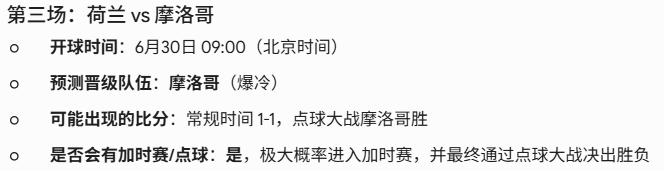
Gemini 预测荷兰对阵摩洛哥的比赛

DeepSeek 也很接近。它判断这场常规时间大概率会是 1:1 或 0:0,比赛可能一路拖到加时甚至点球,并倾向摩洛哥靠防守和反击爆冷晋级。
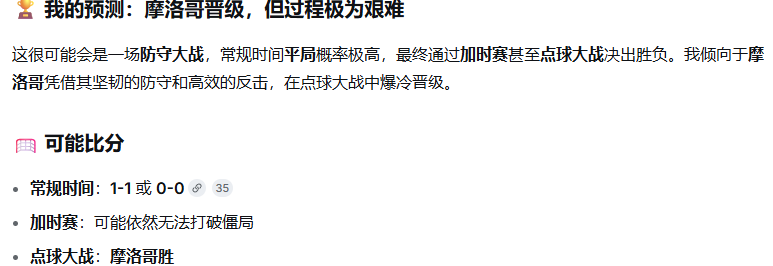
Deepseek 预测荷兰对阵摩洛哥的比赛

这一场之后,DeepSeek 和 Gemini 的存在感直接拉满。尤其是 Gemini,这次不像是在做赛前预测,更像是提前看过了比赛剧本。

Grok 和千问连续命中具体比分,稳定性比想象中更强

除了 DeepSeek 和 Gemini 在摩洛哥这场打出高光,Grok 和千问也不是没有存在感。它们最亮眼的地方,是在一些胜负方向相对清晰的比赛里,不只判断对了晋级球队,还把具体比分也预测得比较贴近最终结果。

南非对加拿大就是一个例子。赛前多数 AI 模型都看好加拿大,但分歧在于加拿大会不会轻松赢。Grok 给赛前给出加拿大 1:0 的预测,千问也给出过一球小胜。最后加拿大确实只靠 1 个进球过关,没有踢成想象中的大胜局。

千问预测南非对阵加拿大的比赛

巴西对日本也是类似。大部分 AI 模型都觉得巴西更强,但日本会不会把比赛咬住,才是这场的关键。Grok 和千问都预测比分会是 2:1,最后比赛也真的踢成巴西 2:1 险胜。它们看对的不是“巴西会赢”这么简单,而是日本能给巴西制造足够麻烦。

科特迪瓦对挪威这场,两者同样踩得比较准。挪威有哈兰德,晋级方向不难理解,但科特迪瓦的身体对抗和边路冲击也不会让比赛变成一边倒。Grok 和千问都预测挪威 2:1 获胜,最后比分也正好落在这个”剧本“里。
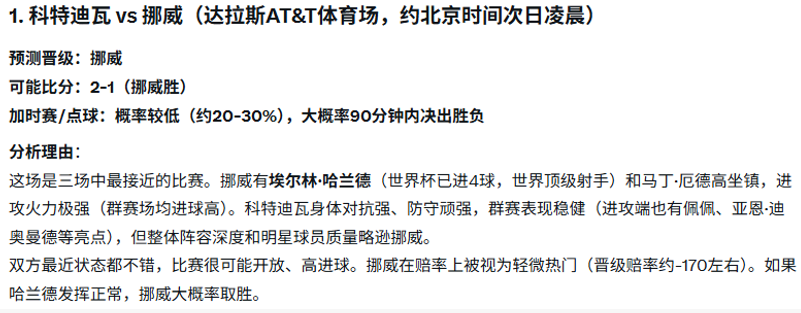
Gork 预测科特迪瓦对阵挪威的比赛

Grok 和千问的优势,是把热门局看得更细。它们没有提前写出摩洛哥淘汰荷兰这种大剧本,但在加拿大、巴西、挪威、法国这些比赛里,胜负方向和比分落点都给得比较贴。换句话说,它们不一定最会抓冷门,但很擅长判断热门队到底是碾压过关,还是艰难小胜。

ChatGPT 没有太多神比分,但比赛过程分析比较准

ChatGPT 没有像 Gemini 那样提前预测出摩洛哥点球淘汰荷兰,也没有像 Grok、千问那样连续踩中几个具体比分。但它的优势——很多比赛赛前看起来是强队占优,ChatGPT 会更明显地提醒一句,这场可能没有那么轻松。

巴西对日本就是例子。ChatGPT 预测巴西晋级,但没有把比赛写成巴西轻松碾压,而是提到日本的压迫、跑动和纪律性会让巴西踢得不舒服,甚至有机会先进球或追平。科特迪瓦对挪威也是类似,ChatGPT 预测挪威晋级,但提前说这不是一场轻松局,科特迪瓦的身体对抗、边路冲击和转换能力都会制造麻烦。

此外,英格兰对刚果民主共和国这场淘汰赛,ChatGPT 也没有简单写英格兰大胜,而是认为比赛可能会比较闷,刚果民主共和国会用低位防守把节奏拖住。最后英格兰虽然晋级,但赢得并不轻松。
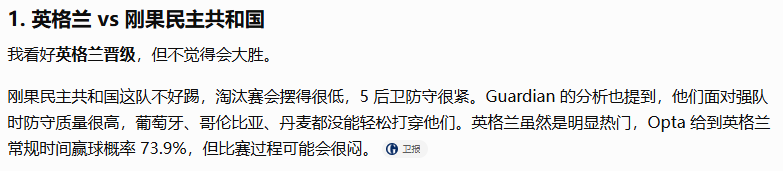
ChatGPT 预测英格兰对阵刚果民主共和国的比赛

ChatGPT 的长处,不在于每次都把比分预测得很准,而是经常能提前说出比赛的阻力在哪里。它很适合拿来理解比赛,但适合只看一个最终比分的预测。它能把过程说得比较准,可真正要写出大冷门时,还是少了一点决断。

德国出局,成了 AI 模型的集体翻车现场

如果说前面几场还能看出不同模型各自的亮点,那么德国对巴拉圭这场,就是一次集体翻车。

赛前,所有 AI 模型都站在德国这边。ChatGPT、Grok、千问、Gemini、Claude 全部站在德国一边,比分预测大多集中在 2:0、3:0 或 3:1。理由也很一致:都认为德国纸面实力更强,阵容深度更好,进攻火力更足。

但结果就是这场出了问题。AI 模型们低估了巴拉圭把比赛拖进泥潭的能力,德国没能在常规时间解决战斗,也没能在加时赛打破僵局,最后被巴拉圭拖进点球大战并淘汰出局。

目前谁最准?

从目前已经结束的淘汰赛来看,不同模型的特点开始显现。

DeepSeek 和 Gemini 最有高光。它们不只是能预测巴西、法国这类热门队晋级,在更难判断的冷门场次里,也给出了很有含金量的答案。荷兰对摩洛哥这场,它们最关键的优势,是敢于提前写出摩洛哥爆冷和点球大战剧本。尤其是 Gemini,直接预测摩洛哥点球晋级,这一场确实很亮眼。

Grok 和千问更像“比分型选手”。它们命中了不少具体比分,尤其在加拿大、巴西、挪威、法国这些比赛里表现不错。但问题是遇到德国、荷兰这种传统强队时,最后还是偏向热门。

ChatGPT 和 Claude 则更像“分析型选手”。理由写得完整,方向大多数不离谱,也能提醒一些加时风险。但问题是,它们经常能看出比赛不好踢,却不太敢把结论写到冷门那边。荷兰对摩洛哥就是这样,明明已经看到加时和点球风险,最后还是更相信荷兰。

所以,与其急着问哪个模型最懂球,不如看它们分别适合什么场景。

Domande pertinenti

Q根据文章,哪两个AI模型因准确预测了荷兰对阵摩洛哥的比赛而备受关注?

A根据文章,DeepSeek和Gemini因准确预测了荷兰对阵摩洛哥的比赛而备受关注。它们不仅预测比赛会很胶着,甚至提前预测了常规时间1:1和摩洛哥通过点球大战晋级的剧本,与实际结果高度吻合。

Q文章中提到Grok和千问在预测哪些比赛时,连续命中了具体比分?

A文章提到Grok和千问在预测南非对加拿大、巴西对日本以及科特迪瓦对挪威的比赛时,连续命中了具体比分。例如,它们准确预测了加拿大1:0胜南非,巴西2:1胜日本,以及挪威2:1胜科特迪瓦。

Q在文章的评价中,ChatGPT的主要优势是什么?

A根据文章,ChatGPT的主要优势在于其比赛过程的分析比较准。它不一定总能精确预测比分,但经常能提前分析出比赛的阻力所在,提醒用户比赛可能不会像纸面实力看起来那么轻松,例如在巴西对日本、英格兰对刚果民主共和国的比赛分析中。

Q哪一场比赛被描述为AI模型的“集体翻车现场”?为什么?

A德国对巴拉圭的比赛被描述为AI模型的“集体翻车现场”。因为赛前所有被提及的AI模型(如ChatGPT、Grok、千问、Gemini、Claude)都一致预测德国会轻松获胜,比分集中在2:0、3:0等。但实际比赛却被巴拉圭拖入点球大战,最终德国被淘汰,所有模型都预测错误。

Q文章最后总结不同AI模型的特点时,将Grok和千问归为哪种类型的“选手”?

A文章最后总结时,将Grok和千问归为“比分型选手”。它们在热门队伍胜负方向相对清晰的比赛中,不只判断对了晋级球队,还经常能把具体比分预测得比较贴近最终结果,展现了良好的稳定性。

Letture associate

MSTR Discloses Sale of 3,588 Bitcoins, Stock Price Drops Over 5% at One Point During Trading

MicroStrategy, the world's largest corporate holder of Bitcoin, has significantly shifted its business model. Between June 29 and July 5, the company sold 3,588 bitcoins for approximately $216 million to fund quarterly dividends for its preferred stock. This marks its largest-ever Bitcoin sale and signals a strategic pivot: Bitcoin is transitioning from a "buy-and-hold" reserve asset to a liquidity management tool for the company. This move follows a recent authorization allowing Bitcoin sales when equity fundraising is less attractive. The announcement contributed to a more than 5% intraday drop in MicroStrategy's stock price, while Bitcoin fell to around $61,800—below the company's average holding cost of roughly $75,700. The sale represents a major departure from MicroStrategy's long-standing "never sell" commitment, which saw its first minor breach in May with a $2.5 million sale. The latest, hundred-times-larger transaction underscores growing financial pressures. Analysts note the company faces about $1.5 billion in annual preferred dividend obligations, far exceeding cash flow from its software business. As of July 5, MicroStrategy holds 843,775 bitcoins. Its current operational logic involves buying Bitcoin during favorable financing conditions and selling portions to cover dividends when needed, creating a flexible capital management cycle amidst a challenging market environment.

华尔街日报3 h fa

MSTR Discloses Sale of 3,588 Bitcoins, Stock Price Drops Over 5% at One Point During Trading

华尔街日报3 h fa

Q-Day Countdown: Will Quantum Computing End Cryptocurrencies?

Quantum Computing's Threat to Cryptocurrency: A Countdown to Q-Day Quantum computing, specifically Shor's algorithm, poses a fundamental threat to the public-key cryptography (e.g., ECDSA, RSA) that secures blockchain networks like Bitcoin and Ethereum. This critical juncture, known as Q-Day, is estimated to occur potentially within the next 5-15 years. The core vulnerability stems from the public and immutable nature of blockchains. Assets in addresses where the public key is already exposed on-chain (e.g., spent outputs) are at direct risk, as a sufficiently powerful quantum computer could derive the private key. This threatens the very trust model of cryptocurrencies. The response lies in Post-Quantum Cryptography (PQC)—algorithms like lattice-based ML-DSA and hash-based SLH-DSA, which are resistant to quantum attacks. NIST has standardized key PQC algorithms (FIPS 203, 204, 205), providing a migration path. However, the primary challenge is not technical but socio-economic and involves complex governance: * **Bitcoin's** path is constrained by its conservative ethos. Migrating requires a soft-fork to new address types, facing hurdles like significantly larger signature sizes and, most critically, the divisive governance question of how to handle at-risk legacy UTXOs without violating core principles. * **Ethereum** is pursuing a "cryptographic agility" strategy, with a multi-layered roadmap. It leverages account abstraction for user accounts and is developing compressed hash-based signatures (e.g., leanXMSS) for its consensus layer, aiming for a full-stack upgrade over time. In conclusion, quantum computing does not spell an instant end for cryptocurrency but initiates a critical countdown. The industry has a limited "engineering comfort window" to orchestrate a coordinated, ecosystem-wide migration to PQC. The ultimate bottlenecks are the immense coordination efforts and governance decisions required for this foundational transition.

marsbit4 h fa

Q-Day Countdown: Will Quantum Computing End Cryptocurrencies?

marsbit4 h fa

Trump, the President Who Knows Best How to 'Trade Stocks'

Former US President Donald Trump reported a record-breaking $2.2 billion in personal income for 2025, the highest annual income ever disclosed by a sitting president. This figure, from a 927-page government ethics filing, represented a 3.5-fold increase from his $600 million income in 2024 and boosted his net worth to $6.5 billion. The primary drivers were cryptocurrency (64% of income, approximately $1.4 billion) and real estate (26%, approximately $575 million). His crypto earnings stemmed largely from the launch of his personal meme coin, $TRUMP, generating over $600 million in licensing fees, and substantial profits from the WLFI token and its parent company. Despite a sluggish property market, his Mar-a-Lago resort and associated golf clubs saw revenue surges of 50% and 27%, respectively, attributed to their use as venues for presidential events. Trump's financial disclosure also revealed an unprecedented level of stock market activity, with over 22,000 trades executed in 2025, averaging 87 trades per market day. Media analyses noted several instances where significant trading coincided with major policy announcements, such as proposed tariffs, raising questions about potential conflicts of interest. While the White House stated these trades were handled by a family-managed trust fund and not Trump directly, critics highlighted this as a departure from the blind trusts traditionally used by presidents post-Watergate. The report has intensified debate over the commercialization of the presidency. Supporters view it as a success story of a businessman-president, while critics argue it demonstrates an unprecedented conversion of public influence into private wealth, with policy decisions potentially linked to personal financial gains. The controversy centers on whether Trump's earnings represent innovative entrepreneurship or a fundamental conflict of interest, sparking renewed calls for stricter ethics reforms in US governance.

marsbit4 h fa

Trump, the President Who Knows Best How to 'Trade Stocks'

marsbit4 h fa

Countdown to Q-Day: Will Quantum Computing End Cryptocurrencies?

The article explores the existential threat quantum computing poses to cryptocurrencies and the urgent need for "post-quantum" migration. It outlines that quantum computers, through Shor's algorithm, could break the elliptic-curve cryptography (ECC) underlying blockchain security, potentially allowing private keys to be derived from public keys. The core challenge is not a lack of post-quantum cryptography (PQC) standards—like NIST's ML-KEM and ML-DSA—but the immense complexity of upgrading entire ecosystems before "Q-Day" (when quantum computers become capable of such attacks, estimated around 2035-2045). Key points include: * **Bitcoin's** risk is concentrated in legacy UTXOs with exposed public keys (e.g., early P2PK outputs). Migration faces massive hurdles: PQC signatures are much larger, increasing transaction size and cost, and the governance dilemma of handling un-migrated assets threatens its "code is law" ethos. * **Ethereum's** strategy focuses on "cryptographic agility," using Account Abstraction for user accounts and developing compressed hash-based signatures (like leanXMSS with SNARK aggregation) for consensus. Its migration is a complex, full-stack overhaul of execution, consensus, and data layers. * The "security debt" is enormous. The comfortable engineering window for a coordinated, ecosystem-wide upgrade is only 5-8 years. High-value infrastructure (exchanges, bridges) may face pressure before mainnet protocols. In conclusion, quantum computing is not an instant "doomsday" event but a forcing function for systemic change. Bitcoin's ultimate test is social consensus and property rights governance, while Ethereum's is technical complexity. Failure to migrate in time could lead to a fundamental re-pricing of crypto assets.

链捕手4 h fa

Countdown to Q-Day: Will Quantum Computing End Cryptocurrencies?

链捕手4 h fa

Trading

Spot
活动图片