Celebrity Meme Coins Are Being Turned into VC-Type Assets Again

marsbitPubblicato 2026-06-30Pubblicato ultima volta 2026-06-30

Introduzione

The article discusses the recent surge of "celebrity meme coins" on Solana, exemplified by $ANSEM and the newly emerged $TJR. $ANSEM, associated with crypto influencer Ansem, saw massive gains, sparking a broader trend where developers create tokens tied to online personalities and airdrop large portions to them, hoping for promotional support. KOL TJR initially hesitated but later engaged, causing his namesake token $TJR to skyrocket. The analysis identifies key drivers: a prolonged meme coin slump creating pent-up demand and fear of missing out (FOMO), and the "VC-ification" of meme coins. Here, influencers, holding large token shares, act like traditional venture capitalists—providing visibility and perceived legitimacy. Their involvement is now seen as a bullish signal rather than a red flag, offering a high-risk, high-reward opportunity for early entrants. While this model has attracted seasoned traders back to the market, the article cautions that the sustainability of this trend heavily depends on flagship tokens like $ANSEM maintaining momentum. The cycle risks being short-lived if leading coins fail to reach new highs.

Yesterday, we introduced the hottest new Solana meme coin, $ANSEM, asking '24-Hour 600x Surge, How Long Can This Solana Meme Last?'

Then, this morning, another token surged over 20x, further heating up the meme frenzy on Solana. Let's first look at the new hot targets, then analyze the reasons behind this sudden market surge.

The 'Celebrity Coin' Spawned a Strong Second

TJR (@_TJRTrades) is also a well-known KOL. His regular content focuses on trading analysis, so on-chain meme players might not be very familiar with him. He has only 250k followers on X, but boasts over 1.5 million followers each on Instagram, TikTok, and YouTube.

Starting yesterday, TJR posted several tweets, publicly stating he would help Ansem create content for TikTok, expanding his influence beyond X to bring in more new users unfamiliar with cryptocurrency. He also purchased $100k worth of $ANSEM and continued to promote it.
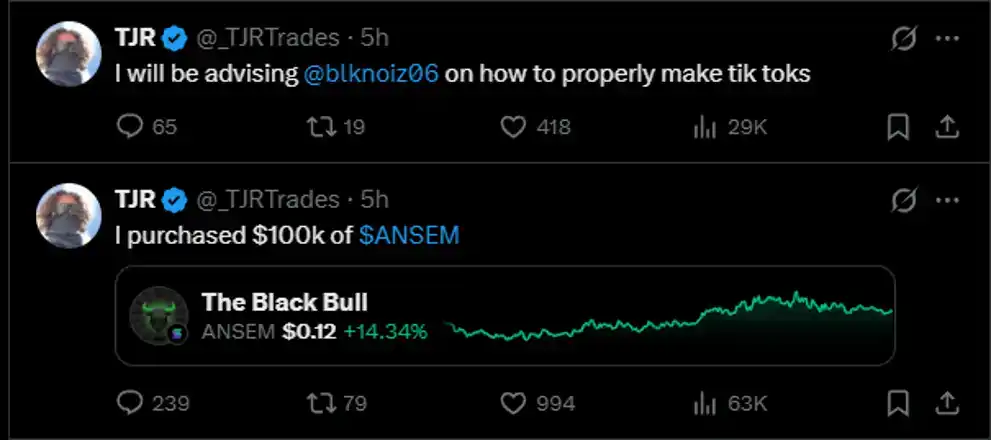
Originally, he indicated he would not participate in the typical behaviors of 'leaving a wallet address,' 'devs sending tokens,' or copying the $ANSEM success path:
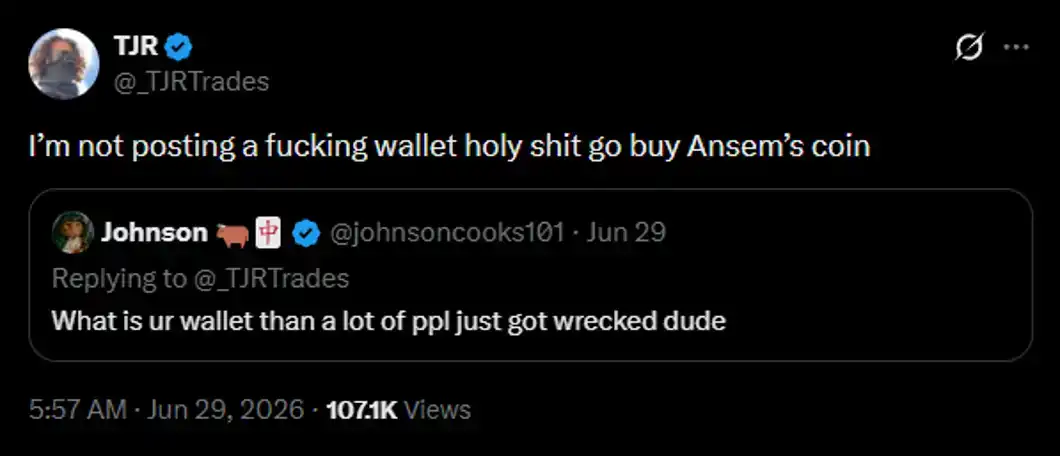
However, things changed at 6 AM this morning. He posted 'Should I hop in?', signaling a shift in stance:

A few hours later, he replied to a tweet asking if he would airdrop his held $TJR with, 'Ofc.' This was seen by the market as a signal of endorsement. $TJR began to be FOMOed, surging from a market cap of around $1.6 million to a peak of $28 million. Just yesterday, $TJR had a market cap of only $400k at one point.
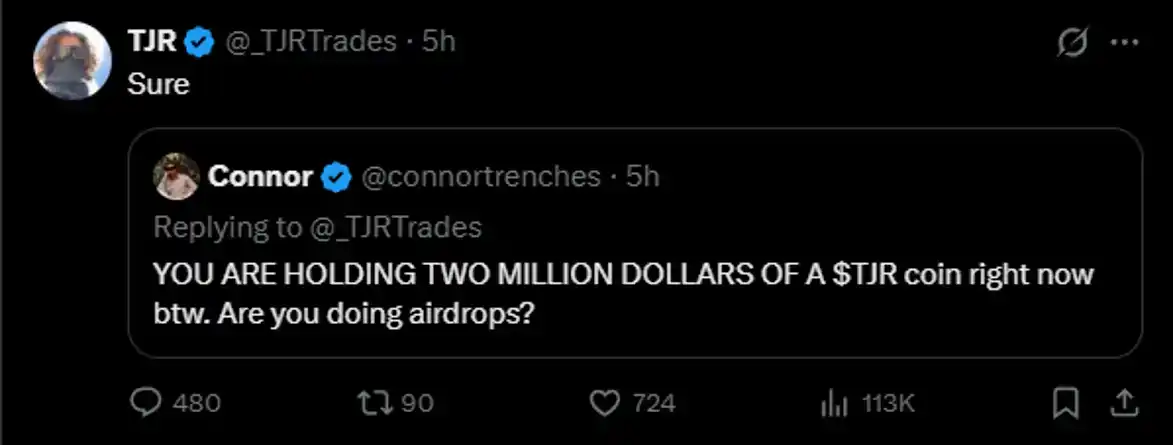
Furthermore, the dev who deployed $TJR is also the dev behind $ANSEM. This time, he sent 79% of the $TJR supply to TJR's address.

According to GMGN monitoring, since creating this token 13 days ago, this dev initially sold for a net profit of $5,500, then, over the past 7 days, began batch-minting tokens, frequently replicating various 'celebrity coins' and building his own positions while being highly active on X social media, frequently interacting to generate hype.

Within these 7 days, this address has created as many as 101 different meme coins (mostly various celebrity coins with some fan base). Among them, 12 reached highs exceeding a million-dollar market cap, and 3 broke through the ten-million-dollar mark.

As of now, the deployer's paper profit over the past seven days has reached 82,000 SOL, approximately $6.08 million. Just the deployer fees from several of these high-market-cap meme coins alone contributed $193k, with a 30-day profit of $8.77 million.

Beyond pure 'celebrity coins' like $TJR with KOLs personally promoting them, some variants have also performed well.

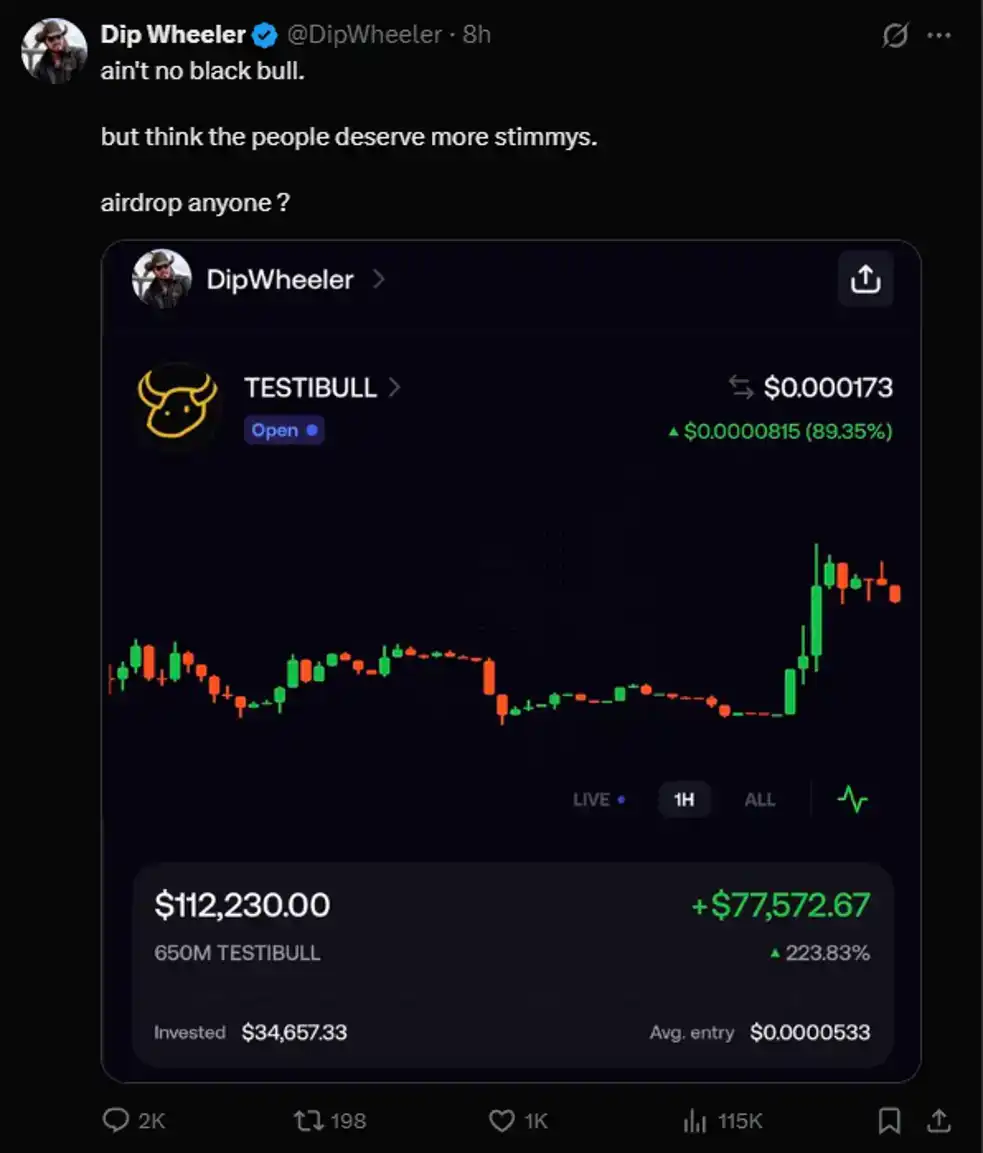
$TESTIBULL, a variant derived from the testicle-themed meme $TESTICLE, imitating the $ANSEM 'The Black Bull' theme. $TESTICLE was previously promoted mainly by KOL Dip Wheeler(@DipWheeler), known for achieving substantial gains on Fartcoin. He announced plans to airdrop $TESTIBULL, causing the coin's market cap to skyrocket from a low of $40k yesterday to nearly $5 million at its peak today.
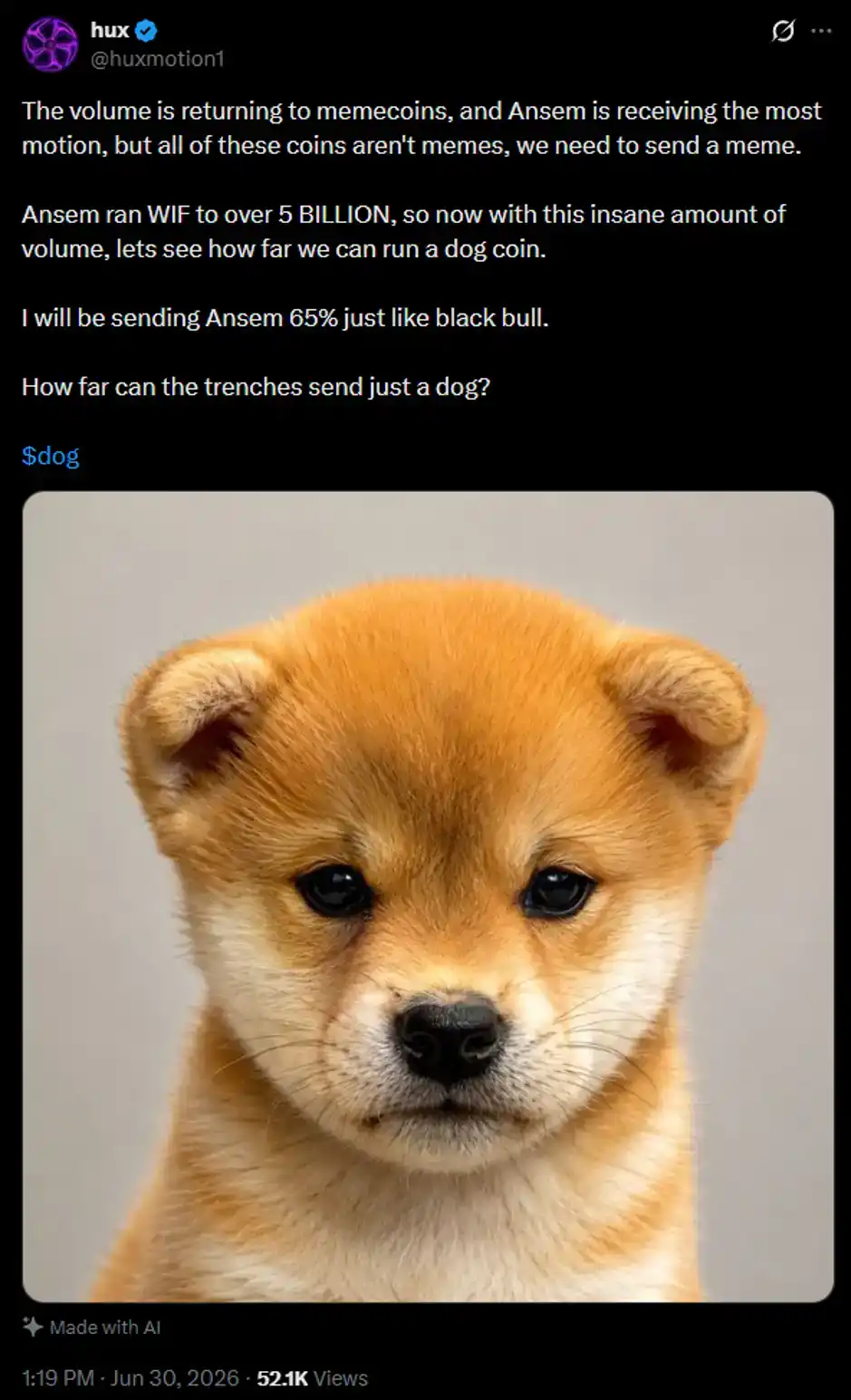
$dog, originally intended to reference Ansem's past success in pushing $WIF to tens of billions in market cap. With the market recovering, sending tokens to Ansem could supposedly create a new dog coin like $WIF.
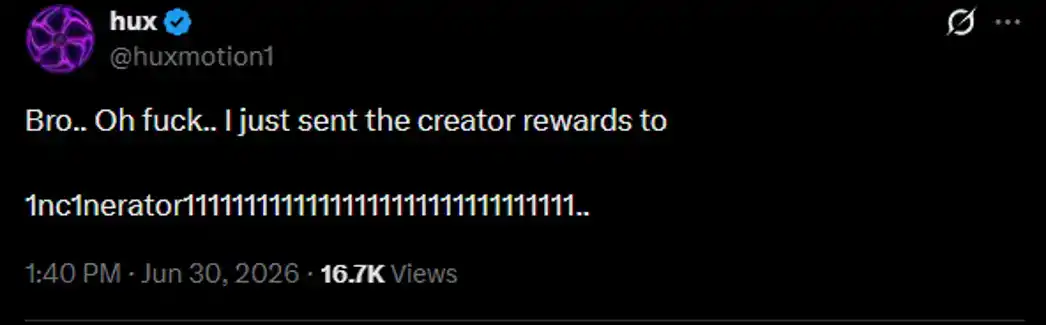
However, the dev made a mistake and sent the tokens to a burn address instead. This twist added a dramatic effect reminiscent of the $SLERF incident, combining the 'celebrity coin' airdrop play with unexpected drama, driving the coin's market cap to exceed $8 million at one point.
Market Analysis

This intraday surge arrived abruptly. While $ANSEM didn't experience a significant drop today, it also didn't continue its upward momentum from the previous two days.

'Celebrity coins' are not a novel concept. Some players who dislike this approach even viewed the rise of $TJR as a potential peak signal for this rally, calling it the 'MELANIA moment.'

While 'celebrity coin' frenzies appear repeatedly, it's not accurate to dismiss them all as the 'same old story.' Each occurrence, at different times and under different circumstances, has specific reasons for analysis. This time:

- On-chain players have been starved for too long. The meme market has been sluggish for a while; Solana hasn't seen a new meme coin break the $100 million market cap mark in a long time (though a large portion of $ANSEM is still controlled by Ansem).

- Severe FOMO from missing out, creating a tinderbox. Due to the prolonged market slump, most players didn't anticipate $ANSEM reaching a market cap exceeding $100 million. Many sold early or completely missed out. This FOMO sentiment transferred to $TJR.

- The VC-ization of Meme coins. On-chain players have persisted diligently, but reality shows it's become quite difficult for meme coins to reach even a ten-million-dollar market cap, with exchanges largely closing listing channels for new meme coins and market makers not providing significant pumps. For players, the 'fairness' of a meme coin is no longer about who holds more or less, but about 'whether I have a chance to get in at a low market cap for high-risk, high-reward odds.' In this context, even if a large portion is controlled by KOLs like Ansem or TJR, people might feel reassured by the celebrity endorsement or think 'they have to pump it to a certain level to exit.'

The VC-ization of meme coins was already evident when Trump launched his token. As long as there's a narrative and potential profits, few complain about large token concentrations; instead, they see a small float and high upside potential. Influencers are effectively playing the role VCs did in the VC coin era—traffic, recognition, and consensus become liquidity.

Based on current observations, this 'celebrity coin' rally has attracted the return of many previously active 'first-level' meme coin hunters. Encouraged by the success of $ANSEM and $TJR, they've begun accumulating tokens associated with potential figures who might step forward to endorse them, such as crypto KOLs like bonkguy, him, etc. However, whether the rally sustains depends on whether $ANSEM can set new highs; otherwise, the hype could dissipate quickly.


Crypto di tendenza

Domande pertinenti

QWhat is the main argument about the trend of 'celebrity meme coins' discussed in the article?

AThe article argues that the recent trend of 'celebrity meme coins' on Solana, exemplified by $ANSEM and $TJR, represents a 'VC-ization' of meme coins. This means influence and consensus from KOLs have replaced traditional venture capital, as investors now see large token holdings by these celebrities as a sign of potential for high returns rather than unfair distribution.

QAccording to the article, what is one reason for the recent surge in popularity of celebrity-themed meme coins like $TJR?

AOne reason is the severe FOMO (Fear Of Missing Out) sentiment among traders. The market had been sluggish for a long time, and many missed out on the massive gains of $ANSEM. When KOL TJR signaled he might endorse a token named after him, this pent-up FOMO led to rapid price speculation on $TJR.

QWhat role did the developer (dev) behind $TJR and $ANSEM play in this trend, according to the on-chain data cited?

AThe dev behind these coins played a highly active and profitable role in driving the trend. They deployed 101 different meme coins in seven days, many targeting celebrities/KOLs. They used strategies like airdropping a large portion of tokens to the KOLs' addresses and actively promoted these coins on social media, netting millions of dollars in profit.

QWhat is the 'MELANIA moment' reference in the article, and how does it relate to the $TJR price action?

AThe 'MELANIA moment' is a reference to a past meme coin event seen as a market peak/sign of euphoria and impending downturn. Some traders viewed the explosive rise of $TJR, a classic 'celebrity coin' after the initial success of $ANSEM, as a similar signal that the current meme coin frenzy might be nearing its top.

QBesides pure 'celebrity coins' like $TJR, what other variations of this trend performed well, according to the article?

ATwo other variations performed well: 1) $TESTIBULL, a derivative of an existing meme ($TESTICLE) that gained traction after a different KOL, Dip Wheeler, promised an airdrop. 2) $dog, a coin created with the intent to airdrop to Ansem but accidentally sent to a burn address, which created a dramatic narrative similar to the $SLERF incident, driving its value up.

Letture associate

Chainlink Adds 6,100 Wallets In Two Days In Strongest Growth Burst Of 2026

Chainlink experienced its strongest wallet growth burst of 2026, adding approximately 6,100 new addresses in just two days. This notable increase in network participation occurred despite LINK's price trading in a difficult market environment alongside other altcoins. The surge in new wallets is seen as a positive signal for user and investor interest, suggesting the ecosystem continues to attract attention even when price action is weak. Wallet growth is considered a useful metric as it measures real participation rather than just price speculation. For an infrastructure project like Chainlink, whose value is tied to oracle services, data, and real-world assets, such growth indicates ongoing engagement with its core technology. However, the article notes that this data point, while constructive, is not conclusive on its own. The nature of the new wallets—whether they belong to small holders, new users, or exchange-related entities—remains unclear. The report maintains a balanced perspective, stating that while this wallet growth is a positive adoption signal for LINK bulls, it does not guarantee a price increase. Skeptics may question whether this user growth translates into value capture for the token. The key takeaway is that this burst of activity should be monitored alongside other factors like transaction volume, price structure, and broader market trends for a more complete picture. The signal requires follow-through in price and demand to be fully validated.

bitcoinist21 min fa

Chainlink Adds 6,100 Wallets In Two Days In Strongest Growth Burst Of 2026

bitcoinist21 min fa

In the AI Era, What's Left for Bitcoin?

As Bitcoin falls below $60,000, the author reflects on the relationship between AI and Bitcoin, seeing them as two sides of the same coin. In the AI era, the cost of generating content has plummeted, making fake text, images, and videos increasingly easy and cheap to produce. This has led to a fundamental shift: while AI dramatically lowers the cost of information production, it also undermines trust and authenticity online. What becomes truly valuable is not more content, but the ability to verify what is real—"verifiability." This perspective offers a new lens for Bitcoin. Its massive energy consumption, often criticized as wasteful, is reinterpreted. While AI burns energy to enhance "capability" and efficiency, Bitcoin burns energy to produce "verifiability." Its purpose is not to be trusted but to enable a system where no trust in intermediaries—banks, platforms, or developers—is needed. Every transaction and the entire ledger's history is secured by cryptography and a decentralized network of nodes, making it independently verifiable. AI cannot forge a transaction on the Bitcoin network because the system is designed for proof, not generation. The author draws a historical parallel to the Renaissance: the printing press drastically reduced the cost of copying knowledge, while double-entry bookkeeping reduced the cost of trust in commerce. Today, AI is the new printing press, reducing content creation costs to near zero. Blockchain, and Bitcoin as its pioneer, may be the modern equivalent of double-entry bookkeeping—a foundational technology for verifying digital asset ownership and historical records without centralized authorities. Thus, AI and blockchain are not competitors. AI lowers the cost of creation; blockchain lowers the cost of verification. In an age where AI can generate anything, true scarcity may lie not in more content, but in independently verifiable facts. Whether the market will reprice Bitcoin accordingly remains uncertain, but its core value proposition as a "machine for producing verifiability" becomes strikingly relevant.

marsbit1 h fa

In the AI Era, What's Left for Bitcoin?

marsbit1 h fa

In the Age of AI, What's Left for Bitcoin?

Author: Sevclub, Seven Research Amid Bitcoin's recent drop below $60k, the author reflects on a growing sense that AI and Bitcoin are two sides of the same coin. Today, encountering any content triggers a new default question: "Was this made by AI?" The cost of generating convincing text, images, and video is now negligible. While the internet lowered information *distribution* costs, AI is crashing information *production* costs to near zero. The consequence is a flood of content where truth and falsehood are increasingly indistinguishable. In this environment, what becomes truly valuable is not more information, but the ability to verify what is real—"verifiability." This reframes the common criticism that Bitcoin "wastes electricity." AI consumes power to produce "capability" (e.g., more powerful models). Bitcoin consumes power to produce something else: "verifiability." Bitcoin's core purpose isn't about belief or trust in any institution, developer, or even its creator. It's about enabling independent verification. Every bitcoin's origin, every transaction, and the integrity of the entire ledger are secured by mathematics, cryptography, and a global network of nodes. AI can fabricate convincing media, but it cannot falsify a transaction on the Bitcoin network. The expended energy makes篡改历史 (tampering with history) prohibitively expensive, purchasing a globally verifiable ledger. The author draws a historical parallel to the Renaissance. The printing press drastically reduced the cost of copying knowledge, while double-entry bookkeeping reduced the cost of trust in commerce—one enabled creation, the other verification. Today, AI is the new printing press, driving content production costs toward zero. The question becomes: what is this era's "double-entry bookkeeping"? Blockchain appears to be the leading candidate. It doesn't verify which news is true or which image is real, but it provides a foundational layer for independently verifying asset ownership and historical records in the digital realm without centralized authorities. Therefore, AI and blockchain are not in competition. AI lowers the cost of *generation*. Blockchain (and Bitcoin as a prime example) lowers the cost of *verification*. One creates, the other proves. Whether Bitcoin ultimately succeeds remains uncertain, facing potential challenges from quantum computing, regulation, and technical evolution. However, the author now sees it less as a "machine for making bitcoin" and more as a "machine for making verifiability." In an age where AI can generate anything, true scarcity may no longer be "more content," but "more independently verifiable facts." Whether the market will price this accordingly is a separate question.

链捕手1 h fa

In the Age of AI, What's Left for Bitcoin?

链捕手1 h fa

Trading

Spot

Articoli Popolari

Cosa è MEME 2.0

Memecoin 2.0: L'Ascesa di $MEME 2.0 nel Mondo delle Criptovalute Introduzione Nel panorama in continua evoluzione delle criptovalute, è emerso un nuovo contendente. Memecoin 2.0, simboleggiato come $MEME 2.0, porta il concetto di meme coin a un livello emozionante. Come prodotto derivato dal Memecoin originale, questo progetto ha catturato l'attenzione della comunità crypto spostando il focus da incentivi finanziari tipici a un'esperienza coinvolgente e divertente. Operando sulla blockchain di Ethereum, Memecoin 2.0 ridefinisce audacemente l'impegno della comunità nella sfera crypto. Che cos'è Memecoin 2.0, $MEME 2.0? Alla base, Memecoin 2.0 è un progetto di criptovaluta che dà priorità allo spirito di comunità e al divertimento associato alla cultura meme. A differenza delle criptovalute convenzionali, che si concentrano su casi d'uso pratici e benefici tangibili, Memecoin 2.0 si distingue abbracciando il lato più leggero della moneta digitale. Il progetto esiste senza promesse di utilità, una roadmap strutturata o ritorni finanziari, concentrandosi invece sulla creazione di una comunità vibrante incentrata sui meme e sul divertimento condiviso. Facendo così, attinge alla crescente tendenza della cultura meme nello spazio online, rendendola un giocatore unico nel mondo degli asset digitali. Creatore di Memecoin 2.0, $MEME 2.0 Nonostante ricerche approfondite sulle origini di Memecoin 2.0, l'identità esplicita del suo creatore rimane sconosciuta. Questa anonimità non è rara nella comunità crypto, dove molti progetti sono guidati da individui o gruppi che preferiscono rimanere dietro le quinte. La mancanza di informazioni pubblicamente disponibili sul creatore potrebbe essere vista come una mossa strategica, mettendo in evidenza l'impegno della comunità piuttosto che la notorietà individuale all'interno dello spazio. Investitori di Memecoin 2.0, $MEME 2.0 Le informazioni riguardanti gli investitori o il supporto finanziario per Memecoin 2.0 sono scarse. Questa assenza di dettagli potrebbe suggerire che il progetto sia autofinanziato o che il suo focus sulla comunità piuttosto che sulle strutture d'investimento tradizionali abbia attratto un tipo diverso di sostenitore. Poiché il mondo delle meme coin coinvolge tipicamente un maggior coinvolgimento di base piuttosto che investimenti istituzionali, questo approccio si allinea con l'etica dei progetti guidati dalla comunità. Come funziona Memecoin 2.0, $MEME 2.0? Memecoin 2.0 opera interamente sulla blockchain di Ethereum, capitalizzando le sue robuste caratteristiche di sicurezza e scalabilità. Sfruttando i punti di forza di Ethereum, Memecoin 2.0 può offrire un ambiente sicuro per le interazioni degli utenti garantendo che le transazioni siano sia efficienti che convenienti. Uno degli attributi unici di Memecoin 2.0 risiede nella sua struttura guidata dalla comunità. Il valore e la popolarità del token $MEME 2.0 derivano dalla partecipazione attiva dei suoi utenti, piuttosto che dalla utilità intrinseca. Questo design rinforza il focus del progetto sull'aspetto dell'intrattenimento delle criptovalute, implicando che la risata e l'impegno della comunità siano le vere monete che guidano il suo successo. Inoltre, il progetto si inserisce all'interno dell'ecosistema più ampio delle meme coin, dove il valore di ciascuna meme coin oscilla in base alla cultura, alle tendenze e all'impegno della comunità piuttosto che ai principi economici tradizionali. Cronologia di Memecoin 2.0, $MEME 2.0 Per comprendere meglio l'evoluzione e le pietre miliari di Memecoin 2.0, ecco una cronologia che evidenzia eventi significativi nella sua storia: 2024: L'inizio di Memecoin 2.0 è riconosciuto come un ramo del Memecoin originale, affermandosi all'interno del contesto fiorente delle meme coin mentre opera sulla blockchain di Ethereum. 13 luglio 2024: Memecoin 2.0 si posiziona ufficialmente come una meme coin incentrata sulla comunità sulla rete Ethereum, enfatizzando il suo approccio centrato sull'intrattenimento che invita gli utenti a impegnarsi e partecipare alla sua crescita. Punti Chiave su Memecoin 2.0, $MEME 2.0 Diverse caratteristiche critiche definiscono Memecoin 2.0: Approccio Centrico alla Comunità: La missione principale di Memecoin 2.0 è creare un'esperienza comunitaria divertente e coinvolgente, capitalizzando il piacere collettivo derivante dalla cultura memetica. Costruita su Ethereum: Operare sulla blockchain di Ethereum fornisce al progetto un'infrastruttura essenziale che garantisce sicurezza e scalabilità. Mancanza di Utilità o Roadmap: In una marcata deviazione dalle criptovalute tradizionali, Memecoin 2.0 non promette alcuna caratteristica utilitaria o ritorni finanziari, riaffermando il suo impegno per il coinvolgimento della comunità e l'impegno sociale. Focus sulla Cultura Memetica: Abbracciando gli aspetti umoristici e culturali del fenomeno meme, Memecoin 2.0 offre una piattaforma per gli utenti per interagire con la crypto offline e online. Ulteriore Contesto: L'Importanza delle Meme Coin Le meme coin sono emerse come una classe distinta di criptovaluta, spesso guidata dall'umorismo e da un approccio spensierato al trading. Queste monete generalmente mancano di significative utilità o roadmap di sviluppo, attirando gli utenti con la promessa di divertimento, interazione comunitaria e rilevanza culturale. Nel panorama del più ampio ecosistema crypto, le meme coin rianimano l'importanza dell'impegno della comunità, opponendosi ad approcci esclusivamente orientati al profitto. Progetti come Memecoin 2.0 danno il via a un'era in cui l'intrattenimento può armonizzarsi con le aspirazioni finanziarie, trasformando la blockchain in un parco giochi per la creatività e l'interazione sociale. Conclusione Memecoin 2.0, o $MEME 2.0, incarna una nuova ondata di criptovaluta che dà priorità all'impegno della comunità rispetto a rigidi strutture finanziarie. Con un focus sull'umorismo e l'interazione sociale, capitalizza sulla fascinazione circondante la cultura meme. Operando sulla blockchain di Ethereum, Memecoin 2.0 sfrutta le capacità della tecnologia mantenendo fermo il suo impegno per il valore ricreativo della valuta digitale. Mentre lo spazio delle criptovalute continua a evolversi, Memecoin 2.0 serve come testimonianza della nozione che il futuro degli asset digitali potrebbe ben dipendere da esperienze condivise, risate e solidi legami comunitari. Nel mondo imprevedibile delle crypto, forse la gioia può essere altrettanto preziosa quanto il guadagno finanziario tradizionale.

103 Totale visualizzazioniPubblicato il 2024.04.04Aggiornato il 2024.12.03

Cosa è MEME 2.0

Come comprare MEME

Benvenuto in HTX.com! Abbiamo reso l'acquisto di Memeland (MEME) semplice e conveniente. Segui la nostra guida passo passo per intraprendere il tuo viaggio nel mondo delle criptovalute.Step 1: Crea il tuo Account HTXUsa la tua email o numero di telefono per registrarti il tuo account gratuito su HTX. Vivi un'esperienza facile e sblocca tutte le funzionalità,Crea il mio accountStep 2: Vai in Acquista crypto e seleziona il tuo metodo di pagamentoCarta di credito/debito: utilizza la tua Visa o Mastercard per acquistare immediatamente MemelandMEME.Bilancio: Usa i fondi dal bilancio del tuo account HTX per fare trading senza problemi.Terze parti: abbiamo aggiunto metodi di pagamento molto utilizzati come Google Pay e Apple Pay per maggiore comodità.P2P: Fai trading direttamente con altri utenti HTX.Over-the-Counter (OTC): Offriamo servizi su misura e tassi di cambio competitivi per i trader.Step 3: Conserva Memeland (MEME)Dopo aver acquistato Memeland (MEME), conserva nel tuo account HTX. In alternativa, puoi inviare tramite trasferimento blockchain o scambiare per altre criptovalute.Step 4: Scambia Memeland (MEME)Scambia facilmente Memeland (MEME) nel mercato spot di HTX. Accedi al tuo account, seleziona la tua coppia di trading, esegui le tue operazioni e monitora in tempo reale. Offriamo un'esperienza user-friendly sia per chi ha appena iniziato che per i trader più esperti.

305 Totale visualizzazioniPubblicato il 2024.12.12Aggiornato il 2026.06.02

Come comprare MEME

Discussioni

Benvenuto nella Community HTX. Qui puoi rimanere informato sugli ultimi sviluppi della piattaforma e accedere ad approfondimenti esperti sul mercato. Le opinioni degli utenti sul prezzo di MEME MEME sono presentate come di seguito.

活动图片