US CFTC Launches Broad Investigation into Polymarket, Is the Prediction Market Party Coming to an End?

marsbitPubblicato 2026-06-30Pubblicato ultima volta 2026-06-30

Introduzione

The U.S. Commodity Futures Trading Commission (CFTC) is conducting a broad investigation into the prediction market platform Polymarket, focusing on its business practices including social media promotions. This follows a bipartisan letter from U.S. senators urging the CFTC to probe alleged fraudulent marketing tactics used to promote gambling-like products. The action coincides with a period of explosive growth for the prediction market sector, driven by events like the World Cup, with platforms like Kalshi and Robinhood reporting record trading volumes and revenue. The investigation signals a potential end to the sector's unregulated expansion and may lead to clearer federal oversight, particularly regarding investor protection and distinguishing prediction markets from traditional sports betting. The CFTC's move has also intensified a jurisdictional conflict with multiple U.S. states (including Kentucky and New York), which have sued platforms like Polymarket and Kalshi, accusing them of operating illegal sports betting and threatening state gambling tax revenues. Furthermore, the CME Group has sued the CFTC, challenging its approval of certain prediction market products. The report also highlights the political and capital interests intertwined with the industry. Donald Trump Jr. holds advisory and investment roles in both Kalshi and Polymarket, and the Trump administration has previously emphasized federal regulatory authority over these markets. The CFTC's investigati...

Original | Odaily Planet Daily (@OdailyChina)

Author | Wenser(@wenser2010 )

Polymarket's deceptive marketing has finally caught the attention of regulatory authorities.

Recently, the U.S. Commodity Futures Trading Commission (CFTC) has initiated a broad investigation into the prediction market platform Polymarket, covering its business activities including social media campaigns. Previously, U.S. Republican Senator John Curtis and Democratic Senator Adam Schiff co-signed a letter to CFTC Chairman Mike Selig, urging an investigation into Polymarket's practices of paying KOLs for deceptive marketing and using fraudulent marketing tactics to promote gambling-like products to American audiences.

At a time when the World Cup is driving a surge in prediction market trading volumes, this move may pour cold water on the development of this sector. More importantly, the CFTC's investigation into Polymarket has brought to light conflicts of interest between U.S. federal and state authorities, as well as between officials and capital. (Recommended reading: "WSJ: Fake Websites, Fake Trades, Real Promotion, Polymarket's Traffic Scam").

End of the Wild West Era for Prediction Market Marketing, Regulatory Policies May Enter Deep Waters

If the earlier incidents involving Polymarket—such as university students posting fake profit videos and paid KOLs exaggerating prediction profits—were seen as the wild attempts of the early expansion phase of prediction markets, then the formal CFTC investigation is clear proof that this wild growth period is over.

Prediction Market Platform Data Sees Explosive Growth, Attracting Strong Attention from Traditional Internet Giants

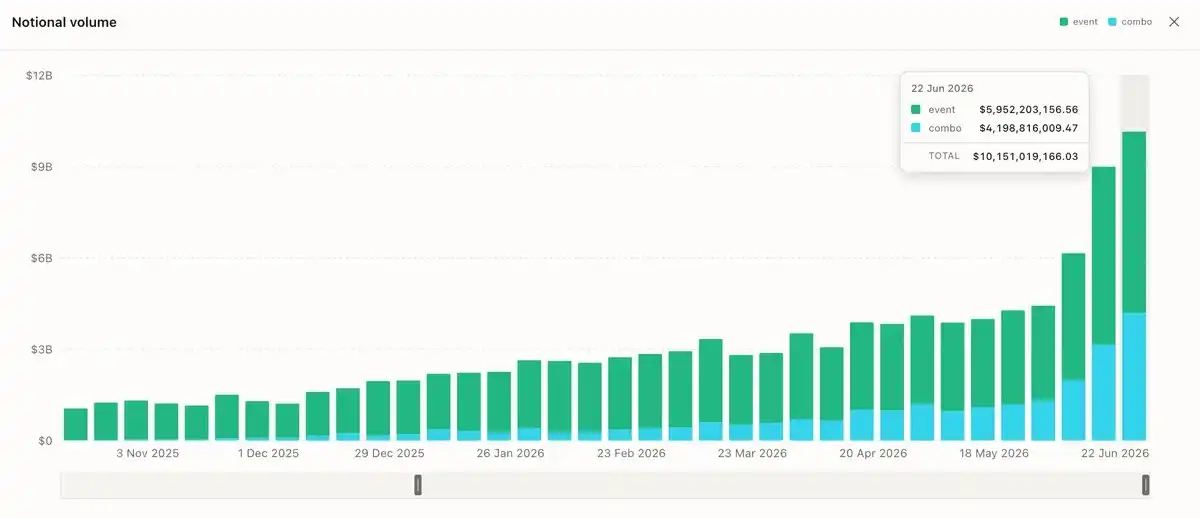
As we entered June 2026, with the official start of the World Cup, prediction markets have received unprecedented attention, leading to a continuous rise in trading volumes.

Data from a16z crypto shows that prediction market trading volume has hit record highs for three consecutive weeks. The total market trading volume reached a historic first of $144 billion last week, a significant increase from approximately $50–60 billion at the beginning of the year. The previous record high of around $100 billion was set just the week before. From the platform side, the data has also seen substantial growth:

  • Latest data shows Kalshi's weekly notional trading volume surpassed $100 billion for the first time.
  • Polymarket officially stated that its annualized revenue has significantly exceeded $1 billion, a development occurring just six weeks after the removal of the waitlist for its U.S. trading platform; data shows that the U.S. platform's daily trading volume grew from about $50 million in mid-May to over $200 million on June 20 (based on Dune Analytics data).
  • Robinhood's prediction market platform business is growing rapidly, with annualized revenue reaching $500 million. In Q2 as of June 25, Robinhood's active contract trading volume was approximately 12.3 billion contracts. Based on a standard rate of 1 cent per contract, the prediction market revenue for this quarter is estimated to be at least $123 million. Its recently launched Rothera prediction market platform achieved over 900 million contract trades in its first week, contributing nearly 60% growth in active contract trading volume for Robinhood.
Such impressive data has also attracted the attention of stock market giant Meta. According to media reports, Meta CEO Mark Zuckerberg has urged the company to explore partnerships with prediction markets Polymarket and Kalshi. Meanwhile, Meta is developing a similar prediction market application called Arena.

All signs indicate that prediction markets have leapt from a niche sector a few years ago to a hot industry experiencing exponential expansion. In the face of this trend, regulatory authorities are unlikely to stand idly by. The recent deceptive marketing incidents at Polymarket serve as a timely and fitting 'soft knife,' providing an opportunity for regulatory intervention. The author believes that subsequent regulations may gradually clarify the boundaries for prediction market platforms regarding marketing, event contract content, and trading fees, aiming to strengthen investor protection and clearly distinguish them from traditional gambling businesses.

Simultaneously, as the investigation deepens, the power struggle between federal regulatory agencies represented by the U.S. CFTC and state-level regulators is also coming to light.

When U.S. CFTC and Nine U.S. States Lock Horns: The Battle for Prediction Market Regulatory Power

Last Tuesday, the U.S. CFTC formally filed a lawsuit against Kentucky, attempting to reaffirm the agency's jurisdiction over prediction market platforms.

In the complaint filed with the U.S. District Court for the Eastern District of Kentucky, the CFTC stated that Kentucky's attempt to shut down federally regulated designated contract markets interferes with the federal regulatory system Congress established for the national swaps market. It claims "exclusive jurisdiction" over related event contracts and prediction market products.

Previously, Kentucky sued platforms like Kalshi and Polymarket, accusing them of operating unlicensed illegal sports betting and gambling businesses within the state. As of June, over 12 U.S. states, including Kentucky and New York, have taken legal action against Polymarket and Kalshi, alleging they operate illegal sports betting. Kentucky has become the ninth state sued by the CFTC in the prediction market regulatory dispute.

This action highlights the escalating conflict between federal derivatives regulation and state-level gambling regulation.

There are two main reasons behind this dispute:

  • First, the practical interests of state and local gambling industries, such as tax revenue. Traditional sports betting previously brought significant tax revenue to various states (e.g., high-tax-rate online gambling). If prediction markets completely replace the gambling industry, potential tax losses for states could amount to hundreds of millions of dollars annually (one estimate is around $600 million).
  • Second, the definition of the regulatory boundary between the gambling industry and prediction markets as an emerging industry. The CFTC seeks to maintain the classification of "event contracts" as commodity derivatives, futures, or swaps, enforcing a policy of federal law preemption.

The final outcome and specific definitions may depend on the interpretation and rulings by state courts, and potentially the U.S. Supreme Court, regarding the Commodity Exchange Act (CEA).

Furthermore, the battle between exchanges and the U.S. CFTC has also ignited. The CFTC's previous approval of Kalshi's application for perpetual futures trading triggered CME's lawsuit—

Reportedly, CME has sued the U.S. Commodity Futures Trading Commission and its Chairman Michael Selig in the U.S. District Court for the District of Columbia. Regarding the CFTC's May 29th approval for prediction market platform Kalshi to launch perpetual futures contracts linked to the Bitcoin spot price, among other actions, the CFTC's treatment of "futures" with expiration dates as "swaps" violates U.S. Congressional directives and the Commodity Exchange Act. CME requests the court to overturn the related perpetual futures actions. CME also claimed that Selig acted unilaterally without the presence of the full five-member panel of commissioners.

A CFTC spokesperson responded that CME is waging a "legal war" against the agency and the government's crypto policy, stating that "the act of filing the lawsuit is extremely imprudent." (Essentially saying "your lawsuit is filed too hastily" right on its forehead.)

Of course, it's no wonder CME is so agitated. The CFTC's move to allow Kalshi to trade crypto perpetual futures contracts essentially lets prediction market platforms like Kalshi, along with crypto exchanges like Coinbase and Kraken, encroach upon CME's "trading territory." As for the driving force behind this, it might have some connection to the Trump family.

The Trump Family's Prediction Market 'Double-Down Strategy': Don Jr. Bets on Kalshi and Polymarket

Recently, it was revealed that Kalshi is negotiating a new round of funding at a valuation of approximately $40 billion, with the deal potentially closing as early as Q3. Following a $10 billion financing round in May (investors included Sequoia Capital, Andreessen Horowitz, Coatue, and Morgan Stanley), Kalshi's valuation rose from its previous $12 billion to $22 billion. Now, that number is about to double.

Kalshi CEO Tarek Mansour stated that the company is considering an IPO no earlier than late 2027 or 2028. Kalshi officially stated that as of April 2026, its annualized trading volume reached $178 billion, a 32-fold increase year-over-year.

Such remarkable market data and the high enthusiasm from capital markets are hard to separate from one of the Trump family's prominent figures, Donald Trump Jr.

It is understood that Don Jr. is essentially "hedging his bets" in the prediction market sector:

On one hand, he served as a paid strategic advisor for Kalshi in early 2025, receiving approximately $300,000 worth of company equity at a time when Kalshi's valuation was less than $2 billion. That investment alone has yielded over a 10x return;

On the other hand, he also serves as an advisor to Polymarket and has made a strategic investment in the latter through his venture capital firm, 1789 Capital, where he is a partner.

Coupled with Trump's previous emphasis on federal government regulatory authority over prediction markets, and his mention that "Kalshi and Polymarket will thrive under his leadership,"

To some extent, the conflict of interest between capital and official regulatory agencies has been eased; and the Trump family serves as the "best lubricant" in this contradictory situation.

Thus, a network of interests connecting the U.S. CFTC and other federal regulatory agencies, U.S. state governments, and Trump family investment entities gradually takes shape.

As for the U.S. CFTC's investigation into Polymarket, it may just be an inevitable step in regulating the prediction market industry.

The era of wild growth, the 'Spring of Prediction Markets,' is coming to an end, while the 'Prosperous Summer' for the prediction market industry is slowly approaching.


Crypto di tendenza

Domande pertinenti

QWhat is the US CFTC investigating regarding Polymarket?

AThe US Commodity Futures Trading Commission (CFTC) is conducting a broad investigation into the prediction market platform Polymarket, covering aspects of its business including social media activities. The investigation is prompted by concerns over paid KOLs engaging in deceptive marketing, using fraudulent methods to promote gambling-like products to a US audience.

QWhat is the core conflict highlighted between the US CFTC and certain US states in the article?

AThe core conflict is a jurisdictional battle between federal regulatory authority (the CFTC) and state-level power. The CFTC asserts exclusive federal jurisdiction over event contracts and prediction market products under the Commodity Exchange Act. However, states like Kentucky and New York are suing platforms like Polymarket and Kalshi, accusing them of operating illegal sports betting and gambling businesses within their borders, which are traditionally regulated by the states. This conflict involves both regulatory boundaries and potential state tax revenue losses from the traditional gambling industry.

QWhat role does Donald Trump Jr. play in the prediction market sector according to the article?

AAccording to the article, Donald Trump Jr. is involved with both major prediction market platforms. He serves as a paid strategic advisor for Kalshi, receiving company equity, and also acts as an advisor for Polymarket through his venture capital firm, 1789 Capital, which made a strategic investment in the platform. His involvement is presented as part of a network connecting capital, political influence, and regulatory bodies.

QWhat significant legal action did the CME Group take against the CFTC, and why?

AThe CME Group filed a lawsuit against the US CFTC and its Chairman, Michael Selig, in the US District Court for the District of Columbia. The lawsuit challenges the CFTC's approval for Kalshi to launch perpetual futures contracts tied to Bitcoin's spot price. CME argues the CFTC violated the Commodity Exchange Act by treating futures with expiration dates as 'swaps' and that Chairman Selig acted unilaterally without a full commission. The move is seen as CME protecting its trading turf from encroachment by prediction market and crypto exchanges.

QHow does the article characterize the current stage and future of the prediction market industry?

AThe article characterizes the current massive growth, driven by events like the World Cup, as the end of a 'wild spring' or野蛮生长期 (barbaric growth period) for prediction markets, marked by early expansion tactics like deceptive marketing. The CFTC's investigation is seen as the start of increased regulatory scrutiny. However, the conclusion suggests this is a necessary step, and a 'prosperous summer' for a more regulated and mature prediction market industry is slowly approaching.

Letture associate

Confirmed: Claude Code Secretly Inspects Users, Time Zone and Chinese AI Labs Are Key Factors

Today was a significant day for Anthropic. The company announced the launch of Claude Sonnet 5, described as its most agentic model yet, and separately confirmed that the U.S. Department of Commerce has lifted export controls on its Claude Fable 5 and Mythos 5 models, allowing their distribution to resume. However, a separate controversy has emerged regarding its coding assistant, Claude Code. Developers have exposed that certain versions of the tool allegedly contain hidden code designed to detect specific user data. This code reportedly checks for the use of Chinese time zones (like Asia/Shanghai), the presence of custom API proxy URLs, and connections to domains associated with Chinese tech companies and AI labs. If triggered, this information is said to be encoded into the system prompt sent to the AI cloud, using subtle, nearly indistinguishable variations in characters (like different Unicode apostrophes in the "Today's date" line) as a form of steganography. The core issue is the covert nature of this data collection. While telemetry for security and abuse prevention is common, implementing it through hidden channels within the prompt—without user awareness or documented disclosure—fundamentally breaches trust. This is particularly sensitive for a coding assistant that operates with access to source code and system commands. Following the exposure, an Anthropic engineer acknowledged the code's existence and stated it would be removed in an upcoming release. The incident raises serious questions about transparency and the boundaries of data collection in AI developer tools.

marsbit38 min fa

Confirmed: Claude Code Secretly Inspects Users, Time Zone and Chinese AI Labs Are Key Factors

marsbit38 min fa

Grayscale: After Halving, BTC is Nearing the Bottom of This Cycle

Grayscale Research suggests Bitcoin's recent decline below $60,000, a >50% drop from its October peak, represents a cyclical correction within a long-term uptrend rather than a trend reversal. Key factors behind the pullback include a shift in market expectations toward Federal Reserve rate hikes under new Chair Kevin Warsh, uncertainty around the CLARITY Act's Senate passage, pressure on leveraged entities like Strategy, and concerns over quantum computing risks. The path out of the current bear market hinges on upcoming catalysts. An optimistic scenario, where the CLARITY Act passes, leverage is contained, and the Fed refrains from hiking, could mean Bitcoin is nearing its cycle bottom. A pessimistic scenario, featuring legislative failure, further deleveraging, and Fed rate hikes, could lead to additional moderate downside. Grayscale does not expect a historically deep ~80% drawdown due to a more measured prior bull run and stickier institutional demand. Despite short-term headwinds, Grayscale remains highly optimistic about crypto's long-term structural prospects, driven by institutional adoption of public blockchains, unsustainable government debt, declining trust in intermediaries, and AI's potential demand for alternative systems. The report concludes that while the exact cycle low depends on near-term catalysts, current valuations present an attractive entry point for long-term investors betting on the decade-ahead growth of digital assets.

marsbit1 h fa

Grayscale: After Halving, BTC is Nearing the Bottom of This Cycle

marsbit1 h fa

Web3 Bear Market Survival Guide: Ten Great Books to Help You Navigate the Cycles

"Web3 Bear Market Survival Guide: Ten Books to Help You Navigate the Cycle" This article presents a curated book list aimed at helping Web3 enthusiasts and professionals endure and grow during crypto market downturns. It argues that bear markets are not just periods of waiting but crucial times for deepening one's foundational understanding beyond technical whitepapers and price charts. The ten recommended books offer perspectives on technology, economics, philosophy, and strategy to build resilience and long-term vision. The list includes: 1. **"The Inevitable" by Kevin Kelly:** For using a long-term technological lens to combat uncertainty about the future, including the role of crypto and AI. 2. **"Human Action" by Ludwig von Mises:** To upgrade one's economic and philosophical framework, understanding action, speculation, and calculation in a bear market context. 3. **"The Nature of Technology" by W. Brian Arthur:** For viewing blockchain and crypto as combinatorial evolutions of existing technologies, understanding their modular and economic development. 4. **"The Distant Savior" (Chinese novel):** Explores the cultural attributes of self-reliance ("strong culture") versus dependency ("weak culture"), crucial for surviving industry cycles. 5. **"The Sovereign Individual" by James Dale Davidson & Lord William Rees-Mogg:** A prophetic 1997 work on how technology empowers individuals and challenges nation-states, foreshadowing Bitcoin's emergence. 6. **"Japanization: What the World Can Learn from Japan's Lost Decades" (Adapted title):** Uses Japan's economic history as a case study to identify structural opportunities that persist even during broader recessions. 7. **"Denationalisation of Money" by F.A. Hayek:** The ideological blueprint for Bitcoin, arguing for competitive currency issuance beyond state monopoly. 8. **"Duan Yongping Investment Q&A" (Chinese compilation):** Emphasizes the simple discipline of "doing the right things and doing things right," focusing on fundamentals and maintaining a "stop doing list." 9. **"The Network State: How To Start a New Country" by Balaji Srinivasan:** A visionary text from a crypto insider outlining bold predictions and concrete ideas for a blockchain-based future across media, governance, and identity. 10. **"Selected Works of Mao Zedong" (Vol. 1):** Analyzed as a strategic playbook for a weak force challenging a powerful establishment, offering lessons on strategy, alliance-building, and perseverance for the crypto movement. The conclusion states that bear markets filter out those with weak conviction, not weak skills. Survival depends on cognitive depth and mental fortitude, which these books aim to provide.

Foresight News1 h fa

Web3 Bear Market Survival Guide: Ten Great Books to Help You Navigate the Cycles

Foresight News1 h fa

Trump's 25-Year Financial Report: Family Earns Over $1 Billion Annually from Crypto, While Retail Investors Lose Money on $TRUMP

Former President Donald Trump's family earned approximately $1.2 billion from cryptocurrency ventures in 2025, according to a financial disclosure report. This revenue stream, outlined in a 927-page filing, now surpasses income from most of his long-established real estate holdings. The crypto earnings originated from two main sources: over $500 million from the sale of products like "governance tokens" by World Liberty Financial, a DeFi project co-owned by the Trump family, and roughly $635 million in royalties from the Trump-themed meme coin $TRUMP, issued by CIC Digital LLC. While Trump's entities profited, retail investors faced significant losses. The $TRUMP token, which peaked above $74 shortly after its January 2025 launch, has plummeted to around $1.68. World Liberty Financial's token has also fallen roughly 80% since its debut. Reports indicate that the majority of meme coin buyers have lost money, with Trump-linked entities still holding about 80% of $TRUMP's supply under vesting plans. The disclosure highlights a stark contrast: Trump's crypto and real estate businesses flourished—with new international property deals bringing in tens of millions—even as his administration shifted to crypto-friendly policies, relaxing the stringent regulatory stance of the previous Biden administration. The White House maintains that Trump acts only in the public interest, with his businesses placed in a trust managed by his sons, denying any conflict of interest. However, the report notes the difficulty of assessing such conflicts, particularly regarding foreign business dealings with countries that later received favorable U.S. policy decisions.

marsbit1 h fa

Trump's 25-Year Financial Report: Family Earns Over $1 Billion Annually from Crypto, While Retail Investors Lose Money on $TRUMP

marsbit1 h fa

Trading

Spot

Articoli Popolari

Come comprare POL

Benvenuto in HTX.com! Abbiamo reso l'acquisto di Polygon Ecosystem Token (POL) semplice e conveniente. Segui la nostra guida passo passo per intraprendere il tuo viaggio nel mondo delle criptovalute.Step 1: Crea il tuo Account HTXUsa la tua email o numero di telefono per registrarti il tuo account gratuito su HTX. Vivi un'esperienza facile e sblocca tutte le funzionalità,Crea il mio accountStep 2: Vai in Acquista crypto e seleziona il tuo metodo di pagamentoCarta di credito/debito: utilizza la tua Visa o Mastercard per acquistare immediatamente Polygon Ecosystem TokenPOL.Bilancio: Usa i fondi dal bilancio del tuo account HTX per fare trading senza problemi.Terze parti: abbiamo aggiunto metodi di pagamento molto utilizzati come Google Pay e Apple Pay per maggiore comodità.P2P: Fai trading direttamente con altri utenti HTX.Over-the-Counter (OTC): Offriamo servizi su misura e tassi di cambio competitivi per i trader.Step 3: Conserva Polygon Ecosystem Token (POL)Dopo aver acquistato Polygon Ecosystem Token (POL), conserva nel tuo account HTX. In alternativa, puoi inviare tramite trasferimento blockchain o scambiare per altre criptovalute.Step 4: Scambia Polygon Ecosystem Token (POL)Scambia facilmente Polygon Ecosystem Token (POL) nel mercato spot di HTX. Accedi al tuo account, seleziona la tua coppia di trading, esegui le tue operazioni e monitora in tempo reale. Offriamo un'esperienza user-friendly sia per chi ha appena iniziato che per i trader più esperti.

229 Totale visualizzazioniPubblicato il 2024.12.11Aggiornato il 2026.06.02

Come comprare POL

Discussioni

Benvenuto nella Community HTX. Qui puoi rimanere informato sugli ultimi sviluppi della piattaforma e accedere ad approfondimenti esperti sul mercato. Le opinioni degli utenti sul prezzo di POL POL sono presentate come di seguito.

活动图片