Opinion: AI Bubble Bursts, Bitcoin and Other Risky Assets Are the First to Be Impacted

marsbitPubblicato 2026-06-30Pubblicato ultima volta 2026-06-30

Introduzione

BIS Warns AI Investment Boom Could Trigger Market Stress, Impacting Bitcoin First The Bank for International Settlements (BIS) warns that a potential bursting of the "AI bubble" could tighten liquidity and severely impact risk assets like Bitcoin in the near term. Major tech firms are projected to spend over $1 trillion on AI infrastructure in 2025-2026. The BIS cautions that if returns fail to meet expectations, a sudden withdrawal of financing could turn this investment boom into a prolonged bust, creating ripple effects across financial markets. While AI holds long-term economic promise, the current scale and speed of investment, coupled with intense competition and physical bottlenecks (e.g., semiconductors, power grids), mirror historical bubbles. The report highlights that the AI funding web—spanning corporate debt, private credit, and complex vendor agreements—makes systemic risks harder to see. A disappointment in AI adoption could transmit stress through this chain, widening credit spreads and pressuring weaker borrowers. For Bitcoin, the initial reaction to such a market shock would likely be defensive. As liquidity tightens, investors typically sell liquid assets first, and Bitcoin often trades in line with other risk assets during portfolio de-risking. Recent correlations, like Bitcoin's drop following a sharp decline in South Korea's stock market, support this view. However, the longer-term outcome for Bitcoin depends on the policy response. If an AI-driven c...

Author: CryptoSlate

Compilation: Deep Tide TechFlow

Deep Tide Introduction: The Bank for International Settlements warns that the five tech giants will invest $1 trillion in AI infrastructure from 2025 to 2026. If the return on investment falls short of expectations, a funding squeeze could first impact risky assets like Bitcoin. While loose monetary policy may benefit Bitcoin in the long run, traders must first survive this round of sell-offs.

Over the past year, AI trading has become one of the main pillars supporting global risk appetite.

However, the Bank for International Settlements (BIS) is now warning: if expected returns fail to materialize, this spending frenzy could become a source of financial stress.

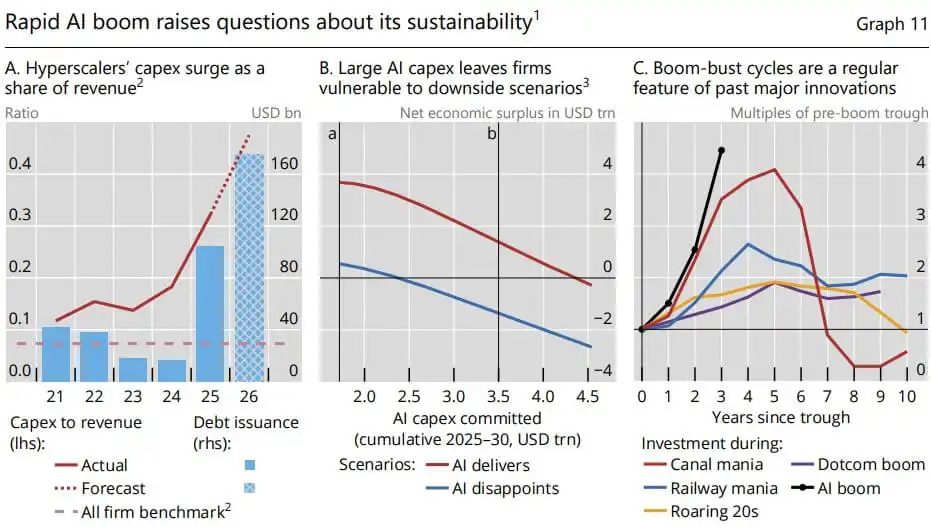
In its annual economic report, the Basel-based institution that advises central banks noted that the five largest cloud computing giants will have AI-related capital expenditures exceeding $1 trillion in 2025 and 2026.

The BIS stated that such massive investment raises the question of whether companies are committing too much capital before their business models are fully validated.

The BIS said:

"Disappointing returns could trigger a sudden withdrawal of financing, turning the capital expenditure boom into a prolonged investment slump, with knock-on effects on financial conditions."

For Bitcoin traders, the implications of this warning extend far beyond the chip and data center race in Silicon Valley.

A sharp reversal in AI spending could tighten liquidity in equity and credit markets, forcing cryptocurrencies to face a tough test: in a sell-off, will Bitcoin initially behave like another risky asset, or will its long-term monetary narrative regain strength after the shock?

AI Spending Boom Draws Central Bank Attention

The Bank for International Settlements (BIS), a forum for central banks, warned in its annual economic report that the race for AI dominance may be pushing investment to levels that future returns cannot sustain.

The BIS stated:

"If supply bottlenecks limit production, the current capital expenditure surge may not be sustainable. Fierce competition for market leadership could further fuel overinvestment, as seen in previous innovation waves, increasing the risk of a sharp reversal if AI returns disappoint."

The issue is not a lack of economic potential for AI. The BIS indicated that this technology could ultimately boost productivity in ways different from earlier waves of automation and software development. If AI systems can self-improve and help generate new ideas, the long-term macroeconomic impact could be significant.

But the near-term financial risks are different. Companies like Google, OpenAI, and Anthropic are pouring huge sums of money without clarity on how much revenue the spending will generate, how long that revenue will last, or how quickly the infrastructure behind AI will become obsolete.

In practice, the largest tech companies are splurging on chips, cloud capacity, data centers, power supplies, and networking equipment, competing for users and market share.
The scale of this race has helped solidify investor confidence in tech stocks while boosting demand for suppliers and infrastructure companies linked to AI construction.

However, the BIS warned that intense competition itself creates fragility. If every major player spends heavily to avoid falling behind, the entire industry could end up with overcapacity, lower returns, and financing structures difficult to maintain once optimism fades.

This dynamic has occurred before. The BIS pointed to earlier investment booms associated with canals, railways, electrification, and the internet.

While each technology later transformed the economy, they also produced periods where investors financed too much, too fast, ultimately leading to painful reversals.

With this in mind, the BIS concluded:

"The scale and speed of the current AI investment boom, coupled with expectations of a significant productivity boost, resemble these precedents and highlight the potential near-term downside risks."

Compounding the issue are severe physical bottlenecks. The insatiable demand for computing power is straining supplies of advanced semiconductors, grid equipment, and raw electricity.

According to the BIS, this surging demand is already pushing up electricity prices, potentially feeding into broader inflation measures—at a time when geopolitical conflicts in the Middle East are independently straining global supply chains.

Credit Risks Build Beneath Equity Rally

Meanwhile, the BIS's concerns extend far beyond a simple stock market correction to how an AI shock could affect the broader financial system.

While the early stages of AI development were funded largely by the massive cash reserves of Silicon Valley giants, the current trillion-dollar scale of investment relies more on debt and increasingly opaque financing structures.

The BIS noted that AI infrastructure now spans corporate debt markets, private credit, lease financing, data center construction, energy contracts, and supplier agreements.

Chipmakers, cloud providers, AI labs, and data center operators are becoming increasingly interconnected through equity investments, procurement commitments, and long-term capacity trades.

Indeed, Bitcoin-focused financial services firm Onramp Bitcoin recently pointed out:

"A web of overlapping commitments now binds AI construction into roughly a $1 trillion loop: Nvidia invests in AI labs like OpenAI, the labs lease cloud capacity from Oracle and CoreWeave, and those cloud services buy Nvidia chips. The same dollar can be booked simultaneously as investment, funding, revenue, and sales, so headline numbers are no longer as meaningful as they appear."
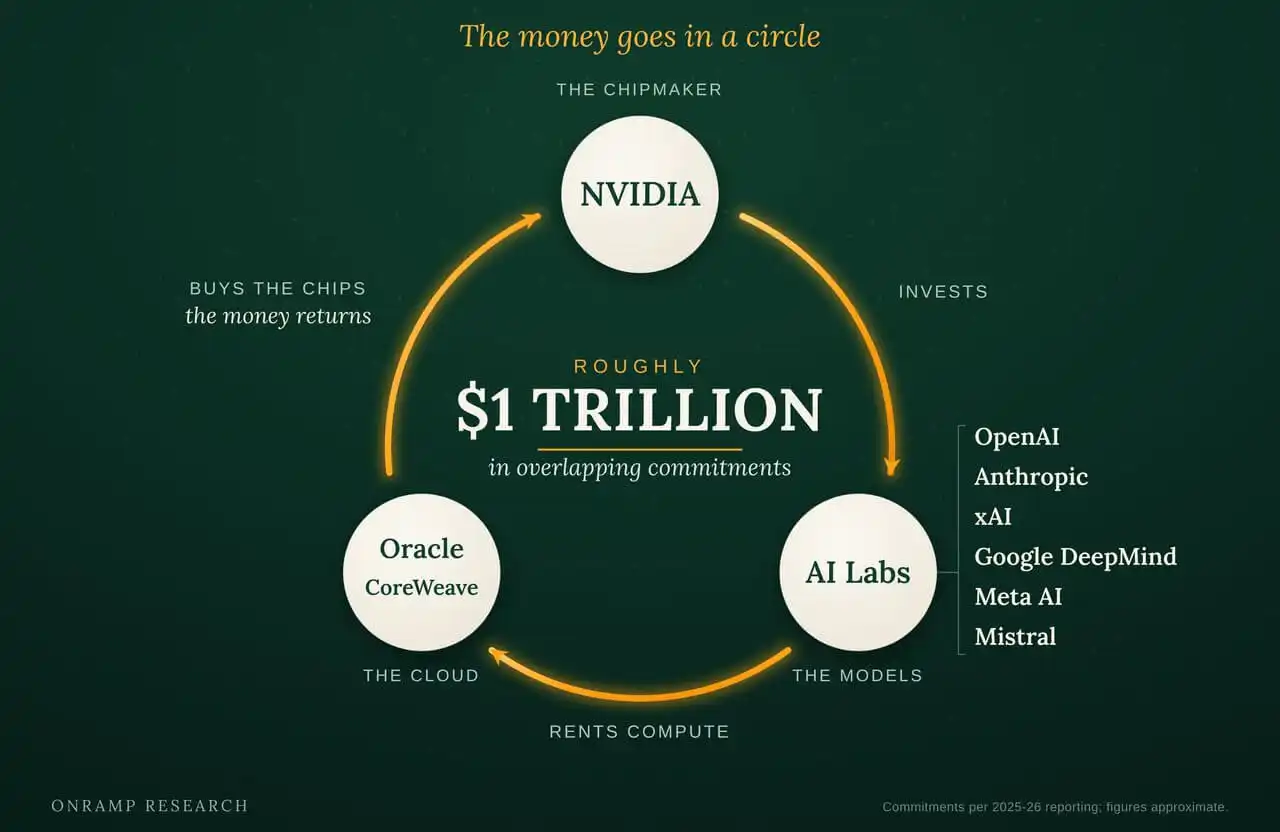
The BIS warned that these arrangements can make risks harder to see, noting that this network of claims is built on expectations of future demand. If AI adoption continues to accelerate, this structure can be self-reinforcing.

But if demand disappoints, stress could reverberate back through the chain.

This could lead to a scenario where suppliers might lose orders, and data center developers might struggle to fill capacity.

Meanwhile, private credit funds could face stress on loans linked to software, infrastructure, or tech borrowers. Banks might find their exposure to private credit and non-bank finance more complex than surface numbers suggest.

This is why the BIS's warning extends beyond tech stocks. A decline in AI-related stocks directly hurts investors. A broader reassessment of AI financing could tighten credit conditions for companies relying on the same funding environment.

Credit spreads have remained relatively narrow, reflecting investor belief that borrowers can continue servicing debt.

A sharp repricing of equity risk could quickly change that. Once lenders demand more risk compensation, weaker borrowers face higher refinancing costs, reduced access to capital, and pressure to cut investment.

This is the path through which AI disappointment could evolve into a macro event.

Bitcoin's Initial Reaction May Be Defensive

In such an economic shock, Bitcoin's role would be complex. Proponents of the asset often describe it as a hedge against currency debasement, fiscal stress, and financial system fragility. Its supply is fixed, it has no corporate issuer, and it does not rely on corporate profits or debt repayment schedules.

These properties could become more attractive if an AI credit crunch ultimately forces policymakers to ease financial conditions. But in the early stages of a broad sell-off, Bitcoin would likely face the same pressure as other risk assets.

When liquidity tightens, investors typically sell liquid positions first. Bitcoin trades continuously, can be sold quickly, and is held by many investors who also own stocks, exchange-traded products, derivatives, and other high-beta assets. This makes it vulnerable during portfolio de-risking.

Recent market behavior supports this concern. CryptoSlate recently reported that Bitcoin fell below $63,000 after South Korea's benchmark KOSPI stock index plunged nearly 10% last week.

This decline suggests that liquidity conditions, leverage, and risk appetite can overwhelm the scarcity narrative for extended periods.

A market shock triggered by AI could follow a similar sequence. Tech stocks linked to construction might fall first. As investors reassess debt linked to data centers, suppliers, and private financing vehicles, credit spreads could widen. Funds facing losses or margin pressure might subsequently cut positions in cryptocurrencies and other liquid assets.

At that stage, Bitcoin wouldn't need a direct link to AI infrastructure to be affected. It just needs to be part of the same risk budget.

Liquidity Questions Follow

But the second stage depends on the government's response to the ensuing market distress.

If a reversal in AI investment remains confined to a small group of tech companies, the damage could be limited. Stocks would reprice, suppliers would adjust, investors would reassess valuations, without forcing a major shift in monetary policy.

But the risk flagged by the BIS is that the spending boom is already large enough to affect the broader financial system.

This suggests that a significant pullback in AI capital expenditure could simultaneously hit corporate investment, employment, household wealth, and credit availability. If inflation remains high and central banks feel unable to cut rates quickly, these pressures could become more severe.

This creates a difficult scenario for risk assets. Higher inflation could keep policy tight even as investment weakens. Tighter credit could expose leverage in private markets. Falling stock prices could reduce household wealth and slow consumption. Each channel could reinforce the others.

For Bitcoin, the policy path is crucial. This asset typically performs best when liquidity is expanding, real rates are falling, and investors anticipate central bank support for markets. A credit shock that ultimately brings looser money could restart that trade.

BitMEX co-founder Arthur Hayes believes that an AI crash could help propel Bitcoin significantly higher if authorities respond by re-creating liquidity, and investors shift away from debt-laden financial structures.

This view remains speculative, but it captures why some crypto traders see AI capital expenditure and credit markets as potential drivers for the next Bitcoin cycle.

But the timing is uncertain. Therefore, traders betting on an eventual liquidity response may still have to endure the preceding drawdown.

Bitcoin rose 2.28% in the past 24 hours and is currently ranked first by market capitalization.

Broader Market Status

Currently, the total cryptocurrency market capitalization is $2.09 trillion, with a 24-hour trading volume of $81.45 billion. Bitcoin's dominance is 57.97%.

For two years, buying more Bitcoin was enough to push up treasury stock prices. Strategy's BTC Yield is now declining, Metaplanet's market capitalization is below the value of its Bitcoin holdings, and new entrants in Europe are asking investors to fund them at terms no one is pricing.


Crypto di tendenza

Domande pertinenti

QAccording to the BIS's warning, what could be the initial impact on Bitcoin and other risk assets if the trillion-dollar AI investment boom fails to deliver expected returns?

AThe initial impact would likely be a sharp sell-off. Liquidity could tighten across equity and credit markets, forcing investors to de-risk their portfolios. As a highly liquid asset held by many of the same investors exposed to tech stocks and high-beta assets, Bitcoin would be vulnerable to these initial waves of selling pressure and would likely behave like another risk asset.

QWhat specific financial system vulnerabilities does the BIS highlight regarding the current AI infrastructure investment boom?

AThe BIS highlights vulnerabilities in the complex and opaque financing web binding the AI ecosystem. This includes corporate debt, private credit, leasing, and long-term capacity contracts between chipmakers, cloud providers, AI labs, and data center operators. This structure, built on expectations of future demand, could transmit stress throughout the chain if demand disappoints, potentially impacting banks with indirect exposure and tightening credit conditions more broadly.

QWhy might Bitcoin's price action be complex in the scenario of an AI-induced market shock, according to the article?

ABitcoin's price action would be complex due to a potential two-phase reaction. In the initial phase, it would likely fall alongside other risk assets as investors sell liquid holdings. However, if the shock is severe enough to force central banks to ease monetary policy and inject liquidity to prevent a broader crisis, Bitcoin's long-term narrative as a hedge against monetary debasement could reassert itself, potentially leading to a significant rally in a subsequent phase.

QWhat historical precedents does the BIS cite to support its concern about the current AI investment surge?

AThe BIS cites historical investment booms associated with major technological innovations like canals, railroads, electrification, and the internet. While these technologies ultimately transformed economies, they also led to periods where investment and financing raced ahead of sustainable returns, resulting in painful reversals and downturns.

QApart from financial risks, what other challenge does the BIS identify that could hinder the AI investment boom?

AThe BIS identifies severe physical bottlenecks as a major challenge. The insatiable demand for computing power is straining supplies of advanced semiconductors, grid equipment, and raw electricity. This is already pushing up electricity prices and could contribute to broader inflationary pressures, adding another layer of economic complexity.

Letture associate

In the AI Era, What's Left for Bitcoin?

As Bitcoin falls below $60,000, the author reflects on the relationship between AI and Bitcoin, seeing them as two sides of the same coin. In the AI era, the cost of generating content has plummeted, making fake text, images, and videos increasingly easy and cheap to produce. This has led to a fundamental shift: while AI dramatically lowers the cost of information production, it also undermines trust and authenticity online. What becomes truly valuable is not more content, but the ability to verify what is real—"verifiability." This perspective offers a new lens for Bitcoin. Its massive energy consumption, often criticized as wasteful, is reinterpreted. While AI burns energy to enhance "capability" and efficiency, Bitcoin burns energy to produce "verifiability." Its purpose is not to be trusted but to enable a system where no trust in intermediaries—banks, platforms, or developers—is needed. Every transaction and the entire ledger's history is secured by cryptography and a decentralized network of nodes, making it independently verifiable. AI cannot forge a transaction on the Bitcoin network because the system is designed for proof, not generation. The author draws a historical parallel to the Renaissance: the printing press drastically reduced the cost of copying knowledge, while double-entry bookkeeping reduced the cost of trust in commerce. Today, AI is the new printing press, reducing content creation costs to near zero. Blockchain, and Bitcoin as its pioneer, may be the modern equivalent of double-entry bookkeeping—a foundational technology for verifying digital asset ownership and historical records without centralized authorities. Thus, AI and blockchain are not competitors. AI lowers the cost of creation; blockchain lowers the cost of verification. In an age where AI can generate anything, true scarcity may lie not in more content, but in independently verifiable facts. Whether the market will reprice Bitcoin accordingly remains uncertain, but its core value proposition as a "machine for producing verifiability" becomes strikingly relevant.

marsbit17 min fa

In the AI Era, What's Left for Bitcoin?

marsbit17 min fa

In the Age of AI, What's Left for Bitcoin?

Author: Sevclub, Seven Research Amid Bitcoin's recent drop below $60k, the author reflects on a growing sense that AI and Bitcoin are two sides of the same coin. Today, encountering any content triggers a new default question: "Was this made by AI?" The cost of generating convincing text, images, and video is now negligible. While the internet lowered information *distribution* costs, AI is crashing information *production* costs to near zero. The consequence is a flood of content where truth and falsehood are increasingly indistinguishable. In this environment, what becomes truly valuable is not more information, but the ability to verify what is real—"verifiability." This reframes the common criticism that Bitcoin "wastes electricity." AI consumes power to produce "capability" (e.g., more powerful models). Bitcoin consumes power to produce something else: "verifiability." Bitcoin's core purpose isn't about belief or trust in any institution, developer, or even its creator. It's about enabling independent verification. Every bitcoin's origin, every transaction, and the integrity of the entire ledger are secured by mathematics, cryptography, and a global network of nodes. AI can fabricate convincing media, but it cannot falsify a transaction on the Bitcoin network. The expended energy makes篡改历史 (tampering with history) prohibitively expensive, purchasing a globally verifiable ledger. The author draws a historical parallel to the Renaissance. The printing press drastically reduced the cost of copying knowledge, while double-entry bookkeeping reduced the cost of trust in commerce—one enabled creation, the other verification. Today, AI is the new printing press, driving content production costs toward zero. The question becomes: what is this era's "double-entry bookkeeping"? Blockchain appears to be the leading candidate. It doesn't verify which news is true or which image is real, but it provides a foundational layer for independently verifying asset ownership and historical records in the digital realm without centralized authorities. Therefore, AI and blockchain are not in competition. AI lowers the cost of *generation*. Blockchain (and Bitcoin as a prime example) lowers the cost of *verification*. One creates, the other proves. Whether Bitcoin ultimately succeeds remains uncertain, facing potential challenges from quantum computing, regulation, and technical evolution. However, the author now sees it less as a "machine for making bitcoin" and more as a "machine for making verifiability." In an age where AI can generate anything, true scarcity may no longer be "more content," but "more independently verifiable facts." Whether the market will price this accordingly is a separate question.

链捕手26 min fa

In the Age of AI, What's Left for Bitcoin?

链捕手26 min fa

Trading

Spot

Articoli Popolari

Cosa è BITCOIN

Comprendere HarryPotterObamaSonic10Inu (ERC-20) e la sua posizione nel mondo delle criptovalute Negli ultimi anni, il mercato delle criptovalute ha assistito a un aumento della popolarità delle meme coin, catturando l'interesse non solo dei trader, ma anche di coloro che cercano coinvolgimento comunitario e valore di intrattenimento. Tra questi token unici c'è HarryPotterObamaSonic10Inu (ERC-20), un progetto intrigante che mescola riferimenti culturali nel tessuto delle criptovalute. Questo articolo esplora gli aspetti chiave di HarryPotterObamaSonic10Inu, analizzando i suoi meccanismi, l'etica guidata dalla comunità e il suo coinvolgimento con il panorama crittografico più ampio. Che cos'è HarryPotterObamaSonic10Inu (ERC-20)? Come suggerisce il suo nome, HarryPotterObamaSonic10Inu è una meme coin costruita sulla blockchain di Ethereum, classificata secondo lo standard ERC-20. A differenza delle criptovalute tradizionali che possono enfatizzare l'utilità pratica o il potenziale investimento, questo token prospera grazie al valore di intrattenimento e alla forza della sua comunità. Il progetto mira a creare un ambiente in cui gli utenti coinvolti possono riunirsi, condividere idee e partecipare ad attività ispirate a diversi fenomeni culturali. Una caratteristica notevole di HarryPotterObamaSonic10Inu è la zero tassa sulle transazioni. Questo elemento allettante tende a incoraggiare il trading e il coinvolgimento della comunità, privo di costi aggiuntivi che possono scoraggiare i trader di piccole dimensioni. L'offerta totale della moneta è fissata a un miliardo di token, un numero che segna la sua intenzione di mantenere una circolazione sostanziale all'interno della comunità. Creatore di HarryPotterObamaSonic10Inu (ERC-20) Le origini di HarryPotterObamaSonic10Inu sono avvolte in un certo mistero; i dettagli sul creatore rimangono sconosciuti. Lo sviluppo di questo token non presenta un team identificabile o un piano esplicito, cosa non rara nel settore delle meme coin. Invece, il progetto è emerso organicamente, con il suo progresso fortemente dipendente dall'entusiasmo e dalla partecipazione della sua comunità. Investitori di HarryPotterObamaSonic10Inu (ERC-20) Per quanto riguarda investimenti esterni e finanziamenti, HarryPotterObamaSonic10Inu rimane ambiguo. Il token non elenca alcuna fondazione di investimento conosciuta o un sostegno organizzativo significativo. Invece, la linfa vitale del progetto è la sua comunità di base, che informa la sua crescita e sostenibilità attraverso azioni collettive e coinvolgimento nello spazio crittografico. Come funziona HarryPotterObamaSonic10Inu (ERC-20)? In quanto meme coin, HarryPotterObamaSonic10Inu opera principalmente al di fuori delle strutture tradizionali che governano spesso il valore degli asset. Ci sono diversi aspetti distintivi che definiscono il funzionamento del progetto: Transazioni senza tasse: Senza costi fiscali sulle transazioni, gli utenti possono comprare e vendere liberamente il token senza preoccuparsi di costi nascosti. Coinvolgimento della comunità: Il progetto prospera sull'interazione della comunità, sfruttando le piattaforme social per creare entusiasmo e facilitare il coinvolgimento. Discussioni, condivisione di contenuti e coinvolgimento sono elementi cruciali che aiutano ad espandere la sua portata e a favorire la lealtà tra i sostenitori. Nessuna utilità pratica: Va notato che HarryPotterObamaSonic10Inu non offre un'utilità concreta all'interno dell'ecosistema finanziario. Piuttosto, è classificato come un token principalmente per attività di intrattenimento e comunitarie. Riferimento culturale: Il token incorpora astutamente elementi della cultura pop per attirare interesse, collegandosi a appassionati di meme e seguaci delle criptovalute. HarryPotterObamaSonic10Inu esemplifica come le meme coin operino in modo diverso rispetto ai progetti di criptovalute più tradizionali, entrando nel mercato come costrutti sociali innovativi piuttosto che come asset utilitari. Cronologia di HarryPotterObamaSonic10Inu (ERC-20) La storia di HarryPotterObamaSonic10Inu è segnata da diversi traguardi notevoli: Creazione: Il token è emerso da un meme virale, catturando l'immaginazione di molti appassionati di criptovalute. Le date di creazione specifiche non sono disponibili, sottolineando la sua crescita organica. Inserimento negli scambi: HarryPotterObamaSonic10Inu ha fatto il suo ingresso in vari scambi, consentendo un accesso e un trading più facili da parte della comunità. Iniziative di coinvolgimento della comunità: Attività in corso volte a migliorare l'interazione della comunità, comprese gare, campagne sui social media e generazione di contenuti da parte di fan e sostenitori. Piani di espansione futura: La tabella di marcia del progetto include il lancio di una collezione NFT, merchandising e un sito di eCommerce relativo ai suoi temi culturali, coinvolgendo ulteriormente la comunità e cercando di aggiungere più dimensioni al suo ecosistema. Punti chiave su HarryPotterObamaSonic10Inu (ERC-20) Natura guidata dalla comunità: Il progetto dà priorità al contributo collettivo e alla creatività, garantendo che il coinvolgimento degli utenti sia al centro del suo sviluppo. Classificazione come meme coin: Rappresenta l'epitome delle criptovalute basate sull'intrattenimento, distinguendosi dai veicoli d'investimento tradizionali. Nessuna affiliazione diretta con Bitcoin: Nonostante la somiglianza nel nome del ticker, HarryPotterObamaSonic10Inu è distintivo e non ha alcuna relazione con Bitcoin o altre criptovalute consolidate. Focus sulla collaborazione: HarryPotterObamaSonic10Inu è progettato per creare uno spazio per la collaborazione e la condivisione di storie tra i suoi detentori, fornendo un canale per la creatività e il legame comunitario. Prospettive future: L'ambizione di espandersi oltre il suo presupposto iniziale verso NFT e merchandising delinea un percorso per il progetto per potenzialmente entrare in strade più mainstream all'interno della cultura digitale. Poiché le meme coin continuano a catturare l'immaginazione della comunità crittografica, HarryPotterObamaSonic10Inu (ERC-20) si distingue per i suoi legami culturali e il suo approccio centrato sulla comunità. Anche se potrebbe non adattarsi al modello tipico di un token orientato all'utilità, la sua essenza risiede nella gioia e nella camaraderia coltivate tra i suoi sostenitori, evidenziando la natura in evoluzione delle criptovalute in un'epoca sempre più digitale. Con la continuazione dello sviluppo del progetto, sarà importante osservare come le dinamiche della comunità influenzano la sua traiettoria nel panorama in continuo cambiamento della tecnologia blockchain.

1.7k Totale visualizzazioniPubblicato il 2024.04.01Aggiornato il 2024.12.03

Cosa è BITCOIN

Come comprare BTC

Benvenuto in HTX.com! Abbiamo reso l'acquisto di Bitcoin (BTC) semplice e conveniente. Segui la nostra guida passo passo per intraprendere il tuo viaggio nel mondo delle criptovalute.Step 1: Crea il tuo Account HTXUsa la tua email o numero di telefono per registrarti il tuo account gratuito su HTX. Vivi un'esperienza facile e sblocca tutte le funzionalità,Crea il mio accountStep 2: Vai in Acquista crypto e seleziona il tuo metodo di pagamentoCarta di credito/debito: utilizza la tua Visa o Mastercard per acquistare immediatamente BitcoinBTC.Bilancio: Usa i fondi dal bilancio del tuo account HTX per fare trading senza problemi.Terze parti: abbiamo aggiunto metodi di pagamento molto utilizzati come Google Pay e Apple Pay per maggiore comodità.P2P: Fai trading direttamente con altri utenti HTX.Over-the-Counter (OTC): Offriamo servizi su misura e tassi di cambio competitivi per i trader.Step 3: Conserva Bitcoin (BTC)Dopo aver acquistato Bitcoin (BTC), conserva nel tuo account HTX. In alternativa, puoi inviare tramite trasferimento blockchain o scambiare per altre criptovalute.Step 4: Scambia Bitcoin (BTC)Scambia facilmente Bitcoin (BTC) nel mercato spot di HTX. Accedi al tuo account, seleziona la tua coppia di trading, esegui le tue operazioni e monitora in tempo reale. Offriamo un'esperienza user-friendly sia per chi ha appena iniziato che per i trader più esperti.

4.1k Totale visualizzazioniPubblicato il 2024.12.12Aggiornato il 2026.06.02

Come comprare BTC

Cosa è $BITCOIN

ORO DIGITALE ($BITCOIN): Un'Analisi Completa Introduzione all'ORO DIGITALE ($BITCOIN) L'ORO DIGITALE ($BITCOIN) è un progetto basato su blockchain che opera sulla rete Solana, con l'obiettivo di combinare le caratteristiche dei metalli preziosi tradizionali con l'innovazione delle tecnologie decentralizzate. Sebbene condivida un nome con Bitcoin, spesso definito “oro digitale” a causa della sua percezione come riserva di valore, l'ORO DIGITALE è un token separato progettato per creare un ecosistema unico all'interno del panorama Web3. Il suo obiettivo è posizionarsi come un asset digitale alternativo valido, anche se i dettagli riguardanti le sue applicazioni e funzionalità sono ancora in fase di sviluppo. Cos'è l'ORO DIGITALE ($BITCOIN)? L'ORO DIGITALE ($BITCOIN) è un token di criptovaluta esplicitamente progettato per l'uso sulla blockchain di Solana. A differenza di Bitcoin, che fornisce un ruolo di stoccaggio di valore ampiamente riconosciuto, questo token sembra concentrarsi su applicazioni e caratteristiche più ampie. Aspetti notevoli includono: Infrastruttura Blockchain: Il token è costruito sulla blockchain di Solana, nota per la sua capacità di gestire transazioni ad alta velocità e a basso costo. Dinamiche di Offerta: L'ORO DIGITALE ha un'offerta massima fissata a 100 quadrilioni di token (100P $BITCOIN), sebbene i dettagli riguardanti la sua offerta circolante siano attualmente non divulgati. Utilità: Sebbene le funzionalità precise non siano esplicitamente delineate, ci sono indicazioni che il token potrebbe essere utilizzato per varie applicazioni, potenzialmente coinvolgendo applicazioni decentralizzate (dApp) o strategie di tokenizzazione degli asset. Chi è il Creatore dell'ORO DIGITALE ($BITCOIN)? Attualmente, l'identità dei creatori e del team di sviluppo dietro l'ORO DIGITALE ($BITCOIN) rimane sconosciuta. Questa situazione è tipica tra molti progetti innovativi nel settore blockchain, in particolare quelli allineati con la finanza decentralizzata e i fenomeni delle meme coin. Sebbene tale anonimato possa favorire una cultura guidata dalla comunità, intensifica le preoccupazioni riguardo alla governance e alla responsabilità. Chi sono gli Investitori dell'ORO DIGITALE ($BITCOIN)? Le informazioni disponibili indicano che l'ORO DIGITALE ($BITCOIN) non ha alcun sostenitore istituzionale noto o investimenti di venture capital prominenti. Il progetto sembra operare su un modello peer-to-peer incentrato sul supporto e sull'adozione della comunità piuttosto che su percorsi di finanziamento tradizionali. La sua attività e liquidità si trovano principalmente su exchange decentralizzati (DEX), come PumpSwap, piuttosto che su piattaforme di trading centralizzate consolidate, evidenziando ulteriormente il suo approccio di base. Come Funziona l'ORO DIGITALE ($BITCOIN) Le meccaniche operative dell'ORO DIGITALE ($BITCOIN) possono essere elaborate in base al suo design blockchain e alle caratteristiche della rete: Meccanismo di Consenso: Sfruttando il proof-of-history (PoH) unico di Solana combinato con un modello di proof-of-stake (PoS), il progetto garantisce una validazione efficiente delle transazioni contribuendo all'alta performance della rete. Tokenomics: Sebbene meccanismi deflazionistici specifici non siano stati dettagliati ampiamente, l'ampia offerta massima di token implica che potrebbe soddisfare microtransazioni o casi d'uso di nicchia che devono ancora essere definiti. Interoperabilità: Esiste il potenziale per l'integrazione con l'ecosistema più ampio di Solana, inclusi vari piattaforme di finanza decentralizzata (DeFi). Tuttavia, i dettagli riguardanti integrazioni specifiche rimangono non specificati. Cronologia degli Eventi Chiave Ecco una cronologia che evidenzia traguardi significativi riguardanti l'ORO DIGITALE ($BITCOIN): 2023: Il dispiegamento iniziale del token avviene sulla blockchain di Solana, contrassegnato dal suo indirizzo di contratto. 2024: L'ORO DIGITALE guadagna visibilità poiché diventa disponibile per il trading su exchange decentralizzati come PumpSwap, consentendo agli utenti di scambiarlo contro SOL. 2025: Il progetto assiste a un'attività di trading sporadica e a un potenziale interesse per impegni guidati dalla comunità, sebbene non siano state documentate partnership significative o avanzamenti tecnici fino ad ora. Analisi Critica Punti di Forza Scalabilità: L'infrastruttura sottostante di Solana supporta alti volumi di transazioni, il che potrebbe migliorare l'utilità di $BITCOIN in vari scenari di transazione. Accessibilità: Il potenziale basso prezzo di trading per token potrebbe attrarre investitori al dettaglio, facilitando una partecipazione più ampia grazie a opportunità di proprietà frazionata. Rischi Mancanza di Trasparenza: L'assenza di sostenitori, sviluppatori o di un processo di audit pubblicamente noti potrebbe generare scetticismo riguardo alla sostenibilità e all'affidabilità del progetto. Volatilità del Mercato: L'attività di trading è fortemente dipendente dal comportamento speculativo, il che può comportare una significativa volatilità dei prezzi e incertezze per gli investitori. Conclusione L'ORO DIGITALE ($BITCOIN) emerge come un progetto intrigante ma ambiguo all'interno dell'evolvente ecosistema di Solana. Sebbene tenti di sfruttare la narrativa dell'“oro digitale”, la sua partenza dal ruolo consolidato di Bitcoin come riserva di valore sottolinea la necessità di una chiara differenziazione della sua utilità e struttura di governance. L'accettazione e l'adozione future dipenderanno probabilmente dall'affrontare l'attuale opacità e dalla definizione più esplicita delle sue strategie operative ed economiche. Nota: Questo rapporto comprende informazioni sintetizzate disponibili a ottobre 2023, e potrebbero essersi verificati sviluppi oltre il periodo di ricerca.

114 Totale visualizzazioniPubblicato il 2025.05.13Aggiornato il 2025.05.13

Cosa è $BITCOIN

Discussioni

Benvenuto nella Community HTX. Qui puoi rimanere informato sugli ultimi sviluppi della piattaforma e accedere ad approfondimenti esperti sul mercato. Le opinioni degli utenti sul prezzo di BTC BTC sono presentate come di seguito.

活动图片