Can the US Maintain Its Credibility? Ray Dalio's Vision of a 'Tribute-Style' New Order

marsbitPubblicato 2026-06-23Pubblicato ultima volta 2026-06-23

Introduzione

Bridgewater founder Ray Dalio links declining U.S. credibility and rising Chinese influence to a modern "tribute system" – a hierarchical order based on power differentials, economic interests, and diplomatic pressure rather than direct control. This shift, he argues, makes U.S. commitments appear negotiable, prompting Asian nations to reassess security and economic alignments. A key market vulnerability is the advanced semiconductor supply chain concentrated in East Asia, which produces the majority of the world's most advanced chips. Dalio suggests that even without direct conflict, uncertainties over commitments, shipping, or supply chain reshoring can trigger asset price volatility in tech stocks, Asian markets, and RMB-denominated assets. While not predicting immediate extreme events, he warns that policy swings, miscalculations, and non-military pressure could reshape regional order, with market reactions preceding any outright confrontation.

Bridgewater founder Ray Dalio has recently, in interviews and media reports, linked the decline in trust from US allies and the rise in China's strength to a modern version of a 'tribute-style order'. For the markets, this is not merely a historical analogy. If the US's commitments to allies and key regions are seen as more negotiable, while China alters the choices of neighboring countries through economic, financial, and diplomatic influence, the first factors priced into the market are likely to be regional risks, AI chip supply chains, RMB assets, and sentiment in Asian markets.
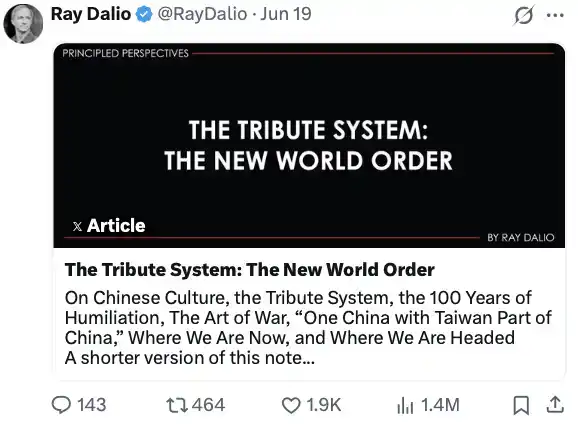
Dalio's assessment is sharp: as US relative deterrence declines and China's economic and financial influence rises, Asian countries may reassess who can provide security and economic order. He borrows the historical concept of the 'tribute system', referring not to simple direct control, but to a hierarchical relationship composed of power differentials, economic interests, diplomatic protocol, and pressure constraints.

One real-world focal point is East Asia's advanced semiconductor supply chain. Related regions hold key positions in the global manufacturing of advanced semiconductors, particularly AI-chip-related wafer fabrication. Public data widely indicates that this region produces over 60% of the world's semiconductors and over 90% of the most advanced chips. Even without extreme events, delays in commitments, shipping uncertainties, diplomatic pressure, or progress in supply chain self-sufficiency alone could be enough to cause related assets to fluctuate in advance.

US Commitments Becoming 'Negotiable' Is a Danger Signal in Dalio's Eyes

Dalio observes several recent events along the same line.

First is the Middle East conflict and risks in the Strait of Hormuz. Market reports surrounding Iran, energy transport, and the cost of US intervention are used by him as an analogy: the US public and government are increasingly unwilling to bear the cost of long-term, multi-front conflicts. This analogy is more of a macro investor's historical reference; it does not mean Middle East developments have already proven US decline. But it explains why a strait risk gets incorporated into narratives about shifts in Sino-US power.

Second is the pace of progress in some US external arrangements. According to reports from AP, *The Washington Post*, etc., planned arrangements involving around $14 billion have not yet been fully finalized. Concerned parties state they have not received suspension notices; a US acting Navy secretary stated that some external arrangements were delayed due to the Iran war and munitions needs. Trump also referred to related matters as a 'negotiating chip' in talks with China.

This is the part most sensitive to the market. If US commitments to key regions are understood by the outside world as negotiable, other Asian economies will reassess the reliability of US promises. Whether the related arrangements are ultimately implemented remains undecided, but 'uncertainty' itself already constitutes a signal.

Third is the change in tone from the US in Asian security forums. US Secretary of Defense Pete Hegseth's speech at the Shangri-La Dialogue on May 30th was interpreted by media compared to 2025 as toning down its hawkishness towards China, though he still emphasized the US would maintain a favorable balance of power in the Indo-Pacific and remain vigilant about China's military expansion. This may not represent a US withdrawal from Asia, but it deepens one question: when the US simultaneously faces pressures in the Middle East, Europe, and the Indo-Pacific, how much cost is it willing to bear for its regional commitments?

'Tribute-Style Order' Is Not a History Lesson, But an Explanation of Indirect Pressure

Dalio's argument sparks discussion because he does not explain China solely from a military perspective, but combines economics and finance, historical narratives, and political culture.

In his understanding, the traditional 'tribute system' was more like a set of regional order arrangements: surrounding states acknowledged power differentials in exchange for trade, protection, and stability; the central state maintained influence through rewards, punishments, protocol, and access rules, without frequently resorting to direct control.

This connects to the idea in *The Art of War* of 'subduing the enemy without fighting'. Truly effective pressure may not be firing shots, but forcing an opponent to adjust on their own in the face of economic, diplomatic, supply chain, and internal costs.

The advanced chip supply chain thus becomes the focal point of this logic. For global markets, key regions are where advanced chip production capacity is highly concentrated. Technology, capital, and regional order overlap here, amplifying any changes in pressure.

Dalio also notes that China's export profits, accumulation of capital surpluses, increased use of the RMB in trade and capital transactions, and the enhanced competitiveness of China's financial system will increase its appeal to neighboring countries. This is not equivalent to 'China's financial system has already replaced the US', but if more trade, financing, and supply chain arrangements revolve around China, regional economies' choices between security and economics will become more complex.

Advanced Chips Are the First Pressure Point Where Markets React

For investors, the most critical question is not 'will an extreme event immediately occur', but whether pressure will change asset prices before an extreme event happens.

Related regions produce the majority of the world's advanced chips. AI servers, cloud computing capital expenditures, semiconductor equipment, and consumer electronics supply chains are all highly tied to them. The AI chip supply chain does not only involve wafer fabrication but also includes HBM, advanced packaging, equipment, and materials. However, the most advanced process capacity is concentrated in key East Asian regions, which remains one of the most sensitive geopolitical risk exposures for global tech stocks.

This is also why Dalio emphasizes 'non-direct conflict'. Modern financial markets do not need to wait for the worst outcome to occur before adjusting. Shipping insurance, chip inventories, corporate capital expenditures, USD and RMB flows, and Asian equity, currency, and bond assets may all fluctuate as risk expectations change.

If China continues to advance self-sufficiency in advanced chips, the external constraints of key production capacity on the mainland supply chain may decrease; but in the short term, related regions remain a key link the global AI industry cannot bypass. The so-called 'threat-as-action' refers precisely to this: when critical capacity is concentrated in a high-pressure region, even just the possibility of blockade or sanctions is enough to affect global tech stock valuations and corporate procurement decisions.

The RMB and Chinese assets will also face dual impacts. On one hand, China's trade surplus and increased use in cross-border settlements will support the RMB internationalization narrative; on the other hand, if regional risks heat up, capital will also reassess the political risk and liquidity constraints of Chinese assets.

Policy Volatility and Miscalculation Are the Hardest Parts to Price

Dalio has not packaged his judgment as a definitive conclusion. His identity is that of a global macro investor; the advantage lies in observing historical cycles, monetary finance, and geopolitical shifts together; the limitation is also here—it's more of a macro scenario than an official policy roadmap.

US policy itself can be volatile. The Trump administration can treat some external arrangements as negotiating chips, but may also re-strengthen regional commitments under pressure from Congress, allies, or electoral politics. The open and contentious nature of US domestic politics increases short-term swings but may also create reverse constraints on key issues.

Internal regional factors will also influence the pace. Different approaches within regions emphasize communication, confrontation, and risk management differently. Election cycles around 2028, US midterms, and China's internal political schedule may all change the timing of actions by various parties.

Chip self-sufficiency is also not something that can be achieved by slogans alone. Advanced processes, equipment, materials, EDA software, and talent systems all require time. If China cannot significantly reduce external dependency in key links, the importance of East Asia's advanced chip capacity will only increase, and the cost of pressure maneuvers will be harder to control.

Indirect pressure does not equal low risk. The greater the reliance on deterrence, ambiguous signals, and diplomatic probing, the more prone the situation is to miscalculation. What the market fears may not be an extreme event suddenly occurring one day, but rather all parties repeatedly testing each other between commitments, exercises, blockades, sanctions, and negotiations, ultimately pushing the situation to a harder-to-manage point. What Dalio truly reminds investors is that changes in the Asian order may not begin with a clear conflict, but first manifest in wavering commitments, diplomatic alignment, chip anxiety, and shifts in capital flows.


Crypto di tendenza

Domande pertinenti

QWhat is Ray Dalio's main concern regarding the changing world order?

ARay Dalio's main concern is a shifting global order where a perceived decline in the reliability of US commitments and the rise of China's economic/financial influence is leading to a modern 'tribute system' in Asia. This could cause regional instability, with financial markets reacting first to changes in risk, supply chains, and capital flows before any direct conflict occurs.

QAccording to the article, why are advanced semiconductor supply chains considered a primary pressure point?

AAdvanced semiconductor supply chains, particularly in a key East Asian region, are a primary pressure point because they produce over 90% of the world's most advanced chips. Their concentration in a geopolitically sensitive area makes global tech valuations and corporate investment decisions highly vulnerable to perceived risks of disruption, delay, or sanctions, even before any extreme events take place.

QHow does Ray Dalio use the historical concept of a 'tribute system' in his analysis?

ADalio uses the 'tribute system' concept not to suggest direct Chinese control, but as an analogy for a hierarchical regional order built on power differentials, economic benefits, diplomatic protocol, and pressure. It represents a scenario where neighboring countries might align with China based on economic and security calculations, with influence maintained through incentives, penalties, and access rather than outright military conquest.

QWhat are the specific examples the article gives of US commitments becoming 'negotiable'?

AThe article cites the delayed implementation of a planned $14 billion arrangement with a key partner, reports of its potential use as a 'negotiating chip' in US-China talks, and a perceived softening of rhetoric from the US Defense Secretary at a major Asian security forum. These instances create uncertainty about the cost and reliability of US security guarantees in Asia.

QWhat does the article suggest is the most difficult factor for financial markets to price in this situation?

AThe most difficult factor for markets to price is policy volatility and the risk of miscalculation. Both US and regional policies can swing due to domestic politics and election cycles. As各方 rely more on indirect pressure, deterrence, and ambiguous signals, the risk of an unintended escalation from repeated probes and counter-probes increases, creating an unstable environment that is hard to quantify.

Letture associate

The Full Story of How Crypto Unicorn Blockstream Is Mired in Serious Fraud Allegations

This article details serious allegations of fraud against Bitcoin infrastructure company Blockstream, founded by Bitcoin pioneer Adam Back. In June 2024, investigative account NatInfoSec published a report accusing Blockstream's mining note (BMN) program of potentially operating a multi-billion dollar scheme with Ponzi-like characteristics. The core allegations focus on Blockstream Mining Notes (BMNs), which offer investors fixed annual yields up to approximately 20% from Bitcoin mining. NatInfoSec's investigation raises several key issues: 1. **Suspicious Hashrate & Payout Capacity**: The analysis suggests Blockstream would need 20-45 EH/s of mining power to cover its BMN obligations, but its public dashboard shows only around 15 EH/s. Furthermore, no verifiable public evidence (e.g., grid connection records, import data) was found to support the massive mining operation required. 2. **Questionable Payout Source**: The BMN contract allows Blockstream to use Bitcoin from *any source* (Substitute Performance BTC) to fulfill investor payouts, raising concerns that payouts may not come from actual mining revenue. 3. **High-Risk, Fixed Returns**: Offering ~20% fixed yields in the volatile, cyclical Bitcoin mining industry is viewed as highly unusual and requires clear explanation. 4. **Undisclosed Criminal Record of Key Figure**: Christopher William Cook, a key figure in Blockstream's mining operations and CEO of spin-off Exacore, was found to have a federal felony conviction for mail fraud in 2008, a fact not disclosed in BMN offering documents. His background was also allegedly embellished. 5. **Potential Contagion to BSTR SPAC**: Questions were raised about whether these liabilities and Cook's record should have been disclosed in the SEC filings for Bitcoin Standard Treasury Company (BSTR), a separate Adam Back-associated firm planning a SPAC merger. The crypto community is divided. BitMEX Research validated Cook's criminal record and expressed concern over the high yields but found other evidence lacking or misleading, noting the legal separation between BMN, Blockstream, and BSTR. Blockstream defenders, like Samson Mow, argue the mining is real. Critics, however, emphasize the lack of independent, verifiable proof of the mining operation's scale and the true source of investor payouts. The article concludes that BMN remains shrouded in key unanswered questions regarding its actual size, the verifiability of its underlying mining assets and payouts, the source of its high yields, and the full role and disclosure concerning Chris Cook. Blockstream had not issued a comprehensive response at the time of writing.

marsbit1 h fa

The Full Story of How Crypto Unicorn Blockstream Is Mired in Serious Fraud Allegations

marsbit1 h fa

The Full Story Behind Encryption Unicorn Blockstream's Deep Entanglement in Serious Fraud Allegations

This article details allegations of serious fraud surrounding the crypto company Blockstream, founded by Bitcoin pioneer Adam Back. Investigation account NatInfoSec accuses Blockstream of raising billions through its Blockstream Mining Note (BMN) products, which offer high fixed yields of up to 20% from purported mining revenue. The core allegations are: 1) Blockstream's public mining hash rate (15 EH/s) appears insufficient to cover the massive payout obligations from sold BMN notes, raising questions about the true source of investor payouts. 2) Key executive Christopher William Cook, central to the mining operations, has a prior federal conviction for mail fraud, a fact not disclosed to investors. Cook's background and lavish lifestyle are highlighted as red flags. 3) The structure allows payouts from any source of BTC, not necessarily mining revenue, which critics argue gives it Ponzi-like characteristics. The controversy also touches on Bitcoin Standard Treasury Company (BSTR), a related entity planning a SPAC上市. Critics question whether BMN's liabilities and Cook's record should be disclosed in BSTR's filings. BitMEX Research offered a tempered analysis, confirming Cook's criminal record is likely true and the high yields concerning, but found other claims like insufficient抵押证据 less substantiated. Community debate centers on the need for verifiable proof of Blockstream's mining output and revenue. The article concludes that while fraud is not proven, BMN presents significant, unresolved questions regarding its actual scale, the source of its high fixed returns, the verifiability of its mining operations and payouts, and the full disclosure of associated risks and personnel backgrounds. Blockstream has not yet issued a formal response.

链捕手3 h fa

The Full Story Behind Encryption Unicorn Blockstream's Deep Entanglement in Serious Fraud Allegations

链捕手3 h fa

Trading

Spot
Futures

Articoli Popolari

Come comprare ORDER

Benvenuto in HTX.com! Abbiamo reso l'acquisto di Orderly (ORDER) semplice e conveniente. Segui la nostra guida passo passo per intraprendere il tuo viaggio nel mondo delle criptovalute.Step 1: Crea il tuo Account HTXUsa la tua email o numero di telefono per registrarti il tuo account gratuito su HTX. Vivi un'esperienza facile e sblocca tutte le funzionalità,Crea il mio accountStep 2: Vai in Acquista crypto e seleziona il tuo metodo di pagamentoCarta di credito/debito: utilizza la tua Visa o Mastercard per acquistare immediatamente OrderlyORDER.Bilancio: Usa i fondi dal bilancio del tuo account HTX per fare trading senza problemi.Terze parti: abbiamo aggiunto metodi di pagamento molto utilizzati come Google Pay e Apple Pay per maggiore comodità.P2P: Fai trading direttamente con altri utenti HTX.Over-the-Counter (OTC): Offriamo servizi su misura e tassi di cambio competitivi per i trader.Step 3: Conserva Orderly (ORDER)Dopo aver acquistato Orderly (ORDER), conserva nel tuo account HTX. In alternativa, puoi inviare tramite trasferimento blockchain o scambiare per altre criptovalute.Step 4: Scambia Orderly (ORDER)Scambia facilmente Orderly (ORDER) nel mercato spot di HTX. Accedi al tuo account, seleziona la tua coppia di trading, esegui le tue operazioni e monitora in tempo reale. Offriamo un'esperienza user-friendly sia per chi ha appena iniziato che per i trader più esperti.

239 Totale visualizzazioniPubblicato il 2024.12.10Aggiornato il 2026.06.02

Come comprare ORDER

Discussioni

Benvenuto nella Community HTX. Qui puoi rimanere informato sugli ultimi sviluppi della piattaforma e accedere ad approfondimenti esperti sul mercato. Le opinioni degli utenti sul prezzo di ORDER ORDER sono presentate come di seguito.

活动图片