Retail Ecology Dwindles, ZKsync Bets on Bank Pilots for a Breakthrough

Foresight NewsPubblicato 2026-06-12Pubblicato ultima volta 2026-06-12

Introduzione

Amidst declining retail activity, ZKsync is pivoting to target institutional banking as its primary growth strategy. The article explores this shift, contrasting it with the competitive "survival of the fittest" narrative by highlighting a cooperative model inspired by naturalist Peter Kropotkin. ZKsync is developing infrastructure like its private, permissioned Prividium suite for banks (e.g., Deutsche Bank's use case via Memento), enabling private transactions with public verifiability via zero-knowledge proofs. This appeals to institutions needing privacy, compliance, and Ethereum-based settlement security, unlike fully private chains (e.g., JPMorgan's Kinaxis) or consortium models (e.g., R3 Corda). However, this strategic focus has coincided with a steep decline in its public DeFi ecosystem, evidenced by plunging TVL and the departure of major protocols like Aave due to low fees. The network's future now hinges on banking adoption, with upcoming pilots like the Cari Network involving regional banks holding over $600 billion in deposits. A significant challenge is balancing this institutional focus with ZKsync's decentralized governance. Banks must operate on a network where rules and fees (denominated in the volatile ZK token) can be changed via community vote, and where a Security Council holds emergency control—a stark contrast to the predictable, contract-bound environments of traditional finance. The coming 18 months will test whether ZKsync can successfully onboar...


Written by: Thejaswini M A

Compiled by: Saoirse, Foresight News


When we think of competition, the phrase 'survival of the fittest' often comes to mind. Hearing it, I picture a brutal scene of everyone fighting each other: the strongest predator wins by eliminating all rivals.


But I've started to doubt that sustainable ecosystems are built this way. In the early 20th century, naturalist and philosopher Peter Kropotkin challenged this notion in his evolutionary essays on mutual aid. Kropotkin observed that species surviving extreme climate changes relied on sophisticated systems of collective cooperation. From a long-term evolutionary perspective, the power of mutual support far outweighs individual struggle. The true 'fittest' are those who know how to cooperate and build stable, shared frameworks to navigate unpredictable environments.


This principle applies across industries.


Right now, all crypto projects are finding their niche; protocols that weathered the bear market have made crucial choices for their future.


Some development teams are returning to their original core tenets, pursuing absolute censorship resistance and pure decentralization; others are adding centralized controls to maintain basic solvency; a few are building walled-garden ecosystems, funneling internal liquidity into isolated scaling chains.


ZKsync has taken a distinctly different path, centered on mutual aid: it is building infrastructure for banks.


The Boston Consulting Group (BCG) predicts the tokenized asset market will fully migrate to blockchain systems, reaching $10-16 trillion by 2030. Major mainstream banks are already running pilots, with some moving from trials to full-scale operations. The infrastructure solutions being chosen now will determine the flow of trillions in capital and who controls the underlying rails.


ZKsync is now a highly competitive Layer 2 solution for these financial rails. Even if you haven't looked at Layer 2 since the last bull run, its trajectory is worth noting.


Why are banks moving into blockchain? And why specifically ZKsync?


The ZKsync environment used by Deutsche Bank is completely segregated from regular crypto users. The bank relies on ZKsync's Prividium suite, with Memento building a private, permissioned Layer 2 network—Memento ZK Chain.


Prividium is ZKsync's commercial product for institutions, supporting private transactions, tiered access controls, built-in compliance tools, with all transactions ultimately settling on Ethereum. Memento compared and tested five blockchain ecosystems before choosing ZKsync. This solution shortened capital deployment timelines from two-to-three months down to two-to-three weeks.


The core reason banks favor zero-knowledge technology: it can prove a statement is true without revealing the underlying private information. Banks can verify transactions without disclosing sensitive details like counterparty names, amounts, or specific assets to the public. This privacy architecture gives banks full control over data visibility, protecting corporate secrets while providing clear evidence to regulators, perfectly fitting Wall Street's existing operational models.


The Tradable platform already hosts $1.7 billion in private credit products on ZKsync, listing nearly 30 institutional-grade investment vehicles with 8% to 15.5% annual yields. In October 2024, Buenos Aires, the capital of Argentina, quietly migrated its entire city-wide digital identity system to ZKsync Era, giving 3.6 million citizens officially recognized, crypto-protected identity credentials overnight, with local governments unable to trace the data—making it the first city globally to deploy such an application.


By the end of 2025, the global private credit market reached $3.5 trillion, while Tradable's volume represents less than 0.05% of that total. The tokenized credit sector will either capture significant market share or remain niche, but current data shows it's on a growth trajectory. Regardless, a vast gap remains between current on-chain capital and the overall market size.


Consider the decision from a corporate risk team's perspective: they have three options—a completely self-controlled, isolated private network; a contractual enterprise consortium; or a public network governed by an online community.


JPMorgan's Kinexys is an example of a fully internal, private network. Since 2019, this operation has independently built a blockchain system, handling repo trades, cross-border payments, and asset settlement with partners like BlackRock and Siemens. JPMorgan runs its own servers, manages the ledger, and has no interaction with the public crypto community. Fees don't change arbitrarily based on token holder votes, system upgrades follow internal planning, and governance is entirely in JPMorgan's hands.


But the bank's own data reveals this model's weakness: Kinexys processes about $5 billion in daily transaction volume, while JPMorgan's payment division handles $10 trillion daily. Five years after launch, its own blockchain business carries only 0.05% of the bank's payment traffic. The bank with the highest level of infrastructure control has the lowest adoption rate. Full self-control hasn't solved the core problem of scaling.


Another competitor, R3 Corda, has cleared $10 billion in tokenized real-world assets and processes one million transactions daily. It's a consortium of over 200 financial institutions, with all rules agreed upon via contracts before launch; to update features, all members must sign off. Every bank gets a seat at the rule-making table before the first transaction settles.


These platforms are ZKsync's competitors, but ZKsync has unique advantages that dedicated consortium or private chains cannot replicate: publicly verifiable transaction validity without leaking private data, coupled with a settlement layer independent of any single corporate entity's survival. If a firm shuts down its internal blockchain tomorrow, on-chain assets are immediately at operational risk; assets anchored on ZKsync ultimately settle on the Ethereum mainnet, with no corporate executive who can order the network shut down. This underlying isolation is its core differentiating advantage, but balancing this with the risks of open governance remains an ongoing industry debate.


Before pivoting fully to institutional business, ZKsync launched an incentive program called Ignite, subsidizing DeFi protocols to maintain on-chain activity. After the strategic shift, the project terminated Ignite, clearly refocusing on enterprise clients, and on-chain activity declined along with the incentives.


Around the same time, the original network ZKsync Lite, launched in 2020, was permanently shut down. Matter Labs signaled this as early as December 2025 and announced the exact shutdown date in late February the following year. User assets remain withdrawable permanently, and no institutional deployments were built on ZKsync Lite, so they were unaffected.


The leading lending DeFi protocol, Aave, proposed shutting down its lending market on ZKsync Era, citing dismal revenue data: over 30 consecutive days, ZKsync generated only $714 in fee revenue for Aave. In contrast, Base chain brought in $300,000, and Ethereum mainnet a staggering $7.7 million during the same period. The governance forum concluded this Layer 2 chain didn't truly meet retail DeFi market demand and proposed a new rule: Aave would only consider deploying a market on any public chain generating at least $2 million in annual fee revenue.


At the peak of the retail Layer 2 scaling frenzy, ZKsync Era's Total Value Locked (TVL) consistently held at several hundred million dollars; now, its public DeFi ecosystem TVL is only about $15 million. In comparison, top retail-focused Layer 2 networks typically have TVLs in the tens of billions.
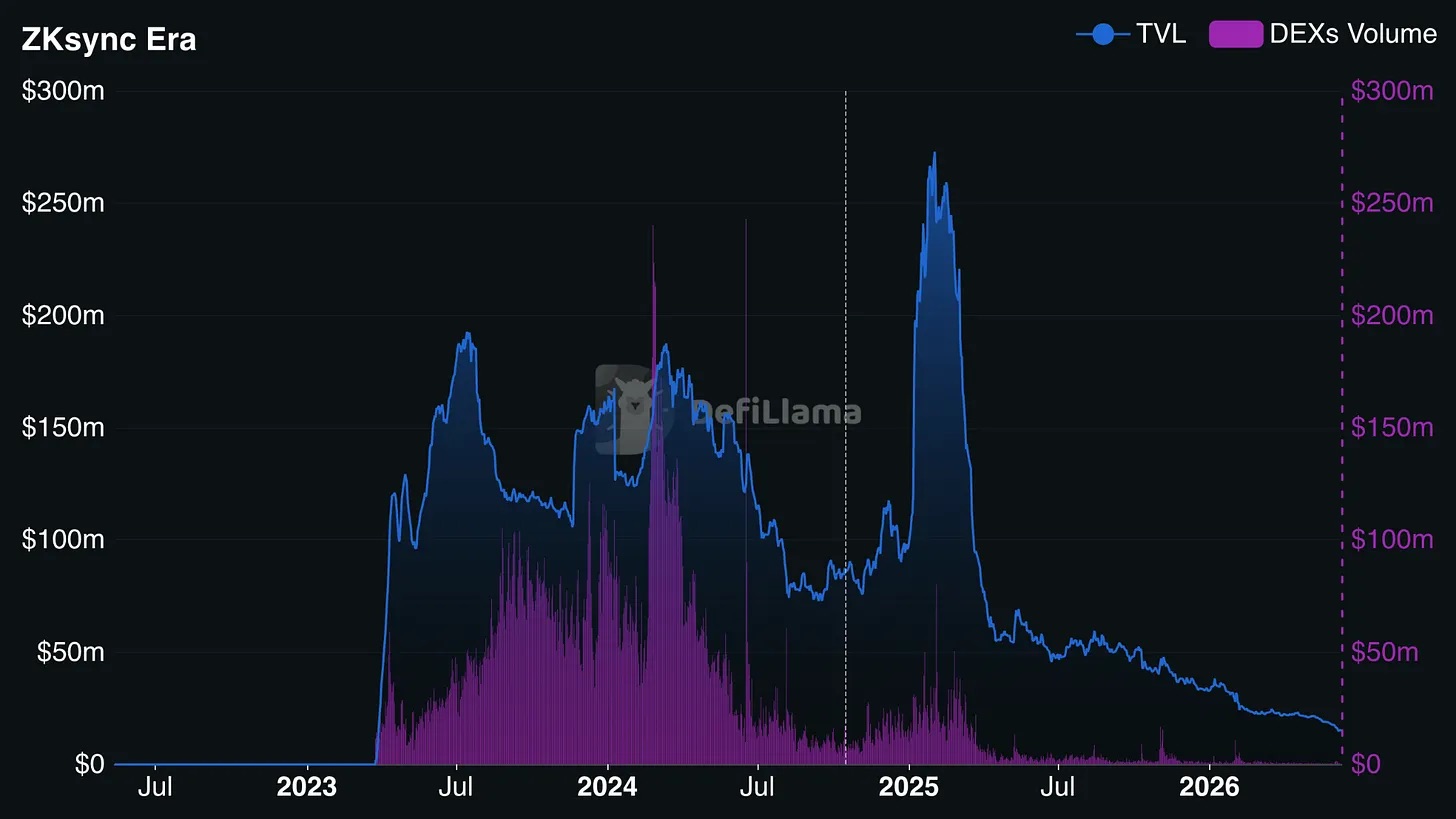

After launching in 2023, ZKsync Era's on-chain TVL (blue line) and DEX volume (purple bars) peaked in early 2025 before sharply and continuously declining, with retail DeFi activity becoming extremely low by 2026. Source: @defillama.com


If the retail ecosystem continues to wither, the chain's entire development will bet solely on the institutional business line. Is a Layer 2 network a retail crypto playground gradually infiltrated by banks, or merely an enterprise financial rail settled on Ethereum? The answer will determine ZKsync's ultimate fate.


Earlier this year, Matter Labs CEO Alex Gluchowski publicly revealed a roadmap clearly refocusing the project on building heavy-duty financial infrastructure for traditional markets.


Product evolution confirms this: the team first launched Prividium, creating segregated environments for banks with non-leaking transaction data; then launched the Bank Stack suite, partnering with institutions like Cari Network to onboard regional banks managing hundreds of billions in traditional deposits. So Aave's departure wasn't a surprise to the development team.


As for Cari Network's rollout plan: led by former US Office of the Comptroller of the Currency officials, it plans to pilot with five regional banks next quarter, which collectively hold over $600 billion in deposits.


If this pilot succeeds, the transaction volume gap left by departing retail DeFi apps will be completely filled by banks' massive flows; but if it fails, ZKsync will become an technologically advanced yet experimental tool with no real mainstream users, hosting only a handful of corporate pilot projects.


The v31 protocol upgrade, passed via ZKsync governance forum vote, officially went live in early May.


ZKsync's official X account posted a reminder: this protocol upgrade was submitted to the governance forum for review. The v31 upgrade includes several core updates, using the ZK token as a universal pricing unit to enable native interoperability across all ZK-based scaling chains.


Key announcement points: This ZKsync Improvement Proposal (ZIP-16) was submitted for forum vote:


  • ZKsync Interoperability Protocol: Enables native cross-chain interaction for all ZK-based scaling chains;
  • Phase 1 supports scaling chains that can settle on Ethereum Layer 1;
  • Expands ZKsync OS compatibility.


Under v31 rules, each cross-chain call between different ZK chains costs a flat fee of 10 ZK tokens, a rate set by DAO vote. Banks already constantly deal with variable costs—like blockchain gas fees, cloud computing costs, foreign exchange spreads—so such fluctuating costs are a normal part of business.


Not just the fee rate, but the entire fee mechanism can be rewritten via the same governance forum, with no obligation for the project to pre-notify institutional partners on the chain.


The ZK Nation governance forum is already discussing next-stage adjustments, currently debating node operator transaction fees, staking rules, and customized pricing for zero-knowledge proof verification. Any topic could trigger a community vote, altering the cost model for all cross-chain operations of institutions like Deutsche Bank and Tradable. All discussions are publicly viewable at forum.zknation.io.


In contrast: JPMorgan's Kinexys system permissions are entirely in its own hands; R3 Corda's rule changes also have formal contracts specifying amendment conditions and processes.


So why would banks choose ZKsync over JPMorgan's private chain? Because ZKsync can provide publicly verifiable proof of transaction validity without leaking private data.


If JPMorgan shuts down its blockchain business tomorrow, all on-chain assets would be frozen; even if Matter Labs, the development company behind ZKsync, goes bankrupt, the network can still run because all assets are ultimately anchored to Ethereum for settlement. But the price for this underlying security is accepting the network belongs to no single entity. An ownerless network's governance belongs to all participating token holders who vote.


The ZK token currently trades around $0.01, having hit an all-time high of $0.3285 in June 2024, a 96% drop from its peak. At a 10 ZK token cross-chain fee, a transaction cost about $3.28 at the bull market peak, now just $0.10. Token price volatility can be managed through hedging, but a community-voted mechanism that can change rules at any time makes long-term, stable budgeting difficult for corporate financial planning.


Layer 2 rating agency L2Beat classifies ZKsync Era as a Stage 0 network: an independent security council can bypass the full DAO voting process to directly pause or modify smart contracts. Mature Stage 1 Layer 2 networks like Arbitrum lack such centralized intervention powers. Enterprise risk managers often favor emergency kill switches to mitigate losses from smart contract bugs; but this control resides with a Web3 security council, completely outside traditional corporate management structures.


Sygnum tokenized $50 million of Matter Labs' corporate treasury assets on ZKsync, connecting to a Fidelity liquidity fund; subsequently, Fidelity also launched an institutional money market fund on the network. The development team injected initial transaction volume by deploying its own capital, creating core enterprise use cases. This asset flow operates smoothly, but the entire business setup directly serves the project's founding team.


The core infrastructure remains subject to an independent security council holding the highest system permissions. In emergencies, the council can bypass normal delay processes entirely, modifying smart contract parameters or freezing functions without prior notice. Actual network control is split between the security council and the active token governance community, meaning partnering banks must operate within a continuously dynamic governance system, not a fixed corporate cooperation agreement.


ZKsync is betting its entire existence on a group that has never led crypto project development—licensed traditional financial institutions. Banks don't care about token prices, nor will they participate in governance forum votes.


But once a bank chooses a core infrastructure to build its business on, it often becomes deeply embedded and difficult to migrate. This adoption path has higher initial barriers, but once established, it's hard to replace.


ZKsync will either become the first crypto project to achieve this, or serve as an expensive case study proving banks ultimately choose to build their own blockchains, then abandon external public chain solutions. The market will deliver its verdict within the next 18 months.


In crypto, many projects boast strong technology but falter on governance mechanisms and long-term sustainability, eventually fading away. ZKsync's grand experiment in governance models is still ongoing.


Domande pertinenti

QWhat major strategic shift has ZKsync made to address the decline in its retail user and DeFi ecosystem?

AZKsync has pivoted its strategic focus towards building heavyweight financial infrastructure for traditional institutions, particularly banks, moving away from competing directly in the retail-focused DeFi arena.

QWhat are the key features and advantages of ZKsync's 'Prividium' suite that appeal to banks like Deutsche Bank?

APrividium offers features like private, permissioned Layer 2 networks, confidential transactions, tiered access control, built-in compliance tools, and settlement on Ethereum. Its key advantage is enabling zero-knowledge proofs that allow transaction verification without exposing sensitive data, fitting perfectly with banking confidentiality and regulatory requirements.

QAccording to the article, what is the core dilemma or challenge ZKsync faces in its new institutional-focused strategy?

AZKsync faces a core governance dilemma: its network is governed by a decentralized community of token holders (ZK Nation) and a Security Council, which can dynamically change rules and fees via voting. This introduces significant uncertainty for institutional clients like banks, who are used to stable, contractually-bound agreements and have no control over or interest in participating in crypto governance processes.

QHow does the article contrast ZKsync's approach with that of its competitors like J.P. Morgan's Kinexys and the R3 Corda consortium?

AJ.P. Morgan's Kinexys is a fully private, internally controlled network offering maximum control but suffering from low internal adoption. R3 Corda is a consortium where rules are set by contract among members before launch. ZKsync differs by offering public verifiability via Ethereum settlement without data exposure, providing independence from any single entity, but at the cost of being subject to unpredictable decentralized governance.

QWhat is the significance of the upcoming pilot with Cari Network and regional banks for ZKsync's future, as described in the article?

AThe pilot with Cari Network, involving five regional banks managing over $600 billion in deposits, is a critical test. Its success could flood ZKsync with massive institutional transaction volume, filling the gap left by departed retail DeFi. Its failure, however, could relegate ZKsync to a niche experimental tool with only minor corporate pilots, jeopardizing its entire institutional-focused strategy.

Letture associate

The Trillion-Yuan Market Cap 'Yi Zhong Tian': Who is the True Value King?

The article analyzes the three leading Chinese optical module companies, collectively nicknamed "Yi Zhong Tian": Xinyisheng, Zhongji Innolight, and TFC Optical Communication. It evaluates their "cost-performance" not by current stock price, but through three lenses: PEG ratio (growth vs. valuation), earnings quality, and premium/discount for certainty. Xinyisheng shows the most attractive PEG ratio and high profitability, but its valuation reflects discounts for risks like high customer concentration and reliance on overseas markets. Zhongji Innolight, the most expensive, commands a premium for its market leadership, dominant share in key products like 800G/1.6T modules, and higher earnings certainty, though it faces geopolitical risks. TFC Optical, as an upstream component supplier ("water seller"), has the highest gross margin and bets on the long-term CPO/NPO architecture trend, but trades at a high valuation with more stable, less explosive growth. The core argument is that while these companies dominate module assembly, the true profit pool and technological moat lie upstream in laser and switch chips, currently controlled by U.S. firms like Lumentum and Coherent. The long-term "cost-performance" for these Chinese leaders hinges on whether the domestic industry, exemplified by companies like Yuanjie Technology, can successfully move up the value chain into high-power laser chips. Otherwise, their high growth may remain confined to the lower-margin assembly segment.

marsbit10 min fa

The Trillion-Yuan Market Cap 'Yi Zhong Tian': Who is the True Value King?

marsbit10 min fa

Has the Crypto Market Bottomed? Here's What Institutions Think

The crypto market is in a period of significant debate, with leading institutions offering differing views on whether a bottom has been reached. Three prominent firms have published detailed analyses: * **Galaxy Digital** argues Bitcoin has **not yet bottomed**. Their analysis of 13 historical indicators across six dimensions (valuation, profit-taking, miner pressure, etc.) shows only four are fully met. They project a potential bottom range between $30k and $54k. * **NYDIG** states a bottom is **possible but not likely**. While metrics are close to historic bear market extremes, they note the absence of a classic panic-selling event. They also suggest increased institutional adoption may have structurally altered the market cycle, potentially leading to a shallower downturn. * **Standard Chartered Bank** asserts the **bottom has already occurred** at around $59k. They cite two key factors: potential US-Iran diplomatic progress and the anticipated SpaceX IPO, which they believe absorbed capital and caused ETF selling pressure that is now subsiding. They forecast a year-end price target of $100k. Despite the surface-level disagreement, the reports share critical common ground more valuable for long-term investors: 1. All three believe the market bottom will form **within this year**. 2. All agree the current price is **closer to the bottom than to previous highs**. 3. All maintain a **bullish long-term outlook** for Bitcoin and a new cycle. The core takeaway is that while the exact bottom price ($40k, $50k, or $60k) is debated, the consensus is that a bottom is imminent. For long-term holders, the primary focus should not be pinpointing the absolute low, but on the future potential for prices to reach $100k, $200k, or higher. The fundamental thesis for Bitcoin—sovereign debt accumulation, inflation, declining trust in centralized institutions, global digitization, and improved accessibility—remains intact and is arguably strengthening. The overall landscape is viewed as more favorable than in previous crypto winters.

marsbit20 min fa

Has the Crypto Market Bottomed? Here's What Institutions Think

marsbit20 min fa

The 'Chip' Challenge and Breakthroughs in China's Optical Industry Chain

China's Photonics Industry: Bottlenecks and Breakthroughs In the global AI race, computing chips dominate the narrative, but the underlying bottleneck increasingly defining the scale of AI clusters is light—or more specifically, optical connectivity. Optical modules, which translate electrical signals to light and vice versa, are crucial for connecting thousands of GPUs in AI data centers, preventing data congestion and ensuring efficient model training. High-speed modules (800G, 1.6T) are now standard, with performance hinging on advanced DSP (Digital Signal Processor) chips. This is where a critical dependency lies. Two US giants—Marvell and Broadcom—collectively dominate over 90% of the high-end DSP chip market. Chinese optical module leaders like Zhongji Innolight and Eoptolink rely on these chips to manufacture modules for overseas AI customers, primarily in North America. While this creates a supply chain vulnerability, complete decoupling is difficult. Marvell derives over half its revenue from Greater China, and the US firms depend on Chinese partners for chip packaging and optical components. The risk from laser chips (e.g., from Lumentum), another key component, is considered more manageable due to multiple global suppliers and faster progress in domestic alternatives from companies like YOFC and Accelink. To mitigate risks, China's industry is pursuing a multi-pronged strategy: diversifying supply chains and locking in long-term orders; fostering a domestic market ecosystem to adopt homegrown DSPs from firms like Huawei HiSilicon and CETC; accelerating R&D in high-speed DSPs and advanced packaging; and investing in next-gen technologies like silicon photonics and Co-Packaged Optics (CPO) to reduce reliance on discrete DSPs. The ultimate solution lies not in short-term博弈 but in persistent advancement of domestic high-end chip R&D and manufacturing. While challenges remain in performance, certification, and ecosystem building, China's vast domestic market and manufacturing base provide a crucial buffer, buying time for the industry to achieve greater technological independence.

marsbit34 min fa

The 'Chip' Challenge and Breakthroughs in China's Optical Industry Chain

marsbit34 min fa

Behind SpaceX's $2 Trillion Market Cap: Why Does Musk Always Have the Next Move Planned?

On June 12th, SpaceX debuted on the Nasdaq, reaching a valuation that briefly touched $2 trillion. This marked the culmination of a 24-year journey from its founding in 2002, driven by Elon Musk's frustration at the high cost of buying rockets. The company's path was defined by early failures, with its first three Falcon 1 launches ending in explosions before a successful 2008 flight opened the era of commercial spaceflight. Key to its model was a fixed-price NASA contract, incentivizing cost reduction. SpaceX mastered rocket reusability, first achieving a Falcon 9 landing in 2015, which drastically cut launch costs. This enabled its profitable Starlink satellite internet constellation, envisioned years before reusability was proven, to create an internal market for frequent launches. Similarly, the next-generation Starship rocket was in development long before its first flight, with its business case evolving from Mars colonization to supporting the emerging concept of in-orbit data centers for AI—a story now central to its valuation. The company's recent IPO, a reversal of its long-standing "no IPO" stance, is funding this ambitious "space-based compute" vision. While major tech players like Google, Blue Origin, and others are investing heavily, significant technical and cost hurdles remain. Ultimately, SpaceX's history is one of creating its own demand: first with Starlink and now with space-based AI compute, betting that its next rocket will enable its next giant market.

marsbit37 min fa

Behind SpaceX's $2 Trillion Market Cap: Why Does Musk Always Have the Next Move Planned?

marsbit37 min fa

Trading

Spot
Futures

Articoli Popolari

Cosa è $BANK

Banca AI: Un Passo Rivoluzionario nel Futuro della Banca Introduzione In un'era caratterizzata da rapidi progressi tecnologici, Banca AI si trova all'incrocio tra intelligenza artificiale (AI) e servizi bancari. Questo progetto innovativo mira a ridefinire il panorama finanziario, migliorando l'efficienza operativa, le misure di sicurezza e le esperienze dei clienti attraverso il potere dell'AI. Mentre ci impegniamo in questa esplorazione di Banca AI, esamineremo cosa comporta il progetto, le sue dinamiche operative, il suo contesto storico e i traguardi significativi. Cos'è Banca AI? Alla sua essenza, Banca AI rappresenta un'iniziativa trasformativa volta a integrare l'intelligenza artificiale in varie operazioni bancarie. Questo progetto sfrutta le capacità dell'AI per automatizzare processi, migliorare i protocolli di gestione del rischio e potenziare l'interazione con i clienti attraverso servizi personalizzati. Gli obiettivi principali di Banca AI includono: Automazione delle Funzioni Bancarie: Sfruttando le tecnologie AI, Banca AI mira ad automatizzare compiti di routine, riducendo il carico sulle risorse umane e aumentando l'efficienza. Miglioramento della Gestione del Rischio: Il progetto utilizza algoritmi AI per prevedere e identificare i rischi, rafforzando così le misure di sicurezza contro le frodi e altre minacce. Personalizzazione dei Servizi Bancari: Banca AI si concentra sull'offrire prodotti e servizi finanziari su misura analizzando i dati e i comportamenti dei clienti. Miglioramento dell'Esperienza del Cliente: L'implementazione di soluzioni guidate dall'AI, come chatbot e assistenti virtuali, mira a fornire agli utenti interazioni più umane, rivoluzionando il modo in cui i clienti si relazionano con le banche. Con questi obiettivi, Banca AI si posiziona come un attore cruciale nel rendere la banca più efficiente, sicura e centrata sull'utente. Chi è il Creatore di Banca AI? I dettagli riguardanti il creatore di Banca AI rimangono sconosciuti. Pertanto, non è stata identificata alcuna persona o organizzazione specifica nelle informazioni disponibili. L'anonimato che circonda la nascita del progetto solleva domande, ma non sminuisce la sua ambiziosa visione e obiettivi. Chi sono gli Investitori di Banca AI? Simile al creatore del progetto, informazioni specifiche riguardo gli investitori o le organizzazioni di supporto di Banca AI non sono state divulgate. Senza queste informazioni, è difficile delineare il sostegno finanziario e istituzionale che potrebbe spingere il progetto in avanti. Tuttavia, l'importanza di avere una solida base di investimento è fondamentale per sostenere lo sviluppo in un campo così innovativo. Come Funziona Banca AI? Banca AI opera su più fronti innovativi, concentrandosi su fattori unici che la differenziano dai framework bancari tradizionali. Di seguito sono riportate le caratteristiche operative chiave: Automazione: Applicando algoritmi di machine learning, Banca AI automatizza vari processi manuali all'interno delle banche. Ciò si traduce in una riduzione dei costi operativi e consente ai lavoratori umani di reindirizzare i propri sforzi verso attività più strategiche. Gestione Avanzata del Rischio: L'integrazione dell'AI nelle pratiche di gestione del rischio fornisce alle banche strumenti per prevedere con precisione potenziali minacce come le frodi, garantendo che le informazioni e i beni dei clienti rimangano al sicuro. Raccomandazioni Finanziarie Personalizzate: Attraverso l'apprendimento continuo dalle interazioni con i clienti, i sistemi AI sviluppano una comprensione sfumata delle esigenze degli utenti, consentendo loro di offrire consigli su misura per le decisioni finanziarie. Interazioni Migliorate con i Clienti: Utilizzando chatbot e assistenti virtuali alimentati dall'AI, Banca AI consente un'esperienza cliente più coinvolgente, permettendo agli utenti di risolvere rapidamente le loro richieste, riducendo così i tempi di attesa e migliorando i livelli di soddisfazione. Tutte queste caratteristiche operative posizionano Banca AI come un pioniere nel settore bancario, stabilendo nuovi standard per la fornitura di servizi e l'eccellenza operativa. Timeline di Banca AI Comprendere la traiettoria di Banca AI richiede uno sguardo al suo contesto storico. Di seguito è riportata una timeline che evidenzia traguardi e sviluppi importanti: Inizio 2010: La concettualizzazione dell'integrazione dell'AI nei servizi bancari ha cominciato a guadagnare attenzione mentre le istituzioni bancarie riconoscevano i potenziali benefici. 2018: Si è verificato un aumento significativo nell'implementazione delle tecnologie AI quando le banche hanno iniziato a utilizzare strumenti AI come i chatbot per servizi clienti di base e sistemi di gestione del rischio per migliorare la sicurezza. 2023: La sofisticazione dell'AI ha continuato ad avanzare, con l'introduzione dell'AI generativa per compiti più complessi come l'elaborazione di documenti e l'analisi degli investimenti in tempo reale. Quest'anno ha segnato un significativo salto nelle capacità offerte alle banche dalla tecnologia AI. 2024-Stato Attuale: A partire da quest'anno, Banca AI è su una traiettoria ascendente, con ricerche e sviluppi in corso pronti a migliorare ulteriormente le capacità nelle operazioni bancarie. L'esplorazione continua delle applicazioni AI suggerisce sviluppi entusiasmanti in arrivo. Punti Chiave su Banca AI Integrazione dell'AI nella Banca: Banca AI si concentra sull'adozione dell'intelligenza artificiale per snellire i processi bancari e migliorare le esperienze degli utenti. Focus su Automazione e Gestione del Rischio: Il progetto enfatizza fortemente queste aree, mirando a spostare il carico di compiti di routine mentre migliora le strutture di sicurezza attraverso analisi predittive. Soluzioni Bancarie Personalizzate: Sfruttando i dati dei clienti, Banca AI consente servizi bancari su misura che si adattano alle esigenze individuali degli utenti. Impegno per lo Sviluppo: Banca AI rimane impegnata in sforzi di ricerca e sviluppo continuativi, garantendo la sua adattabilità e rilevanza continua man mano che la tecnologia continua a evolversi. Conclusione In sintesi, Banca AI rappresenta un passo cruciale in avanti nell'industria bancaria, sfruttando l'intelligenza artificiale per rimodellare i paradigmi operativi, migliorare la sicurezza e promuovere la soddisfazione del cliente. Nonostante le lacune nelle informazioni riguardo il creatore e gli investitori, gli obiettivi chiari e i meccanismi funzionali di Banca AI forniscono una solida base per la sua continua evoluzione. Mentre la tecnologia AI continua ad avanzare e fondersi con il settore bancario, Banca AI è ben posizionata per avere un impatto significativo sul futuro dei servizi finanziari, migliorando il modo in cui comprendiamo e interagiamo con la banca.

108 Totale visualizzazioniPubblicato il 2024.04.06Aggiornato il 2024.12.03

Cosa è $BANK

Come comprare BANK

Benvenuto in HTX.com! Abbiamo reso l'acquisto di Lorenzo Protocol (BANK) semplice e conveniente. Segui la nostra guida passo passo per intraprendere il tuo viaggio nel mondo delle criptovalute.Step 1: Crea il tuo Account HTXUsa la tua email o numero di telefono per registrarti il tuo account gratuito su HTX. Vivi un'esperienza facile e sblocca tutte le funzionalità,Crea il mio accountStep 2: Vai in Acquista crypto e seleziona il tuo metodo di pagamentoCarta di credito/debito: utilizza la tua Visa o Mastercard per acquistare immediatamente Lorenzo ProtocolBANK.Bilancio: Usa i fondi dal bilancio del tuo account HTX per fare trading senza problemi.Terze parti: abbiamo aggiunto metodi di pagamento molto utilizzati come Google Pay e Apple Pay per maggiore comodità.P2P: Fai trading direttamente con altri utenti HTX.Over-the-Counter (OTC): Offriamo servizi su misura e tassi di cambio competitivi per i trader.Step 3: Conserva Lorenzo Protocol (BANK)Dopo aver acquistato Lorenzo Protocol (BANK), conserva nel tuo account HTX. In alternativa, puoi inviare tramite trasferimento blockchain o scambiare per altre criptovalute.Step 4: Scambia Lorenzo Protocol (BANK)Scambia facilmente Lorenzo Protocol (BANK) nel mercato spot di HTX. Accedi al tuo account, seleziona la tua coppia di trading, esegui le tue operazioni e monitora in tempo reale. Offriamo un'esperienza user-friendly sia per chi ha appena iniziato che per i trader più esperti.

689 Totale visualizzazioniPubblicato il 2025.05.09Aggiornato il 2026.06.02

Come comprare BANK

Discussioni

Benvenuto nella Community HTX. Qui puoi rimanere informato sugli ultimi sviluppi della piattaforma e accedere ad approfondimenti esperti sul mercato. Le opinioni degli utenti sul prezzo di BANK BANK sono presentate come di seguito.

活动图片