Broadcom vs AMD: Which is the Most Promising AI Chip Stock to Bet on After Nvidia?

marsbitPubblicato 2026-06-09Pubblicato ultima volta 2026-06-09

Introduzione

Amidst Nvidia's dominance in the AI chip market, Broadcom and AMD are key contenders for the second-place spot. AMD competes directly in general-purpose GPUs, gaining some traction with clients like Meta but facing significant challenges overcoming Nvidia's entrenched CUDA software ecosystem. In contrast, Broadcom pursues a differentiated strategy by designing custom XPU chips tailored to specific AI workloads for major clients like Anthropic, Google, Meta, and OpenAI. This approach offers efficiency advantages and greater customer stickiness, particularly as AI compute shifts from training to inference. Despite a recent stock sell-off following a Q2 revenue guidance miss, Broadcom's CEO reaffirmed the long-term target of $100 billion in annual AI chip revenue by fiscal 2027. With Q2 AI revenue at $10.8 billion, significant growth potential remains as its custom chip projects ramp up. While Broadcom trades at a higher valuation multiple than AMD, analysts argue this premium is justified given its superior competitive positioning and expected faster growth trajectory, making it the more compelling investment choice following its recent pullback.

Author: Justin Pope

Compiled by: Tide Research

Introduction: Beyond Nvidia, the battle for the runner-up position in AI chips is heating up. AMD has chosen to directly challenge Nvidia's general-purpose GPU path, while Broadcom takes a differentiated approach with custom chips (XPU), securing top clients like Anthropic, Google, Meta, and OpenAI.

Following the latest earnings report, Broadcom's stock price fell sharply, but the CEO still maintains the target of reaching $100 billion in annual AI chip revenue by fiscal year 2027. Motley Fool analyst Justin Pope believes that even though Broadcom is more expensive, this premium is worth paying.

Caption: Source Getty Images

Nvidia still firmly holds the top spot in the AI data center chip market. But the AI pie is simply too large, making the runner-up position equally valuable. According to Statista estimates, the AI chip market will grow to $333 billion by 2030.

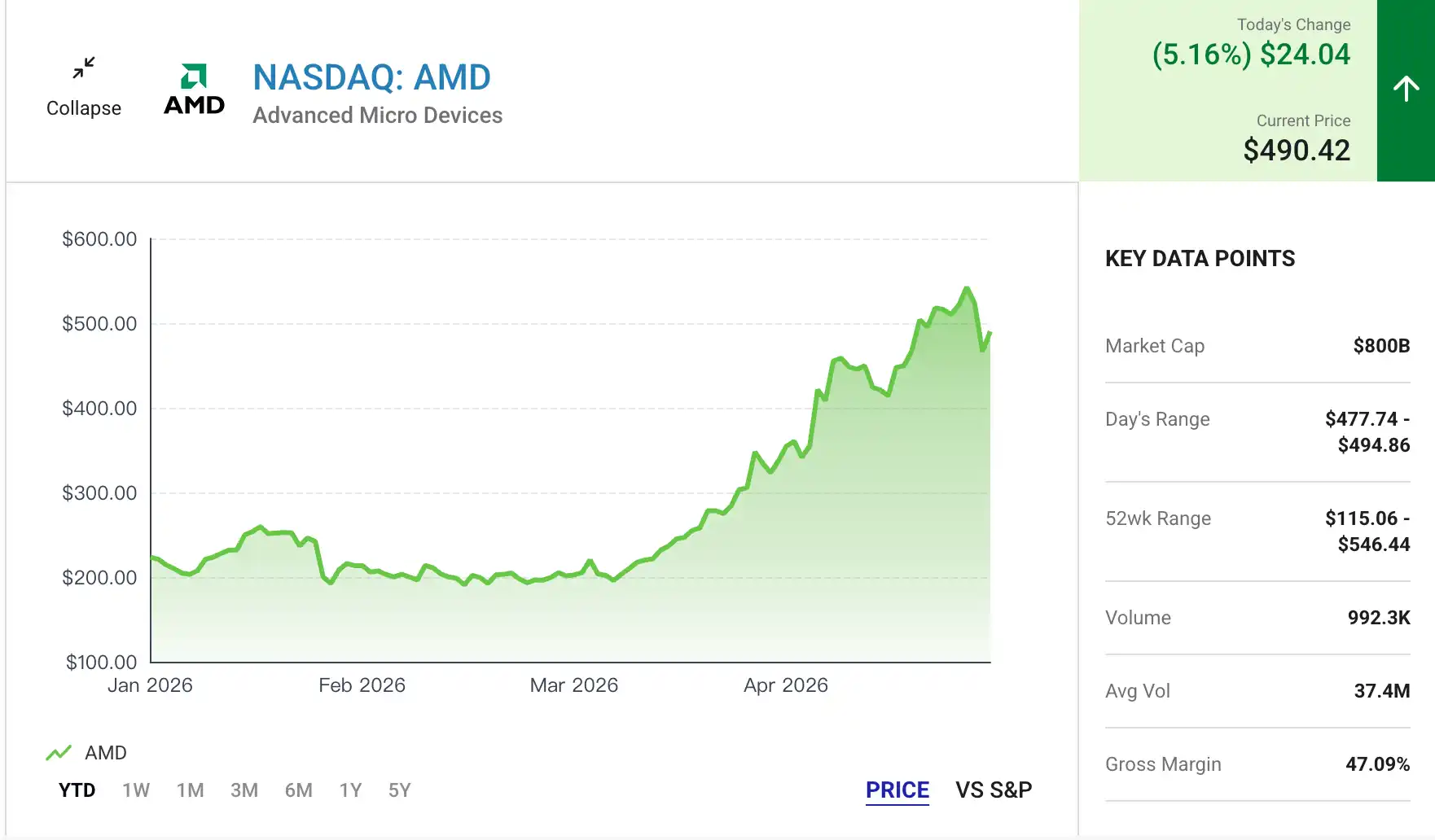
This means other companies also have the opportunity to make investors a lot of money. Broadcom (AVGO, down 7.49% on the day) and AMD (down 11.01% on the day) are the two most competitive candidates. Both companies have made progress in the AI chip field, but overall, one is clearly more worthy of holding than the other.

AMD Chose a More Difficult Path

The core question is: How can a smaller company compete for market share with an industry giant?

AMD's strategy is to compete head-on with Nvidia in the field of general-purpose AI chips. To be fair, it has indeed achieved some results. Q1 2026 data center revenue grew 57% year-over-year to $5.8 billion.

AMD benefits from AI hyperscalers' natural desire not to put all their eggs in Nvidia's basket. AMD recently announced it will supply Meta with 6 GW of Instinct GPUs, with the first GW being a custom version.

But AMD is unlikely to truly threaten Nvidia's dominance. Meta and other Nvidia customers are deeply entrenched in Nvidia's CUDA software ecosystem. The moat of CUDA cannot be crossed by hardware specifications alone.
Broadcom's Custom Chip Path is the Winner

To breach Nvidia's moat, one must take a different path. Broadcom has achieved this with its XPU chips.

Unlike AMD, which emphasizes general-purpose AI chips, Broadcom tailors chips to each customer's specific AI workloads. This approach brings efficiency advantages and makes customer relationships stickier. Currently, Broadcom is designing custom chips for companies like Anthropic, Alphabet (Google's parent company), Meta, and OpenAI.

As computing demand shifts from training to inference, efficiency becomes even more critical, further amplifying the advantages of custom chips.

Following the latest Q2 earnings report, Wall Street heavily sold off Broadcom, mainly due to Q3 AI revenue guidance falling short of expectations. But CEO Hock Tan reiterated on the earnings call that the company's long-term expectation of reaching $100 billion in annual AI chip sales by fiscal 2027 remains unchanged. Q2 AI revenue was $10.8 billion, and there is still significant growth potential as custom chip projects ramp up.

You Get What You Pay For

With a roster of top-tier AI clients and steady progress toward the $100 billion annual revenue target, Broadcom indeed has a stronger competitive position than AMD. Investors may note that Broadcom's stock is more expensive than AMD's, but this premium is justified.
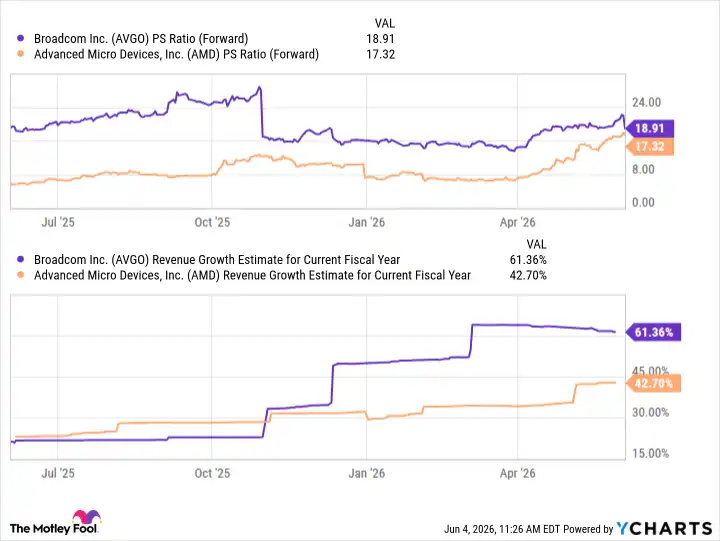
Caption: AVGO vs AMD Forward Price-to-Sales Ratio Comparison, Source YCharts

Analysts expect Broadcom's growth to be significantly faster than AMD's, and the valuation gap between the two is not that large. Especially after the pullback following the earnings report, Broadcom is more worthy of a buy.
Domande pertinenti

QAccording to the article, what are the main differences between AMD's and Broadcom's strategies in the AI chip market?

AAMD is taking a generalist approach, competing directly with Nvidia in the market for general-purpose AI GPUs. In contrast, Broadcom follows a differentiated, custom chip (XPU) strategy, designing chips tailored to the specific AI workloads of individual clients like Anthropic, Google, Meta, and OpenAI.

QWhat reason does the analyst give for Broadcom's stock being more expensive (having a valuation premium) compared to AMD's?

AThe analyst argues that Broadcom's premium valuation is justified because it holds a superior competitive position with a roster of top-tier AI clients and is projected to grow significantly faster than AMD, as it progresses toward its long-term AI revenue target of $100 billion annually by fiscal 2027.

QWhat was the market reaction and the CEO's response following Broadcom's latest quarterly earnings report?

AFollowing its Q2 earnings report, Broadcom's stock fell sharply due to a Q3 AI revenue forecast that fell short of expectations. However, CEO Hock Tan reaffirmed the company's long-term target of achieving $100 billion in annual AI chip sales by fiscal 2027.

QWhat is identified as a key competitive barrier that makes it difficult for AMD to challenge Nvidia's dominance?

AThe article identifies Nvidia's CUDA software ecosystem as a key competitive barrier or 'moat.' Major clients like Meta are deeply entrenched in this ecosystem, making it very difficult for competitors like AMD to overcome through hardware specifications alone.

QWhy might Broadcom's custom chip (XPU) strategy become even more advantageous in the future, according to the article?

AThe article suggests that as the focus of computing demand shifts from AI training to inference, efficiency becomes more critical. Broadcom's custom chips, which are optimized for specific client workloads, offer efficiency advantages that will likely become even more valuable in this evolving market landscape.

Letture associate

Xpeng and NIO Compete on Computing Power, Li Auto Shifts Architecture

On June 15, 2026, Li Auto unveiled details of its self-developed chip, Mahe M100, for its new L9 Livis model. CTO Xie Yan stated the goal was not just a faster chip, but a fundamentally different one, targeting the chip architecture itself. While competitors like NIO, Xpeng, and Huawei highlight TOPS (computing power) figures for their self-developed chips, Li Auto’s Mahe M100 focuses on redesigning the underlying architecture. It employs a "dynamic data flow architecture" to address memory bandwidth bottlenecks in large model inference, claiming up to 3x the effective computing power of Nvidia's Thor U for its specific workloads and a 40% reduction in latency. The chip's design was peer-reviewed and accepted at ISCA 2026. However, this performance is highly optimized for Li Auto's own VLA2.1 algorithm, meaning it may not generalize as well to other tasks. Li Auto aims to achieve full-stack in-house development with Mahe M100, covering chip, compiler, OS, AI algorithms, and domain controller—a level of vertical integration few competitors match. Beyond the chip, CEO Li Xiang introduced a new strategic narrative: the "embodied intelligent vehicle," defined as an integration of an EV, a professional driver, an AI computer, and a life assistant. This shifts competition from features like large screens to systemic AI capabilities. A key commitment was that Li Auto's Mahe VLA autonomous driving model will match Tesla's FSD V14 by Q4 2026, with specific OTA milestones set for July, September, and December. Financially, Li Auto faces pressure with declining revenue and vehicle gross margins since Q4 2025, while maintaining high R&D investment (approx. ¥12B in 2026, 50% AI-related). Its 2026 sales target is 550,000 vehicles, up from 406,000 in 2025. The new L9 Livis garnered over 10,000 pre-orders in two weeks. The effectiveness of these strategic moves—new products, OTAs, and the novel chip architecture—will begin to show in Q3 2026 financial results, with the year-end FSD V14 benchmark being the ultimate test.

marsbit50 min fa

Xpeng and NIO Compete on Computing Power, Li Auto Shifts Architecture

marsbit50 min fa

The Year of AI Applications: Saying 'Yes' While Ignoring Risks? A Comprehensive Open Source Log of Software Development's Journey

The Year of AI Applications: Blindly Saying "Yes" While Ignoring Risks? A Software Development Log Goes Fully Open Source. AI-generated code harbors risks hidden within seemingly correct programs, potentially leading to data leaks or asset loss. The open-source project "Narwhal AI Code Risks," from Peking University's Narwhal-Lab, compiles real-world cases, early warning signs, and typical risk pathways. Its goal is to help developers identify potential hazards early and avoid repeating past mistakes. In 2026, code is generated faster than ever but deployed with less scrutiny. The danger often lies not in glaring errors, but in code that appears normal—syntactically correct, passing all checks—yet introduces subtle but critical flaws like non-existent dependencies, excessive permissions, or exposed databases. A stark example is the Moonwell cbETH oracle incident. A configuration file error, where a cryptocurrency price was set to ~$1.12 instead of ~$2,200, slipped through 28 checks and a pull request signed by both AI (Claude, Copilot) and human developers. This "semantic deviation" resulted in a loss of $1.78 million. The risk is that AI can produce functionally valid code that is semantically wrong for the business context. As AI moves beyond simple code completion to modifying configurations, installing dependencies, and operating via autonomous agents, it traverses longer, less traceable paths within software engineering, blurring traditional boundaries and oversight points. The Narwhal AI Code Risks project structures information into three layers: `/cases` for documented real-world incidents, `/inferred` for early warning signals, and `/scenarios` for clear, generalized risk patterns not yet tied to specific events. This aims to create a lasting, public record to prevent collective amnesia about past AI-coding pitfalls. Risks are categorized into seven areas: Software Supply Chain (e.g., recommending fake packages), Code-Level Vulnerabilities (e.g., reintroducing path traversal bugs), Cloud & Infrastructure Misconfiguration (e.g., overly permissive settings), Agent Risks (from autonomous tool execution), Vertical Domain Risks (e.g., in finance, healthcare), Intellectual Property & Compliance issues, and Human Factors (like over-reliance on AI output). The project's core value is transforming isolated incidents into reusable knowledge—a foundational resource for developers to spot similar issues, for security researchers to build upon, for toolmakers to create detection rules, and for the community to contribute new findings. As AI integration accelerates, this open-source "logbook" serves as a crucial navigational aid, charting past errors to help future projects steer clear of the same traps.

marsbit51 min fa

The Year of AI Applications: Saying 'Yes' While Ignoring Risks? A Comprehensive Open Source Log of Software Development's Journey

marsbit51 min fa

The Foundation of SpaceX's Trillion-Dollar Valuation: Who is Dividing Up Musk's Annual Tens of Billions in Capital Expenditure?

SpaceX's trillion-dollar valuation is built on its three core businesses: Starlink (profitable, 60% of revenue), rockets (driving down launch costs), and AI (a major investment area). This creates a financial cycle: Starlink funds rocket development, which enables low-cost launches for AI hardware, generating future revenue. This cycle fuels annual capital expenditures of tens of billions, flowing to a vast supply chain. Suppliers are categorized by their replaceability. The first group includes irreplaceable players like NVIDIA (GPU/CUDA ecosystem), Eutelsat (critical radio spectrum), Filtronic (specialized amplifiers), Materion (strategic beryllium), and STMicroelectronics (antenna chips). The second group consists of hard-to-replace suppliers due to high switching costs, such as Honeywell (flight control), Carpenter Technology (specialty alloys), Hexcel (carbon fiber), Broadcom (data exchange), and Linde (industrial gases). The third group comprises high-volume, cost-critical suppliers for mass-produced items like Starlink terminals. Key names include Wistron NeWeb (primary manufacturer) and several A-share companies like Shenzhen Sunway (connectors), Pies New Materials (forgings), Western Superconducting (alloys), and Yingliu (castings). Other niche players include Trimble (timing), Astronics (power distribution), and CTS (thermal management). The article argues that investing in these suppliers, rather than SpaceX stock directly, offers an alternative opportunity. The rationale is threefold: procurement is just beginning to scale, SpaceX's IPO brings new transparency to its supply chain, and the situation mirrors early stages of past "super terminal" ecosystems like Apple or Tesla. While risks exist (commodity cycles, geopolitical factors, technology shifts), the core thesis is that SpaceX's massive, ongoing procurement will translate into reliable revenue for its key suppliers, regardless of its own stock price volatility.

marsbit1 h fa

The Foundation of SpaceX's Trillion-Dollar Valuation: Who is Dividing Up Musk's Annual Tens of Billions in Capital Expenditure?

marsbit1 h fa

SpaceX's Trillion-Dollar Valuation Base: Who's Sharing in Musk's Annual Tens of Billions in Capital Expenditure?

**Title: The Foundation of SpaceX's Trillion-Dollar Valuation: Who Benefits from Musk's Annual $100 Billion Capital Expenditure?** This article argues that investors seeking to benefit from SpaceX's growth might find greater opportunities in its supply chain rather than directly investing in the company itself, drawing parallels to historical successes with Apple, Tesla, and NVIDIA suppliers. **SpaceX's Business Model & Cash Flow:** SpaceX generates revenue from three main areas: 1. **Starlink:** Its profitable core, earning $11.3B in 2023 (60% of revenue), funding other ventures. 2. **Rockets (Falcon/Starship):** Requires $3B+ in annual R&D but achieves the world's lowest launch costs. 3. **AI:** Currently unprofitable (-$6B+ in 2023), investing heavily in ground-based supercomputers (220,000 GPUs) and future orbital data centers. The cycle is: Starlink profits → fund cheaper rockets → low-cost launches deploy AI hardware → AI compute rentals generate future revenue. This cycle drives annual procurement spending of tens of billions of dollars. **The Supply Chain Beneficiaries:** Suppliers are categorized by their replaceability: **1. Nearly Irreplaceable (High Barriers to Entry):** * **NVIDIA:** Powers the Colossus supercomputer; its CUDA ecosystem creates immense switching costs. * **Eutelsat (SATS):** Controls critical radio spectrum for satellite communications; holds a ~3% stake in SpaceX. * **Filtronic (FTC):** Supplies millimeter-wave signal amplifiers for Starlink satellites; SpaceX constitutes 83% of its revenue. * **Materion (MTRN):** Global leader in beryllium production, a strategic material used in Starship structures. * **STMicroelectronics (STM):** Supplies phased-array antenna chips for Starlink satellites. **2. Replaceable, but Switching Cost is Prohibitively High:** * **Honeywell (HON):** Provides flight control and inertial navigation systems with decades of certification. * **Carpenter Technology (CRS):** Manufactures ultra-pure specialty steel alloys for Raptor engines. * **Hexcel (HXL):** Supplies custom carbon fiber composites developed over a decade with SpaceX. * **Broadcom (AVGO):** Manages high-speed data switching. * **Linde Group:** Supplies industrial gases (liquid oxygen/nitrogen) from facilities built near SpaceX launch sites. **3. High-Volume, Cost-Critical Manufacturing:** Focuses on mass-producing components like Starlink user terminals (target: 30 million units). * **Key Players:** Wistron NeWeb (6285, primary terminal manufacturer), several Chinese A-share companies (e.g., Sunway Communication, PAX New Materials, Western Metal Materials, Yingliu Co.), and smaller US firms like Trimble (TRMB, timing systems). **Why Now?** Three factors make the supply chain opportunity timely: 1. **Volume Ramp-Up:** SpaceX plans 100 launches in 2026, aims for 30 million Starlink terminals, and will deploy AI data centers, meaning procurement will accelerate. 2. **Increased Transparency:** The IPO provides public financial data, allowing investors to track supplier order growth. 3. **Historical Precedent:** The current phase is likened to Tesla's early mass-production stage (circa 2018), suggesting a long growth runway for suppliers. **Conclusion:** The article posits that while investing in SpaceX stock is betting on Elon Musk's ambitious vision at a high valuation, investing in its established suppliers is a bet on the tangible, recurring revenue from its massive procurement budget, which is largely decoupled from day-to-day stock price volatility.

链捕手1 h fa

SpaceX's Trillion-Dollar Valuation Base: Who's Sharing in Musk's Annual Tens of Billions in Capital Expenditure?

链捕手1 h fa

Trading

Spot
Futures

Articoli Popolari

Come comprare CHIP

Benvenuto in HTX.com! Abbiamo reso l'acquisto di USD.AI (CHIP) semplice e conveniente. Segui la nostra guida passo passo per intraprendere il tuo viaggio nel mondo delle criptovalute.Step 1: Crea il tuo Account HTXUsa la tua email o numero di telefono per registrarti il tuo account gratuito su HTX. Vivi un'esperienza facile e sblocca tutte le funzionalità,Crea il mio accountStep 2: Vai in Acquista crypto e seleziona il tuo metodo di pagamentoCarta di credito/debito: utilizza la tua Visa o Mastercard per acquistare immediatamente USD.AICHIP.Bilancio: Usa i fondi dal bilancio del tuo account HTX per fare trading senza problemi.Terze parti: abbiamo aggiunto metodi di pagamento molto utilizzati come Google Pay e Apple Pay per maggiore comodità.P2P: Fai trading direttamente con altri utenti HTX.Over-the-Counter (OTC): Offriamo servizi su misura e tassi di cambio competitivi per i trader.Step 3: Conserva USD.AI (CHIP)Dopo aver acquistato USD.AI (CHIP), conserva nel tuo account HTX. In alternativa, puoi inviare tramite trasferimento blockchain o scambiare per altre criptovalute.Step 4: Scambia USD.AI (CHIP)Scambia facilmente USD.AI (CHIP) nel mercato spot di HTX. Accedi al tuo account, seleziona la tua coppia di trading, esegui le tue operazioni e monitora in tempo reale. Offriamo un'esperienza user-friendly sia per chi ha appena iniziato che per i trader più esperti.

278 Totale visualizzazioniPubblicato il 2026.04.21Aggiornato il 2026.06.02

Come comprare CHIP

Discussioni

Benvenuto nella Community HTX. Qui puoi rimanere informato sugli ultimi sviluppi della piattaforma e accedere ad approfondimenti esperti sul mercato. Le opinioni degli utenti sul prezzo di CHIP CHIP sono presentate come di seguito.

活动图片