Broadcom vs AMD,谁才是英伟达之后最值得押注的 AI 芯片股?

marsbitPubblicato 2026-06-09Pubblicato ultima volta 2026-06-09

Introduzione

英伟达在AI芯片市场占据主导,但Broadcom与AMD正竞争第二名位置。AMD选择在通用GPU领域与英伟达正面竞争,虽获得部分客户如Meta的订单,但难以突破英伟达CUDA生态的护城河。Broadcom则走定制芯片路线,为Anthropic、谷歌、Meta、OpenAI等客户量身设计XPU,在效率和客户黏性上更具优势。尽管最新财报后股价大跌,且三季度AI收入指引未达预期,但CEO重申2027财年AI芯片年收入1000亿美元的目标不变。分析师认为,Broadcom增长预期更强,估值虽高于AMD,但其竞争优势和增长潜力值得溢价,近期回调或提供买入机会。

作者:Justin Pope

编译:潮向研究

导读: 英伟达之外,AI 芯片的老二之争正在升温。AMD 选择正面硬刚英伟达的通用 GPU 路线,Broadcom 则走定制芯片(XPU)的差异化路径,拿下了 Anthropic、谷歌、Meta、OpenAI 等顶级客户。

最新财报后 Broadcom 股价大跌,但 CEO 仍坚持 2027 财年 AI 芯片年收入达 1000 亿美元的目标。Motley Fool 分析师 Justin Pope 认为,即便 Broadcom 估值更贵,这个溢价也值得支付。
图注:来源 Getty Images

英伟达依然稳坐 AI 数据中心芯片市场的头把交椅。但 AI 的蛋糕实在太大了,老二的位置同样值钱。据 Statista 估算,AI 芯片市场到 2030 年将增长至 3330 亿美元。

这意味着其他公司同样有机会让投资者赚到不少钱。Broadcom(AVGO,当日跌 7.49%)和 AMD(当日跌 11.01%)是最有竞争力的两个候选者。两家公司都在 AI 芯片领域取得了进展,但综合来看,一个明显比另一个更值得持有。

AMD 选了一条更难的路

核心问题是:一家体量更小的公司怎么跟行业巨头抢市场?

AMD 的策略是在通用 AI 芯片领域跟英伟达正面竞争。公平地说,它确实拿到了一些成果。2026 年 Q1 数据中心收入同比增长 57%,达到 58 亿美元。

AI 超大规模客户天然不想把鸡蛋全放在英伟达的篮子里,AMD 从中获益。AMD 最近宣布将为 Meta 供应 6 GW 的 Instinct GPU,其中第一个 GW 是定制版本。

但 AMD 大概率无法真正威胁英伟达的统治地位。Meta 和其他英伟达客户已经深度绑定了英伟达的 CUDA 软件生态。CUDA 的护城河,不是靠硬件参数能翻过去的。
Broadcom 的定制芯片路线才是赢家

要在英伟达的护城河上撕开口子,得换一条路走。Broadcom 用 XPU 芯片做到了这一点。

和 AMD 强调通用 AI 芯片不同,Broadcom 为每个客户的 AI 工作负载量身定制芯片。这种方式带来了效率优势,也让客户关系更具粘性。目前,Broadcom 正在为 Anthropic、Alphabet(谷歌母公司)、Meta 和 OpenAI 等公司设计定制芯片。

随着算力需求从训练向推理转移,效率变得更加关键,定制芯片的优势会进一步放大。

最新二季度财报后,华尔街大幅抛售 Broadcom,主要原因是三季度 AI 收入指引低于预期。但 CEO Hock Tan 在财报电话会上重申,公司对 2027 财年 AI 芯片年销售额达到 1000 亿美元的长期预期不变。二季度 AI 收入为 108 亿美元,随着定制芯片项目陆续落地,增长空间还很大。

贵有贵的道理

Broadcom 拥有一批顶级 AI 客户,且朝着 1000 亿美元年收入的目标持续推进,它的竞争地位确实比 AMD 更好。投资者可能注意到 Broadcom 的股票比 AMD 更贵,但这个溢价是合理的。
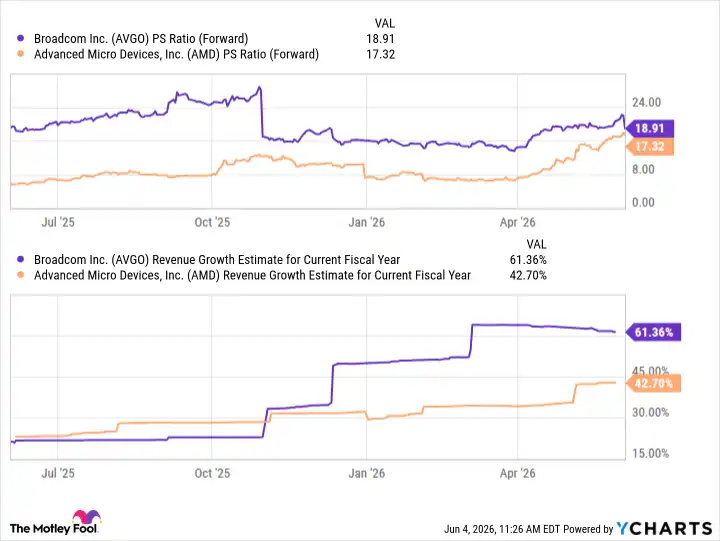
图注:AVGO 与 AMD 远期市销率对比,来源 YCharts

分析师预计 Broadcom 的增长速度将远快于 AMD,而两者之间的估值差距并不算大。尤其是在财报后的这波回调中,Broadcom 更值得买入。
Domande pertinenti

Q根据文章,Broadcom和AMD在AI芯片市场上采用了怎样不同的竞争策略?

AAMD选择了在通用AI芯片领域(如GPU)与英伟达正面竞争;而Broadcom则采取了定制芯片(XPU)的差异化路线,为每个客户(如Anthropic、谷歌、Meta、OpenAI)的特定AI工作负载量身定制芯片。

Q文章中提到,AMD在通用AI芯片路线上面临的主要挑战是什么?

AAMD面临的主要挑战是英伟达强大的CUDA软件生态系统护城河。由于Meta等大客户已深度绑定CUDA,仅凭硬件优势难以撼动英伟达的统治地位。

QBroadcom的CEO对公司AI芯片业务的长期收入目标是什么?

ABroadcom的CEO Hock Tan重申,公司的长期目标是在2027财年实现AI芯片年销售额达到1000亿美元。

Q为什么文章作者认为Broadcom的股票估值比AMD更贵是合理的?

A作者认为这个溢价是合理的,因为Broadcom拥有一批顶级AI客户,其定制芯片路线竞争地位更优,且分析预计其增长速度将远快于AMD,两者间的估值差距并不算大。

Q文章预计,AI芯片市场的哪一趋势将放大Broadcom定制芯片路线的优势?

A文章预计,随着AI算力需求从训练(Training)向推理(Inference)转移,效率变得更加关键,这将进一步放大Broadcom定制芯片在效率和粘性上的优势。

Letture associate

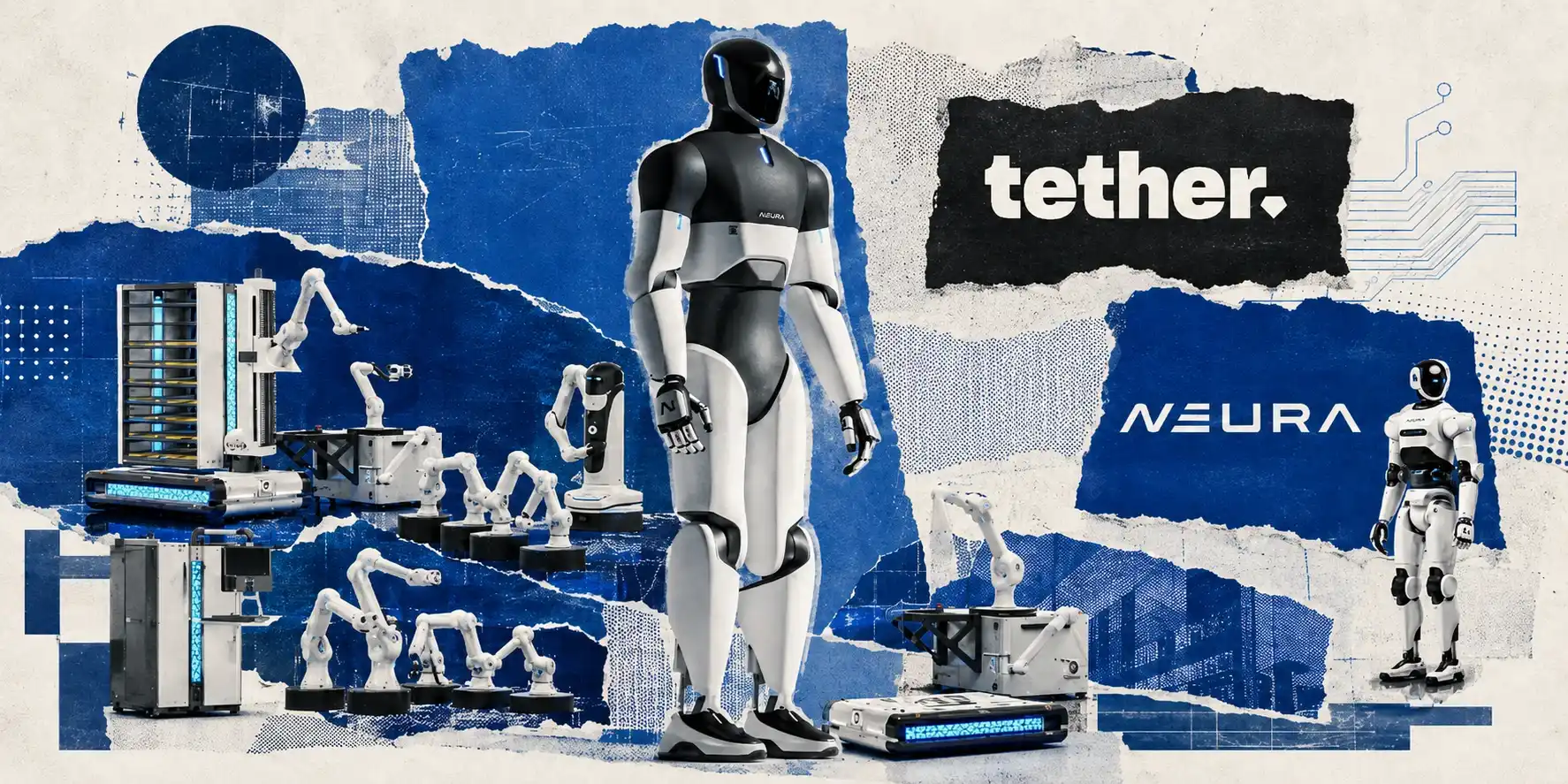
Do Robots Also Need Encrypted Wallets? Stablecoin Giant Tether Bets on German Company NEURA Robotics

Do Robots Need Crypto Wallets? Stablecoin Giant Tether Bets on German Firm NEURA Robotics German robotics company NEURA Robotics has secured up to $1.4 billion in what is claimed to be the largest-ever funding round in the full-stack robotics industry, valuing the company at $7 billion. The Series C round attracted major investors like Tether, Qualcomm, Amazon, NVIDIA, Bosch, and the European Investment Bank. NEURA, founded in 2019, initially focused on AI-powered collaborative robots (cobots) for industrial automation, later expanding to autonomous mobile robots, service robots, and humanoid robots. Its core strategy is evolving from a hardware manufacturer to the operator of "Neuraverse," a platform designed to enable different robots to share learned experiences and data, creating network effects. A key, crypto-focused aspect of this investment is Tether's involvement. Tether plans to integrate its open-source Wallet Development Kit (WDK) into NEURA's robot platforms. This would embed self-custody wallet functionality, allowing robots to autonomously handle payments and settlements for tasks under pre-set rules—envisioning use cases in logistics or Robotics-as-a-Service (RaaS) models. This move could position stablecoins and crypto wallets as potential "machine payment infrastructure." Additionally, the partnership will see Tether's QVAC (QuantumVerse Automatic Computer) edge-AI framework tested and deployed within Neuraverse. This aims to enable low-latency, offline-capable AI decision-making directly on robots, reducing reliance on cloud computing for critical, time-sensitive operations. The investment underscores Tether's broader ambition to expand beyond being just a stablecoin issuer into AI, energy, and digital infrastructure, with NEURA's robotics network serving as a testbed for merging crypto-based financial layers with edge-based intelligence for the future of automation.

marsbit8 min fa

Do Robots Also Need Encrypted Wallets? Stablecoin Giant Tether Bets on German Company NEURA Robotics

marsbit8 min fa

AMD Launches Compact AI Host, Directly Challenging NVIDIA DGX Spark

In June 2026, AMD announced the Ryzen AI Halo, a compact AI developer desktop to rival NVIDIA's DGX Spark. Both feature 128GB unified memory for running 200B+ parameter models locally. Priced from $2,949 to $3,999, AMD undercuts NVIDIA's $3,999+ DGX Spark. The core divergence lies in architecture and philosophy. Ryzen AI Halo uses an x86-based Ryzen AI Max+ 395 APU (CPU+GPU+NPU), runs standard Windows/Linux, and emphasizes general-purpose PC flexibility. DGX Spark uses an ARM-based Grace Blackwell Superchip, runs a custom DGX OS, and includes a high-speed ConnectX-7 NIC for cluster prototyping, anchoring it to NVIDIA's full-stack CUDA ecosystem. AMD's ROCm software has improved, with simpler installation and support for major frameworks, but still lags behind CUDA's 17-year maturity in community support and cutting-edge library availability. AMD's broader strategy focuses on becoming a viable second-source supplier. Key moves include acquiring design capabilities via ZT Systems (while outsourcing manufacturing) and securing two major 6GW GPU supply deals with OpenAI and Meta in late 2025/early 2026. These contracts validate AMD's role in diversifying the AI supply chain, rather than outright beating NVIDIA. NVIDIA counters with a tightly integrated stack from desktop (DGX Spark) to data center, emphasizing seamless scalability and enterprise software subscriptions (AI Enterprise). In summary, Ryzen AI Halo represents AMD's pragmatic path: offering a cost-effective, open-ecosystem alternative for developers wary of vendor lock-in, while its large data center contracts aim to capture share from customers seeking a second GPU supplier. The choice boils down to a familiar, flexible PC environment with potential software gaps (AMD) versus a premium, optimized, but locked-in ecosystem (NVIDIA).

marsbit8 min fa

AMD Launches Compact AI Host, Directly Challenging NVIDIA DGX Spark

marsbit8 min fa

Sharplink CEO: One Million Ethereum Developers, Who Can Compete?

Etherean Ecosystem: One Million Developers and a Formidable Moat The Ethereum network has surpassed a significant milestone: over one million unique lifetime developers, with approximately 232,000 active in the past year. This vast and growing talent pool is Ethereum's core advantage, far more critical than transient metrics like speed or transaction fees. The central question is not which blockchain is fastest, but where the best builders choose to build long-term. Ethereum's answer lies in a decade-long accumulation of infrastructure, standards, tools, liquidity, and collaborative culture that is exceptionally difficult to replicate. It has become the default operating system for programmable finance. This massive developer base is actively working on complex, high-risk challenges that deepen Ethereum's strategic moat: * **Glamsterdam Upgrade (2026):** Focused on core protocol scalability (ePBS, parallel execution) while preserving core values like credible neutrality. * **Synchronous Composability:** Aims to make numerous Rollups interoperate like a single chain, directly addressing fragmentation concerns. * **Quantum Resistance:** Ethereum leads mainstream ecosystems in coordinated preparation for post-quantum cryptography, with a targeted migration plan around 2029. This developer advantage is self-reinforcing, fueled by: * **Deep Composability:** Applications interact like interoperable financial Lego bricks via shared standards (e.g., EVM, Solidity). * **Credible Neutrality:** Secured by over 900,000 validators, making it trusted by major institutions. * **Modularity:** Rollups (Base, Arbitrium, etc.) expand, rather than fracture, the ecosystem into a tightly connected modular internet economy. * **Culture:** Attracts top-tier researchers and standard-setters who guide the entire industry. In essence, while other chains generate activity, Ethereum is consolidating as the trusted, long-term coordination layer for internet-native finance. Its future is being built now by the architects of the next-generation financial infrastructure.

Odaily星球日报1 h fa

Sharplink CEO: One Million Ethereum Developers, Who Can Compete?

Odaily星球日报1 h fa

Ethereum Reaches the Milestone of One Million Developers, Sharplink CEO Delves Deep into Ethereum's Future Possibilities

Ethereum Surpasses One Million Developers Milestone: A Look at Its Unshakeable Dominance and Future Joseph Chalom, CEO of Sharplink, reflects on his recent Asia trip where he engaged deeply with Ethereum developers and ecosystem leaders. The most striking takeaway was not just the industry's vibrancy, but the rigorous, long-term vision of local builders. This context brings to life a pivotal statistic: Ethereum has now surpassed one million cumulative developers (1,012,824), with approximately 232,000 remaining active in the past year—a talent pool unmatched by any other crypto ecosystem. The critical question isn't which blockchain is fastest, but where top developers choose to build long-term. Ethereum's answer is unequivocal. Its decade-long lead stems from a unique convergence of technology, institutional culture, economic systems, and composability, cementing its role as the foundational operating system for programmable finance. This massive developer base is tackling the industry's hardest problems, continuously strengthening Ethereum's moat. Key initiatives include: * **The Glamsterdam Upgrade (planned 2026):** Introducing ePBS and Block-level Access Lists for parallel execution and higher throughput while preserving core values like credible neutrality and fair MEV distribution. * **Synchronous Composability:** Projects are working to enable atomic transactions across dozens of Rollups, making them function as one unified chain and eliminating ecosystem fragmentation. * **Post-Quantum Security:** Ethereum is far ahead in preparing for quantum computing threats, with a dedicated foundation working group and testnets targeting a full migration by ~2029—a crucial factor for institutional adoption. Beyond developers, Ethereum's core network effects are its unparalleled composability and unified standards (like EVM and Solidity), which create a powerful flywheel: more developers → better tools → greater liquidity → more institutional participation. Its other decisive advantages include credible neutrality (over 900k validators), a secure modular architecture with interconnected Rollups, and a deeply entrenched culture shaped by top-tier researchers. Ultimately, there's a vast difference between generating short-term activity and becoming the trusted, long-term coordination layer for global native finance. Major institutions prioritize security, trust, and liquidity—areas where Ethereum holds dominant mindshare. The industry's trajectory shows resources consolidating around unified standards, deep liquidity, and developer consensus. After meeting the builders in Seoul and Hong Kong, Chalom is more convinced than ever: Ethereum's unshakeable future is being built right now.

Foresight News1 h fa

Ethereum Reaches the Milestone of One Million Developers, Sharplink CEO Delves Deep into Ethereum's Future Possibilities

Foresight News1 h fa

Saylor's Latest Long Read: Bitcoin is Not Money, It's Digital Capital, and Money is Built Upon It

Michael Saylor presents his "Digital Asset Stack" theory, positioning Bitcoin as the foundational layer of digital capital. He argues Bitcoin itself should remain unchanged—no staking, inflation, or protocol alterations. Instead, a five-layer financial architecture should be built atop it: Digital Capital (BTC), Digital Credit (e.g., yield instruments like STRC), Digital Currency (stable, yield-bearing instruments pegged to fiat), Digital Yield (leveraged/structured products), and Digital Equity (e.g., MSTR stock, absorbing residual volatility). Saylor asserts this stack transforms Bitcoin's high-volatility, high-energy capital into tailored products: stable currencies for payments/savings, yield instruments for income seekers, and equity for growth investors. This approach meets diverse needs—corporate treasuries, banks, retirees, emerging market users—without compromising Bitcoin's core properties (scarcity, decentralization). The "killer use case" is rebuilding global money, credit, and capital markets on Bitcoin, bridging the fiat world with a superior digital asset foundation. The system leverages traditional finance principles (risk layering, structured products) while using Bitcoin as the ultimate collateral. This expands Bitcoin's utility, drives adoption, and offers a better monetary experience: digital, yield-bearing, stable-value tools for everyday use.

marsbit1 h fa

Saylor's Latest Long Read: Bitcoin is Not Money, It's Digital Capital, and Money is Built Upon It

marsbit1 h fa

Trading

Spot
Futures

Articoli Popolari

Come comprare CHIP

Benvenuto in HTX.com! Abbiamo reso l'acquisto di USD.AI (CHIP) semplice e conveniente. Segui la nostra guida passo passo per intraprendere il tuo viaggio nel mondo delle criptovalute.Step 1: Crea il tuo Account HTXUsa la tua email o numero di telefono per registrarti il tuo account gratuito su HTX. Vivi un'esperienza facile e sblocca tutte le funzionalità,Crea il mio accountStep 2: Vai in Acquista crypto e seleziona il tuo metodo di pagamentoCarta di credito/debito: utilizza la tua Visa o Mastercard per acquistare immediatamente USD.AICHIP.Bilancio: Usa i fondi dal bilancio del tuo account HTX per fare trading senza problemi.Terze parti: abbiamo aggiunto metodi di pagamento molto utilizzati come Google Pay e Apple Pay per maggiore comodità.P2P: Fai trading direttamente con altri utenti HTX.Over-the-Counter (OTC): Offriamo servizi su misura e tassi di cambio competitivi per i trader.Step 3: Conserva USD.AI (CHIP)Dopo aver acquistato USD.AI (CHIP), conserva nel tuo account HTX. In alternativa, puoi inviare tramite trasferimento blockchain o scambiare per altre criptovalute.Step 4: Scambia USD.AI (CHIP)Scambia facilmente USD.AI (CHIP) nel mercato spot di HTX. Accedi al tuo account, seleziona la tua coppia di trading, esegui le tue operazioni e monitora in tempo reale. Offriamo un'esperienza user-friendly sia per chi ha appena iniziato che per i trader più esperti.

279 Totale visualizzazioniPubblicato il 2026.04.21Aggiornato il 2026.06.02

Come comprare CHIP

Discussioni

Benvenuto nella Community HTX. Qui puoi rimanere informato sugli ultimi sviluppi della piattaforma e accedere ad approfondimenti esperti sul mercato. Le opinioni degli utenti sul prezzo di CHIP CHIP sono presentate come di seguito.

活动图片