Over $31 Million Stolen from Humanity, Is the Team Behind It Paving the Way for a New Project?

Odaily星球日报Pubblicato 2026-06-09Pubblicato ultima volta 2026-06-09

Introduzione

The article reports a major security incident involving Humanity Protocol (H), resulting in over $31 million stolen. The team attributes the hack to a private key leak from a Humanity Foundation member, leading to a rapid sale of H tokens and a 90% price drop. However, prominent on-chain investigator ZachXBT suggests the event might be an "exit scam" orchestrated by the team, rather than an external hack. This suspicion is fueled by the team's controversial history, including past management failures, legal issues, and previous scandals like outsourced technology and problematic airdrops. Further investigation reveals that the core team behind Humanity is already involved with a new project called "Everything," which recently secured funding. This has led to community speculation that the alleged hack is a deliberate scheme to abandon the H project while shifting focus and resources to their new venture, leaving investors to bear the losses. The article questions whether this is a genuine security failure or a premeditated "rug pull" strategy.

Original | Odaily Planet Daily(@OdailyChina)

Author | Wenser(@wenser 2010)

When it rains, it pours. The crypto market has once again been hit by a major security incident with over $30 million in stolen funds.

In the early hours this morning, on-chain monitoring showed that the Humanity Protocol was hacked, with over 17 wallets holding H tokens compromised, resulting in total losses exceeding $19 million. Subsequently, the scale of the lost funds expanded to over $31 million. After the successful attack, the hacker quickly swapped the H tokens for ETH to facilitate subsequent money laundering.

Terence, the founder of Humanity, later confirmed that the incident was due to the private key of a Humanity Foundation member being leaked and exploited by hackers. Following this news, the price of the H token plummeted below $0.08, with a 24-hour drop of over 90%.

Against the backdrop of a minor rebound in the broader market, the "bear market staple" has played out once again. Is it hackers being unpreventable, or is there more to the story?

When a "Human-Induced Security Incident" Occurs at Humanity: Team Member Private Key Leak OR Project Team's Deliberate Plot?

According to the latest official response from Humanity, project founder Terence confirmed that the private key of a Humanity Foundation member had been leaked. As a precaution, please do not interact with cross-chain bridges or any liquidity pools until safety is confirmed. The Foundation is working with security experts and exchange partners to handle the matter and will provide ongoing updates. Furthermore, the official advises users to temporarily revoke permissions granted to the project's contract addresses until the official investigation results are disclosed.

Meanwhile, the "hack" continues. According to LookonChain monitoring, the Humanity hacker minted an additional 100 million H tokens on BSC, valued at $11.4 million, indicating that the sell-off may continue.

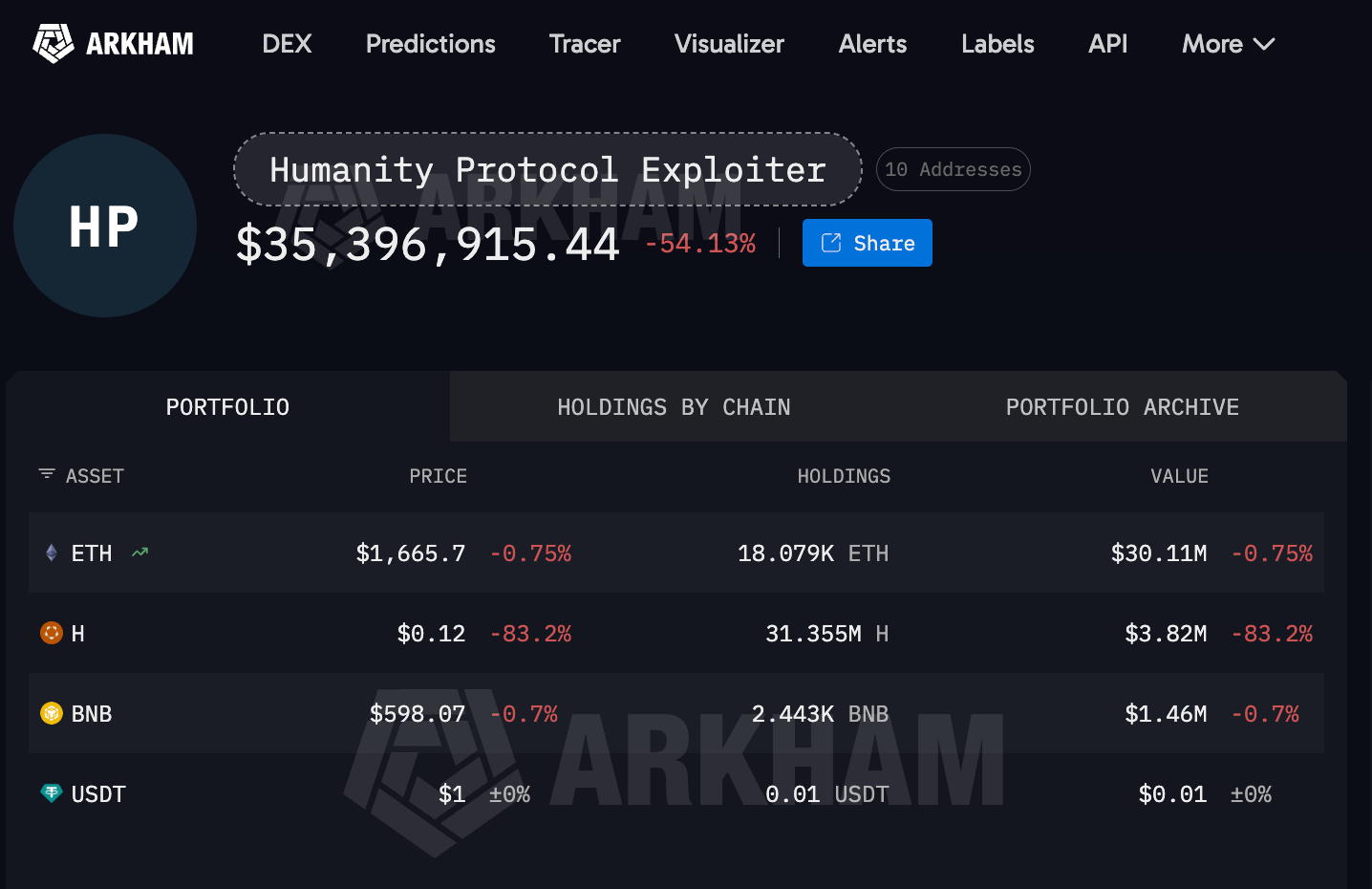
As of the time of writing, the address associated with the Humanity hacker holds over 31.35 million H tokens, valued at approximately $3.82 million; holds about 18,000 ETH, valued at over $30.11 million; its BNB holdings have also increased to 2,443, worth nearly $1.5 million; and it continues to mint more H tokens.

On-chain address monitoring information for the hacker can be found at: https://arkm.com/explorer/entity/dcfac174-1b67-46d6-8cab-5b8e955ca921.
Regarding this major security incident with over $30 million in stolen funds, on-chain detective ZachXBT also offered his preliminary investigation conclusions:

He first posted, "Unclear if hack or team maliciously rugged. Looking at the chart and the concentrated supply, the H team was likely working with an active market maker. However, all H tokens were sold on (on-chain) DEXs, not CEXs."

Subsequently, he gave a preliminary conclusion, stating: "This 'security incident' was likely planned. I don't believe the team's corresponding story at all; it's just an excuse made by ill-intentioned people to get away." It's worth mentioning that the Humanity project team does indeed have a "dark history."

Humanity Team's Dark History: Technical Outsourcing, Airdrop Drama, and Team Scandals

In fact, the crypto community's dissatisfaction with Humanity is not without reason.

Previously, when WorldCoin gained fame as a "human iris identity verification project," Humanity, as a "palm print verification identity security protocol," quickly capitalized on the hot concept and rose to prominence. At that time, it was highly sought after as a partner for KYC or identity verification in numerous crypto project airdrops. However, on the other hand, its background team, its promoted "palm print security verification technology," and its token airdrop process all sparked market controversy. For more details, see "From Palm Print 'Revolution' to Access Control Manufacturer, Tearing Apart Humanity's Two-Faced 'Technological' Charade."

Not only that, in June last year, on-chain investigator Specter pointed out in a post: "After understanding the team composition of Humanity, it's concerning: Among the 4 team leaders, 3 have problematic past records involving mismanagement, lawsuits, or financial irregularities."

Among them, project founder and CEO Terence Kwok has a previous "entrepreneurial history." He founded Tink Labs, which once raised $200 million and reached a peak valuation of $1.5 billion, but ultimately went bankrupt in 2019 due to "mismanagement."

Foundation head Mario Nawfal has previously been accused of withholding wages and is implicated in improper financing, false promises, and coercing whistleblowers into silence. He also has a series of "blemished histories": the project Froothie was fined in Australia for false advertising; sued by Juicero; accused of invoice manipulation during his tenure at NFT Tech; and engaged in controversial behavior with BitClout token trading.

As for Yat Siu, founder of Animoca Brands, one of Humanity's backers, he was previously involved in violations related to blockchain and crypto investments, leading to his company being delisted from the Australian Securities Exchange.

Coupled with Humanity's past incidents being exposed, such as "Shenzhen technical outsourcing," large-scale sybil attacks in token airdrops, and airdrops worth single-digit amounts for loyal users, this theft incident is hard not to be seen as having ulterior motives.

Appearing Hacked, Actually a Golden Cicada Shedding Its Shell? Humanity Team Accused of Already Shifting to a New Project

Soon, more information was revealed by the crypto community and on-chain detective ZachXBT.

After suggesting that the Humanity theft might be a planned event, ZachXBT again posted, questioning Humanity's official account: "You chose to hype your token for weeks without any real substance and think the crypto community would blindly believe your story? Please disclose all your active market-making agreements with related entities in Hong Kong first."

Subsequently, he even shared a previous tweet from crypto KOL Irene Zhao, which mentioned: "2 years ago, I made a 100x return on my KOL round investment in H tokens; now, I have also participated in the KOL round financing for Everything, a new project incubated by the Humanity team."

In January this year, Everything, which promotes the concept of an "all-in-one exchange," announced the completion of a $6.9 million seed round. The round was led by Humanity's venture capital arm, Humanity Investments, with participation from Animoca Brands, Hex Trust, WallStreetBets creator Jamie Rogozinski, and Three Point Capital. The platform emphasizes its advantage in integrating perpetual contracts, spot markets, prediction markets, and payment functions.

Looking at it now, it's a familiar taste (combining current hotspots), a familiar recipe (similar investor team composition). Often, we have to admire the keen sense and superb execution of these "entrepreneurial veterans." As for the KOLs and investors involved, perhaps all benefits have already been divided behind the scenes, leaving the losses for the token traders on stage.

Of course, in the crypto market, projects and token prices are always two sides of the same coin. As for how the H token price performs subsequently, it may still depend on the handling plan of the Humanity project team and the stage performance of the market makers.


Domande pertinenti

QAccording to the article, what was the official explanation given by the Humanity Protocol team for the massive security breach?

AThe official explanation, as confirmed by Humanity founder Terence, was that a private key belonging to a member of the Humanity Foundation was compromised and exploited by hackers.

QWhat was the estimated total loss from the Humanity Protocol attack as detailed in the report?

AThe estimated total loss from the attack exceeded $31 million. Initially, over 17 wallets holding H tokens were drained for over $19 million, and the scale later expanded to over $31 million.

QWho is ZachXBT and what was his preliminary conclusion about the nature of the incident?

AZachXBT is a well-known on-chain investigator. His preliminary conclusion was that the security event was likely a deliberate, man-made scheme, suggesting it was an exit strategy rather than a genuine hack.

QWhat new project is mentioned as being incubated by the Humanity team, according to the article?

AThe new project mentioned is called 'Everything', a platform described as an all-in-one exchange. It was announced in January and raised $6.9 million in seed funding, led by Humanity's venture arm, Humanity Investments.

QWhat are some of the alleged 'black histories' or past controversies associated with key members of the Humanity team mentioned in the article?

AThe article mentions several controversies: Founder Terence Kwok's previous venture Tink Labs collapsed due to mismanagement; Foundation lead Mario Nawfal allegedly had issues with unpaid wages, false promises, and questionable financial practices; and investor Yat Siu's company was delisted from the Australian Stock Exchange for irregularities in blockchain investments.

Letture associate

Microsoft Announces Commercial-Grade Quantum Computer to be Completed in Three Years: Will the Boots Land?

Microsoft announces plans to build a commercially viable quantum computer by 2029, a significant acceleration from the previous industry consensus of a decade. The breakthrough is fueled by their new Majorana 2 quantum chip, which boasts a record-breaking average qubit lifetime of 20 seconds—a 1,000-fold reliability improvement over its predecessor. This leap was achieved by leveraging topological qubits, a theoretically more stable technology using Majorana zero modes, and switching the core superconducting material from aluminum to lead. Crucially, Microsoft's "Discovery" agentic AI platform accelerated the R&D process. AI agents autonomously analyzed vast experimental data, optimized manufacturing parameters (like the lead alloy composition), and solved issues like "ghost noise," dramatically speeding up experimentation. While the 20-second coherence time is a landmark, challenges remain: scaling from 12 qubits to the millions needed for practical applications, managing compilation costs, and verifying quantum results. Skeptics call for peer-reviewed data, and questions persist about whether even 20 seconds is sufficient for complex algorithms like breaking RSA encryption. The race is on with other approaches (superconducting, trapped ions), but Microsoft's confidence in its topological roadmap signals a potential shortcut to a scalable quantum future.

marsbit11 min fa

Microsoft Announces Commercial-Grade Quantum Computer to be Completed in Three Years: Will the Boots Land?

marsbit11 min fa

Is There Really a "World Cup Curse" in the Market?

Is there really a "World Cup Curse" affecting markets? Historical data shows global equity markets often underperform during the tournament. The S&P 500 has averaged negative returns of -1.5% to -2.11% across 19 World Cups since 1950, with declines in 58% of events. China's Shanghai Composite fell in 71% of tournaments since 1994. Studies confirm reduced trading activity during matches, with volumes dropping significantly, especially when a home nation plays. A team's loss can also lead to negative sentiment and selling pressure in its domestic market the next day. However, the "curse" may be partly attributed to seasonal weakness. Many tournaments are held in June-July, a historically weaker period for stocks ("Sell in May and go away"). The 2022 Qatar World Cup, held in November-December, saw a smaller drop in trading volume compared to summer events, suggesting timing plays a role. The cryptocurrency market's performance during World Cups has been mixed and largely driven by its own major catalysts (e.g., Mt. Gox hack, FTX collapse, halving cycles) rather than the tournament. Investment opportunities have shifted over time. Traditional beneficiaries like TV manufacturers have seen fading returns as streaming platforms become the core viewing channel. Classic consumer plays like beer and sportswear face challenges from changing consumption trends. Newer digital assets, like fractionalized collectible player cards on blockchain, have seen explosive growth. While gambling is a traditional sector, prediction markets are emerging. In conclusion, while a statistical correlation exists, the World Cup's direct impact on markets is likely limited and intertwined with seasonal patterns. With lower liquidity during the event, the simplest strategy for many might be to step back from trading and enjoy the games.

marsbit18 min fa

Is There Really a "World Cup Curse" in the Market?

marsbit18 min fa

Why 'AI Service Subscription' Is Destined to Die Out?

"Why 'AI Service Subscription Models' Are Doomed to Disappear" The article argues that the flat-rate subscription model for AI services is fundamentally unsustainable. It points to recent industry shifts, such as Anthropic limiting access to its flagship Claude Fable 5 model for subscribers after just 14 days, and GitHub and OpenAI moving towards credit-based or usage-based billing. The core problem is that subscription models rely on a capped human consumption limit—like watching videos or listening to music—which keeps costs predictable. However, the rise of autonomous AI agents shatters this premise. Agents can consume 5 to 30 times more computing resources (tokens) than a human chatting, and they operate continuously without user presence. This removes the natural usage cap, making fixed-price plans financially unviable as heavy users incur massive costs. Attempts to patch the model with higher tiers or usage caps have failed, often leading to "adverse selection" where only the heaviest users subscribe. The industry's solution is to hollow out subscriptions, replacing "unlimited" access with prepaid credits charged per token, akin to a utility meter. While chat-based subscriptions may linger, the real value and revenue are shifting to pay-as-you-go models. The current period represents a final, heavily subsidized phase for users. The conclusion is that the soul of subscription—a fixed price for worry-free use—is dying, soon to be replaced by pure usage-based pricing where everyone pays for their own "electricity meter."

marsbit19 min fa

Why 'AI Service Subscription' Is Destined to Die Out?

marsbit19 min fa

Trading

Spot
Futures
活动图片