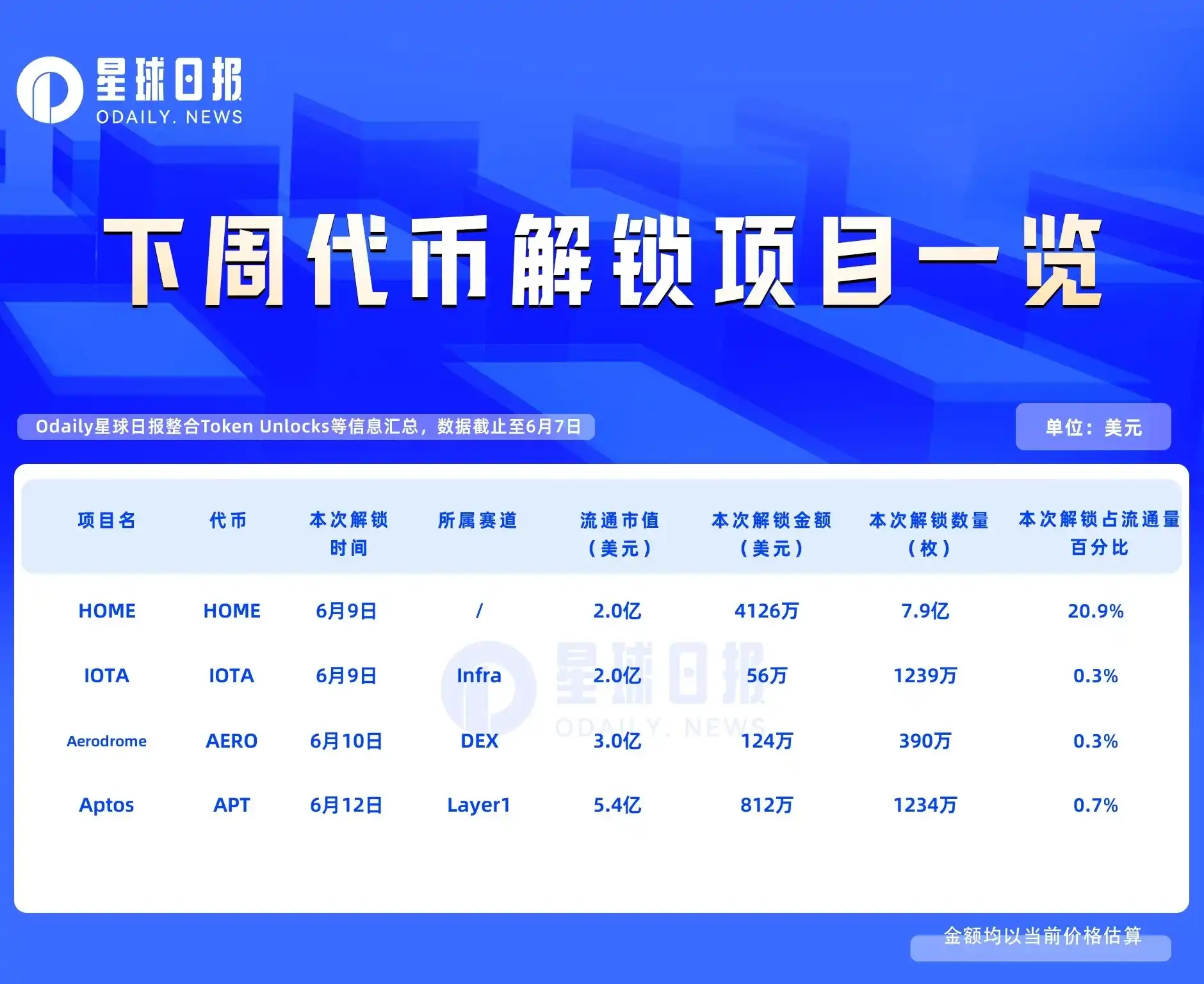
Desbloqueo semanal de tokens: HOME desbloquea más del 20% del suministro circulante

marsbitPubblicato 2026-06-07Pubblicato ultima volta 2026-06-07

Introduzione

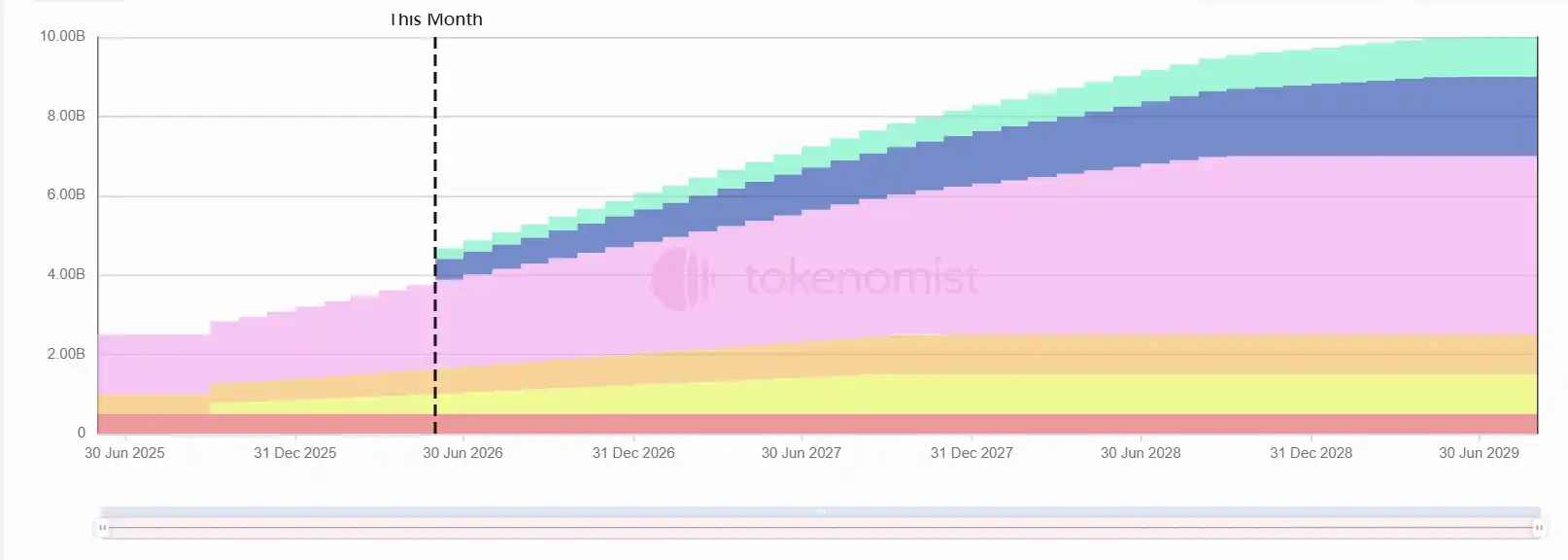
**Unlock de Tokens HOME: Más del 20% de la oferta circulante se libera esta semana** La plataforma **DeFi.app** llevará a cabo un importante unlock (liberación) de tokens esta semana, poniendo en circulación **790 millones** de sus tokens HOME. Este evento representa más del **20% de su oferta circulante actual**, con un valor estimado de aproximadamente **41.26 millones de dólares**. DeFi.app se presenta como una solución integral para simplificar las operaciones en finanzas descentralizadas, permitiendo a los usuarios mantener la custodia total de sus activos. Entre sus funciones destacadas se incluyen la compra de tokens en cualquier blockchain, intercambios transfronterizos instantáneos con un solo clic, acceso a mercados de derivados descentralizados y oportunidades de generación de rendimiento. La plataforma afirma ofrecer estos servicios sin necesidad de que los usuarios paguen tarifas de gas (gas fees) o utilicen puentes (bridges) externos. El artículo incluye la curva de emisión detallada que muestra el cronograma de este unlock. Para más información, los usuarios pueden visitar el sitio web oficial del proyecto (https://defi.app/) o su cuenta de Twitter (https://x.com/defiapp).

Defi App

Twitter del proyecto: https://x.com/defiapp

Sitio web del proyecto: https://defi.app/

Cantidad desbloqueada esta vez: 790 millones de tokens

Valor desbloqueado esta vez: Aproximadamente 41.26 millones de dólares

DeFi.app tiene como objetivo simplificar las operaciones DeFi manteniendo la custodia total de los activos criptográficos. A través de DeFi.app, los usuarios pueden comprar tokens en cualquier blockchain, realizar operaciones "instantáneas y con un solo clic" entre cadenas, acceder a mercados de derivados descentralizados y obtener oportunidades de rendimiento, todo sin pagar tarifas de gas ni utilizar puentes.

La curva de liberación específica es la siguiente:

Domande pertinenti

Q¿Qué proyecto de criptomonedas está desbloqueando tokens esta semana según el artículo?

AEl proyecto es DeFi.app, según el artículo.

Q¿Cuál es la cantidad aproximada (en millones) y el valor (en millones de dólares) de los tokens desbloqueados de DeFi.app?

ALa cantidad desbloqueada es de 790 millones de tokens, con un valor aproximado de 41.26 millones de dólares.

QSegún la descripción, ¿qué problema principal busca resolver la plataforma DeFi.app para sus usuarios?

ADeFi.app busca simplificar las transacciones DeFi eliminando la necesidad de pagar tarifas de gas (gas fees) o utilizar puentes (bridges) para operaciones entre cadenas.

Q¿Qué funcionalidades o servicios menciona el artículo que ofrece DeFi.app a los usuarios?

AEl artículo menciona que permite comprar tokens en cualquier blockchain, realizar intercambios transfronterizos (cross-chain) instantáneos, acceder a mercados de derivados descentralizados y encontrar oportunidades de rendimiento (yield).

Q¿Dónde se puede encontrar más información oficial sobre el proyecto DeFi.app según el texto proporcionado?

AEl texto proporciona el sitio web oficial (https://defi.app/) y su cuenta de Twitter/X (https://x.com/defiapp).

Letture associate

Has the Cryptocurrency Market Hit Bottom? Here's What Institutions Think

"Has the crypto market bottomed out? Major institutions are divided on the outlook, according to a recent analysis by Matt Hougan, Chief Investment Officer of Bitwise. Three prominent research firms published in-depth reports on the topic with differing conclusions. Galaxy Digital argues Bitcoin has not yet found its bottom, pointing to only 4 out of 13 historical bottoming indicators being met. Their analysis suggests a potential bottom range of $30,000 to $54,000. NYDIG adopts a more cautious stance, noting that while metrics are close to historical bear market lows, a classic panic-selling capitulation event is missing. They acknowledge the possibility of a bottom but consider it unlikely, citing structural changes from institutional adoption. In contrast, Standard Chartered Bank asserts the bottom is already in at around $59,000. Their revised bullish view, predicting a year-end target of $100,000, hinges on anticipated reductions in ETF selling pressure linked to events like a potential SpaceX IPO. Despite the surface-level disagreement on the exact price floor, the reports share significant common ground crucial for long-term investors. All three institutions agree that a market bottom will likely form within the current year, that current prices are closer to the bottom than to previous cycle highs, and that Bitcoin is poised for another major bull cycle in the future. The core takeaway is that while the precise bottom level remains debated, the long-term value proposition for Bitcoin remains strong and may even be strengthening. Key supportive trends include rising global debt, persistent inflation, declining trust in traditional institutions, accelerating digitization, and improving market infrastructure. Therefore, for investors with a long-term horizon, the focus should shift from pinpointing the exact bottom to recognizing that the cycle's peak is likely still ahead, making current levels an attractive entry point for substantial potential upside."

Foresight News20 min fa

Has the Cryptocurrency Market Hit Bottom? Here's What Institutions Think

Foresight News20 min fa

2029 Finale Prediction: When Cryptocurrency Completely "Vanishes", Who Can Remain in This Financial Upheaval?

By 2029, the crypto industry will have transformed into a largely invisible but foundational layer for traditional finance. This timeline outlines the key shifts from now until then. By mid-2026, the most sought-after assets on-chain will not be traditional tokens, but synthetic perpetual contracts for private, high-growth companies (like SpaceX, OpenAI). These become primary price discovery tools, highlighting the market's craving for real-world asset value. Most altcoins enter a sustained bear market as their fundamental lack of asset-backed value is exposed. In late 2026, the "AI + Crypto" narrative largely fades as AI giants prove they don't need crypto infrastructure, except for prediction markets betting on model performance. Simultaneously, a quiet but significant wave of tokenization for institutional assets (money market funds, private credit) begins. The industry splits into a noisy speculative economy and a silent institutional one. Throughout 2027, major public blockchain foundations pivot decisively to serve institutional clients, building compliance toolkits and sales teams. However, key sectors hit growth ceilings: private perpetual contracts are legally restricted from public promotion, stable币 growth is capped by looming political uncertainty, and tokenization projects remain cautious. In 2028, following a U.S. election assumed to maintain a regulatory (not prohibitive) stance, a pivotal change occurs. After a major liquidation crisis exposes the flaws of synthetic contracts lacking a real-asset anchor, new regulations allow the *public solicitation* of private security sales (secondary market shares) to accredited investors. This creates a legitimate, direct on-ramp for retail capital into previously illiquid private equity. By 2029, the resulting bull market is driven by trading in real, innovative company shares (biotech, robotics, AI labs), not speculative tokens. "Crypto" as a distinct asset class recedes; it becomes the mundane, unseen plumbing for this new global private markets infrastructure. Tokens that survive are those capturing real cash flows from this infrastructure. Speculation persists but is marginalized. The core questions posed at the start are answered: token value is tied to legally enforceable claims on real assets, frontier tech adoption happens via private market channels, and crypto's absorption into traditional finance is marked by its becoming boring and invisible. The key validation for this entire thesis is whether, by late 2028, a legal pathway exists for ordinary accredited investors to access private assets directly.

marsbit1 h fa

2029 Finale Prediction: When Cryptocurrency Completely "Vanishes", Who Can Remain in This Financial Upheaval?

marsbit1 h fa

After the U.S. Banned Fable 5, Zhipu's Stock Soared 47%

On June 15, Chinese AI company Zhipu's stock surged up to 47.6% in Hong Kong, closing with a 32.82% gain. This sharp rise followed two key industry events. On June 12, Anthropic was compelled by a U.S. government export control order to suspend global access to its latest flagship models, Claude Fable 5 and Claude Mythos 5, impacting developers and businesses reliant on them. The next day, Zhipu announced it was opening access to its new open-source flagship model, GLM-5.2, for all Coding Plan users, with API and model weights (under the MIT license) to follow. The Anthropic incident highlighted a critical shift in the AI industry: beyond raw capability, the stability, continuous accessibility, and control over AI models are becoming equally vital, especially as AI integrates deeper into business workflows. Zhipu's move, emphasizing that "frontier intelligence should not belong to a few nor be subject to arbitrary revocation," positioned its open, accessible model as an alternative. GLM-5.2 focuses on "Long Horizon Tasks" with a 1M context window, aiming for consistency in complex, extended projects. Market analysts suggest this event exposes the risk of dependency on closed-source models subject to single jurisdiction policies, potentially accelerating a shift toward domestic base models and localized deployments. The investment response indicates a new valuation metric is emerging—prioritizing which companies can provide AI capabilities that are not only advanced but also reliably and sustainably accessible.

marsbit1 h fa

After the U.S. Banned Fable 5, Zhipu's Stock Soared 47%

marsbit1 h fa

Trading

Spot
Futures

Articoli Popolari

Come comprare HOME

Benvenuto in HTX.com! Abbiamo reso l'acquisto di Defi.app (HOME) semplice e conveniente. Segui la nostra guida passo passo per intraprendere il tuo viaggio nel mondo delle criptovalute.Step 1: Crea il tuo Account HTXUsa la tua email o numero di telefono per registrarti il tuo account gratuito su HTX. Vivi un'esperienza facile e sblocca tutte le funzionalità,Crea il mio accountStep 2: Vai in Acquista crypto e seleziona il tuo metodo di pagamentoCarta di credito/debito: utilizza la tua Visa o Mastercard per acquistare immediatamente Defi.appHOME.Bilancio: Usa i fondi dal bilancio del tuo account HTX per fare trading senza problemi.Terze parti: abbiamo aggiunto metodi di pagamento molto utilizzati come Google Pay e Apple Pay per maggiore comodità.P2P: Fai trading direttamente con altri utenti HTX.Over-the-Counter (OTC): Offriamo servizi su misura e tassi di cambio competitivi per i trader.Step 3: Conserva Defi.app (HOME)Dopo aver acquistato Defi.app (HOME), conserva nel tuo account HTX. In alternativa, puoi inviare tramite trasferimento blockchain o scambiare per altre criptovalute.Step 4: Scambia Defi.app (HOME)Scambia facilmente Defi.app (HOME) nel mercato spot di HTX. Accedi al tuo account, seleziona la tua coppia di trading, esegui le tue operazioni e monitora in tempo reale. Offriamo un'esperienza user-friendly sia per chi ha appena iniziato che per i trader più esperti.

195 Totale visualizzazioniPubblicato il 2025.06.10Aggiornato il 2026.06.10

Come comprare HOME

Discussioni

Benvenuto nella Community HTX. Qui puoi rimanere informato sugli ultimi sviluppi della piattaforma e accedere ad approfondimenti esperti sul mercato. Le opinioni degli utenti sul prezzo di HOME HOME sono presentate come di seguito.

活动图片