XRP Ledger Hits No. 4 In RWA Rankings In Less Than A Year

bitcoinistPubblicato 2026-05-22Pubblicato ultima volta 2026-05-22

Introduzione

The XRP Ledger has rapidly risen to fourth place in RWA.xyz's network rankings for tokenized real-world assets in less than a year, now holding a total distributed RWA value of $4.1 billion. This positions XRPL behind only Canton, Ethereum, and Provenance, and ahead of networks like BNB Chain and Solana. The ledger's 30-day growth rate of 45.97% is the highest among the top ten, starkly contrasting with declines seen on other major networks. RippleX highlighted this as one of the fastest-growing RWA ecosystems, now hosting a diverse range of tokenized assets including US Treasuries, money market funds, and commercial paper. While Canton dominates the sector with an 83.73% market share ($313.6 billion), XRPL's ascent signals its emergence as a notable player in the competitive institutional tokenization market. Broader sector data shows distributed asset value at $33.87 billion, with US Treasury debt as the largest tokenized category at $15.3 billion.

XRP Ledger has moved into fourth place on RWA.xyz’s network rankings, according to RippleX, marking a rapid climb for the blockchain in the tokenized real-world asset sector. The move puts XRPL behind Canton, Ethereum and Provenance by total distributed RWA value, while placing it ahead of BNB Chain, zkSync Era, Solana, Stellar and Avalanche.

XRP Ledger Jumps To No. 4 In RWA Rankings

RippleX framed the milestone as one of the faster growth stories in tokenized assets. “In less than a year, XRP Ledger has climbed from the top 10 to #4 on the @RWA_xyz league table, making it one of the fastest-growing RWA ecosystems in the space,” the team wrote on X.

“Today, XRPL is home to a growing range of tokenized financial assets onchain, from US Treasuries and money market funds to commercial paper, structured credit, and more. Bringing assets onchain is an important milestone. Expanding what those assets can enable across financial markets is part of the broader opportunity ahead, and one the XRP community is building toward together,” Ripple added.

The RWA.xyz data places XRP Ledger at $4.1 billion in total distributed RWA value, with 302 listed RWAs and a 1.09% market share. The network’s 30-day growth rate stands out sharply among the top ten, rising 45.97% over the period. That compares with declines of 4.92% for Canton, 4.37% for Ethereum and 4.36% for BNB Chain, while Provenance rose 6.37%, Solana climbed 8.24%, Stellar gained 11.33% and Avalanche increased 39.29%.

Canton remains the dominant network in the table by a wide margin, with $313.6 billion in total value and an 83.73% market share. Ethereum ranks second with $19.0 billion and a 5.08% share, followed by Provenance with $18.0 billion and 4.80%. XRP Ledger’s fourth-place position therefore does not yet imply parity with the largest RWA networks by value, but it does show that XRPL has become a visible venue in an increasingly competitive institutional tokenization market.
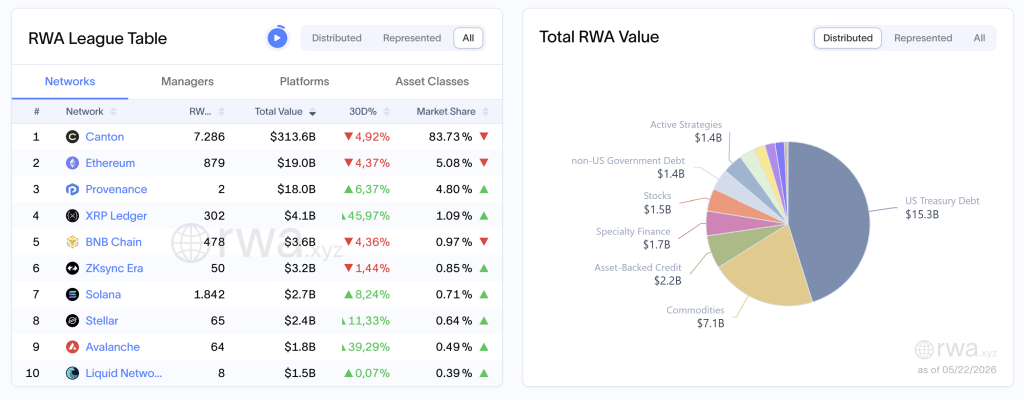
RWA ranking by networks | Source: X RWA.xyz

The broader market data from RWA.xyz shows the sector continuing to expand unevenly. Distributed asset value stood at $33.87 billion, up 1.77% over 30 days, while represented asset value was listed at $340.04 billion, down 2.98% over the same period. Total asset holders reached 800,067, up 8.04% from 30 days earlier. Stablecoin figures were substantially larger, with total stablecoin value at $305.08 billion and total stablecoin holders at 256.21 million.
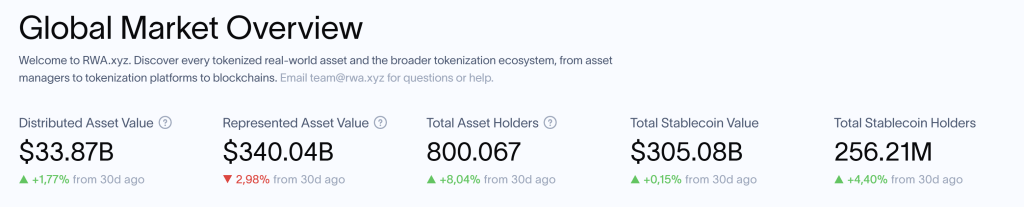
RWA globals market overview | Source: X RWA.xyz

The composition of distributed RWA values also shows where tokenization activity is currently concentrated. US Treasury debt accounted for $15.3 billion, the largest category shown, followed by commodities at $7.1 billion. Asset-backed credit stood at $2.2 billion, specialty finance at $1.7 billion, stocks at $1.5 billion, non-US government debt at $1.4 billion and active strategies at $1.4 billion.

At press time, XRP traded at $1.3596.
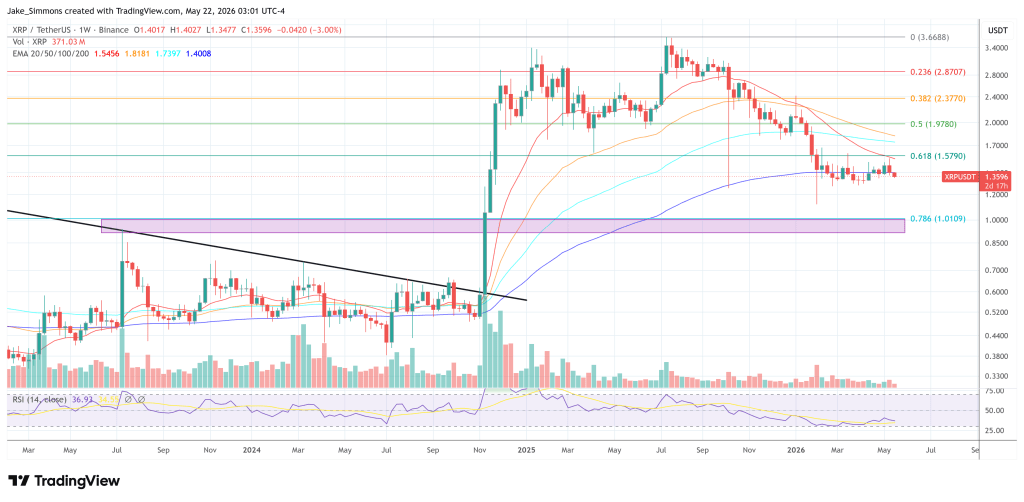
XRP bulls must break the 0.618 Fib, 1-week chart | Source: XRPUSDT on TradingView.com

Domande pertinenti

QAccording to the article, what position did XRP Ledger achieve in RWA.xyz's network rankings and what is its total distributed RWA value?

AXRP Ledger achieved the 4th position in RWA.xyz's network rankings, with a total distributed RWA value of $4.1 billion.

QWhat does RippleX highlight as one of the key characteristics of XRP Ledger's rise in the RWA rankings?

ARippleX highlights that XRP Ledger is one of the fastest-growing RWA ecosystems, having climbed from the top 10 to #4 in less than a year.

QHow does XRP Ledger's 30-day growth rate in distributed RWA value compare to other top networks like Ethereum and Canton?

AXRP Ledger's 30-day growth rate was a sharp increase of 45.97%. In contrast, Ethereum declined by 4.37% and Canton declined by 4.92% over the same period.

QWhat are the two largest categories of tokenized Real-World Assets by distributed value, according to the broader market data from RWA.xyz?

AThe two largest categories are US Treasury debt at $15.3 billion and commodities at $7.1 billion.

QDespite being ranked #4, why does the article state that XRP Ledger does not yet have parity with the largest RWA networks?

AIt does not have parity because the top networks like Canton, Ethereum, and Provenance have significantly larger total values and market shares. For example, Canton has $313.6 billion and an 83.73% share, while XRP Ledger has $4.1 billion and a 1.09% share.

Letture associate

Retail Investors' 'Lead Brother' Serenity vs. Newly Minted Stock God Leopold: How Are the Two Top Hunters Mining AI's 'Physical Limits'?

The article profiles two prominent figures, Serenity and Leopold Aschenbrenner, who are gaining attention for their unconventional investment strategies focused on the physical constraints of the AI boom, moving beyond mainstream software narratives. Serenity, an anonymous online trader, advocates a "shiso leaf" theory. He targets small-cap companies with monopolies on critical, overlooked components in the AI hardware supply chain, such as specific semiconductor materials. His deep, technical analysis of bottlenecks in areas like co-packaged optics (CPO) has reportedly yielded massive returns, though his anonymity and focus on illiquid micro-cap stocks pose significant risks for followers. Leopold Aschenbrenner, a former OpenAI researcher, founded a multi-billion dollar hedge fund. His macro thesis argues that physical infrastructure—power grids, land, data centers—is the true bottleneck for AI growth, lagging far behind chip production. Consequently, his fund employs an infrastructure arbitrage strategy: heavily investing in storage and compute infrastructure companies while placing massive bearish bets (put options) against major semiconductor stocks, betting their valuations will correct as physical constraints become apparent. While their methods differ—Serenity drills into microscopic supply chain details, while Leopold takes a macroscopic, infrastructure-focused view—both share a core belief: the real power and investment alpha in the AI era lie in controlling scarce physical resources, not just software. The article concludes by noting the inherent risks in both approaches, such as liquidity issues for micro-caps and timing risks for macro bets, but suggests they signal a broader market re-evaluation of AI's foundational assets.

marsbit4 h fa

Retail Investors' 'Lead Brother' Serenity vs. Newly Minted Stock God Leopold: How Are the Two Top Hunters Mining AI's 'Physical Limits'?

marsbit4 h fa

Who Will Make Money in the Age of Agents?

In the Agents era of blockchain, traditional value capture theories face challenges. The "Fat Protocol" theory, dominant since 2016, suggested protocols capture most value as their tokens are essential for network use. However, the proliferation of interchangeable L1s, L2s, and modular layers has eroded protocol scarcity and pricing power. Conversely, the "Fat App" theory posits that applications capturing user relationships (like wallets and exchanges) become the primary value layer by controlling distribution and transaction flows. This aligns with the current "Great Repricing" cycle. Agents disrupt this logic. As software users, they lack brand loyalty, prioritize cost and efficiency, and switch between platforms seamlessly. This undermines the front-end UX moats that "Fat Apps" rely on. The article explores several potential futures: 1. **Headless Applications:** Current leading apps could strip their front-ends and become backend API infrastructure for Agents, preserving their role. 2. **Protocol Resurgence:** If integration becomes trivial, Agents might bypass aggregators and interact directly with protocols, reviving "Fat Protocol" dynamics. 3. **Pricing Power Collapse:** Agents' rational, frictionless routing could commoditize the entire stack, compressing margins toward cost and leaving little profit for intermediaries. 4. **Unprecedented Activity:** Agents may enable new, high-frequency, machine-to-machine economic activities, expanding the total value pie even if margins are thin. 5. **A New, Unnamed Model:** Historically, major tech shifts (like the internet's attention economy) create unforeseen business models. The Agents era may spawn entirely new ways to capture value. The most likely outcome is a coexistence where "Fat Apps" continue to serve human users valuing UX, while a separate, Agent-driven economy emerges governed by different rules—where loyalty is based on factors like liquidity, latency, and settlement guarantees rather than brand.

marsbit5 h fa

Who Will Make Money in the Age of Agents?

marsbit5 h fa

Trading

Spot
Futures

Articoli Popolari

Come comprare 4

Benvenuto in HTX.com! Abbiamo reso l'acquisto di 4 (4) semplice e conveniente. Segui la nostra guida passo passo per intraprendere il tuo viaggio nel mondo delle criptovalute.Step 1: Crea il tuo Account HTXUsa la tua email o numero di telefono per registrarti il tuo account gratuito su HTX. Vivi un'esperienza facile e sblocca tutte le funzionalità,Crea il mio accountStep 2: Vai in Acquista crypto e seleziona il tuo metodo di pagamentoCarta di credito/debito: utilizza la tua Visa o Mastercard per acquistare immediatamente 44.Bilancio: Usa i fondi dal bilancio del tuo account HTX per fare trading senza problemi.Terze parti: abbiamo aggiunto metodi di pagamento molto utilizzati come Google Pay e Apple Pay per maggiore comodità.P2P: Fai trading direttamente con altri utenti HTX.Over-the-Counter (OTC): Offriamo servizi su misura e tassi di cambio competitivi per i trader.Step 3: Conserva 4 (4)Dopo aver acquistato 4 (4), conserva nel tuo account HTX. In alternativa, puoi inviare tramite trasferimento blockchain o scambiare per altre criptovalute.Step 4: Scambia 4 (4)Scambia facilmente 4 (4) nel mercato spot di HTX. Accedi al tuo account, seleziona la tua coppia di trading, esegui le tue operazioni e monitora in tempo reale. Offriamo un'esperienza user-friendly sia per chi ha appena iniziato che per i trader più esperti.

345 Totale visualizzazioniPubblicato il 2025.10.20Aggiornato il 2025.10.20

Come comprare 4

Discussioni

Benvenuto nella Community HTX. Qui puoi rimanere informato sugli ultimi sviluppi della piattaforma e accedere ad approfondimenti esperti sul mercato. Le opinioni degli utenti sul prezzo di 4 4 sono presentate come di seguito.

活动图片