L'industrie de la cryptographie surveille la Pologne alors qu'elle avance un projet de loi réglementaire longtemps retardé

bitcoinistPubblicato 2026-05-16Pubblicato ultima volta 2026-05-16

Introduzione

Le Premier ministre polonais Donald Tusk a lié l'adoption retardée d'une régulation crypto à un scandale de fraude impliquant l'échange Zondacrypto, mettant en lumière le manque de protection des investisseurs. En réponse, la chambre basse du parlement (Sejm) a approuvé, par 241 voix contre 200, le projet de loi n°2529 du gouvernement, confiant des pouvoirs étendus à l'Autorité de supervision financière (KNF) pour surveiller le marché, imposer des sanctions et bloquer des comptes ou transactions. Cependant, la communauté crypto critique le texte, car des dispositions controversées autorisant ces blocages, ayant déjà motivé deux vetos présidentiels précédents, demeurent. L'absence de contrôle judiciaire renforcé suscite des craintes que le président n'impose un troisième veto, prolongeant l'incertitude réglementaire. Cette impasse survient malgré l'urgence pour la Pologne de se conformer au règlement européen MiCA, dont les délais de mise en œuvre approchent en juillet. Le vote final a suivi l'examen de quatre propositions concurrentes, celle du gouvernement l'ayant emporté.

Le Premier ministre polonais a lié l'échec répété du pays à adopter des règles sur les cryptomonnaies à une affaire de fraude très médiatisée — une accusation qui a ajouté de l'urgence à un vote parlementaire qui avait déjà échoué deux fois auparavant.

Un scandale façonne le débat

Le Premier ministre Donald Tusk a pointé du doigt Zondacrypto, une plateforme d'échange de cryptomonnaies polonaise actuellement sous enquête du parquet pour fraude, comme preuve de ce qui se passe lorsque les protections des investisseurs ne sont pas en place.

Des milliers d'utilisateurs de la plateforme n'auraient pas pu accéder à leurs fonds, et Tusk a affirmé que la plateforme avait des liens avec le capital et l'influence russes remontant à ses premières années.

Il a soutenu que l'incapacité de la Pologne à finaliser un cadre réglementaire avait ralenti toute réponse officielle à la crise.

Le scandale de la plateforme a projeté une ombre longue sur la session de cette semaine du Sejm, la chambre basse du parlement polonais, où les députés ont débattu simultanément de quatre projets de loi distincts sur les cryptomonnaies.
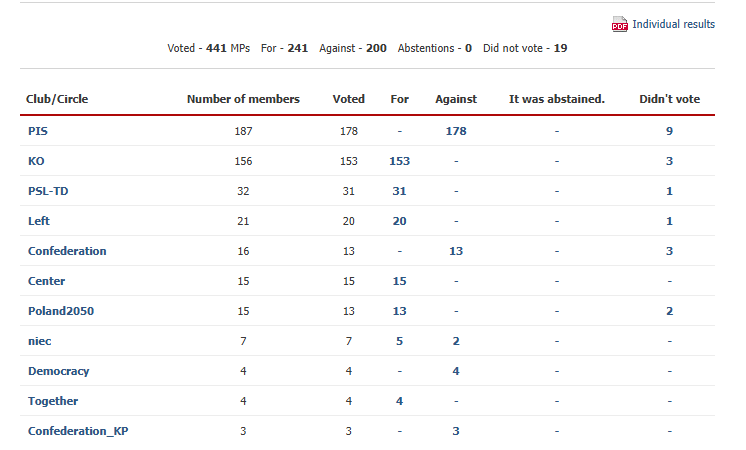
Source : SEJM

Vendredi, ils ont approuvé le projet de loi soutenu par le gouvernement — numéroté 2529 et soutenu par le ministère des Finances — par un vote de 241 voix contre 200. C'était la troisième fois que le gouvernement poussait ce type de législation au parlement après que le président Karol Nawrocki ait opposé son veto à deux versions antérieures.

Le projet de loi approuvé confie de larges pouvoirs à l'Autorité de surveillance financière polonaise, connue sous le nom de KNF, pour surveiller les participants au marché des cryptomonnaies, imposer des sanctions administratives et bloquer des comptes et des transactions lorsque cela est jugé nécessaire.

Les critiques soulignent des dispositions inchangées

Le résultat n'a pas été accueilli favorablement par toute la communauté des cryptomonnaies. Les acteurs du marché et les commentateurs ont noté que les dispositions sur le blocage des comptes et des transactions — les mêmes qui avaient motivé les vetos précédents de Nawrocki — restaient largement intactes dans le texte final. Des modifications proposées, telles qu'un contrôle judiciaire renforcé des mesures d'exécution, n'ont pas été incluses.

BTCUSD s'échange à 79 182 $ sur le graphique 24h : TradingView

Ces préoccupations n'étant pas résolues, de nombreux observateurs s'attendent à ce que le président oppose à nouveau son veto au projet de loi. Cette perspective inquiète les acteurs du secteur, car un troisième rejet approfondirait l'incertitude réglementaire à un moment particulièrement inopportun.

La Pologne est tenue d'aligner ses règles sur le Règlement de l'Union européenne sur les marchés des crypto-actifs, connu sous le nom de MiCA, avec des échéances de mise en œuvre approchant en juillet.

Quatre projets de loi, un seul résultat

Le vote est intervenu après que les députés aient examiné des propositions concurrentes provenant de quatre sources distinctes : le gouvernement, le président, le parti Confédération et un groupe parlementaire. Une commission a fusionné les textes avant le vote final, et la version gouvernementale a finalement prévalu.

Image principale de Hotels.com, graphique de TradingView

Domande pertinenti

QQuel événement a ajouté de l'urgence au vote parlementaire polonais sur la régulation des cryptomonnaies, selon l'article ?

ALe Premier ministre Donald Tusk a lié l'échec répété de l'adoption de règles sur les cryptomonnaies au cas de fraude très médiatisé de l'échange Zondacrypto, ce qui a ajouté de l'urgence au vote.

QQuelle est l'autorité qui obtiendra des pouvoirs étendus de surveillance du marché des cryptomonnaies selon le projet de loi approuvé ?

AL'autorité qui obtiendra des pouvoirs étendus est la Commission de surveillance financière polonaise, connue sous le nom de KNF (Komisja Nadzoru Finansowego).

QPourquoi de nombreux observateurs s'attendent-ils à un nouveau veto présidentiel contre ce projet de loi ?

ADe nombreux observateurs s'attendent à un nouveau veto présidentiel car les dispositions controversées sur le blocage des comptes et des transactions, qui avaient motivé les vetos précédents du président Nawrocki, sont restées largement inchangées dans le texte final.

QQuelle est la contrainte de temps qui pèse sur la Pologne concernant la régulation des cryptomonnaies, mentionnée dans l'article ?

ALa Pologne est tenue de mettre ses règles en conformité avec le Règlement de l'Union européenne sur les marchés des crypto-actifs (MiCA), avec des délais de mise en œuvre qui approchent en juillet 2026.

QCombien de projets de loi distincts ont été débattus simultanément au Sejm (la chambre basse du parlement polonais) ?

ALes députés ont débattu simultanément de quatre projets de loi distincts, provenant du gouvernement, du président, du parti Confédération et d'un groupe parlementaire.

Letture associate

When Futu Turns into a Matchmaking Corner: Overseas Identity Becomes the Hard Currency for the Middle Class

When Futu Becomes a Matchmaking Corner: Overseas Status as the New Hard Currency for China's Middle Class Following a severe penalty announcement from Chinese regulators on May 22nd targeting offshore brokerages like Futu, its app community unexpectedly transformed into an impromptu matchmaking platform. Users posted相亲 (matchmaking) requests, explicitly seeking partners with overseas residency or citizenship, revealing a stark new reality: for China's middle class, an overseas identity has become a crucial asset. The regulatory crackdown, which restricts mainland Chinese residents from opening new accounts to buy overseas securities like US stocks, has sharply escalated the value of a foreign passport or permanent residency. This status now acts as a gateway to global asset allocation—including US equities, offshore property, and foreign currency deposits—effectively becoming a new form of "hard currency." Its scarcity, non-transferability (except through marriage, inheritance, etc.), and role as a hedge against domestic uncertainty have driven its premium. The article traces the evolution of how China's middle class views overseas resources: from an investment for opportunity (2000s), to risk diversification (2010s), and now to a mandatory "insurance policy" for financial access. With the regulatory window closing for many, the demand is shifting towards securing such status for the next generation through international education. The surreal scene of high-performing investors posting dating resumes underscores a 2026 where financial talent can be secondary to the right passport.

marsbit23 min fa

When Futu Turns into a Matchmaking Corner: Overseas Identity Becomes the Hard Currency for the Middle Class

marsbit23 min fa

Understanding Bound in One Article: The "Multi-signature + Timelock" Escape Mechanism and the Off-Chain Matching Black Box

**Title**: Understanding Bound: The Escape Mechanism of "Multi-Sig + Time Lock" and the Off-Chain Matching Black Box **Summary**: Bound Exchange, evolved from the earlier radFi platform, introduces a novel approach to Bitcoin trading by combining self-custody security with exchange-like speed. Its core mechanism relies on a 2-of-2 multi-signature (multi-sig) address for user deposits. One private key is held by the user via a passkey, and the other is held by Bound. This setup requires both keys to sign any transaction, preventing Bound from unilaterally accessing user funds (non-custodial). To address the risk of Bound becoming unavailable, a 3-month timelock is integrated into the Bitcoin script. After this period, users can withdraw their assets with just their single signature, ensuring an escape hatch. For trading, Bound operates a concentrated liquidity AMM. However, as Bitcoin L1 lacks smart contracts, the AMM curve, liquidity management, and trade price calculations occur off-chain in Bound's backend database. On-chain Bitcoin transactions serve only as final settlement receipts for pre-determined amounts. This creates a centralization point: the critical sequence of trade execution—which determines the exact price along the curve for each order—is managed off-chain by Bound in a non-transparent "black box." While the 2-of-2 setup protects user本金 (principal), the pricing and ordering of trades introduce potential operational MEV risks, as the order processing is invisible and unverifiable on-chain. In practice, users can also connect external wallets (like Unisat) for fully self-custodied trading, but this requires manually signing every transaction. The platform currently supports deposits of BTC and Runes only.

marsbit28 min fa

Understanding Bound in One Article: The "Multi-signature + Timelock" Escape Mechanism and the Off-Chain Matching Black Box

marsbit28 min fa

Technology Has No Barriers, 24/7 Trading is the Key to Hyperliquid's Success

The article argues that Hyperliquid's competitive edge lies not in technological superiority but in its 24/7 trading model, which fundamentally challenges traditional finance's fixed market hours. Based in Singapore with an 11-person team, Hyperliquid has generated significant revenue and trading volume. Its core advantage is the ability to facilitate trading continuously, including during weekends when major exchanges like the CME are closed. This was demonstrated when Hyperliquid listed a SpaceX pre-IPO perpetual contract on a Sunday, allowing the market to price the company hours before traditional institutions opened. This disruption has drawn regulatory scrutiny from traditional giants like CME and ICE, who cite risks like lack of KYC and market manipulation. However, the article suggests their concern stems from Hyperliquid eroding the "time monopoly" of established markets. The piece contrasts Hyperliquid's synthetic derivatives—pure price-betting contracts with no underlying asset or centralized issuer—with other models like PreStocks (dependent on real股权) and Ondo (licensed but targetable). Hyperliquid's code-based, decentralized structure makes it resilient to takedowns, even if founders face legal action. Ultimately, the author concludes that while it raises legitimate regulatory questions, Hyperliquid's "unforgeable" competitive barrier is the time advantage of non-stop trading, a feature legacy systems cannot replicate.

marsbit34 min fa

Technology Has No Barriers, 24/7 Trading is the Key to Hyperliquid's Success

marsbit34 min fa

New Information Laundering in Prediction Markets: How Secrets Blend into Investment Signals

"The New Information Laundering in Prediction Markets: How Secrets Infiltrate Investment Signals In late February 2026, nine linked anonymous wallets on Polymarket placed over 80 bets on specific details of a US-Iran war, winning over $2.4 million with a 98% win rate. This exemplifies 'information laundering'—a destructive flaw inherent to prediction markets. These markets function by aggregating trader supply and demand on an order book to set prices, which represent collective probability estimates. This makes them valuable real-time sentiment indicators for institutions. However, the system cannot distinguish between public information and stolen secrets. Confidential information enters one end, and 'clean' market prices—bearing no trace of their illicit origin—emerge from the other. For example, an insider knowing of an imminent strike can buy contracts at low odds, pushing the price up and disguising the secret as a savvy market signal, then profit massively when the event occurs. Analysts can sometimes uncover these schemes due to the blockchain's transparency, as seen with Bubblemaps. Paradoxically, this same transparency can inadvertently broadcast secrets to adversarial observers, providing them with low-cost intelligence. Current laws, like insider trading regulations focused on corporate information, fail to address this issue, especially concerning events like military actions with no 'issuer.' Jurisdictional challenges are amplified as platforms operate offshore, easily bypassing national bans with VPNs. Recent US congressional investigations and proposed bills aim to ban war betting and trading on non-public information by officials. The core issue is that information laundering is not a bug but a feature: a market that perfectly converts knowledge into price will inherently reward those with the best information, including those who obtained it illicitly. As prediction markets grow, potentially reaching hundreds of billions in volume, society must confront whether it can tolerate a machine that profitably transforms its most guarded secrets into public, tradable numbers."

链捕手43 min fa

New Information Laundering in Prediction Markets: How Secrets Blend into Investment Signals

链捕手43 min fa

Trading

Spot
Futures

Articoli Popolari

Come comprare BILL

Benvenuto in HTX.com! Abbiamo reso l'acquisto di Billions Network (BILL) semplice e conveniente. Segui la nostra guida passo passo per intraprendere il tuo viaggio nel mondo delle criptovalute.Step 1: Crea il tuo Account HTXUsa la tua email o numero di telefono per registrarti il tuo account gratuito su HTX. Vivi un'esperienza facile e sblocca tutte le funzionalità,Crea il mio accountStep 2: Vai in Acquista crypto e seleziona il tuo metodo di pagamentoCarta di credito/debito: utilizza la tua Visa o Mastercard per acquistare immediatamente Billions NetworkBILL.Bilancio: Usa i fondi dal bilancio del tuo account HTX per fare trading senza problemi.Terze parti: abbiamo aggiunto metodi di pagamento molto utilizzati come Google Pay e Apple Pay per maggiore comodità.P2P: Fai trading direttamente con altri utenti HTX.Over-the-Counter (OTC): Offriamo servizi su misura e tassi di cambio competitivi per i trader.Step 3: Conserva Billions Network (BILL)Dopo aver acquistato Billions Network (BILL), conserva nel tuo account HTX. In alternativa, puoi inviare tramite trasferimento blockchain o scambiare per altre criptovalute.Step 4: Scambia Billions Network (BILL)Scambia facilmente Billions Network (BILL) nel mercato spot di HTX. Accedi al tuo account, seleziona la tua coppia di trading, esegui le tue operazioni e monitora in tempo reale. Offriamo un'esperienza user-friendly sia per chi ha appena iniziato che per i trader più esperti.

68 Totale visualizzazioniPubblicato il 2026.05.07Aggiornato il 2026.05.12

Come comprare BILL

Discussioni

Benvenuto nella Community HTX. Qui puoi rimanere informato sugli ultimi sviluppi della piattaforma e accedere ad approfondimenti esperti sul mercato. Le opinioni degli utenti sul prezzo di BILL BILL sono presentate come di seguito.

活动图片