$30 Billion DeFi Capital Exodus: LayerZero Stumbles, Chainlink Feasts

marsbitPubblicato 2026-05-13Pubblicato ultima volta 2026-05-13

Introduzione

Following the major DeFi security incident involving Kelp DAO, a significant migration of funds is underway from the cross-chain protocol LayerZero to Chainlink's CCIP (Cross-Chain Interoperability Protocol). Over $30 billion in Total Value Locked (TVL) from protocols like Kelp DAO, Solv Protocol, Re, and Tydro has moved to Chainlink in the past week, driven by security concerns. LayerZero is facing a severe trust crisis after the attack. Initially denying responsibility, LayerZero Labs has now issued a public apology, acknowledging management oversights. These include a vulnerable "1/1" single-node configuration for its Decentralized Verification Network (DVN) and past misuse of a multi-signature wallet by a team member. The protocol's weekly bridge volume has slumped to near-historic lows of around $470 million. In contrast, Chainlink is experiencing a surge in adoption and activity. Its independent active addresses recently hit multi-month highs, and whales have been accumulating LINK tokens. Beyond DeFi, Chainlink is securing partnerships with traditional finance giants like DTCC, European stock exchange operator SIX Group, and asset manager Amundi. While LayerZero has announced security upgrades—such as migrating to stronger multi-signature configurations and developing a second DVN client—and contributed to a rescue fund, the event underscores that security is becoming a decisive competitive factor as DeFi matures.

Author: Nancy, PANews

With several leading protocols stepping in to inject capital, quickly covering the funding gap and advancing on-chain recovery, the rescue efforts for the Kelp DAO attack incident have recently seen substantial progress. However, compared to the financial repairs, the harder thing to restore remains market trust.

At the center of this vortex, cross-chain leader LayerZero is facing accelerating withdrawals from many protocols and was forced to make a dramatic shift in attitude within just a few weeks—from initially shifting blame and denying responsibility to now publicly apologizing and initiating rectifications. Meanwhile, Chainlink has unexpectedly become a beneficiary of this crisis, with its CCIP protocol absorbing a large portion of migrating liquidity, showing notable growth in on-chain data.

Securing $30 Billion in Migration in a Single Week, Chainlink Reaps Security Dividends

As the largest DeFi security incident to date in 2026, the Kelp DAO attack has accelerated the migration of on-chain liquidity.

As LayerZero's security controversy continues to ferment, an increasing number of DeFi protocols are reevaluating cross-chain risks and proactively seeking more reliable havens. Over the past week, Chainlink has intensively announced multiple migration cases.

On May 9, Chainlink officially disclosed that four protocols, including Kelp DAO, Solv Protocol, Re, and Tydro, had recently abandoned their original cross-chain bridge or oracle solutions and migrated to Chainlink CCIP. The combined TVL of these related protocols exceeds $30 billion. The official even specifically added the phrase "The Great Migration" to hype this ecosystem shift, revealing strong competitive undertones.

Behind this migration wave is a realignment centered on security.

And besides DeFi protocols realigning due to security concerns, Chainlink has also been continuously gaining favor from traditional financial institutions and crypto projects in recent months.

In March of this year, Coinbase directly put its exchange market data on-chain for the first time via Chainlink's newly launched DataLink service; Europe's largest asset management firm, Amundi, collaborated with Spiko to launch a tokenized public fund based on Chainlink.

In April, OpenAssets formed a strategic partnership with Chainlink, launching an asset tokenization infrastructure solution for institutions; major European stock exchange operator SIX Group partnered with Chainlink to push Swiss and Spanish stock market data on-chain; AWS Marketplace listed Chainlink data services, connecting traditional cloud and blockchain.

In May, the US Depository Trust & Clearing Corporation (DTCC) announced the introduction of Chainlink to build a blockchain collateral management platform, aiming to achieve near-real-time settlement around the clock; Huma Finance partnered with Chainlink to introduce institutional-grade yield products into the multi-chain ecosystem.

Accompanying the ongoing ecosystem expansion, Chainlink's on-chain activity has also noticeably heated up. According to Santiment monitoring, Chainlink's number of unique active addresses broke 282,000 and 264,000 on May 9 and 10, respectively, hitting the highest records since September 2025, and noted this was primarily influenced by the recent large-scale migration of DeFi protocol infrastructure.
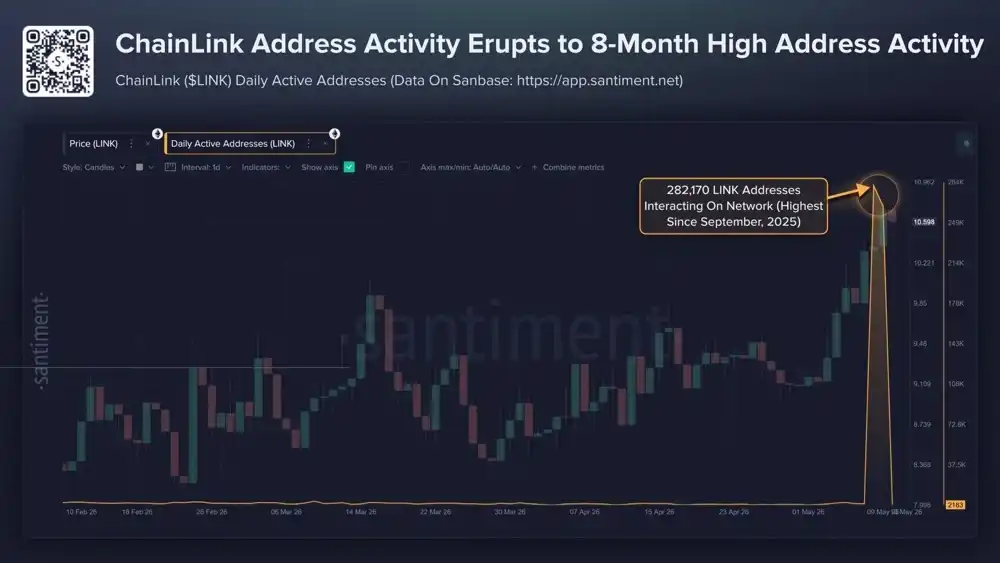
Meanwhile, official Chainlink data shows that the total value of its cross-chain tokens has exceeded $61.8 billion, with CCIP transaction volume reaching $19.5 billion.

Market confidence is also reflected in changes in LINK token holdings. According to Santiment monitoring earlier this month, over the past month, Chainlink whale and shark addresses holding between 100,000 and 10 million LINK cumulatively added 32.93 million LINK. Historically, this has often been a strong bullish signal. Over the past 30 days, LINK has risen approximately 19.7%.

LayerZero Faces Trust Crisis, Officials Issue Emergency Apology and Overhaul

Currently, LayerZero is mired in a trust crisis.

According to DefiLlama data, LayerZero's weekly Bridge transaction volume has now declined to about $470 million, approaching historical lows. This attack incident has plunged LayerZero into a trust crisis.
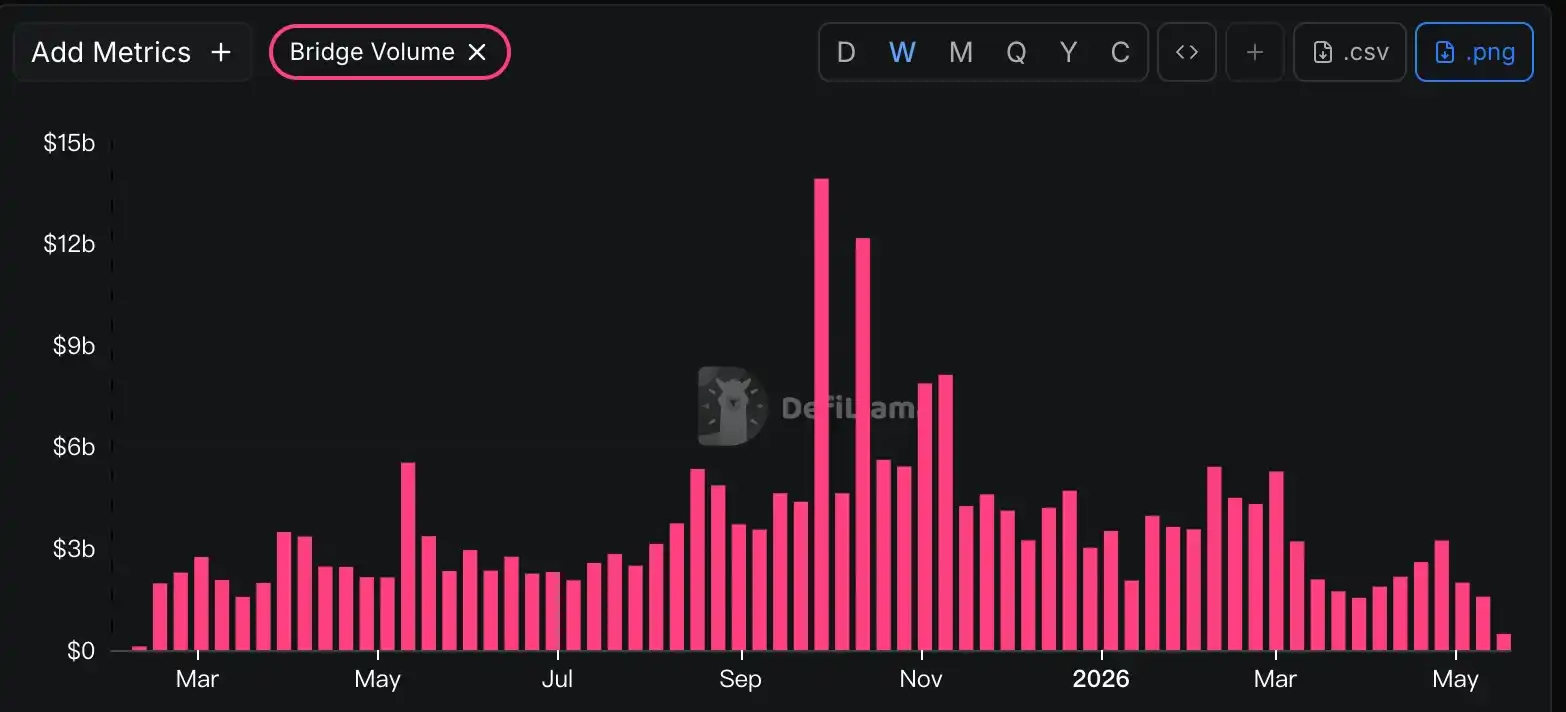
In the early stages of the hack, Kelp DAO attributed the vulnerability exploit to LayerZero's security issues. Subsequently, LayerZero quickly denied responsibility, stating that multiple accusations by Kelp DAO in the rsETH security incident were completely false.

But the controversy did not subside. Last week, LayerZero Labs co-founder and CEO Bryan Pellegrino engaged in heated debates with several security researchers in the ETHSecurity Community Telegram group.

The focal point of contention is that LayerZero Labs could immediately upgrade the default library contract without a timelock, theoretically allowing forged cross-chain messages. This exposed over $3 billion in LZ OFT assets to potential risk for a period. Security researcher Banteg pointed out that several mainstream projects, including Ethena and EtherFi, were still using this default library weeks ago, and about $178 million in assets remain exposed to risk.

Simultaneously, on-chain data also showed that LayerZero's multi-signature address had conducted Meme coin trading, DEX swaps, and cross-chain bridging operations unrelated to multi-signature duties, further raising community concerns about key security. In response, Bryan admitted that related operations were indeed performed by multi-signature team members but denied they constituted "Meme coin speculation trading," claiming the purpose was merely "testing PEPE OFT functionality," and stated that the involved members had been removed.

To mitigate risks, Bryan also publicly advised project teams to promptly adopt a "fixed configuration" to replace the default configuration. Subsequently, Banteg published a list of LayerZero projects still using the default library contract and called on related protocols to migrate as soon as possible.

These remarks quickly sparked industry discussion and skepticism. Chainlink Strategy Lead Zach Rynes had previously criticized LayerZero Labs, stating that its multi-signature keys had long suffered from serious OPSEC (operational security) failures, directly exposing tens of billions in OFT assets to security risks. He further stated that if LayerZero and the industry had truly heeded the persistent warnings from security researchers over the past few years, such attack incidents could have been entirely avoided.

Facing market舆论 and ongoing ecosystem bleeding, LayerZero's attitude shifted noticeably. On May 9, LayerZero officially released a public apology statement, addressing the security incidents and communication issues over the past three weeks.

LayerZero Labs stated that the internal RPC it used had been attacked by the Lazarus Group over the past three weeks, compromising the authenticity source of its DVN (Decentralized Verification Network), while external RPC providers suffered DDoS attacks. The incident affected only 0.14% of applications and approximately 0.36% of asset value, the LayerZero protocol itself was unaffected, and over $9 billion in assets continued normal cross-chain flow after the incident.

However, LayerZero Labs also acknowledged for the first time that it was responsible for management oversight in previously allowing DVNs to provide security for high-value transactions with a "1/1" single-node configuration, which posed a single point of failure risk. The official also disclosed that three and a half years ago, a multi-signature signer mistakenly used a multi-signature hardware wallet for personal transactions. That signer has been removed, and the relevant wallet has been rotated.

Regarding subsequent rectifications, LayerZero Labs announced a series of security upgrade measures, including: already ceasing services for the 1/1 DVN configuration, currently migrating all path default configurations to a 5/5 multi-signature setup with a minimum of 3/3; developing a second DVN client based on Rust to achieve client diversity; launching the dedicated multi-signature tool OneSig to enhance signature security; and launching the unified management platform Console for asset issuance configuration and abnormal behavior detection.

Additionally, LayerZero also contributed over 10,000 ETH to this DeFi United rescue effort, of which 5,000 ETH will be used for the fund, and the remaining 5,000 ETH will be reserved for Aave.

Despite the escalating controversy, LayerZero has not completely lost its market. Major assets, including Ethena's USDe product, EtherFi's weETH asset, and BitGo's WBTC, continue to use LayerZero's OFT standard.

Every major security crisis triggers a redistribution of liquidity and discourse power. As the crypto industry increasingly moves towards mainstream financial markets, the criteria for evaluating underlying infrastructure will become ever more stringent, with security capabilities becoming one of the core competitive advantages.


Domande pertinenti

QWhat was the immediate consequence of the Kelp DAO hack on the cross-chain infrastructure landscape?

AIt triggered a rapid migration of DeFi liquidity away from LayerZero due to security concerns, with over $30 billion in TVL from protocols like Kelp DAO moving to Chainlink's CCIP within a week.

QAccording to the article, what were two key security issues highlighted by researchers regarding LayerZero?

AFirst, LayerZero's default library contract, which could be upgraded instantly without a timelock, potentially allowing forged cross-chain messages. Second, suspicious non-multisig-related activities from a multisig signer address, raising concerns about key security.

QHow did Chainlink's on-chain activity and LINK token react to the migration trend mentioned in the article?

AChainlink's daily active unique addresses surged to over 282,000 and 264,000, the highest since September 2025. Furthermore, whales and sharks holding 100k to 10M LINK accumulated over 32.9 million LINK in a month, while the LINK token price rose approximately 19.7% in 30 days.

QWhat specific corrective measures did LayerZero announce in its public apology on May 9th?

ALayerZero announced several measures: stopping service for 1/1 DVN configurations, migrating all paths to at least 3/3 or 5/5 multisig setups, developing a second DVN client in Rust for client diversity, launching a dedicated multisig tool called OneSig, and releasing a management platform called Console for configuration and anomaly detection.

QDespite the crisis, which major assets and protocols were mentioned as still continuing to use LayerZero's technology?

AMajor assets and protocols continuing to use LayerZero's OFT standard include Ethena's USDe, EtherFi's weETH, and BitGo's WBTC.

Letture associate

Duan Yongping Opens Position in Circle: What Is He Betting On?

Duan Yongping, the renowned value investor known as the "Chinese Buffett," has made a surprising move by taking a $19 million position in Circle (CRCL), a leading regulated stablecoin issuer, via his H&H International investment vehicle. This signals a significant embrace of Web3 assets by traditional capital. The article analyzes Circle's recent strategic shift to diversify beyond its core model, where 99% of its 2024 revenue came from interest on USDC reserves. To transform from an "interest rate proxy" into an infrastructure platform, Circle has launched two major initiatives. First, it raised $222 million in a token presale for Arc, a new Layer-1 blockchain optimized for USDC-native finance. This move is seen as a defensive play to build a proprietary settlement rail and reduce its heavy reliance on a revenue-sharing agreement with Coinbase, which claimed over half of Circle's 2024 income. Second, Circle introduced the Circle Agent Stack, a developer toolkit for building AI agents that can transact with USDC, targeting the emerging field of nanopayments for autonomous AI activity. This is framed as an offensive strategy against competitors like Stripe. However, Circle's core business faces headwinds from falling interest rates and new U.S. regulations (the GENIUS Act) that could encourage banks to issue their own stablecoins. While new revenue streams from Arc and Agent Stack are growing, they currently constitute less than 6% of total revenue. The bullish thesis depends on successful execution of all three strategic pillars: USDC circulation growth, Arc adoption generating meaningful fees, and Agent Stack gaining early dominance. The bear case warns that structural pressures on the core business may outpace these new ventures' growth. The market currently prices CRCL cautiously, reflecting the high stakes of this transition.

marsbit12 min fa

Duan Yongping Opens Position in Circle: What Is He Betting On?

marsbit12 min fa

NVIDIA Earnings Countdown: Beating Expectations Is a Near Certainty, but Wall Street Is Most Concerned About These Five Questions

NVIDIA Earnings Countdown: Beating Expectations is a Given, but Wall Street Cares Most About These Five Issues The upcoming NVIDIA Q1 earnings report is expected to easily surpass the consensus revenue estimate of ~$78.7B. However, Wall Street's focus has shifted from the numbers themselves to five key strategic questions. **1. Shareholder Returns: Will "Frugality" Change?** Despite being the S&P 500's largest company, NVIDIA's shareholder returns (dividends + buybacks) averaged only 47% of its free cash flow from 2022-2025, far below the 80% peer average and its own historical norm. Its 0.02% dividend yield also lags the peer average of 0.89%. This low cash return, partly due to investments in AI ecosystem partners, is cited as a core reason for NVIDIA's valuation discount compared to other "Magnificent 7" stocks. Increasing returns could attract long-term income funds and be a catalyst. **2. Vera Rubin: The Next-Gen Chip Timeline** Analysts expect the next-generation Vera Rubin (R200) platform to ramp in the second half of 2026, following the current Blackwell series. It will use TSMC's 3nm process and share Blackwell Ultra's "Oberon" rack architecture, suggesting a smooth transition with limited gross margin impact. The market also awaits any update on NVIDIA's $1 trillion cumulative revenue forecast for 2025-2027. **3. Gross Margin: Can the 75% Level Hold?** Gross margin, a key valuation support, is expected to stabilize in the near term due to the shared architecture between Blackwell and Vera Rubin. The consensus sees it fluctuating between 74-75%. The main long-term pressure is the rising cost contribution of HBM memory. **4. AI Accelerator Market Forecast Update** The report anticipates the total AI accelerator market will reach ~$1.17 trillion by 2030, with NVIDIA maintaining a 68-70% share. The focus is on whether NVIDIA will update its forecast to include new growth drivers: LPU racks, its Vera CPU, and the Vera Rubin Ultra platform. **5. Competition: Are Threats from Google TPU/CPU Overstated?** The analysis disputes narratives that the rise of "Agentic AI" elevates CPU importance over GPU, threatening NVIDIA. It notes NVIDIA's own "Vera CPU" is competitive, and current Blackwell/TPU clusters already use a 1:2 CPU-to-GPU ratio, contrary to the "more CPUs needed" story. NVIDIA's dominance in AI accelerators is seen as secure. **Valuation Discount:** NVIDIA trades at a significant discount to Mag-7 peers: ~50% based on CY26/27 P/E (26x/19x vs. 49x/42x avg.) and over 66% based on EV/FCF. Bank of America maintains a "Buy" rating with a $320 price target.

marsbit14 min fa

NVIDIA Earnings Countdown: Beating Expectations Is a Near Certainty, but Wall Street Is Most Concerned About These Five Questions

marsbit14 min fa

Interlace: The World's Leading Agentic Payment and Stablecoin Infrastructure Platform, Building the Next-Generation Digital Financial Foundation

Interlace: A Leading Agentic Payment and Stablecoin Infrastructure Platform Interlace is a global stablecoin infrastructure platform bridging traditional and crypto finance. It addresses the fragmentation between crypto assets, global payments, and enterprise treasury management by integrating stablecoin payments, digital business banking, asset management, virtual card issuance, and AI payment capabilities into a unified global financial network. Key product pillars include: 1. **Next-Generation Payment Network**: Features **Agent Card** for AI agents (enabling autonomous spending with controls) and **Scan to Pay** for seamless stablecoin (USDT/USDC) to fiat payments via QR codes in emerging markets. 2. **Stablecoin Payment & Card Issuance**: Offers **Infinity Card** for corporate spend management, **CaaS (Card as a Service)** for embedded card issuance APIs, and **Infinity Launch** for turnkey white-label financial systems. 3. **Enterprise Accounts & Banking**: Provides **Business Accounts** for multi-currency management and **BaaS (Banking as a Service)** APIs for embedded global payments and banking capabilities. 4. **Crypto Finance Infrastructure**: Enables **On/Off Ramp** services for fiat-crypto conversions and ensures security with PCI DSS Level-1 certification, MPC wallets, and global compliance licenses. 5. **Integrated Financial Ecosystem**: Includes **Yield Treasury** for idle cash management and a full suite of APIs, serving over 12,000 businesses across 180+ countries. Interlace aims to make stablecoins viable for everyday payments and empower AI agents with secure spending, building the foundational infrastructure for the future of digital finance.

链捕手24 min fa

Interlace: The World's Leading Agentic Payment and Stablecoin Infrastructure Platform, Building the Next-Generation Digital Financial Foundation

链捕手24 min fa

Stanley Druckenmiller: From Soros' Comrade-in-Arms to the Godfather of Macro Investing—System, Disciples, and Latest Thoughts

Stanley Druckenmiller is a pivotal figure in global macro investing, renowned for his partnership with George Soros, his legendary fund Duquesne Capital, and a decades-long track record of near-30% annualized returns without a single annual loss. His methodology uniquely blends value, growth, macro, and trend investing. A key early experience was as a bank stock analyst, grounding him in both company fundamentals and macro forces. His most famous trade, shorting the British Pound in 1992, exemplified his approach: identifying unsustainable structural contradictions and concentrating capital on high-probability, high-payoff opportunities. The "Duquesne System" is built on four pillars: macro-directional analysis, concentrated bets on best ideas, rapid error correction, and acute awareness of liquidity. His famous phrase "Invest, then investigate" reflects a dynamic approach of entering a position based on a strong initial thesis and then adjusting based on market feedback. This differs fundamentally from Warren Buffett's focus on long-term intrinsic business value; Druckenmiller focuses on marginal changes, cycles, and capital allocation at inflection points. His influence extends through protégés like Scott Bessent (market execution) and Kevin Warsh (policy insight), representing the dual market-and-institutional understanding he embodies. He closed his flagship fund in 2010 at its peak, prioritizing flexibility and performance over asset-gathering. Recent moves highlight his core logic: reducing AI exposure as expectations became crowded while investing in copper, recognizing the underlying infrastructure and resource demands of the AI boom. He remains concerned about long-term US dollar purchasing power due to fiscal deficits and monetary policy. His core skill is judging risk/reward payoff, not just prediction accuracy. For ordinary investors, key lessons are to focus on marginal changes, align position size with conviction and risk, and seek second-order opportunities beneath surface-level narratives. Ultimately, Druckenmiller is a strategist who combines macro insight with price discipline, decisive action with rigorous risk management, succeeding by identifying major market mispricings, acting before full consensus, and exiting swiftly when proven wrong.

marsbit1 h fa

Stanley Druckenmiller: From Soros' Comrade-in-Arms to the Godfather of Macro Investing—System, Disciples, and Latest Thoughts

marsbit1 h fa

Trading

Spot
Futures
活动图片