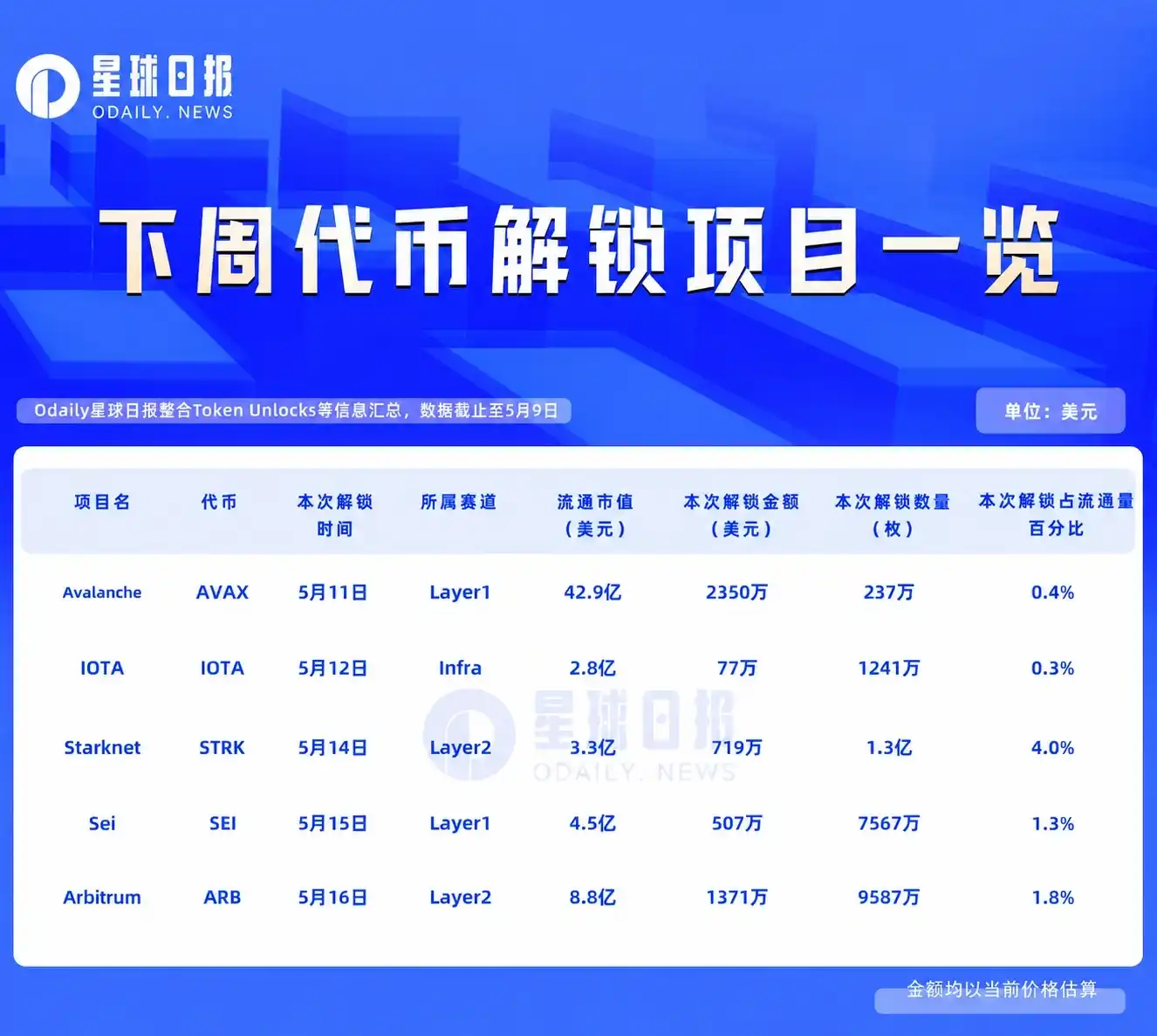
Déblocage de tokens hebdomadaire : STRK débloque 4% de l'offre en circulation mais le prix monte

marsbitPubblicato 2026-05-10Pubblicato ultima volta 2026-05-10

Introduzione

Déverrouillage hebdomadaire de jetons : STRK déverrouille 4% de l'offre circulante mais le prix augmente. **Starknet (STRK)** * Quantité déverrouillée : 130 millions de jetons. * Valeur : environ 7.19 millions de dollars. * Description : Starknet est un réseau Layer 2 pour Ethereum, utilisant la technologie zk-STARKs pour accélérer les transactions et réduire les frais. Développé par StarkWare, il valide les calculs hors chaîne pour améliorer le débit. **Arbitrum (ARB)** * Quantité déverrouillée : 95.87 millions de jetons. * Valeur : environ 13.71 millions de dollars. * Description : Arbitrum est une solution Rollup pour Ethereum qui regroupe les transactions hors chaîne pour plus de rapidité et de faibles coûts, tout en préservant la sécurité du réseau principal Ethereum. Son jeton natif, ARB, permet une gouvernance protocolaire.

Starknet

Projet Twitter : https://twitter.com/Starknet

Site web du projet : https://starknet.io/

Quantité débloquée cette fois : 130 millions de jetons

Montant débloqué cette fois : Environ 7,19 millions de dollars US

Starknet est une solution de couche 2 (Layer2) pour Ethereum, utilisant la technologie zk-STARKs pour rendre les transactions sur Ethereum plus rapides et moins coûteuses. La société mère de Starknet, StarkWare, a été fondée en 2018, son siège est en Israël, et ses principaux produits sont Starknet et StarkEx. En utilisant STARK, Starknet vérifie les transactions et les calculs sans que tous les nœuds du réseau aient besoin de vérifier chaque opération. Cela réduit considérablement la charge de calcul et augmente le débit du réseau blockchain.

Arbitrum

Projet Twitter : https://twitter.com/arbitrum

Site web du projet : https://arbitrum.io/

Quantité débloquée cette fois : 95,87 millions de jetons

Montant débloqué cette fois : Environ 13,71 millions de dollars US

Arbitrum est une solution Rollup pour Ethereum, conçue pour améliorer l'évolutivité d'Ethereum. Il agrège et traite les transactions hors chaîne avant de soumettre une seule transaction à la chaîne principale d'Ethereum. Cela permet aux utilisateurs de bénéficier de transactions plus rapides et moins chères, tout en profitant toujours de la sécurité et de la décentralisation du réseau Ethereum. Le jeton natif d'Arbitrum est l'ARB. Les détenteurs d'ARB peuvent participer au processus décisionnel, par exemple en proposant et en votant des mises à niveau ou des modifications du protocole.


Domande pertinenti

QQuel est le sujet principal de cet article ?

AL'article traite principalement du déverrouillage hebdomadaire de tokens, en se concentrant sur le déverrouillage d'un montant important de tokens STRK de Starknet, et mentionne également le déverrouillage de tokens ARB d'Arbitrum.

QCombien de tokens STRK de Starknet seront déverrouillés et quelle est leur valeur approximative ?

A130 millions de tokens STRK seront déverrouillés, d'une valeur approximative de 7,19 millions de dollars.

QQuelle est la technologie fondamentale utilisée par Starknet pour améliorer Ethereum ?

AStarknet utilise la technologie zk-STARKs pour rendre les transactions Ethereum plus rapides et moins coûteuses en vérifiant les calculs hors chaîne avant de les soumettre à la chaîne principale.

QCombien de tokens ARB d'Arbitrum seront déverrouillés et quelle est leur valeur approximative ?

A95,87 millions de tokens ARB seront déverrouillés, d'une valeur approximative de 13,71 millions de dollars.

QQuel est le principal objectif d'Arbitrum en tant que solution de couche 2 pour Ethereum ?

AL'objectif principal d'Arbitrum est d'améliorer l'extensibilité d'Ethereum en agrégeant et en traitant les transactions hors chaîne pour offrir des transactions plus rapides et moins chères, tout en préservant la sécurité et la décentralisation du réseau Ethereum.

Letture associate

Focus: Five Leading AI Stocks on Nasdaq

The report analyzes five Nasdaq-listed AI infrastructure stocks—Micron (MU), MaxLinear (MXL), AMD, Lumentum (LITE), and Vicor (VICR)—as distinct plays within the AI capital expenditure chain, rather than a single "AI trade." While all benefit from AI data center spending, they differ in their specific roles (e.g., memory, computing, optics, power, connectivity), financial resilience, and risk profiles. The author argues that the key question is not whether the AI narrative remains intact, but whether capital expenditure translates into real orders, earnings justify valuations, and portfolios can withstand high volatility. Historical data shows these stocks have significantly outperformed benchmarks but also experienced deeper drawdowns (~28% to -32%), highlighting their high-beta, high-volatility nature. An investment framework is proposed: core positions (e.g., MU, AMD) for stocks with stronger fundamental evidence; satellite positions (e.g., LITE, VICR) for high-potential, high-volatility names; and cautious observation (e.g., MXL) for smaller-cap ideas with unproven financials. The emphasis is on disciplined, phased buying during pullbacks—only when price corrections align with intact fundamentals and available risk budget—rather than emotional "buy-the-dip" strategies. Overall, AI infrastructure offers long-term potential, but success requires strict position sizing, role definition for each holding, and preparedness for significant volatility.

marsbit38 min fa

Focus: Five Leading AI Stocks on Nasdaq

marsbit38 min fa

Will UNI Reach $100 in Four Years? Will Standard Chartered's Prediction Come True?

TL;DR: - According to reports, Standard Chartered Bank has published a research report on Uniswap, setting a 2030 price target of $100 for the UNI token. - The bank's core logic is that the tokenization of assets will drive demand for open DeFi liquidity, and Uniswap could capture significant trading volume and fee revenue. - However, most institutional-grade tokenized products are permissioned, and the example of BlackRock's BUIDL shows that DeFi still faces significant access barriers. Standard Chartered's $100 target for UNI by 2030 is based on the hypothesis that tokenized assets will grow massively and a significant portion will flow into open DeFi markets, requiring decentralized exchange platforms like Uniswap for liquidity. The bank forecasts tokenized assets could reach $4 trillion by 2028, with up to 30% in DeFi by 2030. The key question is whether tokenized assets like treasuries and funds will trade in open, decentralized markets or remain within closed, permissioned institutional systems. This directly impacts Uniswap's potential growth. A real-world example is BlackRock's BUIDL fund, which, while using UniswapX for trading, is strictly limited to pre-approved, whitelisted institutional participants. This highlights the current trend: institutions may leverage DeFi infrastructure but maintain strict control over access and transfers. Furthermore, for UNI's value to rise significantly, Uniswap must establish a clear value-capture mechanism, such as the approved fee switch and token burn proposal. Regulatory and interoperability hurdles also persist, as noted by bodies like the Financial Stability Board. In summary, Standard Chartered's bold prediction hinges on the future flow of tokenized asset liquidity. While it signals institutional recognition of DeFi's potential, the path to $100 depends on overcoming current permissioned models and enabling truly open, cross-asset liquidity pools on platforms like Uniswap.

Foresight News42 min fa

Will UNI Reach $100 in Four Years? Will Standard Chartered's Prediction Come True?

Foresight News42 min fa

Odaily Editorial Team Tea Talk (June 17)

Odaily Editorial Team Casual Chat (June 17) This is an informal column sharing real-time thoughts from Odaily's editorial team on industry news, data, and events. The content is based on actual investment and observations, does not constitute investment advice, and aims to expand perspectives. Azuma shared recent operations: small-scale buys in crypto (mainly BTC) at relatively high levels, a small addition to HOOD stock, and participation in World Cup prediction markets. He also discussed Hyperliquid, noting that while its token HYPE has performed well, its high price may hinder the expansion of its HIP-3 ecosystem by making market creation cost-prohibitive, potentially limiting the platform to just one major market (trade.xyz). Suzz emphasized the importance of a calm mindset in investing, stating that markets offer perpetual opportunities. He warned against "hindsight bias," where past opportunities seem obvious, and stressed that the present always holds new chances for those with the right knowledge and temperament. Golem analyzed SpaceX's acquisition of AI tool Cursor's parent company, Anysphere, for $60 billion paid entirely in SpaceX stock. He speculated whether Musk's interests might work to keep SpaceX's trading volume and market cap high in the short term to reduce the actual equity cost of the deal, noting current high retail investor enthusiasm. Wenser shared a market outlook: cautiously bullish on BTC, monitoring SpaceX stock post-IPO for a potential rise, observing World Cup trends favoring strong teams, and noting the continued strength of Japanese and Korean stocks. He highlighted Anthropic's potential for a massive future IPO and the defensive investment logic in "picks and shovels" AI infrastructure. Qin Xiaofeng discussed trading HYPE around $56-$70, viewing the $50-$60 range as long-term support due to Hyperliquid's dominance in on-chain traditional asset trading and its substantial fee revenue used to buy back HYPE. On ETH, he noted a divide between disappointed crypto natives and bullish traditional investors like Tom Lee, personally viewing current ETH prices as undervalued.

Odaily星球日报53 min fa

Odaily Editorial Team Tea Talk (June 17)

Odaily星球日报53 min fa

Under the Shock of Oil Prices and Inflation, Which Country Will Be the First to Sell Off Its Gold Reserves?

The article draws a parallel between the 2003 North American blackout and the potential collapse of the global financial system, framing the US dollar and Treasury market as the world's economic "power grid." It argues that the closure of the Strait of Hormuz is creating a shockwave, starting with oil-importing emerging markets like Turkey, India, and Indonesia. As oil prices rise, these nations are forced to sell dollar-denominated assets—first US Treasuries, then potentially their gold reserves—to afford fuel. Turkey is highlighted as a key case, having sold nearly 90% of its Treasuries and begun tapping gold reserves when oil was between $70-$105/barrel. The article warns that if prices spike to $150-$160/barrel, global buffers like oil inventories and strategic reserves will be depleted. This could trigger a cascade: vulnerable nations, having exhausted assets, could face economic and political collapse (like Sri Lanka in 2022). Their forced asset sales would drive US Treasury yields higher, potentially past a critical threshold (around 5%), forcing the US to choose between a bond market crash or hyperinflation through massive money printing. Ultimately, the piece posits that the dollar's long-term decline is inevitable. The first domino to fall will likely be a fragile emerging market, signaling the start of a chain reaction that eventually threatens the core of the dollar system. The conclusion advises holding tangible assets like gold and energy, which cannot be printed, as a hedge against currency devaluation.

marsbit1 h fa

Under the Shock of Oil Prices and Inflation, Which Country Will Be the First to Sell Off Its Gold Reserves?

marsbit1 h fa

Trading

Spot
Futures

Articoli Popolari

Come comprare 4

Benvenuto in HTX.com! Abbiamo reso l'acquisto di 4 (4) semplice e conveniente. Segui la nostra guida passo passo per intraprendere il tuo viaggio nel mondo delle criptovalute.Step 1: Crea il tuo Account HTXUsa la tua email o numero di telefono per registrarti il tuo account gratuito su HTX. Vivi un'esperienza facile e sblocca tutte le funzionalità,Crea il mio accountStep 2: Vai in Acquista crypto e seleziona il tuo metodo di pagamentoCarta di credito/debito: utilizza la tua Visa o Mastercard per acquistare immediatamente 44.Bilancio: Usa i fondi dal bilancio del tuo account HTX per fare trading senza problemi.Terze parti: abbiamo aggiunto metodi di pagamento molto utilizzati come Google Pay e Apple Pay per maggiore comodità.P2P: Fai trading direttamente con altri utenti HTX.Over-the-Counter (OTC): Offriamo servizi su misura e tassi di cambio competitivi per i trader.Step 3: Conserva 4 (4)Dopo aver acquistato 4 (4), conserva nel tuo account HTX. In alternativa, puoi inviare tramite trasferimento blockchain o scambiare per altre criptovalute.Step 4: Scambia 4 (4)Scambia facilmente 4 (4) nel mercato spot di HTX. Accedi al tuo account, seleziona la tua coppia di trading, esegui le tue operazioni e monitora in tempo reale. Offriamo un'esperienza user-friendly sia per chi ha appena iniziato che per i trader più esperti.

356 Totale visualizzazioniPubblicato il 2025.10.20Aggiornato il 2026.06.02

Come comprare 4

Discussioni

Benvenuto nella Community HTX. Qui puoi rimanere informato sugli ultimi sviluppi della piattaforma e accedere ad approfondimenti esperti sul mercato. Le opinioni degli utenti sul prezzo di 4 4 sono presentate come di seguito.

活动图片