Chainlink enregistre 480 millions d'engagements sociaux : Qu'est-ce que cela signifie pour le prix du LINK ensuite

ambcryptoPubblicato 2026-04-06Pubblicato ultima volta 2026-04-06

Introduzione

Chainlink (LINK) connaît une attention sociale massive avec 480 millions d'interactions, tandis que son prix atteint 8,97 USD (+5,24%). Cette dynamique est portée par trois facteurs principaux : le lancement d’un ETF par Grayscale (GLINK) ayant attiré 82,79 millions USD, le partenariat avec Mastercard pour connecter 3,5 milliards de cartes à la DeFi, et l’utilisation par Coinbase de Chainlink pour publier des données de trading on-chain. Cependant, les données on-chain de Santiment tempèrent cet optimisme, montrant une baisse des adresses actives et de l’intérêt ouvert, suggérant une activité réduite et un engouement peut-être temporaire. Malgré un sentiment positif fort de 82%, les métriques indiquent une prudence concernant le prix de LINK à court terme.

Au moment de la rédaction, la capitalisation mondiale du marché des crypto-monnaies s'élevait à 2,37 billions de dollars, en hausse de 3,04 %. Parmi les altcoins, Chainlink [LINK] gagnait un traction notable, se négociant à 8,97 $ après une hausse de 5,24 % au cours des 24 dernières heures.

Par ailleurs, la plateforme d'intelligence sociale LunarCrush a rapporté "une accélération à 480 millions d'engagements sociaux sur l'année écoulée", accompagnée d'une hausse de 82 % du sentiment positif envers les altcoins.
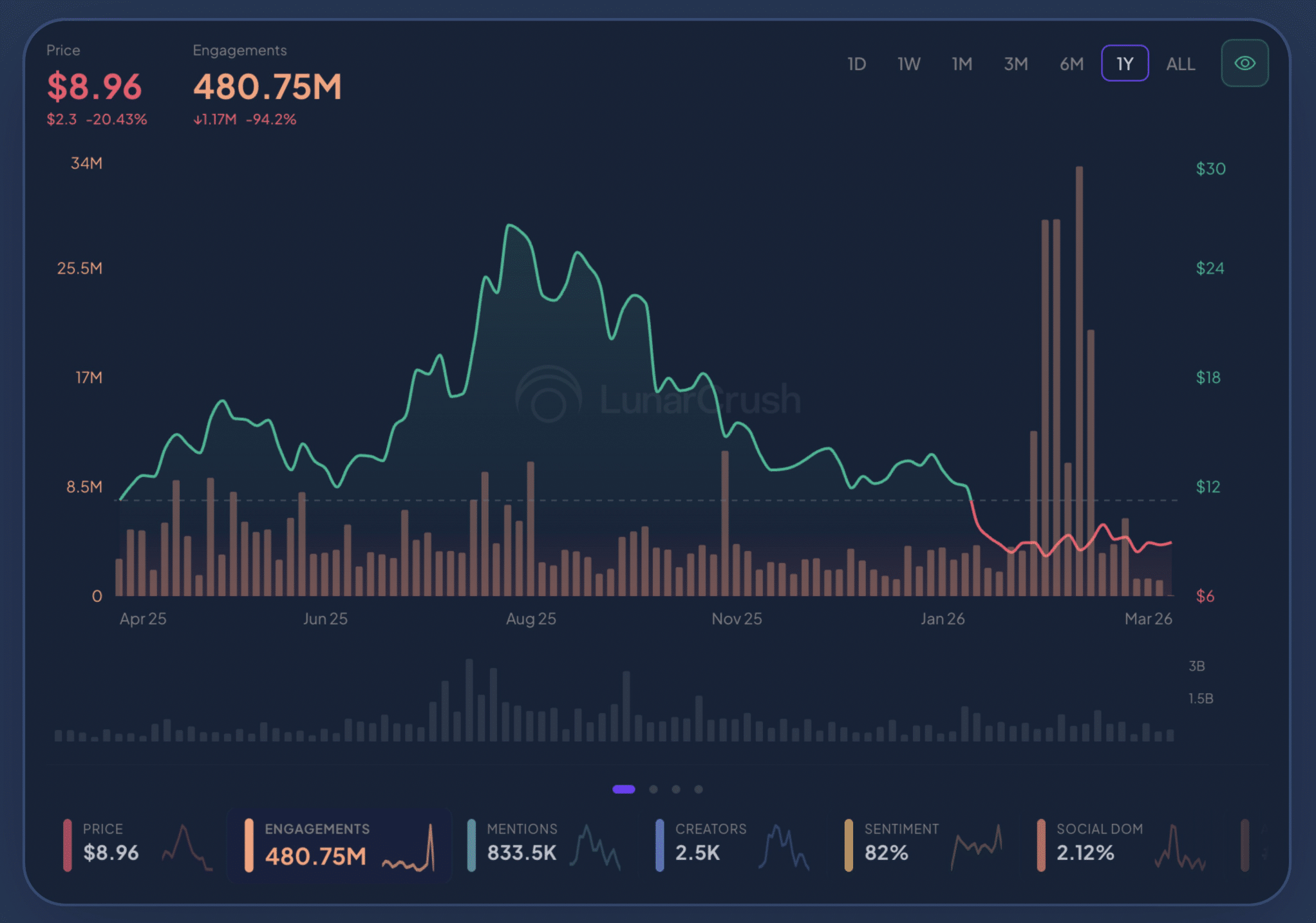
Source : Lunar Crush

Qu'est-ce qui se cache derrière cette flambée d'engouement autour de Chainlink ?

Cette augmentation des engagements sociaux est due à trois raisons principales. Commençons par l'inscription par Grayscale de leur premier ETF Chainlink américain ($GLINK) sur NYSE Arca, l'ETF ayant attiré 41 millions de dollars en seulement un jour. En fait,selon les dernières données de trading du 4 avril, GLINK a enregistré un flux net cumulé de 82,79 millions de dollars.

Parallèlement, l'ETF Chainlink de Bitwise ($CLINK) a enregistré 11,82 millions de dollars le même jour en flux net cumulé.
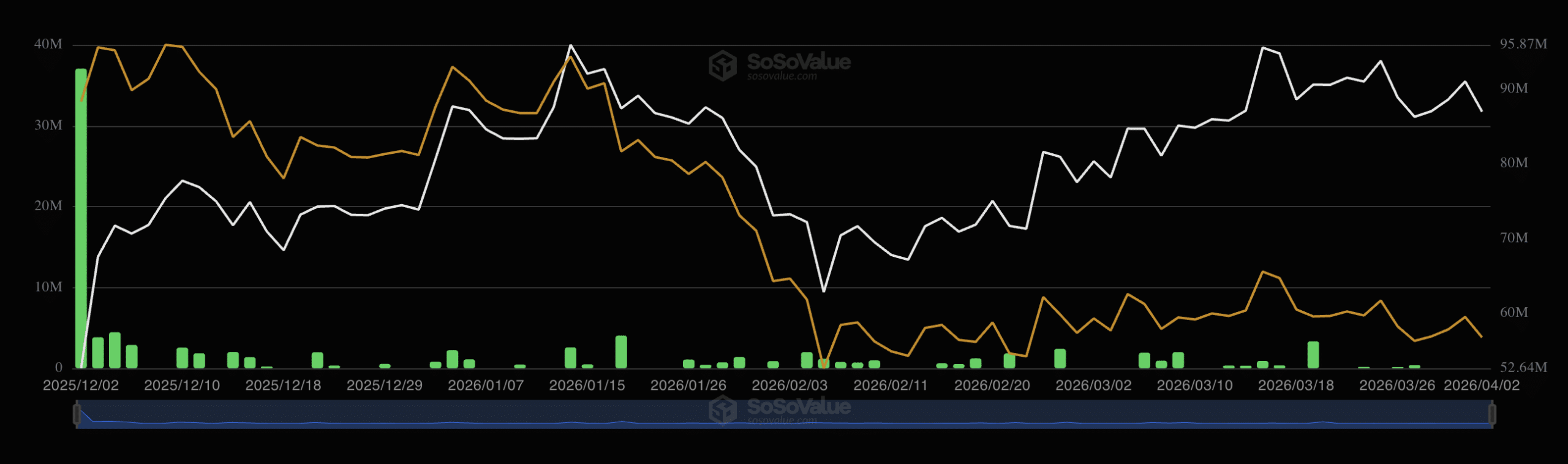
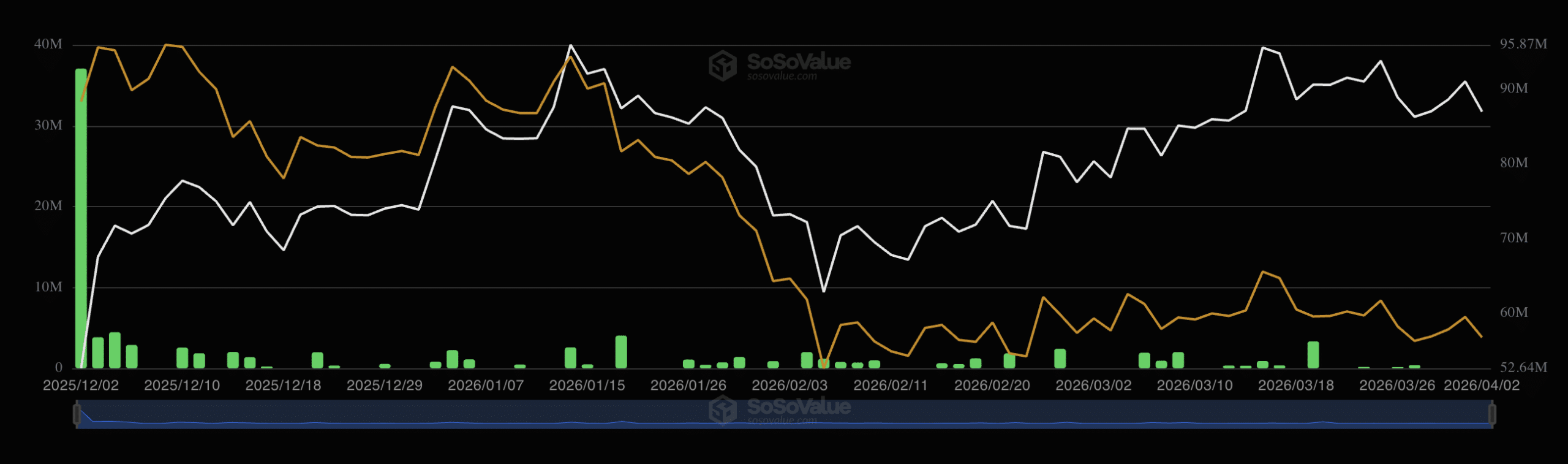
Source : SoSoValue

Deuxièmement, Mastercard a choisi Chainlink pour connecter ses 3,5 milliards de cartes (paiements hors chaîne) directement au monde DeFi sur chaîne. Avec cette initiative, les détenteurs de Mastercard peuvent accéder directement aux actifs crypto sur la chaîne avec l'aide de Swapper Finance, en s'appuyant sur le protocole Uniswap.

Commentant cela en 2025, Raj Dhamodharan, vice-président exécutif, Blockchain & Digital Assets chez Mastercard, avait déclaré :

Il n'y a aucun doute là-dessus – les gens veulent pouvoir se connecter facilement à l'écosystème des actifs numériques, et vice versa.

Chainlink agit comme un pont

Enfin, Coinbase envoie des données de trading, qui incluent "le carnet d'ordres et les données de perpétuelles (perpétuelles) sur la chaîne" directement sur la blockchain en utilisant Chainlink. Cela montre comment Chainlink agit comme un pont entre les classes d'actifs traditionnelles et numériques.

Voyant cet engouement autour de LINK, LunarCrush l'avait parfaitement résumé en notant :

C'est l'accès à Wall Street, l'accès au grand public et les données de niveau exchange, tout cela arrivant dans le même cycle.

Les données on-chain sèment davantage la confusion chez les investisseurs

Cependant, les métriques on-chain suggèrent que cet engouement pourrait être temporaire. Le graphique ci-dessous par Santiment montre clairement une baisse des Adresses Actives et de l'Intérêt Ouvert.
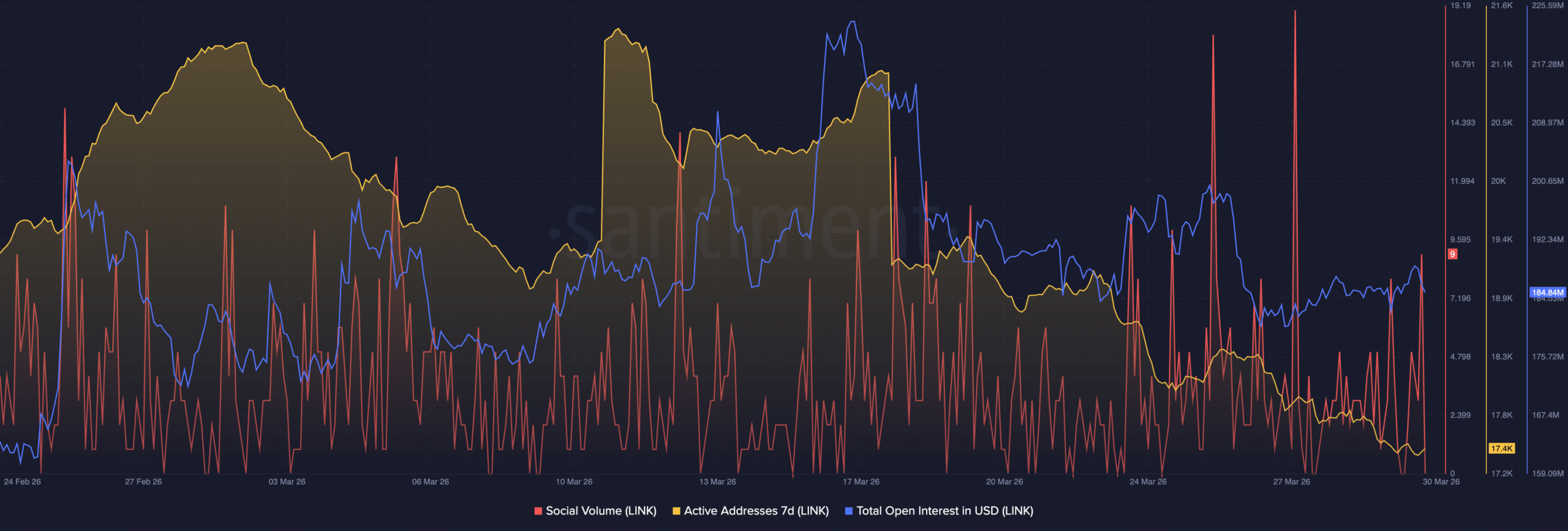
Source : Santiment

Ensemble, ces baisses indiquent une activité on‐chain réduite et un positionnement à court terme. Notamment, cela a coïncidé avec LINK faisant face aux plus importantes entrées de fonds cette année, environ 14,9 millions de LINK ayant été transférés entre des portefeuilles.


Résumé final

  • L'engagement social de Chainlink bat des records grâce aux ETF, Mastercard et Coinbase.
  • Les métriques on-chain suscitent des préoccupations négatives plutôt que des sentiments positifs.


Domande pertinenti

QQu'est-ce qui a provoqué l'augmentation de 480 millions d'engagements sociaux autour de Chainlink ?

ATrois facteurs principaux ont contribué à cette hausse : le lancement du premier ETF Chainlink par Grayscale (GLINK) qui a attiré 41 millions de dollars en un jour, le partenariat avec Mastercard pour connecter 3,5 milliards de cartes au monde DeFi, et l'utilisation de Chainlink par Coinbase pour transmettre des données de trading on-chain.

QQuel a été l'impact des ETF Chainlink sur les flux financiers ?

ALe GLINK de Grayscale a enregistré un flux net cumulé de 82,79 millions de dollars au 4 avril, tandis que le CLINK de Bitwise a atteint 11,82 millions de dollars le même jour, démontrant un intérêt institutionnel significatif.

QComment Mastercard utilise-t-il Chainlink pour relier les paiements traditionnels à la blockchain ?

AMastercard utilise Chainlink pour connecter ses 3,5 milliards de cartes de paiement off-chain à l'écosystème DeFi on-chain, permettant aux détenteurs d'accéder aux actifs cryptos via Swapper Finance et le protocole Uniswap.

QQue révèlent les métriques on-chain de Santiment sur l'activité réelle de Chainlink ?

ALes données de Santiment montrent une baisse des adresses actives et de l'intérêt ouvert (Open Interest), indiquant une réduction de l'activité on-chain et des positions à court terme malgré les annonces positives.

QQuel est le paradoxe entre le sentiment social et les indicateurs techniques pour LINK ?

AAlors que l'engagement social et les partenariats institutionnels génèrent un optimisme, les métriques on-chain signalent une activité réduite et des préoccupations à court terme, créant une divergence entre la perception du marché et les données techniques.

Letture associate

Uncovering the Truth About Agent Commerce, Payments, and Infrastructure

Decoding Agent Commerce, Payments, and Infrastructure: The Reality Over the past year, I've been building infrastructure for the Agent economy, engaging with major players like Stripe, Visa, Coinbase, Google, and dozens of startups. A clear conclusion emerges: true, large-scale demand does not yet exist. Startups face structural challenges. Data points illustrate this gap. Stripe's Agent commerce platform has over 1,000 merchants but only single-digit transacting agents. Visa's Agent payment token requires 9-month KYC and a $250M revenue threshold, accessible only to giants like Amazon. On-chain analysis reveals actual daily Agent transaction volume is around $17k, half of which are test transactions. The article analyzes four potential markets: **1. Agent-to-Merchant (A2M):** Current AI shopping UX is often inferior to traditional e-commerce for visual, comparison-heavy purchases (clothing, electronics). Chat interfaces are a step back. Real merchant interest is defensive "Agent Engine Optimization," fearing future obsolescence, not current demand. Potential exists in high-frequency, low-decision purchases (e.g., food delivery) or simplifying terrible UX (complex checkouts, non-native shoppers), but these require massive consumer distribution channels dominated by giants like DoorDash and Amazon. **2. Agent-to-API (A2A):** Developers already have subscriptions and billing for core APIs (compute, data). The argument for micro-payments via crypto for sub-dollar API calls is addressed by pre-paid balances today. The deeper issue is supplier resistance; major SaaS firms rely on enterprise contracts, not fractional cent pricing. Opportunity lies in the long tail of niche services, but this is a smaller market catering to developers, a historically low-paying group. **3. Agent-to-Agent (A2A):** This remains a theoretical long-term vision with near-zero current transaction volume. It involves unique challenges: discovery, trust, negotiation, dispute resolution. When it materializes, it will require a fundamentally new settlement infrastructure for high-speed, variable-value, multi-party transactions. It's a real long-term bet, but not the current market. **4. Agent-to-Finance (A2F):** This is the only category with existing, paying demand. Integrating AI into financial workflows (trading, portfolio management) is a natural evolution and enables new capabilities like autonomous rebalancing. However, competition favors incumbents with regulatory licenses, compliance infrastructure, and existing client relationships. **The Real Issue:** Why is infrastructure still being built? Incumbents can afford long-term bets, and payment companies see every problem as a nail for their payment hammer. However, payment is just one piece. The core challenge is *coordination*—orchestrating work between Agents and humans, verifying outcomes, and settling results. Payment is part of settlement, which is part of coordination. Companies that solve the coordination problem will subsume payments, not the other way around. Startups lack the infinite runway of giants and must find today's real market, which, after a year of exploration, lies outside these four categories—in an area with real, growing, and underserved activity.

marsbit6 min fa

Uncovering the Truth About Agent Commerce, Payments, and Infrastructure

marsbit6 min fa

Kalshi, MTS, and a16z's Ambition

The article "Kalshi, MTS, and a16z's Ambition" explores prediction markets as a focal point of excitement in 2025 for investors, crypto enthusiasts, and media. It traces their intellectual lineage from Friedrich Hayek's ideas on dispersed knowledge and market coordination to Robin Hanson's Logarithmic Market Scoring Rule (LMSR), which incentivizes truthful information sharing. The piece argues that a16z's significant investment in prediction market platform Kalshi (valued at $220B) transcends mere financial speculation. a16z frames prediction markets as a new form of "media" that provides "presence"—a way for individuals to actively engage with and influence world events through financial stakes, countering postmodern detachment. By wagering on outcomes, users become "super observers," and the market's aggregated probabilities gain authoritative power to define event truth and importance. The article uses media company MTS ("Monitoring The Situation") as a case study of a16z's "new media" strategy: rapidly producing high-intensity, multi-format content to "take over the timeline." However, prediction markets like Kalshi are presented as the ultimate piece in this media empire. Their real-money, crowd-sourced probabilities possess a unique "reality distortion field" and perceived objectivity, potentially swaying public opinion and granting a private company unprecedented interpretive power over reality. Ultimately, Kalshi's immense valuation is attributed not just to its exchange model, but to its role as a foundational component in a16z's envisioned new media landscape, where prediction markets define narrative and truth.

链捕手6 min fa

Kalshi, MTS, and a16z's Ambition

链捕手6 min fa

US Stocks Suffer Worst Plunge Since 2025: Three Triggers Ignite Tech Stock Valuation Reset

The US stock market experienced its most severe sell-off since the 2025 tariff crisis on June 5th, 2025. The Nasdaq Composite plummeted 4.18%, the S&P 500 fell 2.64%, and the Dow Jones dropped 695 points. The panic stemmed from three converging factors. First, Broadcom's earnings report ignited fears of a slowdown in AI growth. While its AI chip revenue surged 143% YoY to $10.8B, its Q3 AI revenue guidance of $16B fell short of the $17.2B consensus. This triggered a massive sector-wide sell-off, with the Philadelphia Semiconductor Index crashing 10.26% and semiconductor stocks losing roughly $1.3 trillion in market value in a single day. Second, a shockingly strong May jobs report crushed hopes for Federal Reserve rate cuts. Non-farm payrolls added 172,000 jobs, doubling expectations. This robust data, combined with persistently high oil prices above $92/barrel due to the ongoing Iran war and blockade of the Strait of Hormuz, drastically increased market expectations for a potential Fed rate hike instead of a cut. Higher interest rates compress the valuations of growth-heavy tech stocks. Third, the prolonged Iran conflict continues to fuel inflationary pressures, complicating the Fed's policy decisions and undermining the "inflation is tamed" narrative. Together, these events challenged the twin pillars of the market rally: the "limitless AI growth" story and expectations for imminent monetary easing. The sell-off spread globally, impacting Asian and European markets and cryptocurrencies. The article posits this is likely a severe "valuation repricing" rather than the end of the AI story. The underlying demand for AI remains strong, but investor expectations for growth speed and the prices they are willing to pay are being recalibrated. Key upcoming factors include the June FOMC meeting, future AI company earnings, and developments in the Iran conflict.

marsbit4 h fa

US Stocks Suffer Worst Plunge Since 2025: Three Triggers Ignite Tech Stock Valuation Reset

marsbit4 h fa

From Madison Square Garden to Kalshi: Prediction Markets Break into the NBA Finals

From Madison Square Garden to Kalshi: Prediction Markets Break into the NBA Finals Prediction markets are playing a significant role in the 2026 NBA Finals, particularly around the New York Knicks' unexpected 2-0 series lead. Platforms like Kalshi and Polymarket have seen massive trading volumes, exceeding hundreds of millions of dollars on championship and related markets. Their influence extends beyond online trading. Kalshi's official partnership with Madison Square Garden has given it prominent physical branding at the arena. Furthermore, local businesses like The Jeffrey bar are using prediction market contracts to hedge the risk of game-result-based promotions, turning potential losses into manageable costs—a concept similar to the famous "Mattress Mack" strategy from traditional sports betting. These markets differentiate themselves by offering a wider, more entertainment-focused range of "event contracts" beyond typical game outcomes, such as predicting celebrity attendance. They also have broader accessibility across the U.S. compared to age- and location-restricted traditional sportsbooks. However, their rapid integration into sports raises regulatory and ethical questions. The NBA is cautiously engaging, discussing integrity frameworks with regulators like the CFTC. While the league permits minor investments like Giannis Antetokounmpo's stake in Kalshi, it advocates for strict rules to prevent insider trading. Many fans express concern on platforms like Reddit, fearing that the close ties between prediction markets, the league, and players could compromise the game's integrity. The NBA Finals has thus become a high-stakes testing ground, showcasing prediction markets' commercial potential while challenging traditional boundaries between financial trading, entertainment, and gambling.

marsbit6 h fa

From Madison Square Garden to Kalshi: Prediction Markets Break into the NBA Finals

marsbit6 h fa

Trading

Spot
Futures

Articoli Popolari

Come comprare LINK

Benvenuto in HTX.com! Abbiamo reso l'acquisto di ChainLink (LINK) semplice e conveniente. Segui la nostra guida passo passo per intraprendere il tuo viaggio nel mondo delle criptovalute.Step 1: Crea il tuo Account HTXUsa la tua email o numero di telefono per registrarti il tuo account gratuito su HTX. Vivi un'esperienza facile e sblocca tutte le funzionalità,Crea il mio accountStep 2: Vai in Acquista crypto e seleziona il tuo metodo di pagamentoCarta di credito/debito: utilizza la tua Visa o Mastercard per acquistare immediatamente ChainLinkLINK.Bilancio: Usa i fondi dal bilancio del tuo account HTX per fare trading senza problemi.Terze parti: abbiamo aggiunto metodi di pagamento molto utilizzati come Google Pay e Apple Pay per maggiore comodità.P2P: Fai trading direttamente con altri utenti HTX.Over-the-Counter (OTC): Offriamo servizi su misura e tassi di cambio competitivi per i trader.Step 3: Conserva ChainLink (LINK)Dopo aver acquistato ChainLink (LINK), conserva nel tuo account HTX. In alternativa, puoi inviare tramite trasferimento blockchain o scambiare per altre criptovalute.Step 4: Scambia ChainLink (LINK)Scambia facilmente ChainLink (LINK) nel mercato spot di HTX. Accedi al tuo account, seleziona la tua coppia di trading, esegui le tue operazioni e monitora in tempo reale. Offriamo un'esperienza user-friendly sia per chi ha appena iniziato che per i trader più esperti.

835 Totale visualizzazioniPubblicato il 2024.12.13Aggiornato il 2026.06.02

Come comprare LINK

Discussioni

Benvenuto nella Community HTX. Qui puoi rimanere informato sugli ultimi sviluppi della piattaforma e accedere ad approfondimenti esperti sul mercato. Le opinioni degli utenti sul prezzo di LINK LINK sono presentate come di seguito.

活动图片