LayerZero Anjlok Setelah Dijual $15 Juta oleh Alameda – Akankah ZRO Alami Lebih Banyak Tekanan?

ambcryptoPubblicato 2026-04-01Pubblicato ultima volta 2026-04-01

Introduzione

LayerZero (ZRO) mengalami tekanan jual signifikan setelah Alameda Research mendepositokan 7,93 juta token ZRO senilai $15,3 juta ke Wintermute, mengosongkan seluruh kepemilikannya. Dampaknya, harga ZRO turun 8,42% menjadi $1,83, dengan kapitalisasi pasar merosot 7% ke $575 juta. Indikator teknis seperti RSI yang turun ke 41 dan harga di bawah EMA 50/100 hari mengonfirmasi tren bearish. ZRO kini menguji support $1,8; jika tembus, berpotensi lanjut ke $1,4. Meski demikian, Netflow negatif selama 30 hari berturut-turut menunjukkan permintaan pembeli masih aktif, memberikan harapan stabilisasi jika tekanan jual mereda. Pemulihan ke $2 mungkin terjadi jika demand mampu serap tekanan jual.

LayerZero mengalami tekanan penurunan signifikan sejak ditolak di level $2.2 seminggu lalu. Altcoin ini telah ditutup pada level terendah yang lebih rendah selama periode tersebut, menyentuh titik terendah $1.8.

Pada waktu peliputan, LayerZero [ZRO] diperdagangkan pada $1.83, turun 8.42% dalam grafik harian. Pada periode yang sama, kapitalisasi pasar altcoin ini anjlok 7% menjadi $575 juta.

Meskipun pasar melemah, pemain institusional terus menjual ZRO, semakin memberatkan pasar.

Alameda Research Jual 7.93 Juta ZRO

Setelah 2 bulan tidak aktif, Alameda Research melanjutkan aksi jual LayerZero-nya. Menurut Lookonchain, Alameda Research mendepositokan 7.93 juta ZRO senilai $15.3 juta ke Wintermute.

Dengan penjualan terbaru ini, dompet tim telah melepas seluruh kepemilikan LayerZero-nya. Biasanya, ketika tim melepas aset selama tren turun, hal ini menandakan kurangnya kepercayaan terhadap pasar.

Adakah Dampak pada ZRO?

Perlu dicatat, Alameda Research telah beberapa kali menjual ZRO sebelumnya, dan hampir setiap kali, mereka menjual di dekat puncak lokal.

Misalnya, terakhir kali tim Alameda menjual token ini, ZRO anjlok dari $2.10 ke $1.50. Kali ini, bagaimanapun, tampaknya tim menjual lebih dalam ke dalam penurunan.

Menyusul penjualan terbaru, token bereaksi agresif, turun lebih dari 6%. Bahkan, tekanan jual mempercepat momentum penurunan altcoin ini.

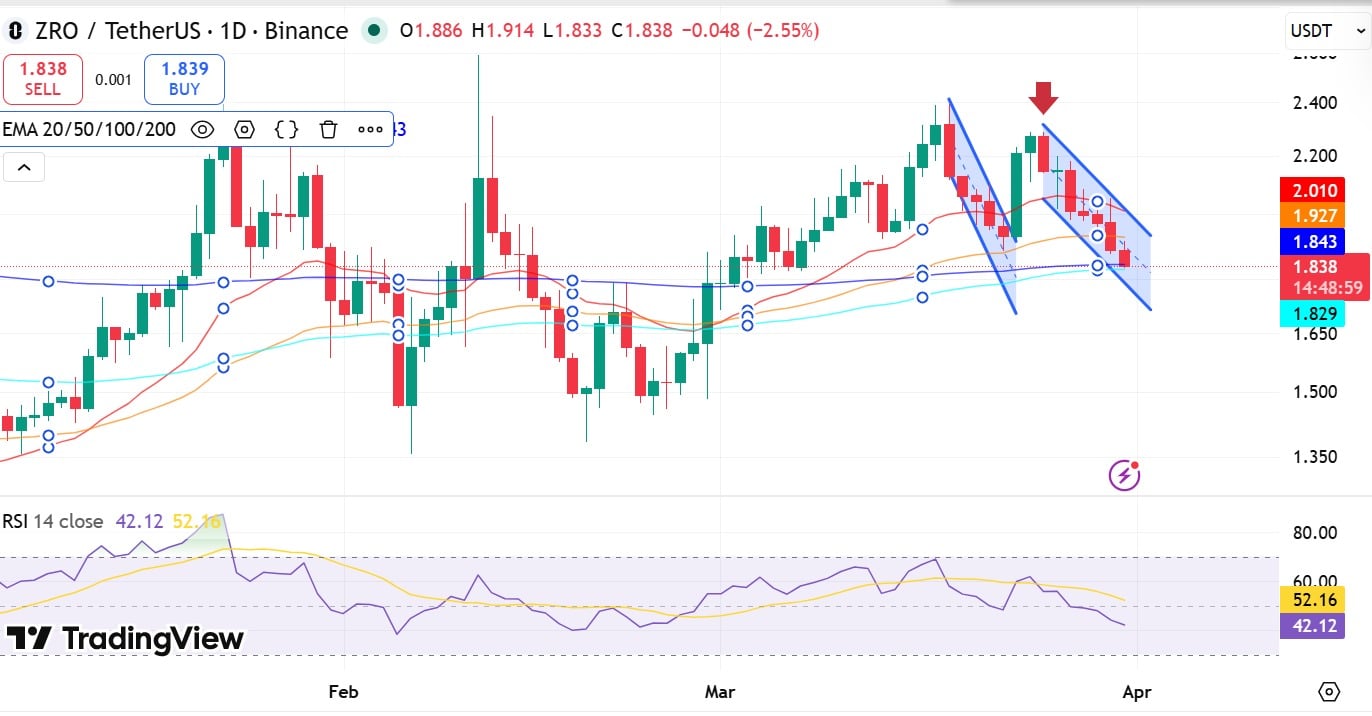
Karenanya, Relative Strength Index (RSI) altcoin ini turun dari 47 ke 41, semakin jauh masuk ke zona bearish.
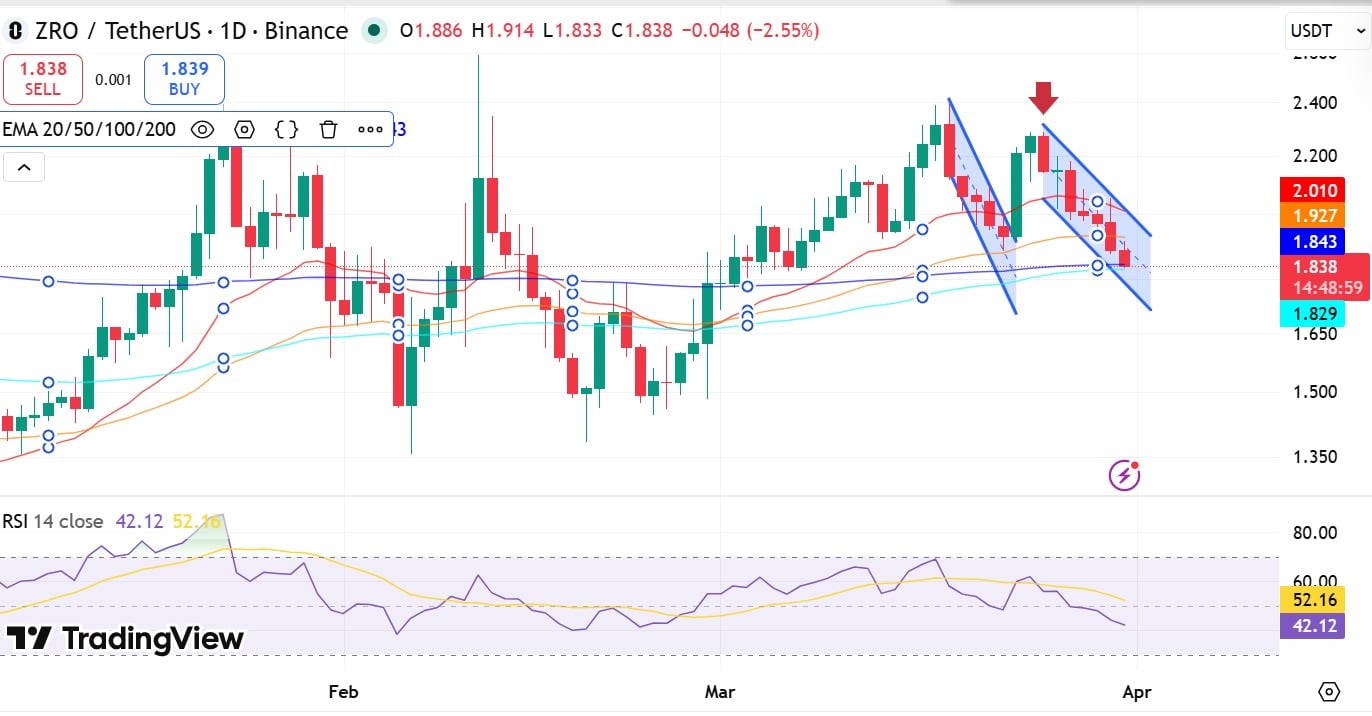
Sumber: TradingView

Pada saat yang sama, ZRO jatuh di bawah EMA 50 dan 100 hari, semakin mengonfirmasi kekuatan tren. Oleh karena itu, jika tekanan jual, terutama dari entitas besar, terus berlanjut, tren turun kemungkinan akan menguat.

Saat ini, ZRO sedang menguji support $1.8; jika tekanan mengintensif dan gagal bertahan, altcoin bisa meluncur ke arah $1.4.

Pembeli LayerZero Masih Tetap Aktif di Pasar

Meskipun LayerZero terus menurun, pembeli sebagian besar tetap aktif selama periode ini. Aktivitas bursa semakin menggema permintaan pasar ini.

Data Coinglass menunjukkan bahwa Arus Bersih Spot (Spot Netflow) tetap negatif selama lebih dari 30 hari berturut-turut. Pada waktu peliputan, Arus Bersih altcoin adalah -$609k.
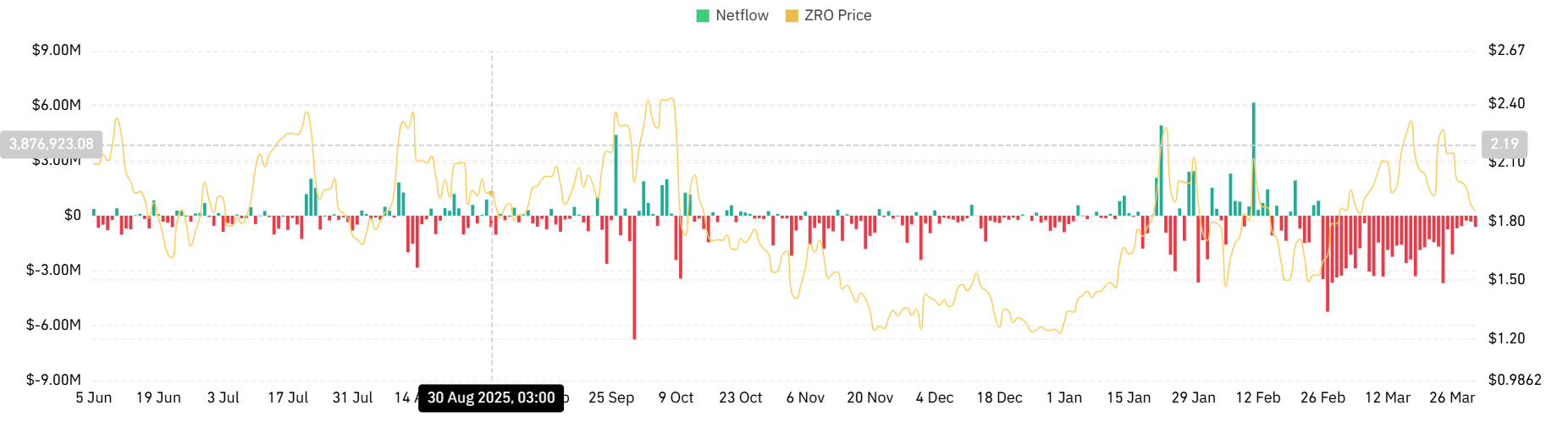
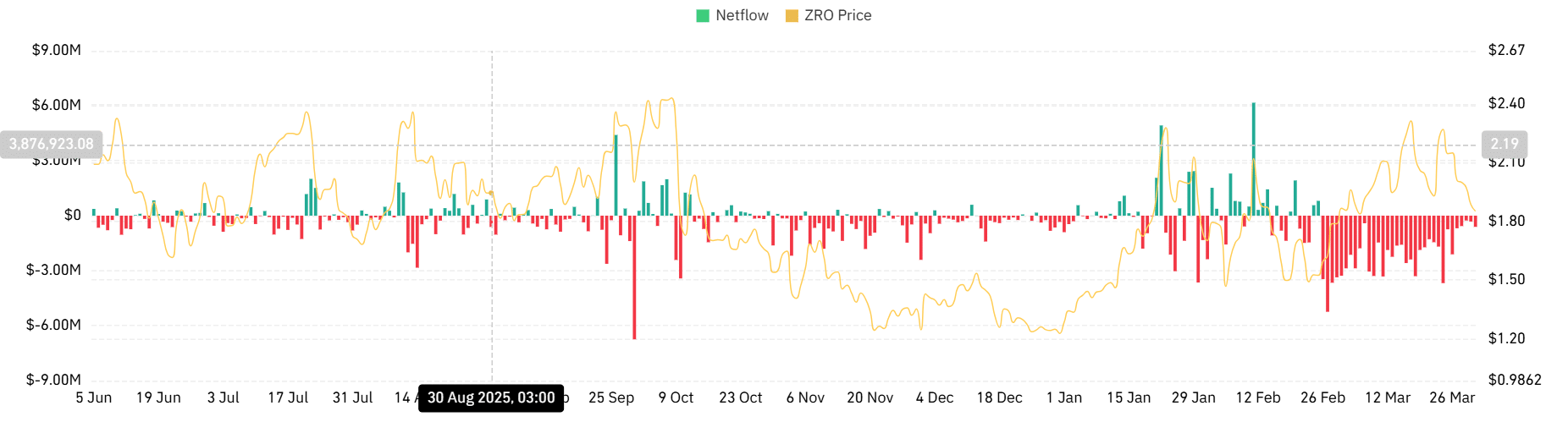
Sumber: CoinGlass

Arus bersih negatif yang berkelanjutan menunjukkan bahwa pembeli telah melampaui penjual di bursa. Secara tradisional, kehadiran pembeli yang lebih tinggi telah mengurangi pasokan, meningkatkan kelangkaan, dan dengan demikian membantu menstabilkan harga.

Meskipun sejua ini permintaan gagal menyerap tekanan, hal ini memberikan altcoin ini tali penyelamat dan dapat menawarkan dukungan signifikan. Jika pasar akhirnya merasakan permintaan ini dan penjual sudah kelelahan di bawah $2, ZRO bisa rebound, merebut kembali $2, dan menargetkan $2.2.


Ringkasan Akhir

  • Alameda Research kembali setelah dua bulan tidak aktif dan menjual 7.93 juta ZRO senilai $15.3 juta.
  • LayerZero [ZRO] turun 8.42%, menerobos support $2, dan menyentuh titik terendah $1.83 di tengah tekanan jual yang meningkat.


Domande pertinenti

QApa yang menyebabkan penurunan harga LayerZero (ZRO) baru-baru ini?

AHarga LayerZero (ZRO) mengalami tekanan penurunan signifikan setelah Alameda Research mendepositokan 7,93 juta ZRO senilai $15,3 juta ke Wintermute, yang menandakan kurangnya kepercayaan dan mempercepat momentum penurunan.

QBerapa banyak ZRO yang dijual oleh Alameda Research dan apa dampaknya?

AAlameda Research menjual 7,93 juta token ZRO senilai $15,3 juta. Dampaknya, harga ZRO turun lebih dari 6% dan RSI-nya jatuh dari 47 ke 41, semakin memperkuat zona bearish.

QBagaimana kondisi support level ZRO saat ini dan kemungkinan skenario selanjutnya?

AZRO saat ini sedang menguji level support di $1,8. Jika tekanan jual berlanjut dan gagal bertahan, altcoin berpotensi turun hingga $1,4. Namun, jika permintaan buyer kuat, ZRO bisa rebound ke $2 dan menargetkan $2,2.

QApa yang ditunjukkan oleh Netflow negatif ZRO di bursa?

ANetflow negatif yang bertahan selama lebih dari 30 hari berturut-turut menunjukkan bahwa buyer lebih dominan daripada seller di bursa, yang mengurangi pasokan dan dapat membantu menstabilkan harga meski belum sepenuhnya menyerap tekanan jual.

QApakah Alameda Research pernah melakukan aksi jual serupa sebelumnya dan bagaimana hasilnya?

AYa, Alameda Research telah beberapa kali menjual ZRO sebelumnya, dan hampir setiap kali mereka menjual di dekat puncak lokal. Contohnya, penjualan terakhir menyebabkan ZRO anjlok dari $2,10 menjadi $1,50.

Letture associate

Dalio's Latest Warning: Don't Get Carried Away by AI, Real Returns on US Stocks in the Next 5-10 Years Could Be -5% to -10%

Ray Dalio, founder of Bridgewater Associates, warns investors against excessive concentration in AI stocks. He argues the current market, dominated by a few AI giants, mirrors historical patterns where revolutionary new technologies lead to high risk, volatility, and uncertainty. While acknowledging AI's transformative potential, Dalio emphasizes that most investors fail at this stage of the cycle by over-concentrating in a handful of leading companies. He cites inherent risks: companies cannot accurately forecast investment needs or external shocks (e.g., monetary policy, geopolitics, taxes), face potential disruption from future technologies and international competition (notably from China), and experience significant price swings. Dalio's core advice is diversification, calling it his "Holy Grail of Investing." He presents a mathematical case that a well-diversified portfolio of 15-20 uncorrelated, good bets offers a superior risk-adjusted return compared to a concentrated position. Dalio also offers a cautious outlook, suggesting U.S. stocks may deliver real returns of -5% to -10% over the next 5-10 years based on valuation and bubble indicators. He concludes that in the face of high uncertainty, the prudent strategy is not to avoid betting entirely, but to avoid large, concentrated bets where one lacks sufficient informational edge. Instead, investors should build a strategically balanced, diversified portfolio.

marsbit50 min fa

Dalio's Latest Warning: Don't Get Carried Away by AI, Real Returns on US Stocks in the Next 5-10 Years Could Be -5% to -10%

marsbit50 min fa

Rain Valuation Approaches $20 Billion: The Battle for U-Cards Extends to Rewards Systems

Rain, a stablecoin payments infrastructure company, is shifting the competitive focus for U Cards from simple issuance to user retention and repeated usage. On June 15, Rain launched "Rain Rewards," an embedded loyalty program capability within its card-issuing infrastructure. This allows partner businesses—like fintech platforms and neobanks—to configure branded loyalty points, earning rules, redemptions, and merchant promotions directly within their card products. The system, built from the 2025 acquisition of Uptop, ensures points are only issued upon final transaction settlement, preventing liabilities from refunds. Trials, such as with Avalanche Card, reportedly boosted spending by 25% among enrolled users. Founded by Farooq Malik and Charles Yoo-Naut, Rain evolved from a tool for managing Web3 company expenses into a full-stack enterprise platform. It is a Principal Member of Visa and Mastercard, enabling partners to issue stablecoin-backed cards and wallets while leveraging traditional payment networks. Notably, the popular U Card Plasma One is issued by Rain under Visa's authority. Rain also integrates with Visa's stablecoin settlement pilot, using USDC for network settlement. Rain's rapid funding reflects growing institutional interest in stablecoin payment infrastructure. It raised a $245 million Series A in March 2025, a $58 million Series B in August 2025, and a $250 million Series C in January of this year, reaching a $19.5 billion valuation. Annualized transaction volume exceeds $3 billion, serving over 200 partners including Western Union and Nuvei. Beyond cards, Rain is expanding into programmable payments. Its June 2026 "Agent Control Layer" allows businesses to set spending rules—like merchant categories, amounts, and frequency—for AI agents before transactions occur. This positions Rain not as a single product but as an operating system for stablecoin payments, handling everything from card issuance and wallet management to rewards, on/off-ramps, and automated compliance. The goal is to enable seamless, often invisible, real-world spending of on-chain assets.

Foresight News53 min fa

Rain Valuation Approaches $20 Billion: The Battle for U-Cards Extends to Rewards Systems

Foresight News53 min fa

Google TPU Shipments Revised Up by 50%

Recent industry research indicates a significant upward revision in the shipments of Google's TPU (Tensor Processing Unit) chips. Previous expectations for 2027 were set at around 10 million units, but new estimates now point to 15 million units, a 50% increase. This substantial boost directly translates to higher demand across the entire supporting supply chain. Google's TPU clusters utilize a standardized all-optical interconnect architecture. Consequently, key hardware components are deeply integrated and scaled in fixed ratios with the chips. The 15 million TPU target will drive corresponding demand increases for NPO optical engines (roughly a 1:1 match), 1.6T optical modules, OCS optical switches, high-end server power supplies, fiber optics & MPO connectors, and liquid cooling solutions. Among these, liquid cooling is highlighted as the sector experiencing the most significant transformation and offering the most stable potential for excess returns. As next-generation TPU chips reach power levels where traditional air cooling is insufficient, liquid cooling becomes essential. 2026 is forecasted as the first year of substantial adoption for Google's liquid cooling solutions. This shift, coupled with delivery and capacity bottlenecks faced by incumbent overseas manufacturers, is creating a prime window for domestic Chinese suppliers to enter and secure Google's core supply chain. The market size for Google-specific liquid cooling is projected to potentially triple from a baseline of hundreds of billions to around 300 billion units by 2028. The logic for the fiber optic sector is also being rewritten. Once considered a cyclical commodity tied to telecom operator procurement, fiber is now a strategic and scarce resource for AI Data Centers (AIDC). A severe supply-demand imbalance, driven by the long lead time for preform production (18-24 months) and surging demand from cloud giants, is supporting strong performance. Chinese fiber manufacturers are well-positioned to capture a significant share of global AIDC demand, with exports potentially reaching 200-300 million core kilometers in 2026. Overall, the investment focus within the AI computing industry is shifting from pure "chip performance speculation" towards the more certain incremental growth in computing infrastructure and its supporting ecosystem. The upward revision in Google TPU shipments, along with the potential for further doubling by 2028, is seen as solidifying performance visibility for the entire supporting supply chain over the next two years.

marsbit2 h fa

Google TPU Shipments Revised Up by 50%

marsbit2 h fa

Trading

Spot
Futures

Articoli Popolari

Come comprare ZRO

Benvenuto in HTX.com! Abbiamo reso l'acquisto di LayerZero (ZRO) semplice e conveniente. Segui la nostra guida passo passo per intraprendere il tuo viaggio nel mondo delle criptovalute.Step 1: Crea il tuo Account HTXUsa la tua email o numero di telefono per registrarti il tuo account gratuito su HTX. Vivi un'esperienza facile e sblocca tutte le funzionalità,Crea il mio accountStep 2: Vai in Acquista crypto e seleziona il tuo metodo di pagamentoCarta di credito/debito: utilizza la tua Visa o Mastercard per acquistare immediatamente LayerZeroZRO.Bilancio: Usa i fondi dal bilancio del tuo account HTX per fare trading senza problemi.Terze parti: abbiamo aggiunto metodi di pagamento molto utilizzati come Google Pay e Apple Pay per maggiore comodità.P2P: Fai trading direttamente con altri utenti HTX.Over-the-Counter (OTC): Offriamo servizi su misura e tassi di cambio competitivi per i trader.Step 3: Conserva LayerZero (ZRO)Dopo aver acquistato LayerZero (ZRO), conserva nel tuo account HTX. In alternativa, puoi inviare tramite trasferimento blockchain o scambiare per altre criptovalute.Step 4: Scambia LayerZero (ZRO)Scambia facilmente LayerZero (ZRO) nel mercato spot di HTX. Accedi al tuo account, seleziona la tua coppia di trading, esegui le tue operazioni e monitora in tempo reale. Offriamo un'esperienza user-friendly sia per chi ha appena iniziato che per i trader più esperti.

179 Totale visualizzazioniPubblicato il 2024.12.10Aggiornato il 2026.06.02

Come comprare ZRO

Discussioni

Benvenuto nella Community HTX. Qui puoi rimanere informato sugli ultimi sviluppi della piattaforma e accedere ad approfondimenti esperti sul mercato. Le opinioni degli utenti sul prezzo di ZRO ZRO sono presentate come di seguito.

活动图片