Ethena lucha mientras sus ingresos caen un 32% – ¿Puede la demanda salvar a ENA en $0.089?

ambcryptoPubblicato 2026-03-28Pubblicato ultima volta 2026-03-28

Introduzione

Resumen: Ethena (ENA) enfrenta un rendimiento financiero más débil, con su precio cayendo a $0.089. Los ingresos brutos del protocolo cayeron un 32% en Q1 2026, reflejando menor actividad y recompensas de staking. El TVL también disminuido, con una salida constante de capital. Aunque la rentabilidad bruta mejoró ligeramente, sigue muy por debajo de niveles anteriores y los usuarios activos diarios han caído. Sin embargo, la demanda en el mercado spot muestra acumulación constante, con compras netas recientes, lo que podría limitar pérdidas futuras. Sin una mejora en los fundamentos, la recuperación podría ser limitada.

El precio de Ethena [ENA] ahora parece estar alineándose con su debilitamiento del rendimiento financiero. En las últimas 24 horas, el activo ha registrado una caída de dos dígitos, descendiendo a $0.089 al cierre de esta edición.

Aunque las cifras reflejan una presión creciente, es necesaria una evaluación más amplia de las condiciones del mercado para determinar si esta caída marca el inicio de una corrección más profunda o un ajuste temporal.

El impulso de Ethena se debilita en métricas clave

Los datos on-chain muestran que ENA ha tenido un rendimiento inferior en múltiples frentes desde el inicio del primer trimestre de 2026, particularmente en comparación con su desempeño en los dos trimestres anteriores.

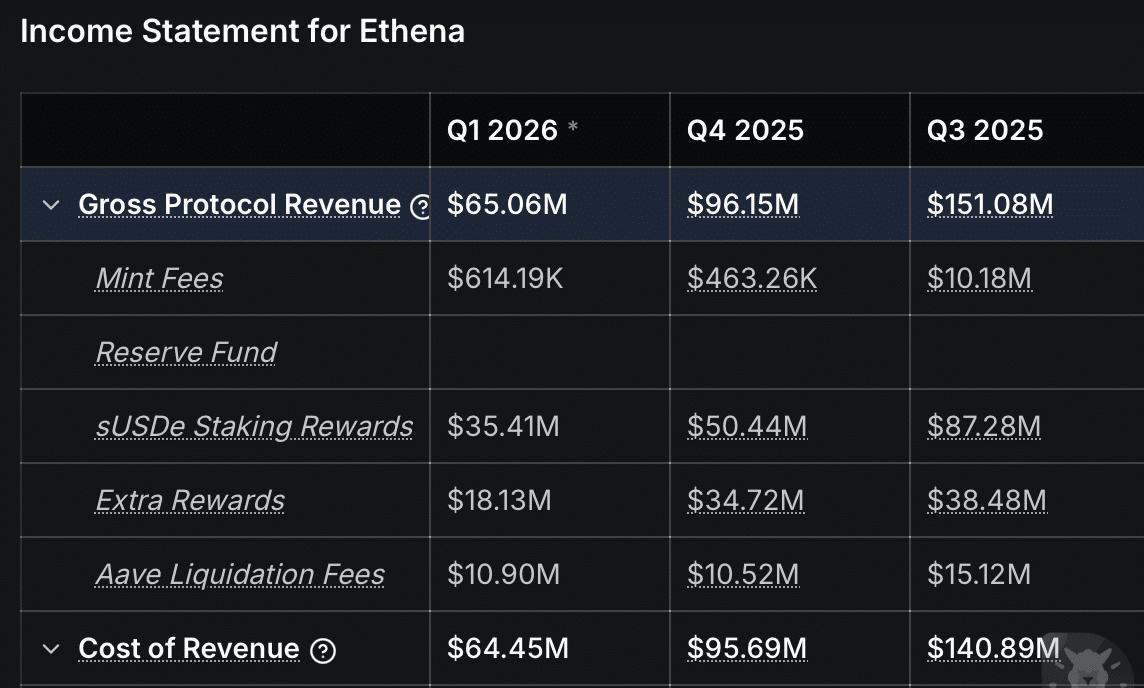
Un área clave de preocupación es la eficiencia de los ingresos. Los Ingresos Brutos del Protocolo cayeron a $65.06 millones, desde $96.15 millones en el Q4 de 2025, lo que representa un descenso del 32%. La caída se vuelve aún más pronunciada al compararla con el Q3 de 2025.

Esta contracción apunta a una actividad de acuñación más débil y a una reducción de las recompensas de staking, lo que sugiere una disminución de la participación en la cadena.
Fuente: DeFiLlama

En un mercado que se ha mantenido relativamente estable en comparación con el ciclo de octubre-diciembre de 2025, este bajo rendimiento genera preocupación sobre un debilitamiento de la demanda de los usuarios más que por una presión externa.

Las condiciones de liquidez refuerzan esta tendencia. El Valor Total Bloqueado (TVL), un indicador central de la salud del protocolo y el compromiso de los usuarios, ha continuado disminuyendo de manera constante.

Desde el inicio de marzo de 2026, el TVL ha caído aproximadamente $130 millones, situándose en alrededor de $6.66 mil millones al momento de escribir. Solo en las últimas 24 horas, se han desbloqueado aproximadamente $16 millones, lo que señala una salida sostenida de capital del protocolo.

¿Puede la ganancia por sí sola mantener el interés de los usuarios?

A pesar de la desaceleración general, Ethena ha registrado una ligera mejora en la rentabilidad bruta.

En el Q1 de 2026, el protocolo ha generado $614,190 en ganancias brutas, en comparación con $463,200 en el Q4 de 2025. Aunque esto refleja un aumento marginal, hace poco para compensar la fuerte caída de los niveles de rendimiento anteriores.

Para contextualizar, el Q3 de 2025 registró $10.18 millones en ganancias brutas, aproximadamente 16.5 veces más que las cifras actuales. Esta brecha resalta un declive estructural en el potencial de ganancias, incluso cuando la rentabilidad a corto plazo muestra una mejora menor.

La implicación es clara: un crecimiento modesto de las ganancias por sí solo puede no ser suficiente para retener usuarios, especialmente en un entorno DeFi competitivo donde el capital rota rápidamente hacia oportunidades de mayor rendimiento.

Los datos de actividad del usuario respaldan esta visión. Según Artemis, los Usuarios Activos Diarios han caído a alrededor de 1,200, el nivel más bajo registrado desde diciembre.

La demanda spot ofrece una contraseñal

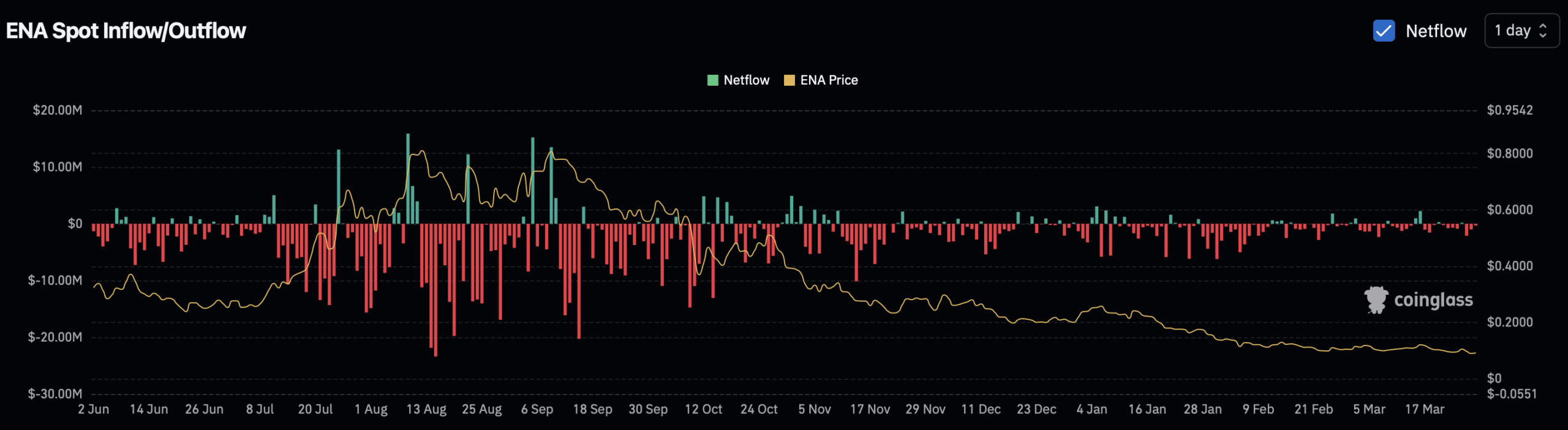
A pesar del debilitamiento de los fundamentos y la disminución de la liquidez, la actividad del mercado spot presenta una imagen más resiliente. Los datos de flujo neto de exchanges indican que la presión de compra ha aumentado recientemente. En las últimas 24 horas, las entradas netas en posiciones spot alcanzaron aproximadamente $303,000.

Más notablemente, esto no es un evento aislado. En los últimos tres días, las compras acumuladas han ascendido a alrededor de $3.41 millones, lo que sugiere una acumulación constante.
Fuente: CoinGlass

Una demanda tan sostenida indica que los inversores continúan absorbiendo la presión de venta, incluso cuando el capital sale de la capa del protocolo.

Si esta tendencia de acumulación se mantiene, podría limitar mayores caídas y apoyar la estabilización del precio. Sin embargo, sin una recuperación en los fundamentos centrales, particularmente la actividad de los usuarios y la generación de ingresos, cualquier alza puede permanecer limitada dentro de un rango estrecho.


Resumen Final

  • El rendimiento del protocolo de Ethena se deterioró en el Q1 de 2026, incluso cuando las condiciones generales del mercado se mantuvieron relativamente estables.
  • Los inversores spot continúan acumulando, a pesar del aumento de las salidas de liquidez y la disminución del TVL.


Crypto di tendenza

Domande pertinenti

Q¿Por qué ha caído el precio de ENA a $0.089 y qué indica esta disminución?

AEl precio de ENA cayó a $0.089 debido a un debilitamiento en el rendimiento financiero del protocolo, incluyendo una caída del 32% en los ingresos brutos y una reducción en la actividad de acuñación y recompensas de staking, lo que sugiere una disminución en la participación en la cadena.

Q¿Cómo ha afectado la actividad de los usuarios y el TVL a Ethena en el primer trimestre de 2026?

AEl Valor Total Bloqueado (TVL) de Ethena ha disminuido constantemente, cayendo aproximadamente $130 millones desde marzo de 2026, y los usuarios activos diarios se redujeron a alrededor de 1,200, el nivel más bajo desde diciembre, indicando una salida de capital y menor participación.

Q¿Qué muestra la data de flujo neto de exchanges sobre la demanda spot de ENA?

ALos datos de flujo neto de exchanges indican que la presión compradora ha aumentado, con entradas netas de aproximadamente $303,000 en 24 horas y compras acumuladas de alrededor de $3.41 millones en tres días, sugiriendo una acumulación constante a pesar de la salida de capital del protocolo.

Q¿Por qué la mejora marginal en la rentabilidad bruta no es suficiente para Ethena?

AAunque la ganancia bruta aumentó marginalmente a $614,190 en Q1 2026, es 16.5 veces menor que los $10.18 millones de Q3 2025, lo que refleja una disminución estructural en el potencial de ganancias que no es suficiente para retener usuarios en un entorno DeFi.

Q¿Qué se necesita para que ENA estabilice su precio y limite further caídas?

APara estabilizar el precio y limitar further caídas, ENA necesita una recuperación en los fundamentos clave, como la actividad de usuarios y la generación de ingresos, ya que la acumulación en el mercado spot por sí sola puede no ser suficiente sin mejoras en la salud del protocolo.

Letture associate

Unveiling the Whales of the World Cup Prediction Market: Smart Money Stumbles on the Pitch, 'Buy No' Outperforms 'Buy Yes'

**Title: Unveiling the Whales of the World Cup Prediction Market: "Smart Money" Stumbles on the Pitch as "Buying No" Outperforms "Buying Yes"** An analysis of pre-match trades over $5,000 on Polymarket for 20 completed group stage matches reveals a counterintuitive finding: large "smart money" bets were not consistently accurate. Aggregated pre-match buying volume was $89.55 million, with a weighted hit rate of only 48.5%. Holding these positions would have resulted in an estimated net loss of about $1.76 million (ROI -2.0%), challenging the notion that big money reliably predicts outcomes. The data highlights several key dynamics. Draws proved to be a major risk, significantly impacting bets on favored teams, as seen in Belgium-Egypt and Spain-Cape Verde. Markets were more efficient for clear mismatches (e.g., Germany's big win) but became prone to bias when favorites were overvalued. Notably, buying "No" shares (betting against a specific outcome) significantly outperformed buying "Yes," with hit rates of 62.4% vs. 37.5%. This suggests the market often overprices popular narratives, creating value in contrarian positions. Individual trades showed extreme volatility. One wallet (mintblade) earned an estimated $6.77 million by betting against Iran, while another (LEEEROYJENKINS) lost roughly $8.39 million on a Belgium win. The market favors high-risk, high-reward information trading rather than steady arbitrage. For sustained insight, wallets with consistent performance across multiple matches (e.g., swisstony) are more telling than one-off big bets. Ultimately, the Polymarket acts less as a crystal ball and more as a mirror, reflecting crowd bias and the inherent unpredictability of football. True "smart money" may lie not in predicting the future, but in identifying and exploiting market mispricings while respecting risk.

marsbit6 min fa

Unveiling the Whales of the World Cup Prediction Market: Smart Money Stumbles on the Pitch, 'Buy No' Outperforms 'Buy Yes'

marsbit6 min fa

Bezos' Third Startup Still Can't Avoid Musk

Jeff Bezos Returns as CEO for Third Venture, Still Can't Avoid Musk After stepping down as Amazon CEO in 2021, Jeff Bezos has returned to the front lines as co-CEO of Prometheus, an AI startup he founded. In a recent CNBC interview, Bezos described the experience as "Type 2 fun"—exhausting but ultimately rewarding. Founded less than a year ago, Prometheus has already raised over $18 billion in two funding rounds, achieving a staggering $41 billion valuation. Prometheus aims to develop a "General Engineer AI" to accelerate the entire "invention loop"—design, simulation, testing, and manufacturing—for complex physical products like jet engines, spacecraft, and medical devices. This positions the company at the intersection of Bezos's past experiences: Amazon's platform-building scale and Blue Origin's rigorous physical engineering. This marks Bezos's third major venture, following Amazon and Blue Origin. His co-CEO is Vik Bajaj, bringing expertise from life sciences and hard tech. Bezos now dedicates most of his time to Prometheus, signaling his belief in its transformative potential. The move also comes as Bezos's space company, Blue Origin, faces challenges, including a recent test explosion delaying its New Glenn rocket. Meanwhile, Elon Musk's SpaceX achieved a record-breaking IPO, surpassing Amazon's market cap. While Musk focuses on AI for executing physical tasks (like Tesla's robots and SpaceX's engineering), Bezos is betting on AI to *invent* in the physical world. Prometheus enters a crowded industrial AI field with players like OpenAI, NVIDIA, and Tesla's Optimus. Its lofty valuation bets on the unproven but massive opportunity to become the foundational platform for engineering in the AI era—a "blue ocean" Bezos hopes to define before Musk does.

marsbit9 min fa

Bezos' Third Startup Still Can't Avoid Musk

marsbit9 min fa

Won't US Stocks Ever Fall Again? The 'Great Melt-up' Trap in the Era of High Debt

The article analyzes a popular theory circulating online that the U.S. stock market may be mathematically incapable of a true, sustained decline due to the country's massive and growing national debt. The argument suggests that the government's only path to managing this debt is through inflation and money printing, which would nominally lift asset prices like stocks, creating a perpetual "melt-up." The author places this idea within the historical context of market melt-ups, such as the dot-com bubble and Japan's asset bubble, where prices detach from fundamentals driven by momentum and FOMO. While acknowledging that a high-debt environment creates incentives for inflation, which is generally favorable for assets over cash, the article refutes key claims of the online theory. It clarifies that interest payments are not about to exceed GDP, that printing money is not the only option for the government, and that stocks do not reliably rise in lockstep with hyperinflation, citing historical examples from Germany, Zimbabwe, and Venezuela. The more probable outcome, according to the author, is a prolonged period of financial repression—moderate inflation above interest rates that slowly erodes debt and cash purchasing power, leading to nominally higher asset prices but potentially lower real returns. The core warning is that while long-term market trends may be upward, this does not eliminate the risk of significant interim crashes (30%, 40%, or more) or guarantee real wealth creation during inflationary times. The conclusion advises against betting one's entire financial future on a smooth, perpetually rising market narrative. Instead, it recommends a disciplined, diversified strategy involving productive assets (stocks, real estate, some gold, short-term bonds) and an adequate cash buffer to avoid forced selling during downturns. The key takeaway is to avoid extreme concentration in expensive assets and leverage, and not to base investment decisions on the hope that every market dip will inevitably be rescued.

marsbit30 min fa

Won't US Stocks Ever Fall Again? The 'Great Melt-up' Trap in the Era of High Debt

marsbit30 min fa

The Fate of Digital Banks: No Fancy App Can Outshine a Banking License

The Fate of Digital Banks: A Flashy App is No Match for a Banking License The article argues that despite attracting billions of users with fee-free checking accounts and sleek apps, most "neobanks" struggle to be profitable because their core business—transaction fees—is inherently low-margin. The real profit engine of banking is lending (credit), which generates interest income. However, many early neobanks operated without their own banking licenses, which restricted their ability to lend at scale. Examples like Nubank, Revolut, and Chime illustrate the point. While they gained users with free accounts, their eventual profitability came from rolling out credit products. The piece highlights systemic risks for neobanks that rely on third-party infrastructure, citing the Synapse bankruptcy, which froze user funds and revealed the fragility of such models. The solution, according to the author, is obtaining a formal banking license, like the U.S. OCC's national trust charter. This provides regulatory backing, allows direct custody of funds, and eliminates dependency on intermediary partners. The trend is now evident in the crypto sector, where companies like Kraken, SoFi, and others are actively pursuing such licenses. The article concludes that while technology changes, the fundamental business logic of banking—profiting from lending—remains constant. Successful digital banks ultimately conform to this old model, just with better interfaces and fairer terms.

Foresight News38 min fa

The Fate of Digital Banks: No Fancy App Can Outshine a Banking License

Foresight News38 min fa

Trading

Spot
Futures

Articoli Popolari

Come comprare ENA

Benvenuto in HTX.com! Abbiamo reso l'acquisto di Ethena (ENA) semplice e conveniente. Segui la nostra guida passo passo per intraprendere il tuo viaggio nel mondo delle criptovalute.Step 1: Crea il tuo Account HTXUsa la tua email o numero di telefono per registrarti il tuo account gratuito su HTX. Vivi un'esperienza facile e sblocca tutte le funzionalità,Crea il mio accountStep 2: Vai in Acquista crypto e seleziona il tuo metodo di pagamentoCarta di credito/debito: utilizza la tua Visa o Mastercard per acquistare immediatamente EthenaENA.Bilancio: Usa i fondi dal bilancio del tuo account HTX per fare trading senza problemi.Terze parti: abbiamo aggiunto metodi di pagamento molto utilizzati come Google Pay e Apple Pay per maggiore comodità.P2P: Fai trading direttamente con altri utenti HTX.Over-the-Counter (OTC): Offriamo servizi su misura e tassi di cambio competitivi per i trader.Step 3: Conserva Ethena (ENA)Dopo aver acquistato Ethena (ENA), conserva nel tuo account HTX. In alternativa, puoi inviare tramite trasferimento blockchain o scambiare per altre criptovalute.Step 4: Scambia Ethena (ENA)Scambia facilmente Ethena (ENA) nel mercato spot di HTX. Accedi al tuo account, seleziona la tua coppia di trading, esegui le tue operazioni e monitora in tempo reale. Offriamo un'esperienza user-friendly sia per chi ha appena iniziato che per i trader più esperti.

231 Totale visualizzazioniPubblicato il 2024.12.10Aggiornato il 2026.06.02

Come comprare ENA

Discussioni

Benvenuto nella Community HTX. Qui puoi rimanere informato sugli ultimi sviluppi della piattaforma e accedere ad approfondimenti esperti sul mercato. Le opinioni degli utenti sul prezzo di ENA ENA sono presentate come di seguito.

活动图片