Bitcoin Vs. Altcoins: You Should See This Chart That Shows Another Alt Season Is About To Begin

bitcoinistPubblicato 2026-02-27Pubblicato ultima volta 2026-02-27

Introduzione

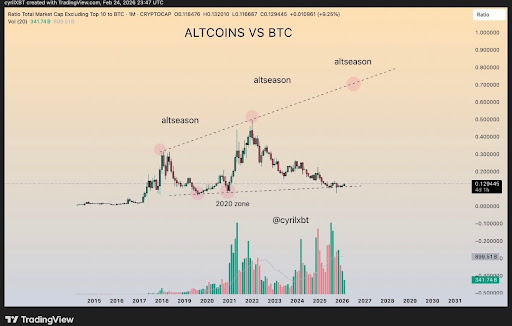
Based on a long-term chart analysis by crypto expert @CyrilXBT, the total altcoin market cap relative to Bitcoin has returned to a critical historical level of approximately 0.129, which has previously signaled the start of major altcoin seasons. This ratio, representing the total crypto market excluding the top 10 assets compared to Bitcoin, is now in what the analyst describes as the "base" or "accumulation zone." Historically, this level has preceded significant altcoin rallies, such as those in 2017-2018 and the largest recorded alt season in 2021 when the ratio surged above 0.55. Despite recent Bitcoin dominance and price declines, the current market reset suggests that conditions may be forming for a new alt season. The analyst notes that if historical patterns repeat, the ratio could potentially reach between 0.80 and 0.90 in the current cycle. This indicates that altcoins are not "dead" but may be poised for a significant upward movement as market dynamics align with past bullish trends.

Talks of a potential altcoin season this cycle have since subsided compared to previous years, despite the recent decline in the Bitcoin (BTC) price and dominance. Notably, a crypto analyst has shared a new long-term chart showing the total altcoin market capitalization relative to Bitcoin at a level that has historically preceded major alt seasons. Based on his analysis, the alt market has fully reset and could be gearing up for a fresh altcoin season if historical trends play out as expected.

Historic Alt Season Setup Forms As Bitcoin Ratio Hits Base Zone

In a recent analysis on X, market expert @CyrilXBT shared a monthly chart tracking the ratio of the total crypto market, excluding the top 10 assets, to Bitcoin. According to the analysis, the chart currently sits at approximately 0.129, a level the analyst describes as the same base or accumulation zone that has launched every major altcoin season in crypto history.

@CyrilXBT noted that this zone is where all alt seasons are born, with each past altcoin rally beginning when the ratio stopped falling and stabilized around the $0.12 to $0.13 range. Looking at the chart, the analyst noted that during the 2015-2016 cycle, the ratio starts near zero and remains flat, with minimal volatility. Following this, a dramatic spike occurred during the 2017-2018 bull run, pushing the altcoin vs Bitcoin ratio above 0.3, marking one of the first major alt seasons.
Source: X

By 2020, the ratio crashed back below the 0.129 level, erasing most of its previous gains as it consolidated near the low-ranged accumulation/base zone. Notably, 2021 marked the largest altcoin season spike in history, with the ratio exploding upward to over 0.55 amid the bull market frenzy. During this time, volume hit new highs, with bars towering above those of previous years.

New Alt Season Conditions Take Shape

Similar to the 2020 crash, the 2022-2024 cycle saw a post-peak correction, with the ratio trending downward as Bitcoin regained dominance. In the current 2025-2026 cycle, the altcoin vs Bitcoin ratio has finally returned to the historically significant 0.129 accumulation zone, with BTC.D falling to a yearly low of 57.9%.

@CyrilXBT has suggested that the current positioning mirrors the pre-altseason setup that led to a major altcoin explosion in previous years. He noted that the rising trendline connecting successive altcoin season peaks on the chart points to a ratio of roughly 0.80 to 0.90 as the next potential target for this cycle.

As the ratio stabilizes and historical trends repeat, @CyrilXBT argues that recent market performance does not indicate that altcoins are dead. Rather, it shows that the market has fully reset and could be quietly creating the conditions for its next alt season.

Total altcoin market cap remains below $1 trillion | Source: Crypto Total Market Cap Excluding BTC from Tradingview.com

Crypto di tendenza

Domande pertinenti

QAccording to the analyst @CyrilXBT, what is the significance of the total altcoin market cap to Bitcoin ratio reaching the 0.129 level?

AThe analyst states that the 0.129 level is the historic accumulation or base zone where every major altcoin season in crypto history has been launched from. It is the level where the ratio stops falling and stabilizes, signaling the potential start of a new alt season.

QWhat was the peak value of the altcoin vs. Bitcoin ratio during the 2021 bull market, as mentioned in the article?

ADuring the 2021 bull market, the altcoin vs. Bitcoin ratio exploded upward to over 0.55, marking the largest altcoin season spike in history.

QWhat recent market development, besides the ratio, supports the potential for a new alt season as described in the analysis?

ABitcoin's dominance (BTC.D) has fallen to a yearly low of 57.9%, which, combined with the ratio returning to the 0.129 base zone, helps create the conditions for a potential alt season.

QBased on the historical trendline of alt season peaks, what is the next potential target for the altcoin vs. Bitcoin ratio in the current cycle?

AThe rising trendline connecting successive altcoin season peaks points to a ratio of roughly 0.80 to 0.90 as the next potential target for this cycle.

QHow does the analyst, @CyrilXBT, interpret the recent market performance and the decline in the altcoin ratio?

AHe argues that it does not indicate that altcoins are dead. Instead, it shows that the market has fully reset and could be quietly creating the conditions for its next alt season, mirroring pre-altseason setups from previous years.

Letture associate

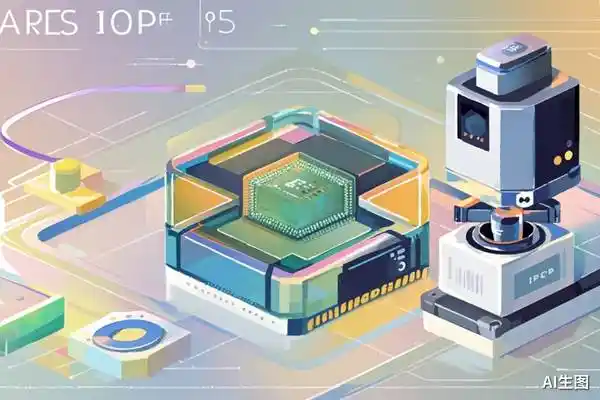
Former ASML Employee at the Helm, China's AMEC's Peer Files for IPO, Focusing on Integrated Circuit Metrology and Inspection Equipment

Eastern Jingyuan Microelectronics Technology (Beijing) Co., Ltd. ("Eastern Jingyuan"), led by a former ASML employee, has filed for a Shanghai STAR Market IPO. The company specializes in integrated circuit (IC) metrology/inspection equipment and manufacturing EDA software, key upstream segments in the semiconductor supply chain. Driven by demand from automotive electronics and AI, China's semiconductor equipment market is expanding rapidly. Eastern Jingyuan's products, including CD-SEM and EBI equipment, as well as computational lithography software (PanGen), aim to break the dominance of international giants like Applied Materials, ASML-HMI, and Siemens EDA in these high-tech, low-domestication-rate fields. Financially, the company's performance is mixed. While revenue grew from 191 million yuan in 2023 to 375 million yuan in 2024, it dipped to 317 million yuan in 2025. The firm has been consistently unprofitable, with net losses totaling approximately 860 million yuan over the past three years. Its gross margin has declined steadily from 67.5% to 39.7%, and both equipment and software毛利率 lag behind industry peers. High R&D expenses (exceeding 90% of revenue) and rising debt levels further pressure profitability. The IPO aims to raise 2.5 billion yuan to fund R&D upgrades for metrology/inspection equipment and EDA tools, alongside working capital. Despite being a domestic pioneer, the company acknowledges gaps versus international leaders in technology, product breadth, and scale, while also facing growing competition from local rivals.

marsbit4 min fa

Former ASML Employee at the Helm, China's AMEC's Peer Files for IPO, Focusing on Integrated Circuit Metrology and Inspection Equipment

marsbit4 min fa

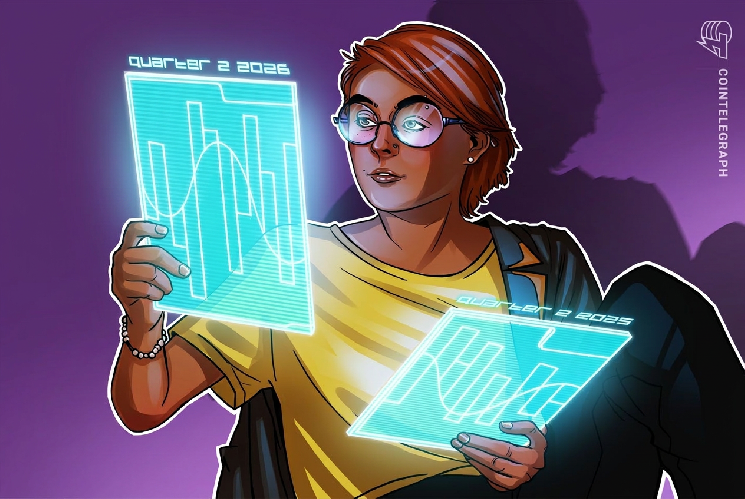
The Era of Easy Gains in AI Ends: 13F Rebalancing Map Points the Way – The Latest 13F Reveals Where Top Institutions' Money is Flowing

The era of easy AI profits is ending, as evidenced by the latest 13F filings from major institutions for Q2 2026. These reports, which are delayed by over 45 days, reveal a significant shift in strategy: capital is moving from a broad "AI frenzy" towards assets with strong cash flows, tangible technology, and durable competitive advantages. Key institutional moves highlight this trend. Temasek increased stakes in SpaceX (representing next-gen infrastructure), Alphabet (for its AI infrastructure and cash flow), and semiconductor equipment giant ASML. Baillie Gifford made SpaceX its top holding. Berkshire Hathaway ended its passive stance with a major $10 billion purchase of Alphabet, while Bridgewater maintains significant positions in tech giants but with a balanced, macro-aware approach. Notably, asset manager JingLin dramatically reduced overall exposure by 43%, completely exiting Nvidia and Meta, and pivoting towards semiconductor equipment and optical communication stocks like ASML and Applied Materials. The analysis reveals several key conclusions: 1. **Alphabet is becoming a consensus holding**, valued for its blend of AI infrastructure, stable cash flows, and reasonable valuation. 2. **Nvidia remains core but faces scrutiny**; its future depends on sustaining growth and justifying its valuation. 3. **Capital is flowing upstream** into semiconductor equipment and hardware (e.g., ASML, AMAT), focusing on the "bottlenecks" of AI compute. 4. **SpaceX represents a new theme** in next-generation infrastructure, attracting long-term capital. The article warns against common mistakes when interpreting 13Fs: treating them as real-time trading signals, focusing only on *what* was bought and not *how much*, and ignoring the different investment styles of the reporting funds. Instead, investors should use a disciplined five-step framework: analyze the overall portfolio structure, focus on marginal changes (new adds/sells), identify sector/theme migrations, look for consensus or divergence among multiple funds, and finally, independently verify the current price, valuation, and fundamentals. In essence, 13Fs provide valuable footprints and research clues left by sophisticated investors, but they are not a substitute for one's own analysis and investment thesis.

marsbit6 min fa

The Era of Easy Gains in AI Ends: 13F Rebalancing Map Points the Way – The Latest 13F Reveals Where Top Institutions' Money is Flowing

marsbit6 min fa

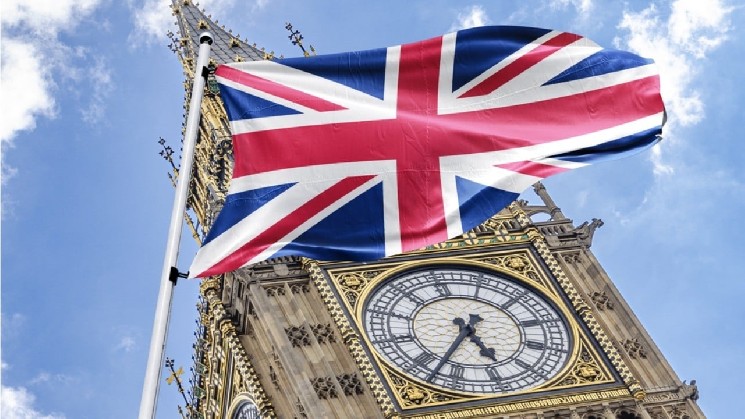
As New Rules Approach, UK Lawmakers Pressure Banks to Ensure Crypto Access

UK lawmakers are intensifying scrutiny of banks' treatment of cryptocurrency companies as the country prepares to enact official regulation for much of the digital asset industry. Gurinder Singh Josan MP and Lord Vazi of Didcot, co-chairs of the All-Party Parliamentary Group (APPG) on Crypto and Digital Assets, sent a letter to leading UK banks on August 11th. They requested the banks detail their account policies for crypto firms, transaction restrictions, and any planned changes once the new regulatory regime takes effect. The legislators warn that banking access is a major potential obstacle for UK crypto businesses and could undermine the success of the incoming regulatory framework. The APPG has received numerous complaints from licensed and compliant crypto companies facing difficulties in opening or maintaining bank accounts, along with payment limits on crypto-related transactions. While acknowledging banks' anti-money laundering and consumer protection duties, the lawmakers question whether broad restrictions should persist for firms once they are licensed under the new system. They argue banks should assess companies based on their individual risk profiles rather than their sector alone. This view echoes earlier comments from Economic Secretary to the Treasury, Lucy Rigby. The letter is part of a broader APPG inquiry launched in July, examining the scale of the banking access problem, its impact on investment and growth, and whether further government action is needed. The investigation covers exchanges, custodians, payment firms, wallet providers, and stablecoin issuers. Banks have been asked what policymakers could do to ease access to financial services for legitimate crypto businesses. Responses are due by August 31st and will inform the group's recommendations to the government. The timing is critical as the UK aims to attract digital asset firms while implementing clearer rules. Lawmakers fear that if licensed companies continue to struggle for basic banking services, the new regulatory regime may fail to achieve its broader competitiveness goals.

cryptonews.ru8 min fa

As New Rules Approach, UK Lawmakers Pressure Banks to Ensure Crypto Access

cryptonews.ru8 min fa

Trading

Spot

Articoli Popolari

Come comprare ALT

Benvenuto in HTX.com! Abbiamo reso l'acquisto di AltLayer (ALT) semplice e conveniente. Segui la nostra guida passo passo per intraprendere il tuo viaggio nel mondo delle criptovalute.Step 1: Crea il tuo Account HTXUsa la tua email o numero di telefono per registrarti il tuo account gratuito su HTX. Vivi un'esperienza facile e sblocca tutte le funzionalità,Crea il mio accountStep 2: Vai in Acquista crypto e seleziona il tuo metodo di pagamentoCarta di credito/debito: utilizza la tua Visa o Mastercard per acquistare immediatamente AltLayerALT.Bilancio: Usa i fondi dal bilancio del tuo account HTX per fare trading senza problemi.Terze parti: abbiamo aggiunto metodi di pagamento molto utilizzati come Google Pay e Apple Pay per maggiore comodità.P2P: Fai trading direttamente con altri utenti HTX.Over-the-Counter (OTC): Offriamo servizi su misura e tassi di cambio competitivi per i trader.Step 3: Conserva AltLayer (ALT)Dopo aver acquistato AltLayer (ALT), conserva nel tuo account HTX. In alternativa, puoi inviare tramite trasferimento blockchain o scambiare per altre criptovalute.Step 4: Scambia AltLayer (ALT)Scambia facilmente AltLayer (ALT) nel mercato spot di HTX. Accedi al tuo account, seleziona la tua coppia di trading, esegui le tue operazioni e monitora in tempo reale. Offriamo un'esperienza user-friendly sia per chi ha appena iniziato che per i trader più esperti.

347 Totale visualizzazioniPubblicato il 2024.12.10Aggiornato il 2026.06.02

Come comprare ALT

Discussioni

Benvenuto nella Community HTX. Qui puoi rimanere informato sugli ultimi sviluppi della piattaforma e accedere ad approfondimenti esperti sul mercato. Le opinioni degli utenti sul prezzo di ALT ALT sono presentate come di seguito.

活动图片