Stablecoin Pattern Suggests Massive Bitcoin Breakout May Be Incoming, According to Crypto Analytics Firm Santiment

Daily HodlPubblicato 2022-08-03Pubblicato ultima volta 2022-08-03

Introduzione

Santiment also notes that Bitcoin’s price is now in line with its valuation based on the network value-to-transaction (NVT) model

Crypto analytics firm Santiment says that the dwindling supply of stablecoins may be a sign that a massive Bitcoin (BTC) breakout is on the horizon.

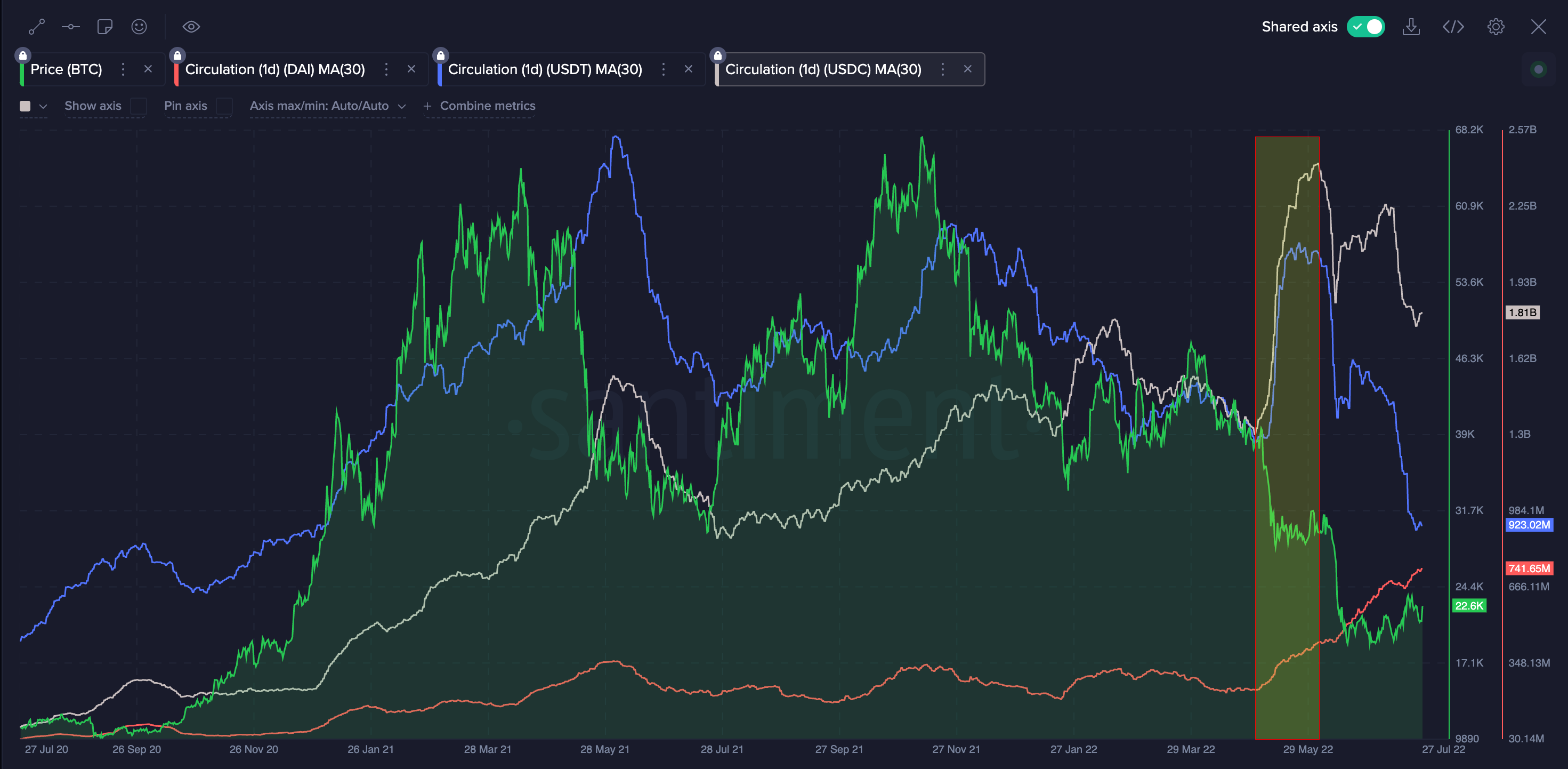
According to the market intelligence firm, the circulating supply of Tether (USDT) and USD Coin (USDC), the two biggest stablecoins by market cap, has been dramatically decreasing since May 2022.

Santiment says that the volume of these two assets continues to decline even as the price of Bitcoin rises, which in the past has foreshadowed parabolic BTC rallies, specifically in July 2021 right before the king crypto went from the $29,000 level all the way to $69,000.

“Stablecoin circulation kept going down even on a growing market. We might say that [the] first significant growth happened on a decreasing circulation. Stablecoins tried to heat up strongly, but no, the market didn’t go up.

The best pattern could be [stablecoins] still decreasing [during a] recovering market. Like nowadays. When stablecoins don’t believe in recovery yet, preferring to wait. We’re probably witnessing the same as July 2021 now, at least on two stablecoins.”
Source: Santiment

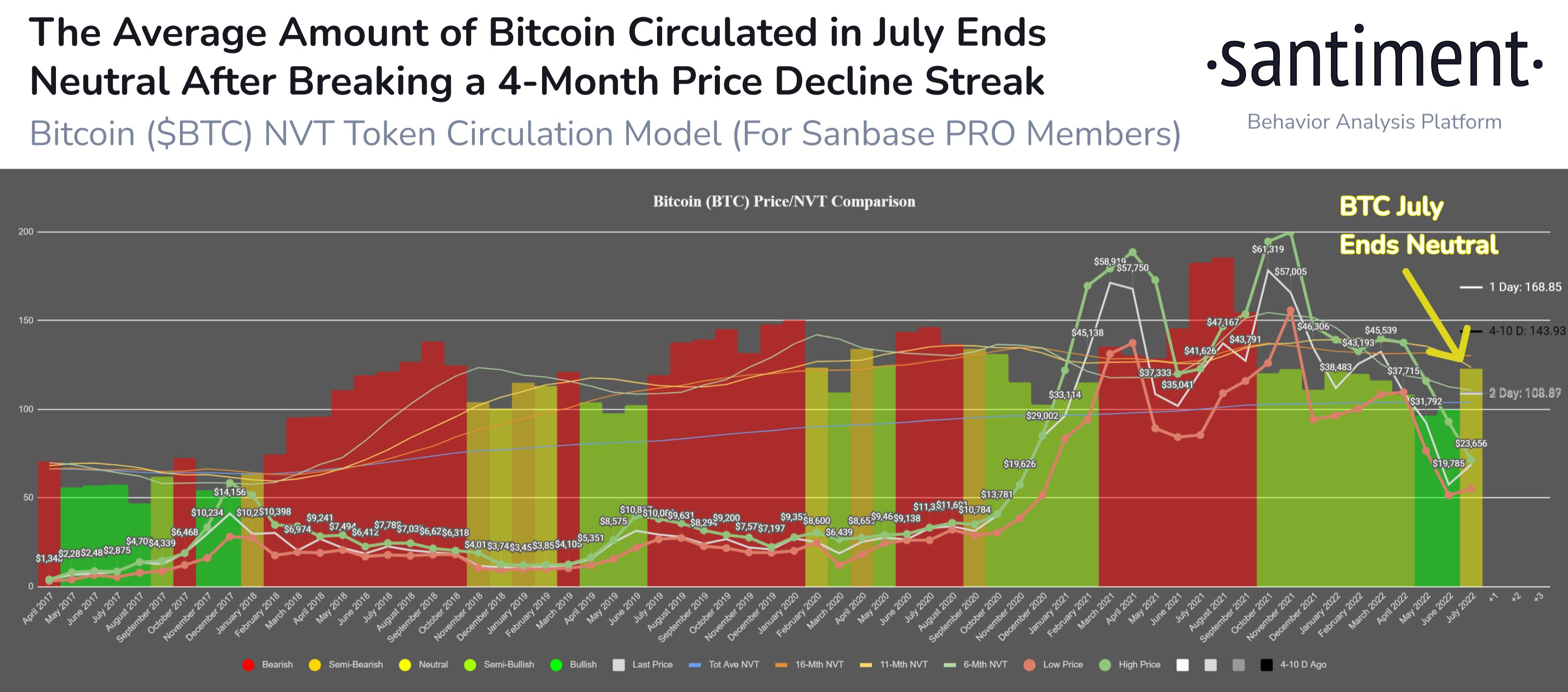
Santiment also notes that Bitcoin’s price is now in line with its valuation based on the network value-to-transaction (NVT) model, a metric aiming to gauge an asset’s price based on the ratio between its daily market cap and daily circulation.

“Bitcoin jumped +18% in July after [the] NVT model’s growing bullish divergence in May and June finally saw a price bounce come to fruition. With a neutral signal now as prices have risen and token circulation has declined slightly, August can move either direction.”
Bitcoin is changing hands at $23,297 at time of writing, a 1.25% dip on the day.


Letture associate

The Entire Internet Hails Noam's Joining, But OpenAI's Loss Bill Just Got Thicker

While the AI community celebrates Noam Shazeer, co-author of the "Attention Is All You Need" paper, joining OpenAI as Head of Architectural Research, the company's audited financials reveal a starkly different reality. In 2025, OpenAI reported $13.07 billion in revenue but a massive $20.92 billion operating loss. Even excluding a one-time accounting charge, the cash burn is severe, with $3.7 billion consumed in Q1 2026 alone. This high-profile hiring occurs against a backdrop of significant internal research talent drain, with key founders and researchers departing as the company's focus shifts from exploratory research to product iteration. Meanwhile, OpenAI's fundamental business model faces a deep crisis. It paid Microsoft $10.59 billion for compute in 2025, while its vast user base of 9 billion weekly actives includes only 50 million paying customers, making growth a direct driver of escalating costs. The article argues Shazeer's recruitment is less about technical necessity and more about crafting a compelling narrative for OpenAI's upcoming IPO, aiming to justify a rumored $1 trillion valuation to future public market investors. It contrasts OpenAI's strategy with Anthropic's reported path to profitability, which relies on a strong enterprise customer base and cost control, rather than star-powered narratives. Ultimately, the piece concludes that while Shazeer's architectural work may take 1-2 years to materialize, OpenAI's financial clock is ticking much faster, with its massive losses undercutting the celebratory headlines.

marsbit1 h fa

The Entire Internet Hails Noam's Joining, But OpenAI's Loss Bill Just Got Thicker

marsbit1 h fa

Market Trend (June 19): US-Iran Deal Drives Out Geopolitical Premium; Chip Stocks Soar to New Highs; Energy Sector Leads Declines

U.S. Market Trends (June 19): U.S.-Iran Deal Eases Tensions, Chip Stocks Soar, Energy Sector Leads Declines. U.S. stocks rallied on Thursday as the signing of a temporary U.S.-Iran deal in Geneva de-escalated Middle East tensions, with Saudi oil tankers transiting the Strait of Hormuz. This geopolitical relief helped markets recover from recent Fed-driven volatility. The S&P 500 rose over 1%, the Nasdaq gained nearly 2%, and the Dow Jones Industrial Average closed at another record high. The Philadelphia Semiconductor Index surged over 6% to a historic peak. Chip stocks were the standout performers. Reports of an Apple-Intel design and foundry deal for certain products, alongside mentions of potential Nvidia and SpaceX collaborations with Intel, propelled the sector. Intel surged ~10.5%, while memory chip makers like Micron also saw significant gains, highlighting sustained confidence in long-term AI capital expenditure. In contrast, the energy sector was the day's sole loser, with the S&P 500 energy sub-index declining as WTI crude fell ~2% to around $74.29/barrel. The reopening of key shipping routes erased prior geopolitical risk premiums. SpaceX extended losses for a second day on news of a potential large bond offering. Market volatility (VIX) dropped sharply, indicating a swift reversal of post-Fed jitters. Treasury yields dipped slightly but remained elevated. The focus now shifts to upcoming economic data, including next week's PCE inflation report and Micron's earnings, which will serve as a key test for the AI trade's durability.

marsbit2 h fa

Market Trend (June 19): US-Iran Deal Drives Out Geopolitical Premium; Chip Stocks Soar to New Highs; Energy Sector Leads Declines

marsbit2 h fa

Trading

Spot
Futures
活动图片