First Mover Asia: Was the Metaverse All Just a Dream?

CoinDeskPubblicato 2022-08-02Pubblicato ultima volta 2022-08-02

Introduzione

Bitcoin has fallen for four straight days, but the (small-ish) scope of the price decline offers a reminder of how listless digital-asset markets have suddenly become. Sam Reynolds tots up the losses on metaverse-related tokens.

Good morning. Here’s what’s happening:

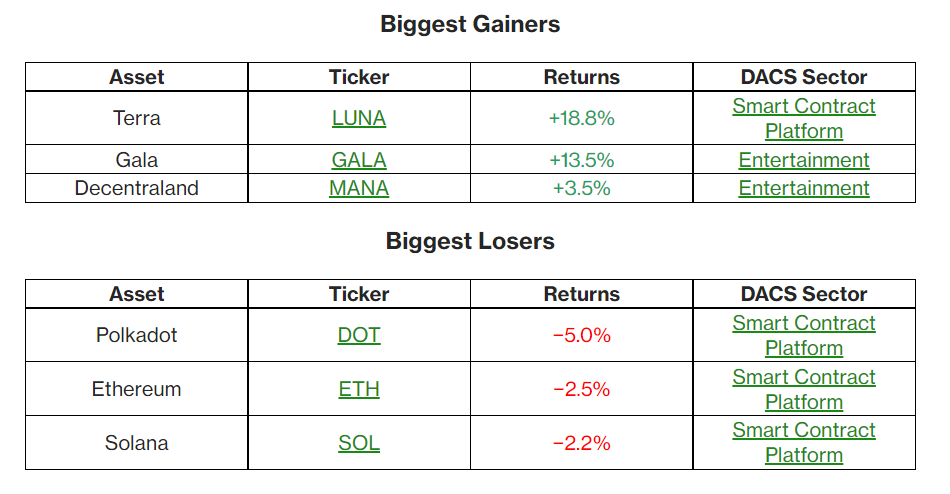
Prices: Bitcoin falls for fourth straight day as traditional markets struggle. Declining volatility in the cryptocurrency's price shows how far digital-asset markets have come since the nervy days of mid-June. (Wells Fargo's still a long-term believer, for what it's worth.)

Insights: Meta's Mark Zuckerberg acknowledges that the metaverse could be a long time in the making. Metaverse-related cryptocurrencies are undergoing their own reality check, having lost $10.9 billion of their market capitalization in the second quarter.

Prices

●Bitcoin (BTC): $23,179 −0.8% ●Ether (ETH): $1,630 −2.8% ●S&P 500 daily close: 4,118.63 −0.3% ●Gold: $1,770 per troy ounce +0.4% ●Ten-year Treasury yield daily close: 2.61% −0.04

Bitcoin has fallen for four straight days. But as market volatility ebbs, the price slide doesn't look like much to worry about.

By Bradley Keoun

Bitcoin (BTC) was lower for a fourth straight day, but there wasn't much to panic about because the price drops have been pretty modest by the standards of usually-volatile cryptocurrency markets: Over the four-day slide, the cumulative price drop is less than 4%.

That's pretty harmless for an asset whose price has been known to fall 16% in a single day.

The listlessness might be a sign that the Northern Hemisphere is entering the dog days of summer, during a (largely) post-pandemic stretch when many people really are taking vacations for the first time in years.

Or it might be a sign of just how little there is in the way of any firm direction in markets, torn between the angst of wondering if the U.S. economy meets the definition of a recession and if the Federal Reserve must still keep ratcheting monetary policy tighter to wring out inflation trending at its fastest in four decades.

Trading volume is light.
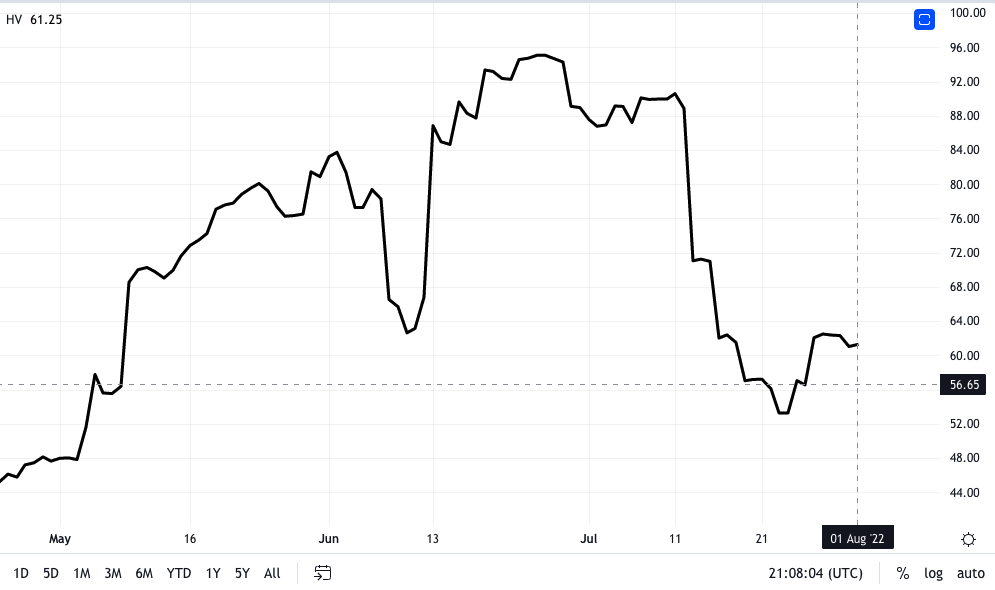
One sign of hope for the bulls: Despite this year's crash in crypto markets, traditional financial firms are still keenly interested in the long-term prospects: "We believe digital assets are a transformative innovation on par with the internet, cars and electricity," analysts for the U.S. bank Wells Fargo wrote on Monday. They were quick to add: "At such an early stage of investment development, many investment risks remain."

There's less carnage in the news these days and what appears to be a return to development: The crypto exchange Huobi says it's now able to operate in Australia, and July marked the strongest month of digital-asset fund inflows this year. Coinbase Prime added Ethereum staking for U.S. institutional clients.
Insights

Tens of Billions of Investor Dollars Are Flowing Away From the Metaverse

By Sam Reynolds

Investors are souring on the dream of the metaverse, regardless whether its Meta's superset of virtual reality, augmented reality and the internet – or crypto's cocktail of virtual reality, augmented reality and blockchain.

“We hope to basically get to around a billion people in the metaverse, each doing hundreds of dollars of commerce buying digital goods, digital content, different things to express themselves, so whether that’s clothing for their avatar or different digital goods for their virtual home or things to decorate their virtual conference room, utilities to be able to be more productive in virtual and augmented reality and across the metaverse overall,” is how Mark Zuckerberg described the dream on CNBC’s Mad Money with Jim Cramer.
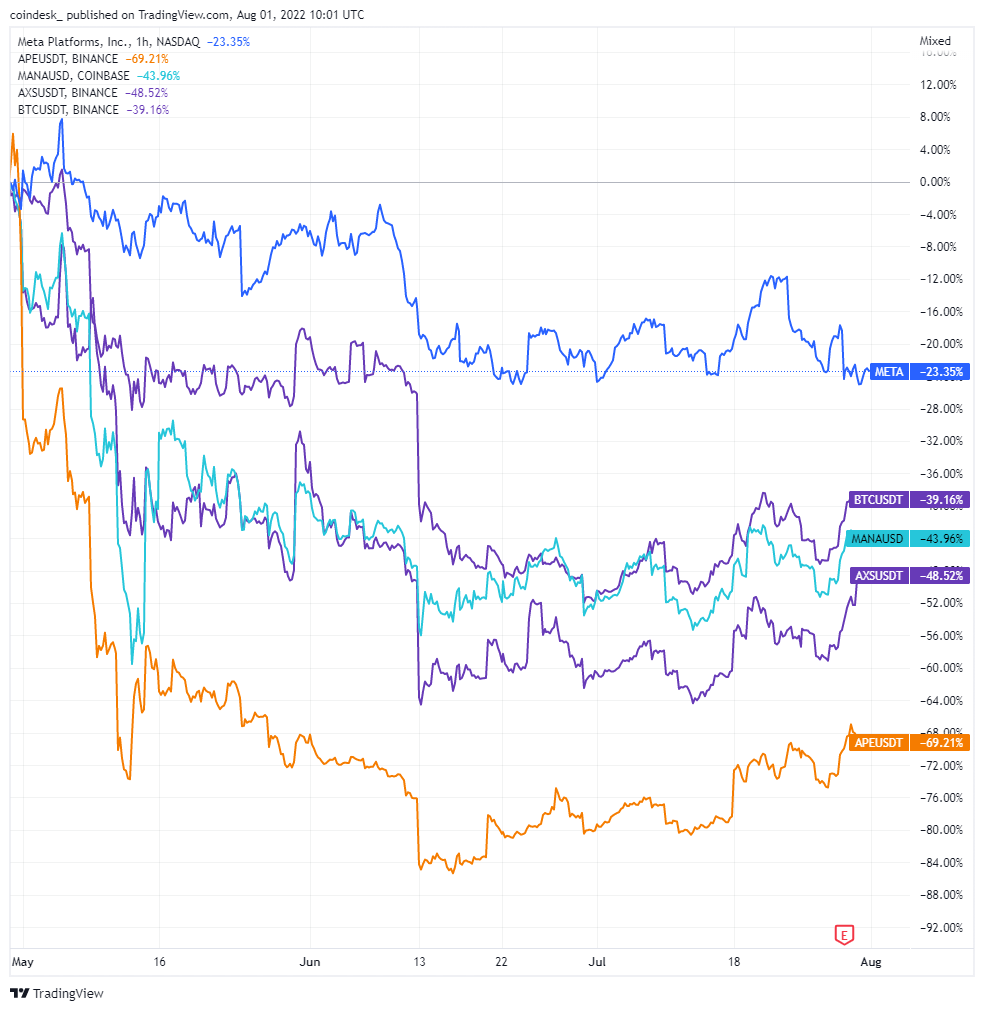
But this vision isn’t at odds with reality. In recent earnings, Meta reported a $2.8 billion loss on its Facebook Reality Labs (FRL) division, home to the augmented and virtual reality operations.

According to 13F filings (a form institutional investors must file quarterly with the Securities and Exchange Commission) aggregated by Whale Wisdom, $21.5 billion in institutional capital flowed out of Meta during the last quarter.

The crypto metaverse isn’t doing much better. Facing a user base that seems to refuse to materialize, and intense market headwinds because of the broader crypto decline, most of the major metaverse tokens saw their market caps dip by over a third as valuations of cryptocurrencies dropped.
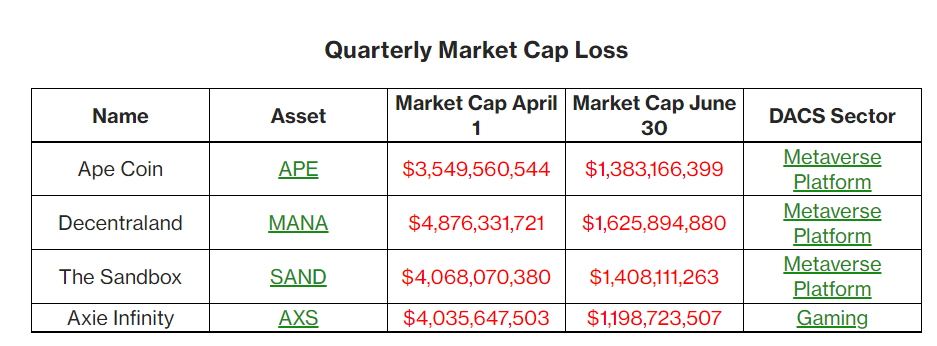
All in all, $10.9 billion departed from the metaverse majors as their market cap deflated. As of late afternoon Asia time on Aug. 1, Decentraland had 803 total online users whereas Steam, an online gaming community, had just under 20 million.

Mark Zuckerberg, Meta’s founder, admits that the current engagement ratio to profitability is a problem. Meta’s virtual world, Horizon Worlds, is said to have 300,000 sign-ups but there’s no publicly available count on active players.

“This is obviously a very expensive undertaking over the next several years,” Zuckerberg said during a recent analysts call. “But as the metaverse becomes more important in every part of how we live, I’m confident that we’re going to be glad we played an important role in building this.”

For a point of comparison, Facebook gained its first million users in less than a year at a per-user acquisition cost that’s infinitely smaller than the company’s pivot to the metaverse. Eight years later, it hit its billionth user.

Zuckerberg’s Meta, and the crypto metaverse majors are nowhere near to following this trajectory. Is this really the future of virtual interaction?


Letture associate

BTC Thrice Rejected at $80,000 Threshold, HYPE Reaches New Highs Signaling Opportunity | Guest Analysis

**Bitcoin (BTC) Struggles at $80k; HYPE Reaches New Highs | Key Analysis & Strategy** Bitcoin faces continued resistance in the $78.5k - $79.5k zone after failing to sustain a break above its daily chart rising channel. It has retreated to the channel's midline. A failure to hold here could see a test of the $73.5k - $75k support area. The 4-hour chart shows a complex corrective structure. The strategy is neutral for mid-term positions. For short-term trading, two scenarios are outlined: **A)** Selling on a failed rally into the $78.5k-$79.5k resistance, and **B)** Selling on a confirmed breakdown below the $73.5k-$75k support, both with tight risk management. Meanwhile, **HYPE** has posted consecutive highs. The 4-hour chart indicates its current uptrend may be weakening near $65, with models showing potential bearish divergence. The view is that a short-term top could be forming. The strategy advises against chasing the rally and instead looking for a potential long entry on a pullback to the $47.5 - $50 support zone, provided clear reversal signals appear. Last week, a disciplined short BTC trade based on model signals yielded a 2.78% profit. The article emphasizes that all analysis is for informational purposes only and not investment advice, highlighting the importance of strict stop-loss discipline and dynamic position management in a volatile market. *(Note: The text references proprietary models like the "Price Difference Trading Model" and "Momentum Quantification Model" for generating trade signals.)*

marsbit16 min fa

BTC Thrice Rejected at $80,000 Threshold, HYPE Reaches New Highs Signaling Opportunity | Guest Analysis

marsbit16 min fa

Tether's New Business: Helping Small Countries Issue Stablecoins

Tether has announced a partnership with the Georgian government to issue GEL₮, a Lari-pegged stablecoin, aiming to reduce costs, accelerate settlements, and promote cross-border payments. This move is part of Tether's broader strategy to establish a replicable, standardized business of issuing sovereign currency-backed stablecoins for smaller nations, alongside its flagship USDT and other regional offerings like MXNT (Mexican Peso) and CNHT (Offshore Yuan). Georgia represents an ideal test case due to its high reliance on remittances (~15% of GDP), established digital asset regulatory framework aligned with U.S. standards, and prior engagement with Tether. The country gains accelerated internationalization of its currency by accessing Tether's global distribution network and liquidity pools, where GEL₮ can be swapped directly with assets like USDT. For Tether, the immediate financial gain from Georgia's small market is minimal. The true value lies in creating a template. Successfully navigating the compliance, reserve, and redemption processes for GEL₮ allows Tether to replicate this model swiftly for other nations with similar profiles, such as Azerbaijan or Nigeria. The deeper strategy involves subtly integrating these national currencies into an informal USDT-anchored dollar system, positioning Tether as the essential routing infrastructure. This partnership highlights a potential new model: the outsourcing of sovereign currency globalization to private stablecoin issuers. It offers smaller states a faster path to digital currency integration than developing a Central Bank Digital Currency (CBDC). However, it raises significant questions about monetary sovereignty, financial stability risks, and increased dependency on a private entity. If more countries adopt this model in the coming year, Tether could evolve from a stablecoin issuer into a unique, cross-sovereign financial infrastructure service provider.

marsbit21 min fa

Tether's New Business: Helping Small Countries Issue Stablecoins

marsbit21 min fa

Notion CEO: AI companies should be a 'Jazz Band,' and I am a 'Refounder'

Notion CEO Ivan Zhao, in a recent podcast, shared his journey of twice rebuilding the company from near-collapse and now applying the same "Refounder" mindset to reshape the 1000-person organization in the AI era. He argues that AI has commoditized technical capability (Capability). True talent now hinges on Taste (judgment/values) and Agency (proactive drive), necessitating a shift in hiring—e.g., hiring more juniors for curiosity and having sales candidates demonstrate work upfront. Zhao envisions the company as a "Jazz Band"—agile and improvisational—versus a rigid "Marching Band." This is reflected in an engineering "dumbbell" structure (super juniors + top-tier seniors, with middle layers compressed), dissolving the CMO role to let teams operate directly, and integrating entrepreneurs via acquisitions to lead their expertise areas. Notion has abandoned traditional long-term product roadmaps, planning only conservatively for finances while adopting a week-by-week, improvisational approach to product strategy, as longer plans proved futile during rapid AI shifts. He concludes that while human nature and roles remain constants, companies must rewrite their approaches to hiring (valuing Taste/Agency over Capability), organizational design (reducing roles focused on coordination/execution), and planning (embracing flexibility). Modern knowledge work, being only ~150 years old, is ripe for reinvention.

marsbit22 min fa

Notion CEO: AI companies should be a 'Jazz Band,' and I am a 'Refounder'

marsbit22 min fa

BTC Faces Triple Resistance at $80,000 Milestone, HYPE Hits New Highs Signaling Potential | Invited Analysis

This weekly analysis maintains a structured framework, focusing on Bitcoin (BTC) and HYPE, dissecting their multi-timeframe price action to identify key support and resistance zones and formulate actionable trading plans. The previous week's short position on BTC yielded a 2.78% gain, reinforcing the "signal-driven, disciplined" approach. For Bitcoin, the core scenario revolves around the battle between the 78,500–79,500 USD resistance zone and the 73,500–75,000 USD support area. The daily chart shows BTC within a rising channel; a failure to hold support at the channel's midline could lead to a test of the lower boundary. The 4-hour chart details an 8-segment corrective structure from the 82,850 USD high. Two short-term strategies are proposed: (A) Selling on a failed rally into the 78.5k-79.5k zone, with a stop above 80,600, or (B) Selling a confirmed breakdown below the 73.5k-75k support, with a stop above 76,500. Medium-term positioning remains neutral. For HYPE, the 4-hour chart indicates a five-wave advance from the May 14th low, now showing potential exhaustion and a top warning signal near 65 USD. The core view is to watch for a potential short-term peak formation. The recommended strategy is to avoid chasing the rally and instead look for a long setup upon a pullback to the 47.5–50 USD support zone, provided clear stabilization and model confirmation signals appear. The report concludes with a detailed review of the prior BTC short trade, executed based on model signals and candlestick patterns, and reiterates strict risk management rules, including immediate stop-loss placement and trailing stops to protect profits. All analysis is presented as a personal trading log, not investment advice.

Odaily星球日报31 min fa

BTC Faces Triple Resistance at $80,000 Milestone, HYPE Hits New Highs Signaling Potential | Invited Analysis

Odaily星球日报31 min fa

Trading

Spot
Futures
活动图片