Heavy selling hits FET, yet buyers refuse to back down

ambcryptoPubblicato 2026-01-20Pubblicato ultima volta 2026-01-20

Introduzione

Fetch.ai (FET) has entered a bearish phase, declining 11% amid a weakening broader market. However, trading activity surged by 145%, indicating intense market participation. This divergence suggests the sell-off may be a market readjustment, with bulls accumulating at lower levels. Key indicators support this view. The Accumulation/Distribution line remains skewed toward buying, showing investors are accumulating FET despite the price drop. The Chaikin Money Flow (CMF) sits at a positive 0.09, signaling that buyers still control market momentum. A dragonfly doji candlestick pattern has formed on the charts, hinting at a potential bullish reversal after the downtrend. For a confirmed recovery, FET must overcome key resistance levels, first at $0.27 and then near $0.31. The broader AI token market has also seen short-term weakness, though its long-term structure remains strong with a 16.59% gain in market cap. FET's current correction appears to be part of a broader adjustment, with strengthening accumulation metrics suggesting downside pressure could soon give way to a bullish rebound.

Fetch.ai [FET] has slipped into one of the more bearish positions in the market as broader market sentiment continues to weaken.

Although FET has declined by 11%, trading activity has intensified sharply. Volume surged by 145% to approximately $145 million, signaling heightened market participation.

This divergence between price and volume suggests that the decline may be part of a broader market readjustment, with bulls positioning at lower levels ahead of a rebound.

Accumulation and buying remain active

The ongoing market pullback has not been fully reflected in key technical indicators, which continue to point toward sustained buying interest.

The Accumulation/Distribution (A/D) indicator, which gauges whether investors are broadly accumulating or distributing FET, remained skewed toward accumulation.

This suggested that buyers continued to dominate despite the price weakness.

Data from the 4-hour chart further supported this view, showing that total traded volume climbed steadily, with accumulated FET reaching approximately 697 million tokens at press time.

Similarly, the Chaikin Money Flow (CMF), which tracks capital inflows and outflows, indicated that buyers still control market momentum.

Measured on a scale from -1 to 1, with 0 representing neutrality, the CMF sat at 0.09 at press time.

This positive reading reinforces a bullish undertone and suggests that continued buying pressure could position FET for a rebound, even as sellers remain active in the short term.

Doji formation hints at upside potential

The price chart shows that FET has formed a dragonfly doji—a T-shaped candlestick pattern that often signals a potential reversal during a downtrend.

This formation emerged after FET endured a pronounced market decline, printing multiple lower lows over several consecutive sessions.

The doji aligns with broader technical indicators that point toward a possible recovery. However, meaningful upside will depend on FET’s ability to clear several critical resistance levels.

The first major hurdle sits at $0.27, a level that previously acted as price support. A successful reclaim of this zone, followed by consolidation above it, would provide the initial signal that trader confidence is returning.

Beyond that, the next key resistance lies near $0.31, the level that marked the previous market peak before the decline accelerated. A decisive move above this zone, accompanied by higher highs, would suggest that traders are fully re-entering positions with a longer-term outlook.

Between the $0.27 resistance and the $0.34 peak, two intermediate resistance zones remain significant and could slow upward momentum. A clean break through this entire range remains the primary objective for a sustained rally.

AI market overview

More broadly, the artificial intelligence segment of the crypto market—where FET is categorized—has underperformed in the short term.

Total market capitalization for AI-related tokens has declined by 1.79% to $19.64 billion, extending a downturn that began around January 15. This short-term weakness reflects broader market caution rather than isolated asset-specific pressure.

From a longer-term perspective, however, the AI token market remains structurally strong. Market capitalization is still up 16.59%, with trading volume holding at $3.34 billion.

FET’s current price action may reflect a similar pattern—a short-term correction within a broader long-term re-adjustment. With accumulation metrics strengthening and reversal signals forming on the chart, the setup suggests that downside pressure could eventually give way to renewed bullish momentum.


Final Thoughts

  • FET accumulation and buying volume continue to rise amid the downturn.
  • Chart patterns suggest rebound potential, though key resistance levels lie ahead.

Crypto di tendenza

Domande pertinenti

QWhat is the current market sentiment for Fetch.ai (FET) according to the article?

AThe broader market sentiment continues to weaken, and FET has slipped into one of the more bearish positions.

QDespite the price decline, what does the surge in trading volume and the A/D indicator suggest?

AThe surge in volume (145%) and the Accumulation/Distribution (A/D) indicator remaining skewed toward accumulation suggest that buyers are actively accumulating FET despite the price weakness, signaling heightened market participation and potential positioning for a rebound.

QWhich specific candlestick pattern formed on FET's chart, and what does it typically signal?

AA dragonfly doji, which is a T-shaped candlestick pattern that often signals a potential reversal during a downtrend.

QWhat are the two key resistance levels that FET needs to clear for a sustained rally?

AThe first major resistance is at $0.27, and the next key resistance lies near $0.31. A break above the entire range up to $0.34 is the primary objective for a sustained rally.

QHow has the broader AI token market performed in the short term versus the long term?

AIn the short term, the AI token market capitalization has declined by 1.79%. However, from a longer-term perspective, it remains structurally strong with a market cap still up 16.59%.

Letture associate

a16z: From Companies to DAOs, DUNA May Become the Next Generation Organizational Form

This article, "From Companies to DAOs: How DUNA Could Become the Next Organizational Form," traces the 500-year evolution of business collaboration. It begins with medieval structures like the *commenda* and Florentine *compagnia*, which exposed partners to personal risk. The modern corporation, exemplified by the Dutch East India Company (VOC), was a revolutionary leap, enabling large-scale, capital-intensive ventures by offering limited liability and reducing coordination costs. However, corporations introduced new challenges like principal-agent problems and bureaucratic overhead. The piece argues that software and internet-native protocols are now reducing these traditional overheads. Decentralized Autonomous Organizations (DAOs) emerged as a new model for coordination without centralized management. Yet, DAOs face a significant legal vacuum: they lack legal recognition, leaving members exposed to unlimited personal liability, and their tokens are vulnerable to being classified as securities under unclear regulations (e.g., the Howey Test). This has forced projects into suboptimal workarounds like offshore foundations. The article identifies the Decentralized Unincorporated Nonprofit Association (DUNA) as a potential solution. Recently legalized in states like Wyoming, the DUNA provides a legal wrapper for decentralized networks. It grants key protections—legal personality, limited liability, and perpetual existence—to a group without imposing a traditional hierarchical management structure. This allows token-holder communities to govern, hold assets, and contract as a single legal entity, aligning with their decentralized nature. While DUNA doesn't solve all governance challenges or magically resolve securities law questions, it represents a crucial step. It fills the legal recognition gap, offering a native legal form for internet-scale, decentralized collaboration and extending the separation of personal risk from organizational venture into a new domain.

marsbit14 min fa

a16z: From Companies to DAOs, DUNA May Become the Next Generation Organizational Form

marsbit14 min fa

2026 Mid-Year Report On-Chain RWA: Tokenized Stock Market Cap Doubles in a Year, But 90% of Rights Are Hollow Shells

The 2026 Mid-Year Report on On-Chain RWA highlights a significant growth in tokenized stock market capitalization, which nearly doubled from $951 million in March to $1.89 billion by July. However, the report reveals a fundamental contradiction in this "layer 2.5" ecosystem: products with the strongest legal foundation (like regulated U.S. infrastructure) lack liquidity and distribution, while freely tradable offshored wrapper products often lack substantive ownership rights. The increase is driven largely by a few products (SECZ, FGRS, STRCx) and platforms (Ondo, xStocks, Securitize collectively hold over 85% share). While distributed value across networks like Ethereum, Solana, and BNB Chain has grown, the market remains fragmented. Products referencing the same underlying asset (e.g., Apple stock) are distinct legal liabilities with different intermediaries and jurisdictional rules, offering varying degrees of legal claim. The report cautions that headline numbers are misleading, as they reflect changes in distributed token value—driven by issuance, conversions, and price movements—not pure investor inflows. True "canonical shares" with legal ownership, wide wallet distribution, institutional liquidity, and independent on-chain price discovery do not yet exist at scale. Tokenized treasuries show stronger product-market fit, and ETFs may be easier to scale than single stocks. The core takeaway is a trade-off: legal certainty versus liquidity and composability.

marsbit1 h fa

2026 Mid-Year Report On-Chain RWA: Tokenized Stock Market Cap Doubles in a Year, But 90% of Rights Are Hollow Shells

marsbit1 h fa

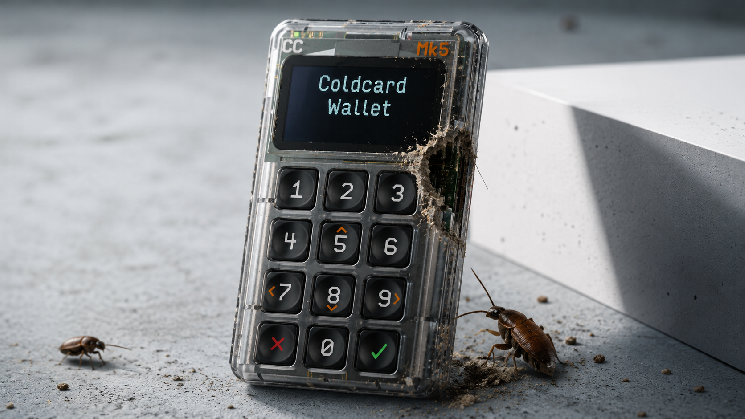
Coldcard Hardware Wallet Hacked: 594 Bitcoin Withdrawn in 25 Minutes

The Coldcard hardware wallet has been compromised, with hackers stealing approximately 594.5 Bitcoin (~$40 million) from 500 addresses in just 25 minutes. The root cause was a critical software bug, undetected for five years, which disabled the device's secure chip for generating true random numbers. This led to the creation of private keys based on predictable data like the processor's serial number, drastically reducing cryptographic security. The attackers exploited this offline by brute-forcing possible seed phrases, finding active addresses on the public ledger, and signing transactions. Initially, Coinkite (Coldcard's maker) claimed only older models were at risk but later admitted all devices running the compromised firmware were vulnerable. CEO Rodolphe Novak (NVK) apologized but ruled out financial compensation for affected users. To secure funds, owners must urgently update their firmware to specific safe versions, generate a completely new seed phrase on the updated device, and transfer all assets to new addresses created with that new seed. While a BIP-39 passphrase can help, it does not replace this migration process. Other Coinkite products like TAPSIGNER were not affected. This incident underscores that even specialized hardware requires rigorous, independent code audits, especially for cryptographic functions. It parallels past failures, like a 2006 OpenSSL bug in Debian, and raises questions about whether automated code analysis can ever fully replace human scrutiny in critical security areas.

cryptonews.ru3 h fa

Coldcard Hardware Wallet Hacked: 594 Bitcoin Withdrawn in 25 Minutes

cryptonews.ru3 h fa

Trading

Spot

Articoli Popolari

Come comprare FET

Benvenuto in HTX.com! Abbiamo reso l'acquisto di FETCH.ai (FET) semplice e conveniente. Segui la nostra guida passo passo per intraprendere il tuo viaggio nel mondo delle criptovalute.Step 1: Crea il tuo Account HTXUsa la tua email o numero di telefono per registrarti il tuo account gratuito su HTX. Vivi un'esperienza facile e sblocca tutte le funzionalità,Crea il mio accountStep 2: Vai in Acquista crypto e seleziona il tuo metodo di pagamentoCarta di credito/debito: utilizza la tua Visa o Mastercard per acquistare immediatamente FETCH.aiFET.Bilancio: Usa i fondi dal bilancio del tuo account HTX per fare trading senza problemi.Terze parti: abbiamo aggiunto metodi di pagamento molto utilizzati come Google Pay e Apple Pay per maggiore comodità.P2P: Fai trading direttamente con altri utenti HTX.Over-the-Counter (OTC): Offriamo servizi su misura e tassi di cambio competitivi per i trader.Step 3: Conserva FETCH.ai (FET)Dopo aver acquistato FETCH.ai (FET), conserva nel tuo account HTX. In alternativa, puoi inviare tramite trasferimento blockchain o scambiare per altre criptovalute.Step 4: Scambia FETCH.ai (FET)Scambia facilmente FETCH.ai (FET) nel mercato spot di HTX. Accedi al tuo account, seleziona la tua coppia di trading, esegui le tue operazioni e monitora in tempo reale. Offriamo un'esperienza user-friendly sia per chi ha appena iniziato che per i trader più esperti.

123 Totale visualizzazioniPubblicato il 2024.12.11Aggiornato il 2026.06.02

Come comprare FET

Discussioni

Benvenuto nella Community HTX. Qui puoi rimanere informato sugli ultimi sviluppi della piattaforma e accedere ad approfondimenti esperti sul mercato. Le opinioni degli utenti sul prezzo di FET FET sono presentate come di seguito.

活动图片