Technical Analysis: Bullish crossover on this would aid ETH buyers

AmbcryptoPubblicato 2022-07-26Pubblicato ultima volta 2022-07-26

Introduzione

Given the double bottom, ETH could see a continued recovery. The potential buying/selling targets would remain the same as discussed above.

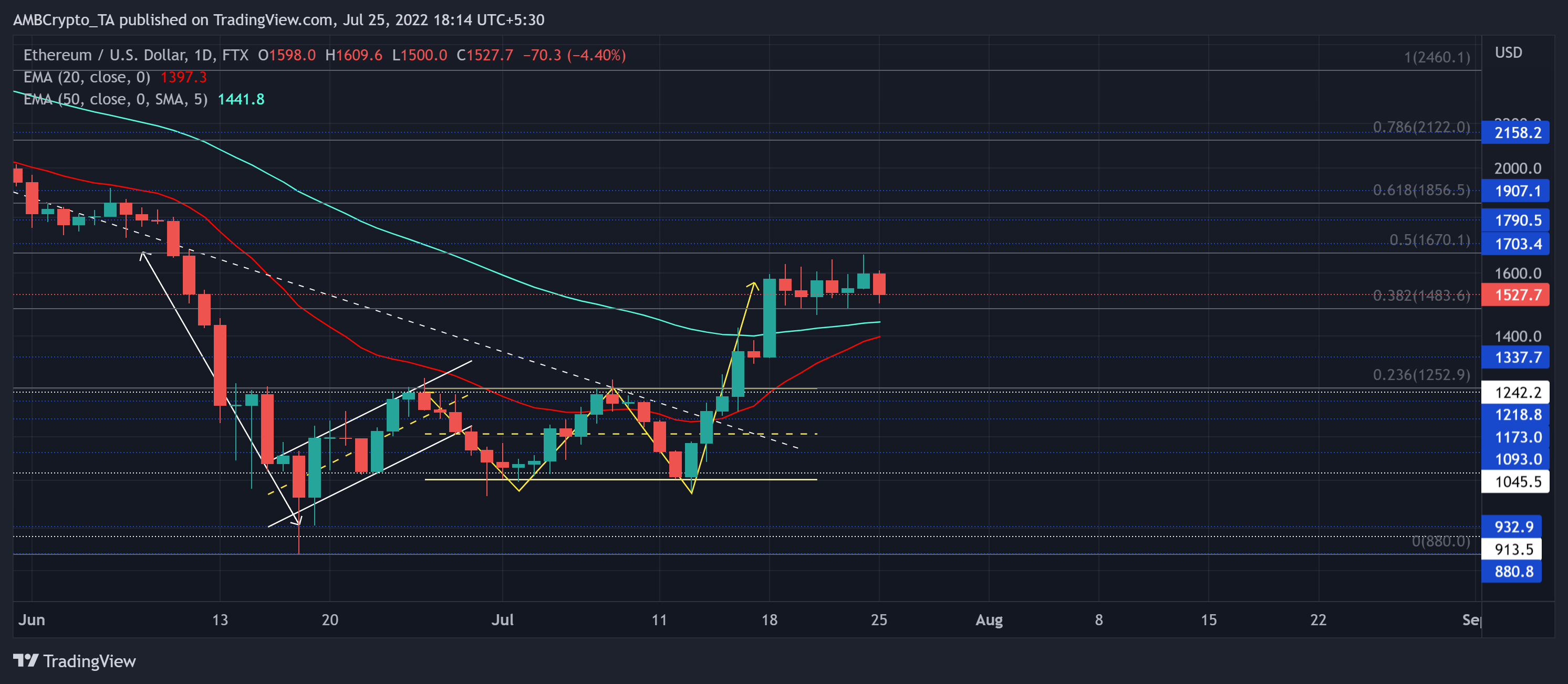
Over the past week, Ethereum [ETH] entered a sideways track after breaking out of its bullish setup in the daily timeframe. Post recovering from the bearish flag breakdown, the bulls found renewed buying pressure and reclaimed their spot above the 20/50 EMA.

After flipping the trendline resistance to support, the buyers asserted their vigor while breaching the 23.6% and the 38.2% Fibonacci resistances.

A potential rebound from the near-term EMAs would position the alt to continue its uptrend in the coming sessions. At press time, the alt was trading at $1,527.7, down by 4.92% in the last 24 hours.

ETH Daily Chart
Source: TradingView, ETH/USD

ETH’s long-term trendline resistance finally cracked after a recent buying comeback. Meanwhile, the 20 EMA (red) has looked north to exhibit a strong buying market.

The coin saw an over 50% ROI from the 13 July low and slammed into the 50% Fibonacci resistance. Since then, the king alt has been consolidating in the $1,500-$1,600 range.

The double-bottom structure reignited the underlying buying pressure lurking in the market. Any bullish crossover on the 20/50 EMA would aid the buyers in amplifying their buying spree. In this case, the potential targets would rest near the 61.8% Fibonacci resistance in the $1,850 zone.

Should the buyers dwindle, any close below the 20/50 EMA could cause a throwback toward the $1300-mark before a likely revival.

Rationale
Source: TradingView, ETH/USD

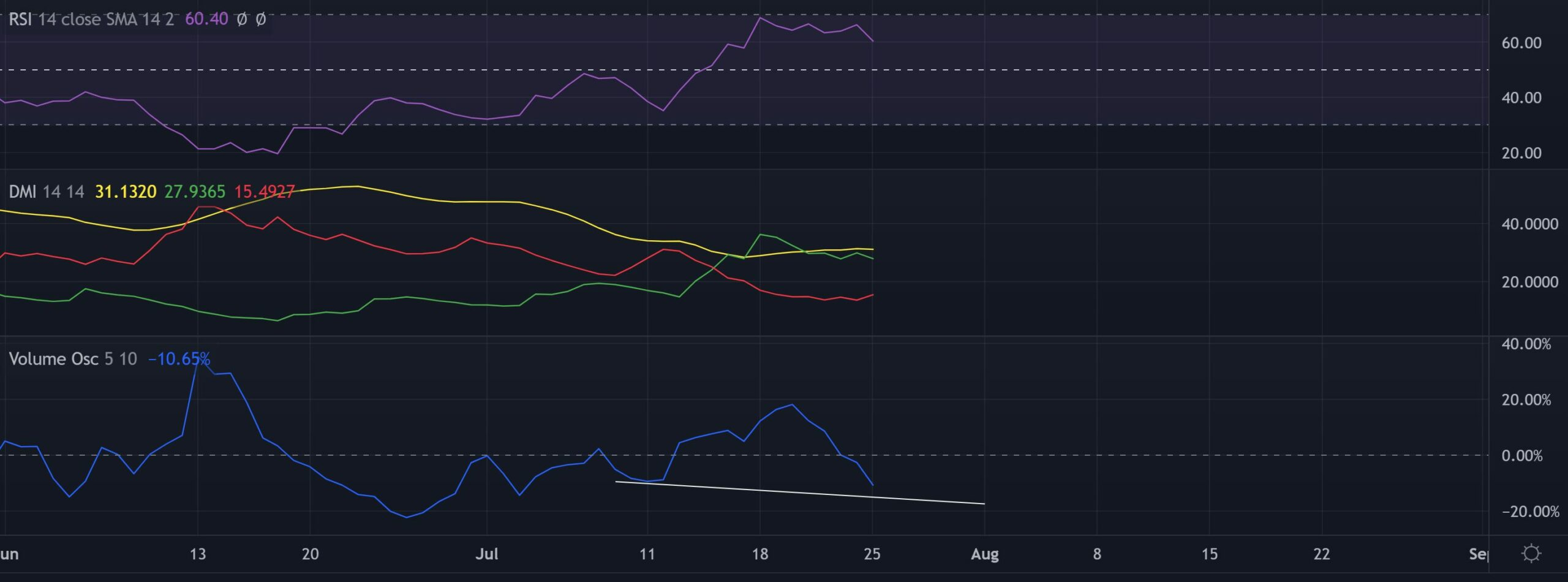
The Relative Strength Index maintained its position above the midline to reflect a buying advantage. Traders/investors should watch for a revival toward or below the equilibrium to identify chances of a bullish invalidation.

Also, the DMI lines continued to exhibit a strong selling advantage with a strong directional trend for ETH. Although the trading volumes have taken a plunge, any recovery on the Volume Oscillator could see an uptick in volumes.

Conclusion

Given the double bottom breakout above the near-term EMAs alongside the bullish edge on technicals, ETH could see a continued recovery. The potential buying/selling targets would remain the same as discussed above.

Finally, investors/traders need to watch out for Bitcoin’s movement. This is because ETH shares a staggering 94% 30-day correlation with the king coin.


Letture associate

Bitcoin Trading Strategy Breakdown: Celebrity Predictions and Classic Models All Fail, Only These Four Indicators Remain

Analysis of Bitcoin Trading Strategies: Why Celebrity Forecasts and Classic Models Fail, Leaving Only These Four Reliable Indicators This analysis examines the failure of common Bitcoin prediction methods and identifies four reliable indicators for constructing a trading strategy. The author reviewed all major BTC prediction approaches from 2017-2025, categorizing them into three groups: celebrity price targets (consistently over-optimistic), analytical models like Stock-to-Flow (broken post-2022), and on-chain signals. The key finding is that more data often creates confusion, not clarity. The strategy discards unreliable elements: celebrity predictions (incentivized to be extreme), pure models (invalidated by post-ETF market changes), and the Fear & Greed Index used alone (too many false signals). Four reliable indicators were selected: 1. **MVRV Z-Score:** Accurately identifies cycle bottoms when entering its green zone (e.g., 2018, 2020, 2022). Note: Its ability to call tops is now ineffective post-2024. 2. **SOPR (28-day MA):** Consistently signals bottoms when below 1.0, indicating holders are selling at a loss. 3. **ETF Net Flow:** A crucial post-2024 metric showing institutional momentum (e.g., sustained inflows = buying). 4. **Macro Liquidity (Fed policy & M2):** Sets the overall directional bias (e.g., bullish during easing cycles). The core strategy involves waiting for a multi-signal共振 (resonance). For example, a bottom signal requires MVRV in the green zone + SOPR < 1.0. A top signal requires overheated on-chain data + sustained ETF outflows. Macro policy sets the overall direction. The Fear & Greed Index is only used as a weighted confirmatory signal, never alone. Action is only taken when three or more indicators align. The author automated this into a monitoring system that sends Telegram alerts only when signals trigger. As of the article's date (April 15, 2026), the system showed a strong bottom signal: extreme fear (F&G=12), MVRV in the buy zone, and SOPR < 1.0. The only contrary signal was weak ETF flows. Historically, such triple on-chain共振 has preceded 100%+ returns. The conclusion emphasizes building a personal framework over relying on external predictions, allowing for iterative improvement and customization based on individual risk tolerance.

marsbit2 h fa

Bitcoin Trading Strategy Breakdown: Celebrity Predictions and Classic Models All Fail, Only These Four Indicators Remain

marsbit2 h fa

Trading

Spot
Futures
活动图片