[Key interpretation] A Whale Dumps 132,882 BTC in 3 Days, What Is the Impact?

Huobi ResearchPubblicato 2022-07-21Pubblicato ultima volta 2022-07-22

Introduzione

BTC rebounded and suffered a sell-off from the giant whale. Pay attention to the market impact.

1、 BTC interval increase space confirmation

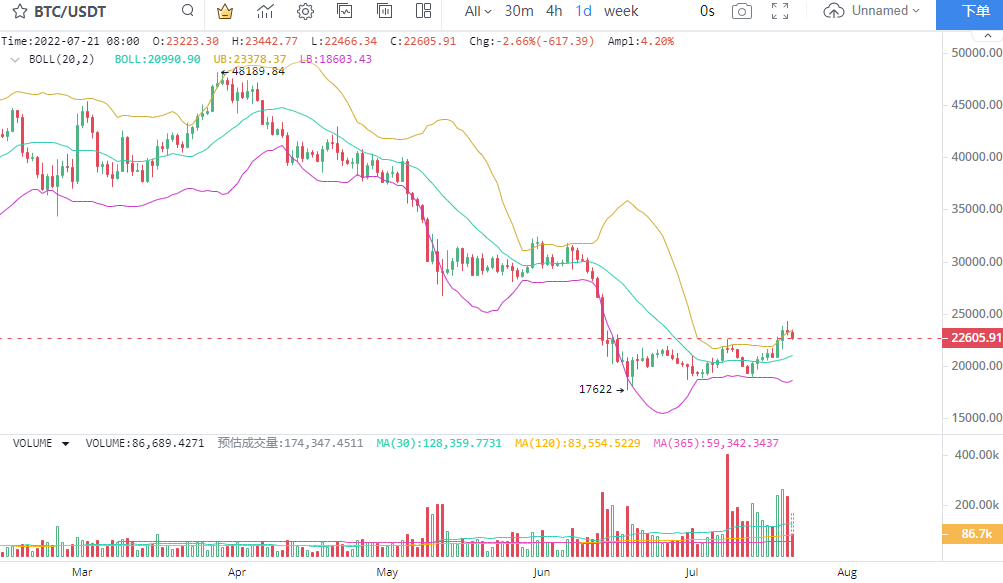
BTC's daily K-line chart was hourly, and there were continuous signs of adjustment during the price rebound. The highest rebound this time was $24276. From the perspective of volume and price performance, BTC still maintains the state of volume trading, but the increase has reached the position above the center of the range. That is to say, from $17246 corresponding to 78.6% of Fibonacci to $28308 corresponding to 61.8% of Fibonacci, of which the pivot price is around $23000.

BTC's rebound may end after the short-term obstruction of the brin online track, the recent increase in major changes and the profit flight of short-term investors.
2. BTC short-term investors profit flight

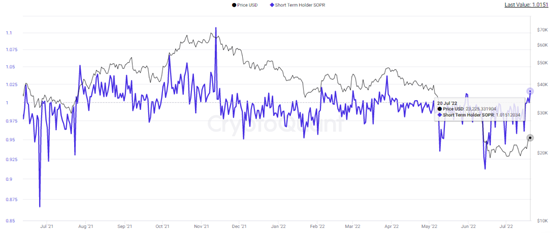
From the SOPR index of short-term investors, the SOPR ratio on July 20 reached 1.015, indicating that investors in short-term and medium-term transactions have obviously gained income. On July 18, the SOPR index value was 1.0058, which was also higher than 1, indicating that investors sold BTC profitably on July 18 and July 20, indicating that the short-term rebound may have encountered greater resistance. Combined with the fact that the transfer of Jujing has increased, we can focus on the adjustment signal next.
3. Clearance of giant whale

The clearance action of giant whale is not frequent, but when encountering special points, the increase of trading means that the energy of market change is enhanced. Judging from the market performance, giant whale has shown signs of position adjustment. The number of giant whales with addresses beginning with 1p5ze reached 132882 BTCs on July 18, with a market value of $2.98 billion based on the closing price of $22432 on that day. Although the number is amazing, the speed of clearance is also surprising.

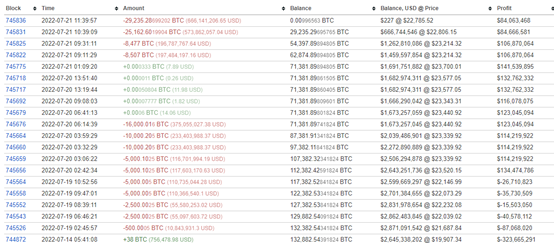
The clearance process of the giant whale began on July 19, and its large-scale clearance process lasted until July 21.
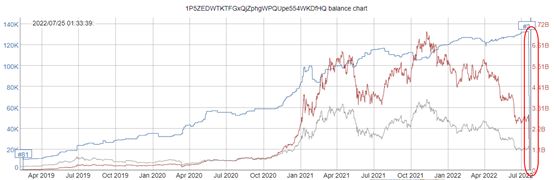
In the change of the account balance of the giant whale at the beginning of 1p5ze, it can be seen that it fell to 117382 BTCs before the end of July 19. At the end of July 20, the number of banknotes decreased to 71381 BTCs. By 11:39 on July 21, the account balance had been cleared.

From the perspective of currency holding cycle, the giant whale has entered the market since February 2019, and the number of coins held has continuously increased from the initial 10000 BTCs to more than 130000. The process of increasing the number of BTC holdings is relatively slow, so the average cost price of holding money is easier to estimate.

The 76000 BTCs in the number of coins held at this address will be completed before December 18, 2021. The cost price of this part of BTC is lower than 23000 US dollars. It is estimated that the holding cost of 76000 BTCs is much lower than US $9000.

After December 18, 2021, the holding cost of this account will increase, which is higher than the current BTC of $23000. On the whole, the profit margin of this account is large, and it is estimated that the overall profit margin is close to 50%. As the holding time of the giant whale investor is more than 3 years, it belongs to the position adjustment of long-term investors.
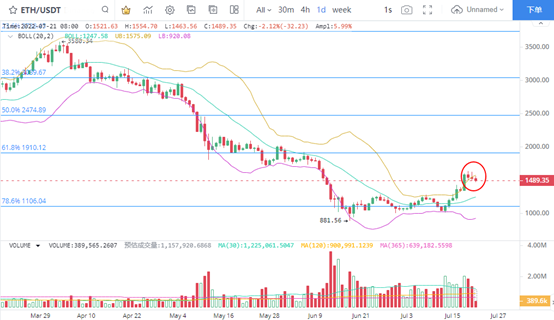
4. Eth continuous adjustment signal

In terms of the daily K-line, ETH showed a reversal signal of continuous pullback. Recently, ETH has a large rebound space, with a cumulative increase of nearly 100%. The price began to adjust at the upper limit of the range shock, which is in line with investors' trading habits. On the brin line, after the ETH price hit the brin online track, it is already the third trading day in the state of adjustment. Considering that there are many chips under the low price range of $1600 in eth, the price is more likely to fluctuate within the range.

Letture associate

WeChat AI Card Hands-On Guide: Has the AI Shopping Era Arrived?

**"WeChat AI Card" Practical Test Guide: Has the Era of AI Shopping Arrived?** WeChat has officially launched the "AI Exclusive Card," a feature integrated into its Workbuddy AI assistant. This card is designed to handle payments for AI-initiated purchases. Our hands-on test reveals it's not yet a tool for fully autonomous AI shopping, but rather a controlled payment layer for AI agents. The AI Card functions as an isolated sub-wallet within WeChat Pay. Users must bind the card and transfer funds into it from their main wallet. Crucially, every transaction requires explicit user confirmation via smartphone scan; AI cannot spend autonomously. Currently accessible through the Workbuddy agent, the card targets specific digital consumption scenarios: purchasing paid content (reports, data), calling paid APIs/tools, and subscribing to services. Its design prioritizes security and control by separating funds and mandating approval for each payment. We tested a real-world scenario: ordering bubble tea via Workbuddy using a "Meituan Life Assistant" skill. The process encountered multiple hurdles: high "skill" usage costs (exceeding daily free credits), and most importantly, while a payment was successfully initiated, the AI purchased an incorrect product (a mismatched group-buy coupon instead of the desired drink). This highlights the current limitation: the **AI Card only solves the payment step**. The broader challenge lies in the **AI agent's execution chain**—accurately understanding intent, navigating third-party platforms, selecting the right product, and ensuring proper fulfillment. The payment succeeded, but the purchase failed to meet the user's need. In conclusion, the WeChat AI Exclusive Card is a cautious, early-step experiment in AI commerce. It provides a secure, user-controlled payment method for agent interactions but is not yet capable of reliable, end-to-end complex purchases. For now, it's best used for low-value, low-risk digital services with careful user verification at each step. The vision of AI handling complete shopping tasks remains a work in progress.

marsbit37 min fa

WeChat AI Card Hands-On Guide: Has the AI Shopping Era Arrived?

marsbit37 min fa

Deconstructing Notion's Growth: From a Note-taking Tool to 100 Million Users—How Notion Built a Triple Growth Flywheel Through Product, Templates, and Community

Notion's growth from a niche note-taking tool to a platform with 100 million users is powered by three interconnected flywheels: Product-Led Growth (PLG), a Template Economy, and Community-Driven Growth. First, Notion's PLG strategy relies on a highly flexible, "plastic" product that users can adapt to countless personal and team workflows. Its freemium model lowers the barrier to entry, while features like page sharing and collaboration drive organic, usage-based viral growth as users naturally invite others. Second, the Template Economy solves the "blank page" problem. Templates, created by both Notion and its community, transform abstract product capabilities into concrete, copyable solutions for specific scenarios (e.g., project management, content calendars). This dramatically lowers activation costs for new users and fuels SEO-driven discovery. Third, a vibrant Community acts as a distributed growth engine. Users and official Ambassadors create tutorials, share use cases, and host local events. This community not only educates users but also fosters a sense of identity around pursuing "better ways of working," strengthening loyalty and enabling global, low-cost expansion. Together, these flywheels create a self-reinforcing ecosystem: a great product attracts users who create templates and community content, which in turn attracts more users and deepens engagement. This system allowed Notion to scale from individuals to teams and enterprises through a bottom-up adoption path. Looking ahead, AI integration promises to accelerate these flywheels further by making templates smarter and the platform a potential AI-native work operating system. Ultimately, Notion's defensible advantage is not just its features, but this deeply entrenched network of user assets, creators, and community trust.

marsbit37 min fa

Deconstructing Notion's Growth: From a Note-taking Tool to 100 Million Users—How Notion Built a Triple Growth Flywheel Through Product, Templates, and Community

marsbit37 min fa

$10 Billion, Qualcomm to Acquire Chip Legend Jim Keller's Company

Global mobile chip giant Qualcomm is in advanced talks to acquire AI chip startup Tenstorrent in a deal valued between $8-10 billion, according to media reports. This potential acquisition would be one of the largest in the AI chip sector in recent years. Tenstorrent, led by legendary chip architect Jim Keller, has gained prominence for its RISC-V architecture and AI accelerator designs. The move highlights Qualcomm's strategic push to diversify beyond its core smartphone chip business. As the smartphone market matures, Qualcomm is aggressively targeting growth in automotive, data center, and cloud AI. Acquiring Tenstorrent would allow Qualcomm to rapidly enter the high-end AI computing market, bypassing lengthy in-house development cycles. Tenstorrent's cost-effective system architecture, which avoids expensive HBM memory and relies on standard Ethernet for clustering, offers a potential alternative to Nvidia's costly solutions. Furthermore, Tenstorrent's high-performance RISC-V CPU technology and its focus on the automotive and edge computing segments align with Qualcomm's strategic goals, including its "Snapdragon Digital Chassis" platform. Despite the strategic rationale, the high valuation has sparked some investor caution. The successful integration of Tenstorrent's open-source culture and independent team into Qualcomm's organization, along with the commercialization of its technology, remains a key challenge.

marsbit1 h fa

$10 Billion, Qualcomm to Acquire Chip Legend Jim Keller's Company

marsbit1 h fa

Trading

Spot
Futures
活动图片