Bitcoin Ends Q4 In The Red, Bear Market May Persist For 2–3 Months

bitcoinistPubblicato 2025-12-27Pubblicato ultima volta 2025-12-27

Introduzione

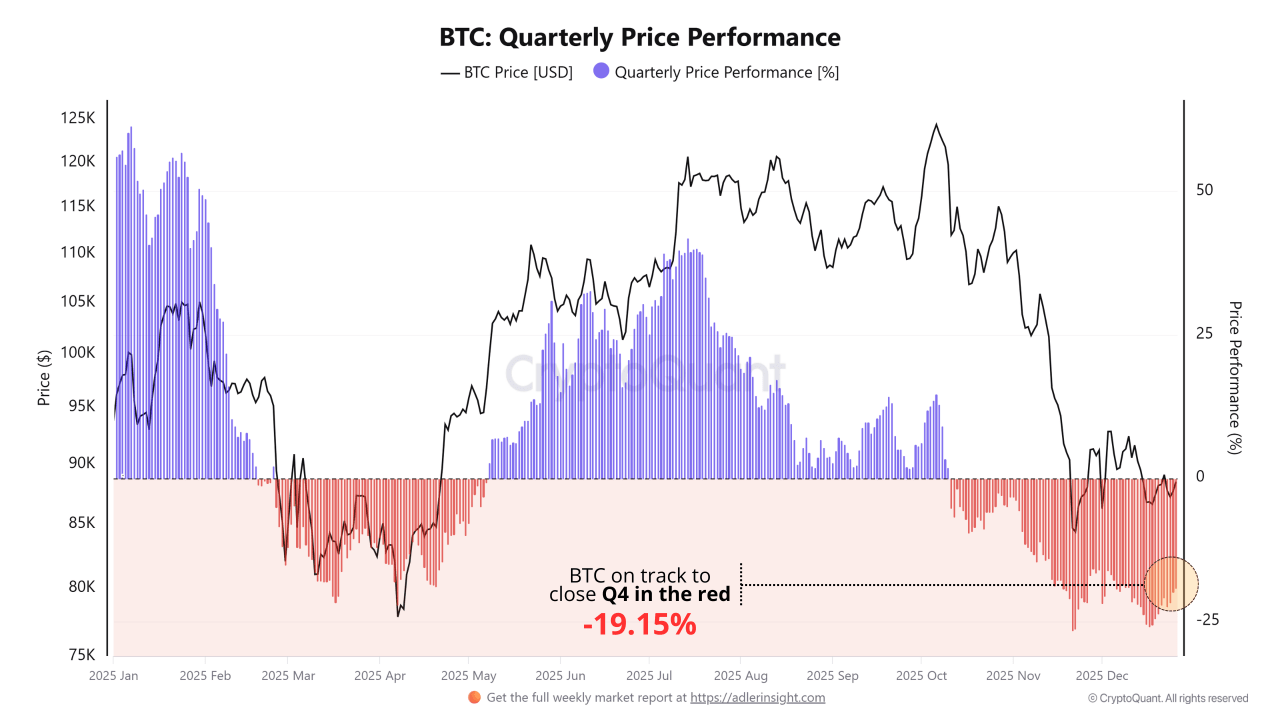
Bitcoin concludes Q4 2025 with a 19.15% decline, having fallen 30% from its October high of $126,200 to around $87,400. Analyst GugaOnChain warns the bearish trend may persist for 2-3 months into early 2026, citing multiple negative indicators. Key metrics include SOPR below 1, signaling investors are selling at a loss; MVRV-STH at 0.87, indicating short-term holders are underwater; and 35.66% of Bitcoin supply in loss. The Fear & Greed Index reflects extreme fear at 20. Institutional outflows from US spot ETFs and a negative Coinbase Premium Gap further confirm weak demand. Market cap growth is negative at -11.65%, reinforcing the expectation of continued corrections until capitulation signals ease.

Bitcoin is closing the fourth quarter of 2025 on a weak note, reinforcing concerns that the market’s correction phase is far from over. After peaking at around $126,200 in early October, the flagship cryptocurrency has slipped into a sustained downturn, losing 30% of its market value at press time.

Since that peak, Bitcoin has struggled to decisively reclaim the $92,000 level, with repeated rejection at higher prices highlighting fading demand and growing caution among investors. Notably, crypto analyst GugaOnChain warns that the poor quarterly close could extend downside pressure into early 2026, as both on-chain data and sentiment indicators point to a continuation of bearish conditions.

Capitulation Indicators Signal Market Stress To Remain In 2026

According to GugaOnChain in the QuickTake post on Friday, the BTC: Quarterly Price Performance indicator reports a negative Q4 performance of -19.15%, which serves as the foundation of this bearish outlook. Furthermore, several key capitulation indicators also suggest that the market is unprepared for any form of bullish revival.

For example, the Spent Output Profit Ratio (SOPR) currently sits below 1 at 0.99, indicating that investors are selling Bitcoin at a loss, a common feature of bear market phases. Similarly, the Short-Term Holder MVRV (MVRV-STH) remains below 1 at 0.87, signaling that short-term holders are deeply underwater and more prone to capitulation at the moment.

Further reinforcing this narrative, GugaOnChain points to the elevated percentage of Bitcoin supply in loss, currently standing at 35.66%, pushing more BTC holders into significant loss positions, thereby reducing confidence and driving market stress. In addition to these metrics, the Fear & Greed Index has dropped into the “extreme fear” zone at 20, suggesting widespread pessimism and risk aversion among participants.
Source: CryptoQuant

Bear Market Confirmation Indicators

Beyond capitulation metrics, GugaOnChain highlights additional confirmation indicators that suggest that downside risks will remain dominant in the near term. One of these indicators, the Market Cap Growth Rate, measured by the 30-day versus 365-day moving average gap ratio, is firmly negative at -11.65%, pointing to contracting market growth rather than expansion.

Institutional flows also reflect waning confidence. US Bitcoin spot ETFs recorded $825.7 million in net outflows between December 18 and December 24, 2025, highlighting reduced institutional appetite as the Q4 price struggles persist. Meanwhile, the Coinbase Premium Gap has remained negative at –66.11, signaling weaker demand from US-based investors compared to offshore markets.

In assessing these several metrics together, GugaOnChain concludes the crypto market is likely to remain in a bear phase for the next two to three months. Therefore, investors should anticipate further corrections in the first quarter of 2026 until the capitulation signals ease and demand is stabilized.

At press time, Bitcoin trades at $87,436, reflecting a slight market loss of 0.42% in the last day.

BTC trading at $87,660 on the daily chart | Source: BTCUSDT chart on Tradingview.com

Domande pertinenti

QWhat was Bitcoin's peak price in early October 2025, and what is its current percentage loss from that peak?

ABitcoin peaked at around $126,200 in early October 2025 and has lost 30% of its market value from that peak at press time.

QAccording to GugaOnChain, what is the two key capitulation indicators that signal investors are selling at a loss and are deeply underwater?

AThe two key capitulation indicators are the Spent Output Profit Ratio (SOPR) at 0.99, indicating selling at a loss, and the Short-Term Holder MVRV (MVRV-STH) at 0.87, signaling short-term holders are deeply underwater.

QWhat does the negative Market Cap Growth Rate of -11.65% indicate about the Bitcoin market?

AThe negative Market Cap Growth Rate of -11.65% indicates the market is contracting rather than expanding, pointing to dominant downside risks in the near term.

QHow did US Bitcoin spot ETFs perform in terms of net flows between December 18 and December 24, 2025, and what does this signify?

AUS Bitcoin spot ETFs recorded $825.7 million in net outflows during that period, highlighting reduced institutional appetite as the Q4 price struggles persist.

QWhat is the overall conclusion from the analyst regarding the expected duration of the current bear market phase?

AThe analyst concludes that the crypto market is likely to remain in a bear phase for the next two to three months, with further corrections expected in the first quarter of 2026.

Letture associate

RWA Weekly: Digital Yuan Wallets Implement Interest on Balances, Ondo's Tokenized Silver Product Surges Over 155% in Market Cap in 30 Days

RWA Weekly: Digital Yuan Wallets to Earn Interest, Ondo's Tokenized Silver Surges Over 155% This weekly report covers December 27, 2025, to January 2, 2026. The on-chain RWA market cap grew steadily to $19.21 billion, with holders nearing 600,000, though growth suggests potential demand constraints. Stablecoin market cap slightly declined to $2.97 trillion, but monthly transfer volume surged 13.77%, indicating an "efficiency-driven" phase. RWA protocol TVL has surpassed DEXes to become the fifth-largest DeFi category. In China, the PBOC announced plans to enhance the digital yuan management system, with six major state-owned banks introducing interest payments (0.05% annual rate) on balances in verified digital yuan wallets starting January 1, 2026, advancing its function toward M1. Cross-border adoption accelerated, with Bank of China completing the first QR code payment between China and Laos. Globally, the US FASB plans to study whether stablecoins can be classified as cash equivalents in 2026. India's central bank urged prioritizing CBDCs over private stablecoins due to financial stability concerns. Notable project developments include BlackRock's tokenized money market fund BUIDL distributing over $100 million in dividends, and Ondo's tokenized silver product (SLVon) surging over 155% in market cap to nearly $18 million. Commodity tokenization expanded with platforms like MSX listing copper, uranium, and oil tokens. The report highlights growing interest in tokenized commodities amid rising gold and silver prices, and discusses stablecoins' evolution toward programmable money and AI-driven "agent finance," emphasizing transparency and global reach as key advantages over traditional finance.

marsbit24 min fa

RWA Weekly: Digital Yuan Wallets Implement Interest on Balances, Ondo's Tokenized Silver Product Surges Over 155% in Market Cap in 30 Days

marsbit24 min fa

2026 US Crypto Policy: Keep an Eye on These Six Key Milestones

The year 2026 is poised to be a pivotal period for US cryptocurrency policy, marked by six key dates. The policy revolution initiated under President Trump's second term is expected to continue, with major legislative and regulatory actions scheduled throughout the year. In January, the Senate is anticipated to hold hearings on the market structure bill, aiming to resolve the regulatory turf war between the SEC and CFTC. Additionally, SEC Chair Paul Atkins is expected to introduce an "innovation exemption" for new technologies. On May 15, the term of Federal Reserve Chair Jerome Powell ends. President Trump is likely to appoint a more dovish successor, whose monetary policy decisions could significantly impact crypto markets and inflation. A new crypto licensing law, the Digital Financial Assets Law, takes effect in California on July 1, potentially setting a precedent for other states. By July 18 deadline, federal and state regulators must issue supplementary rules for the recently passed stablecoin legislation (the Genius Act), covering areas like licensing and anti-money laundering. This process is already facing contention from banks and industry groups. By the end of August, two key developments are expected: the potential passage of crypto tax legislation (the Parity Act) addressing staking and small transactions, and the finalization of CFTC rules on blockchain technology applications in capital markets. The November 3 midterm elections represent the most significant variable. The current pro-industry "golden age" in Washington, facilitated by a Republican-controlled Congress, could end if Democrats regain control of either chamber, drastically reducing the likelihood of future crypto-friendly legislation. The passage of any pending bills too close to this date carries a high risk of stalling.

比推38 min fa

2026 US Crypto Policy: Keep an Eye on These Six Key Milestones

比推38 min fa

6 Key Dates for US Crypto Policy in 2026

Summary of Key US Crypto Policy Dates in 2026: 2026 is poised to be another significant year for US cryptocurrency policy. Key dates include: - **January**: The Senate is expected to hold hearings on the stalled crypto market structure bill (the "Clarity Act"), aiming to resolve the jurisdictional battle between the SEC and CFTC. Additionally, SEC Chair Paul Atkins is expected to unveil an "innovation exemption" for new technologies. - **May 15**: The term of Federal Reserve Chair Jerome Powell ends. President Trump, who has criticized Powell, is likely to appoint a more dovish successor, a move that could impact crypto markets and inflation. - **July 1**: California's Digital Financial Assets Law takes effect, requiring businesses engaging in digital asset activities with state residents to be licensed by the state’s financial regulator. - **July 18**: Regulators face a deadline to publish supplementary rules for the recently passed stablecoin legislation (the "Genius Act"), covering areas like licensing and anti-money laundering. This process is already contentious, with banks and crypto lobbyists clashing over certain provisions. - **August**: Two major developments are anticipated: the potential passage of crypto tax legislation (e.g., the "Parity Act" for de minimis exemptions) and the finalization of CFTC rules on blockchain technology applications in capital markets. - **November 3**: The US midterm elections could drastically alter the crypto policy landscape. The industry's recent successes relied on a Republican-controlled Congress; if Democrats regain control, the passage of pro-industry legislation would become far more difficult. The implementation of new laws and the political climate will be crucial in determining if the US remains a hub for crypto innovation.

marsbit1 h fa

6 Key Dates for US Crypto Policy in 2026

marsbit1 h fa

Trading

Spot
Futures

Discussioni

Benvenuto nella Community HTX. Qui puoi rimanere informato sugli ultimi sviluppi della piattaforma e accedere ad approfondimenti esperti sul mercato. Le opinioni degli utenti sul prezzo di BTC BTC sono presentate come di seguito.

活动图片