3.62亿美元去哪了?Hyperliquid反击FUD,一场对账背后的去中心化路线之争

marsbitPubblicato 2025-12-24Pubblicato ultima volta 2025-12-24

Introduzione

2025年12月20日,一篇技术文章《Reverse Engineering Hyperliquid》通过逆向工程指控Hyperliquid存在9项严重问题,包括3.62亿美元资金缺口及“上帝模式后门”,称其是“伪装成区块链的中心化交易平台”。Hyperliquid官方迅速回应,澄清资金缺口实为用户资产从Arbitrum跨链桥迁移至HyperEVM原生链的账面差异,总储备金43.51亿USDC与用户余额完全吻合。 官方部分澄清了技术质疑,如“CoreWriter”权限受限、测试网残留代码已隔离、8个广播地址为抗MEV措施等,但未正面回应治理提案不可查询及跨链桥无强制提款机制的问题。回应中,Hyperliquid还罕见批评竞品Lighter、Aster等依赖“中心化排序器”,强调自身“全状态上链”的透明度优势。 此外,团队承认近期做空HYPE代币的地址属于前员工个人行为,与现团队无关。此次事件凸显了DeFi协议架构复杂化下的审计挑战,也反映出Hyperliquid在去中心化演进中仍需平衡性能、透明与权限分散。

2025 年 12 月 20 日,一篇发布在 blog.can.ac 上的技术文章《Reverse Engineering Hyperliquid》,通过逆向工程直接拆解了 Hyperliquid 的二进制文件,指控其存在从「资不抵债」到「上帝模式后门」等 9 项严重问题。文章直言:

「Hyperliquid 是一个伪装成区块链的中心化交易平台。」

面对 FUD,Hyperliquid 官方发布长文回应,或许这不仅是一次单纯的辟谣,更是一场关于「谁才是真正去中心化交易设施」的路线宣战。虽然官方成功澄清了资金安全问题,但在去中心化的某些敏感地带,仍留下了耐人寻味的「留白」。

3.62 亿美元去哪了?「双账本」下的审计盲区

指控中最具杀伤力的一点是:Hyperliquid 系统内的用户资产比链上储备少了 3.62 亿美元。如果属实,这意味着这是一家部分准备金运行的「链上 FTX」。

但经过核查,这是一个因为「架构升级」导致的信息不对称误读。质疑者的审计逻辑是:Hyperliquid 储备金 = Arbitrum 跨链桥上的 USDC 余额。根据这一逻辑,他查看了跨链桥地址,发现余额确实少于用户总存款。

Hyperliquid 回应称,正在经历从「L2 AppChain」向「独立 L1」的完全体进化。在这个过程中,资产储备变为了双轨制:

指控者完全忽略了位于 HyperEVM 上的原生 USDC,根据链上数据(截至发稿时):

· Arbitrum 跨链余额: 39.89 亿 USDC(Arbiscan 可查)

· HyperEVM 原生余额: 3.62 亿 USDC(Hyperevmscan 可查)

· HyperEVM 合约余额: 0.59 亿 USDC

总偿付能力 = 39.89 亿 + 3.62 亿 + 0.59 亿 ≈ 43.51 亿 USDC

这一数字与 HyperCore 上的用户总余额(Total User Balances)完全吻合。所谓的「3.62 亿缺口」,恰恰就是已经迁移至 HyperEVM 的原生资产。这并非资金消失,而是资金在不同账本间的流转。

9 点指控对账单:澄清了什么?回避了什么?
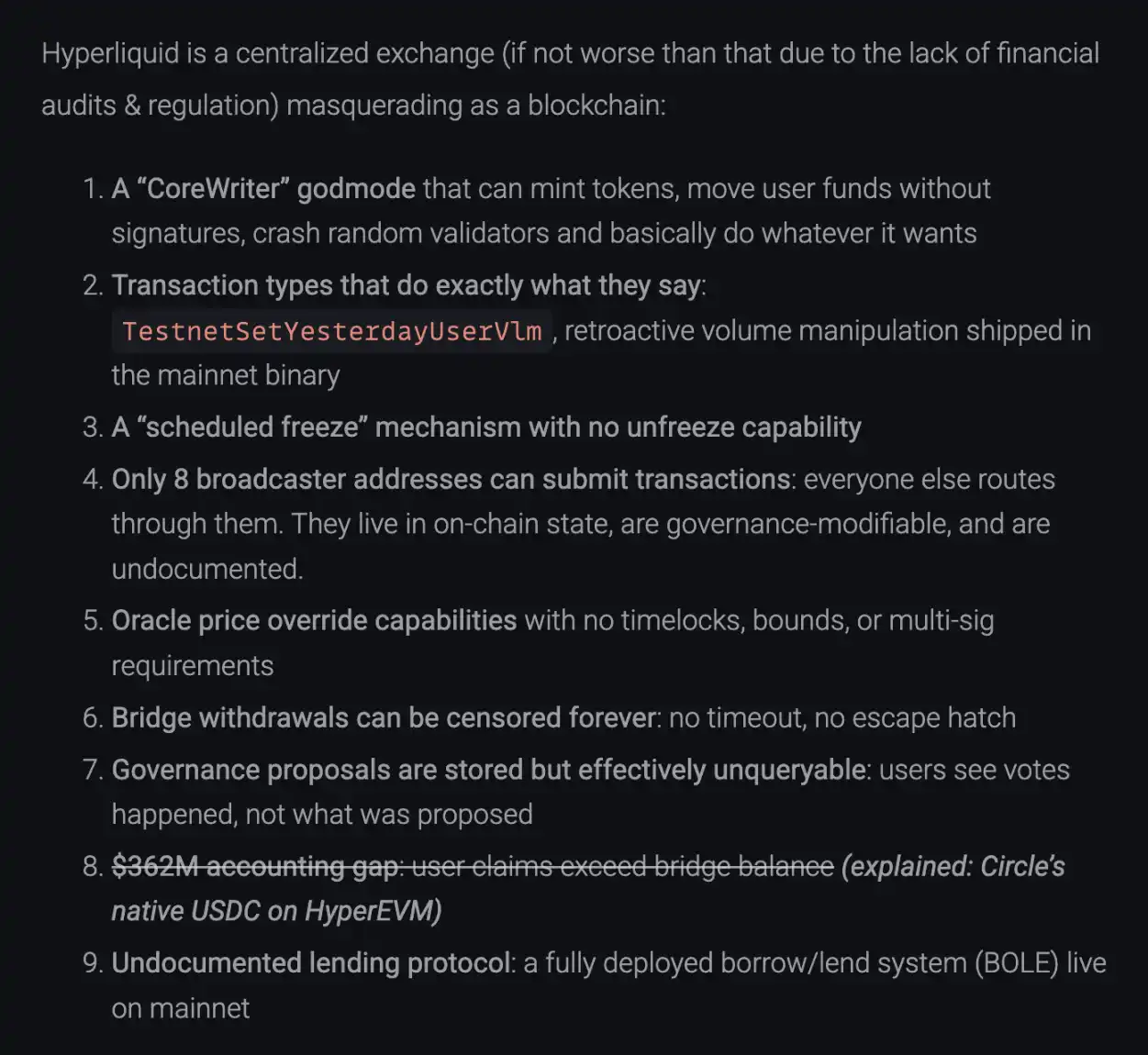
已澄清的指控

指控:「CoreWriter」上帝模式: 指控称其能凭空印钞、挪用资金。

回应: 官方解释这是 L1 与 HyperEVM 交互的接口(如质押),权限受限,并无挪用资金能力。

指控:3.62 亿资金缺口。

回应: 如上文所述,系未计算 Native USDC。

指控:未公开的借贷协议。

回应: 官方指出现货 / 借贷功能(HIP-1)文档已公开,处于预发布阶段,并非秘密运行。

已承认但有合理解释的指控

指控:二进制文件含「修改交易量」代码(TestnetSetYesterdayUserVlm)。

回应: 承认存在。但解释为测试网(Testnet)残留代码,用于模拟费率逻辑,主网节点已物理隔离该路径,无法执行。

指控:只有 8 个广播地址能提交交易。

回应: 承认。解释为抗 MEV(最大可提取价值)措施,防止用户被抢跑。承诺未来会实行「多提议者」机制。

指控:链可以被「计划性冻结」且无撤销功能。

回应: 承认。解释这是网络升级(Upgrade)的标准流程,必须全网暂停切换版本。

指控:预言机价格可被瞬间覆盖。

回应: 解释为系统安全性设计。为了在类似 10/10 的极端波动中及时清算坏账,验证者预言机确实没有设置时间锁。

回应缺失 / 模糊

在我们的核对中,有两点指控在官方回应中未被正面提及或完全解决:

指控:治理提案不可查询(Governance proposals are unqueryable),用户只能看到投票发生了,但链上数据不包含提案的具体文本内容。

回应: 官方未在长文中回应此点。这意味着 Hyperliquid 的治理目前对普通用户而言仍是一个「黑盒」,你只能看到结果,看不到过程。

指控:跨链桥无「逃生舱」(No Escape Hatch),提现可能被无限期审查,用户无法强制提款回 L1。

回应: 官方虽然解释了 POPCAT 事件中锁定桥是为了安全,但未反驳「无逃生舱」这一架构事实。这表明在当前阶段,用户资产进出高度依赖验证者集的放行,不具备 L2 Rollup 那样的抗审查强制提款能力。

「拉踩」竞品

这次风波最有趣的地方,在于它逼迫 Hyperliquid 亮出了自己的底牌,也让我们有机会重新审视 Perp 赛道的格局。官方在回应中罕见地「拉踩」了竞品,将枪口对准了 Lighter、Aster 甚至行业巨头 Binance。

其表示,「Lighter 使用单一的中心化序列器,其执行逻辑和零知识证明(ZK)电路均不公开。Aster 使用中心化撮合,甚至提供暗池交易,而暗池交易只有在单一的中心化序列器且执行过程不可验证的情况下才能实现。其他一些包含开源合约的协议则没有可验证的序列器。」

Hyperliquid 直言不讳地将这些竞争对手归为一类,称它们均依赖「中心化排序器(Centralized Sequencer)」。官方强调:在这些平台上,除了排序器运营者,没有任何人能看到完整的状态快照(包括订单簿历史、仓位细节)。相比之下,Hyperliquid 试图通过让所有验证者执行相同的状态机来消除这种「特权」。

而这波「拉踩」或许也正是因为 Hyperliquid 对当前的市场份额产生了担忧,根据 DefiLlama 过去 30 天的交易量数据,市场格局已呈三足鼎立之势:
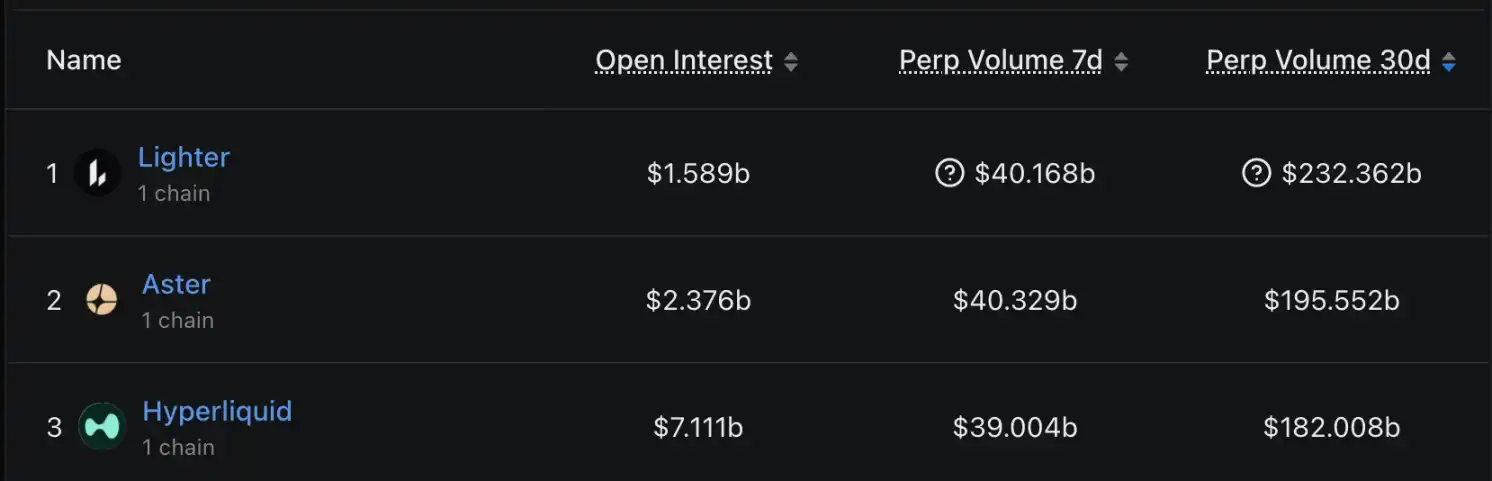
· Lighter:交易量 2323 亿美元,暂居榜首,占比约 26.6%。

· Aster:交易量 1955 亿美元,位居第二,占比约 22.3%。

· Hyperliquid:交易量 1820 亿美元,位居第三,占比约 20.8%。

面对 Lighter 和 Aster 后来者居上的交易量,Hyperliquid 试图打出「透明度」这张牌——即「虽然我有 8 个中心化广播地址,但我全状态上链可查;而你们连查都没法查」。不过值得注意的是,虽然在交易量上 Hyperliquid 略逊于前两名,但在持仓量(Open Interest, OI)上,Hyperliquid 呈现碾压态势。

舆情回应:谁在做空 HYPE?

除了技术与资金问题,社区最为关切的还有近期 HYPE 代币疑似被「内部人士」做空砸盘的传闻。对此,Hyperliquid 团队成员在 Discord 首次给出了定性回应:「0x7ae4 开头做空地址属于一名前员工」,该人员曾是团队成员,但已于 2024 年初被解雇。该前员工的个人交易行为与 Hyperliquid 现有团队无关。平台强调,目前对所有在职员工和承包商实行极其严格的 HYPE 交易限制与合规审查,严禁利用职务之便进行内幕交易。

这一回应试图将「团队作恶」的指控降级为「前员工个人行为」,但在代币分发与解锁机制的透明度上,社区或许仍期待更详尽的公示。

Don't Trust, Verify

Hyperliquid 的这次澄清推文,堪称教科书级别的危机公关——不是靠情绪输出,而是靠数据、代码链接和架构逻辑。它没有止步于自证清白,而是反守为攻,通过对比竞品的架构,强化了自身「全状态上链」的品牌和优势。

虽然 FUD 被证伪,但这次事件给行业留下的思考是深远的。随着 DeFi 协议向独立应用链(AppChain)演进,架构越来越复杂,资产分布越来越碎片化(Bridge + Native)。传统的「看一眼合约余额」的查账方式已经失效。

对于 Hyperliquid 而言,证明了「钱在」只是第一步。如何在保持高性能和抗 MEV 的优势下,逐步移交那 8 个提交地址的权限,真正实现从「透明的中心化」到「透明的去中心化」的跨越,才是它通往「终极 DEX」的必经之路。

而对于用户,这次风波再次印证了加密世界的那条铁律:不要相信任何叙事,去验证每一个字节。

Domande pertinenti

Q针对Hyperliquid的3.62亿美元资金缺口指控,官方是如何回应的?

A官方回应称,所谓的3.62亿美元资金缺口是由于Hyperliquid正在从L2 AppChain向独立L1升级,资产储备采用双轨制。质疑者仅计算了Arbitrum跨链桥上的USDC余额,但忽略了已迁移至HyperEVM的原生USDC。根据链上数据,总偿付能力(Arbitrum跨链余额 + HyperEVM原生余额 + HyperEVM合约余额)与用户总余额完全吻合,不存在资金缺口。

Q在9项指控中,哪些被Hyperliquid官方完全澄清?

A官方完全澄清了以下指控:1. 'CoreWriter'上帝模式:解释为L1与HyperEVM交互的受限接口,无挪用资金能力;2. 3.62亿美元资金缺口:系未计算Native USDC导致的误读;3. 未公开的借贷协议:指出现货/借贷功能(HIP-1)文档已公开,处于预发布阶段。

QHyperliquid在回应中承认了哪些指控但提供了合理解释?

A官方承认但提供合理解释的指控包括:1. 二进制文件含'修改交易量'代码:解释为测试网残留代码,主网已物理隔离;2. 只有8个广播地址能提交交易:解释为抗MEV措施,承诺未来实行多提议者机制;3. 链可被'计划性冻结':解释为网络升级的标准流程;4. 预言机价格可被瞬间覆盖:解释为应对极端波动的安全设计。

QHyperliquid在回应中未正面解决哪些指控?

A官方未正面解决两点指控:1. 治理提案不可查询:用户只能看到投票结果,无法查看提案具体内容,治理过程仍为'黑盒';2. 跨链桥无'逃生舱':未反驳提现可能被审查的架构事实,用户资产进出依赖验证者放行,缺乏抗审查强制提款能力。

QHyperliquid在回应中如何通过'拉踩'竞品突出自身优势?

A官方通过对比竞品强调自身'全状态上链'的透明度优势:指责Lighter使用中心化序列器且执行逻辑不公开,Aster依赖中心化撮合和暗池交易,而其他协议缺乏可验证序列器。Hyperliquid声称其通过所有验证者执行相同状态机消除'特权',尽管当前使用8个广播地址,但全状态可查,竞品则无法提供同等透明度。

Letture associate

Under the Shock of Oil Prices and Inflation, Which Country Will Be the First to Sell Off Its Gold Reserves?

The article draws a parallel between the 2003 North American blackout and the potential collapse of the global financial system, framing the US dollar and Treasury market as the world's economic "power grid." It argues that the closure of the Strait of Hormuz is creating a shockwave, starting with oil-importing emerging markets like Turkey, India, and Indonesia. As oil prices rise, these nations are forced to sell dollar-denominated assets—first US Treasuries, then potentially their gold reserves—to afford fuel. Turkey is highlighted as a key case, having sold nearly 90% of its Treasuries and begun tapping gold reserves when oil was between $70-$105/barrel. The article warns that if prices spike to $150-$160/barrel, global buffers like oil inventories and strategic reserves will be depleted. This could trigger a cascade: vulnerable nations, having exhausted assets, could face economic and political collapse (like Sri Lanka in 2022). Their forced asset sales would drive US Treasury yields higher, potentially past a critical threshold (around 5%), forcing the US to choose between a bond market crash or hyperinflation through massive money printing. Ultimately, the piece posits that the dollar's long-term decline is inevitable. The first domino to fall will likely be a fragile emerging market, signaling the start of a chain reaction that eventually threatens the core of the dollar system. The conclusion advises holding tangible assets like gold and energy, which cannot be printed, as a hedge against currency devaluation.

marsbit13 min fa

Under the Shock of Oil Prices and Inflation, Which Country Will Be the First to Sell Off Its Gold Reserves?

marsbit13 min fa

Behind HYPE's Repeated Record Highs, the 'Minions' in the Ecosystem Can't Keep Up

While HYPE, the native token of the Hyperliquid ecosystem, surges to new all-time highs above $76 and attracts significant institutional ETF inflows, a starkly different reality unfolds within its HyperEVM application layer. Multiple core DeFi protocols across lending, NFTs, stablecoins, and DEXs have announced shutdowns between May and June. The article argues HYPE functions more like an "application stock" than a traditional ecosystem token. Its value is anchored to the trading fees from Hyperliquid's core perpetual contracts platform (HyperCore), which boasts a diversified revenue stream from crypto, commodities, and indices. Approximately 97% of protocol fees fund buybacks and burns of HYPE. This means HYPE's price is largely decoupled from the health of projects built on HyperEVM. The closures of significant projects like lending protocol HypurrFi (peak TVL >$300M) and NFT marketplace Drip.Trade highlight a structural tension. Hyperliquid's minimalist philosophy offers infrastructure without official grants, liquidity support, or marketing coordination for HyperEVM projects. This forces protocols into a fiercely competitive environment from day one. Furthermore, the success of HyperCore creates a liquidity vacuum, and mechanisms like HIP-3 (allowing direct perpetual market deployment) divert user attention and capital away from application-layer projects. The stronger the core perpetual trading business becomes, the more difficult it is for peripheral "DeFi lego" projects to survive and capture value, despite the flagship token's rising price.

Foresight News1 h fa

Behind HYPE's Repeated Record Highs, the 'Minions' in the Ecosystem Can't Keep Up

Foresight News1 h fa

Conversation with Arthur Hayes: AI Has Drained Market Liquidity, BTC Will Be Below 100k by Year-End

In this June 2026 podcast interview, BitMEX co-founder Arthur Hayes explains his decision to sell his major crypto holdings (HYPE, NEAR, Worldcoin, Zcash). His rationale is based on a macro view linking oil prices, the Iran conflict, US politics, and an impending AI bubble burst. Hayes argues that high oil prices, driven by the ongoing war, will pressure domestic US inflation. To salvage the Republican Party's chances in the midterm elections, he believes Donald Trump may pivot to a populist, anti-AI stance—advocating for taxes and regulation—which would deflate the AI investment narrative. He sees the AI sector, particularly massive capital expenditure on data centers, as having absorbed nearly all excess market liquidity (around $1.5 trillion in debt issuance since 2025), starving other assets like Bitcoin. He highlights the upcoming SpaceX IPO at a ~$1.8 trillion valuation and 100x price-to-sales ratio as a potential tipping point. If these hyped IPOs underperform, it could shatter market confidence in AI. In such a scenario, all risk assets, including crypto, would fall together as correlations converge to 1 during a broad correction. Hayes has moved his portfolio into Treasuries and energy stocks (like ExxonMobil), predicting Bitcoin will be below $100k by year-end. He sees a potential crypto bull market only after the AI frenzy cools, liquidity stops flowing exclusively into AI, and possibly after a significant market downturn prompts new monetary stimulus.

marsbit1 h fa

Conversation with Arthur Hayes: AI Has Drained Market Liquidity, BTC Will Be Below 100k by Year-End

marsbit1 h fa

Trading

Spot
Futures

Articoli Popolari

Cosa è ATWO

I. Introduzione al ProgettoArena Two è una piattaforma interattiva decentralizzata che consente ai fan di svolgere un ruolo attivo e tokenizzato nei risultati degli eventi in tempo reale. A differenza dei modelli di trasmissione tradizionali che riducono i fan a spettatori passivi, Arena Two sfrutta la tecnologia blockchain per consentire ai fan di votare direttamente in tempo reale e influenzare i risultati sul campo.II. Informazioni sul TokenNome del token: ATWO(Arena Two)III. Link CorrelatiSito web:https://arenatwo.com/Esploratori:https://basescan.org/token/0x499D35eBE6cEe9B2Ac35Fd003fcBbeeB9CFc7B32Twitter:https://x.com/arenatwoXNota: L'introduzione al progetto proviene dai materiali pubblicati o forniti dal team ufficiale del progetto, che è solo a scopo di riferimento e non costituisce consulenza sugli investimenti. HTX non si assume responsabilità per eventuali perdite dirette o indirette derivanti.

216 Totale visualizzazioniPubblicato il 2026.05.18Aggiornato il 2026.06.02

Cosa è ATWO

Come comprare ATWO

Benvenuto in HTX.com! Abbiamo reso l'acquisto di Arena Two (ATWO) semplice e conveniente. Segui la nostra guida passo passo per intraprendere il tuo viaggio nel mondo delle criptovalute.Step 1: Crea il tuo Account HTXUsa la tua email o numero di telefono per registrarti il tuo account gratuito su HTX. Vivi un'esperienza facile e sblocca tutte le funzionalità,Crea il mio accountStep 2: Vai in Acquista crypto e seleziona il tuo metodo di pagamentoCarta di credito/debito: utilizza la tua Visa o Mastercard per acquistare immediatamente Arena TwoATWO.Bilancio: Usa i fondi dal bilancio del tuo account HTX per fare trading senza problemi.Terze parti: abbiamo aggiunto metodi di pagamento molto utilizzati come Google Pay e Apple Pay per maggiore comodità.P2P: Fai trading direttamente con altri utenti HTX.Over-the-Counter (OTC): Offriamo servizi su misura e tassi di cambio competitivi per i trader.Step 3: Conserva Arena Two (ATWO)Dopo aver acquistato Arena Two (ATWO), conserva nel tuo account HTX. In alternativa, puoi inviare tramite trasferimento blockchain o scambiare per altre criptovalute.Step 4: Scambia Arena Two (ATWO)Scambia facilmente Arena Two (ATWO) nel mercato spot di HTX. Accedi al tuo account, seleziona la tua coppia di trading, esegui le tue operazioni e monitora in tempo reale. Offriamo un'esperienza user-friendly sia per chi ha appena iniziato che per i trader più esperti.

122 Totale visualizzazioniPubblicato il 2026.05.18Aggiornato il 2026.06.02

Come comprare ATWO

Cosa è ZEST

I. Introduzione al Progetto1. Cos'è Zest Protocol?Zest Protocol è un protocollo di prestito nativo di Bitcoin costruito su Stacks Layer 2 che consente agli utenti di guadagnare rendimento con BTC o di prendere in prestito asset collaterizzando BTC. I contratti intelligenti del protocollo sono scritti nel linguaggio Clarity, operano interamente on-chain e sono open-source, con un design ispirato a Aave v3. Zest è attualmente il più grande protocollo DeFi su Stacks, con oltre 800 BTC depositati e un TVL massimo che supera i 100 milioni di dollari. Nel maggio 2026, il protocollo ha ulteriormente introdotto i Bitcoin Collateral Vaults, estendendo le capacità di prestito da Stacks alla rete principale di Bitcoin. Questo consente agli utenti di prendere in prestito stablecoin senza spostare BTC dalla rete Bitcoin, abilitando prestiti in custodia autonoma.2. Come Funziona Zest Protocol?Zest Protocol è composto da due mercati. Il mercato di Stacks è costruito su Aave v3, consentendo agli utenti di depositare asset come sBTC, STX e USDC per guadagnare rendimento o prendere prestiti sovra-collaterizzati. Il LTV massimo predefinito è del 50% (70% per sBTC). Il mercato di Bitcoin opera attraverso i recentemente lanciati Bitcoin Collateral Vaults. Gli utenti prendono in prestito stablecoin bloccando BTC in vaults di custodia autonoma sulla catena di Bitcoin. Il collaterale rimane sulla rete principale di Bitcoin durante l'intero processo, e gli utenti mantengono la custodia a meno che la posizione non venga liquidata.3. Chi Ha Fondato Zest Protocol?Tycho Onnasch (Co-Fondatore): Laureato all'Università di Oxford. Coinvolto nella ricerca e nei finanziamenti per la Stacks Open Internet Foundation. Ex Manager presso Trust Machines e Fondatore di Deedmob. Profilo LinkedIn: https://www.linkedin.com/in/tychokoonnasch/.Fernando Foy (Co-Fondatore): Ha precedentemente lavorato nella consulenza IT presso Objectif Emploi. Profilo LinkedIn: https://www.linkedin.com/in/fernando-foy/.Emil E. (Co-Fondatore): Ha un Master in Fisica dall'Università di Warwick. Ex Partner Ingegneristico presso Trust Machines, Sviluppatore Full-Stack per progetti Web3 e Data Scientist presso HSBC. Profilo LinkedIn: https://www.linkedin.com/in/emil-e-49771a145/.Dettagli sul Finanziamento: Nel maggio 2024, Zest Protocol ha annunciato il completamento di un round di finanziamento seed da 3,5 milioni di dollari guidato da Tim Draper, con la partecipazione di Binance Labs, Flow Traders, Trust Machines e altri.4. Tokenomics di $ZEST$ZEST è il token nativo di Zest Protocol con un'offerta totale fissa di 1 miliardo di token e senza meccanismo inflazionistico.Comunità (27,83%): Utilizzato per airdrop e incentivi per gli utenti;Sviluppo dell'Ecosistema (24,82%): Utilizzato per liquidità, partnership, marketing, listing su exchange, ecc.;Investitori (22,35%): Sostegno alle parti investitrici che hanno supportato lo sviluppo iniziale di Zest Protocol;Team (25%): Allocato per i contributori principali.Piano di Vesting: I token del Team e degli Investitori sono soggetti a un periodo di lock-up di 1 anno seguito da 3 anni di sblocco lineare.5. Cronologia delle Pietre Miliari Chiave2022: Zest Protocol è ufficialmente fondato.Marzo 2024: Completato l'audit di sicurezza e lanciato il mercato di prestiti di Stacks sulla mainnet.Nel febbraio 2026, viene lanciato il Mercato Stacks V2, introducendo i Gruppi di Rischio.Nel maggio 2026, sono stati introdotti i Bitcoin Collateral Vaults e un prototipo operativo della mainnet è ora disponibile. Questo consente agli utenti di utilizzare BTC in custodia autonoma sulla L1 di Bitcoin come collaterale per prendere in prestito stablecoin su catene EVM, ponendo fine a bridging, wrapping e custodia di terze parti. Questo rollout è diviso in due fasi. Fase 1: Utilizza transazioni pre-firmate per limitare il movimento di BTC; Fase 2: Utilizza BitVM per la verifica. II. Informazioni sul TokenNome del token: ZEST (Zest Protocol)III. Link CorrelatiSito web: https://www.zestprotocol.com/Esploratori: https://bscscan.com/token/0x5506599c722389a60580b5213ea1da60d64754a1Twitter: https://twitter.com/ZestProtocolNota: L'introduzione del progetto proviene dai materiali pubblicati o forniti dal team ufficiale del progetto, che è solo a scopo di riferimento e non costituisce consulenza per gli investimenti. HTX non si assume responsabilità per eventuali perdite dirette o indirette risultanti.

117 Totale visualizzazioniPubblicato il 2026.05.19Aggiornato il 2026.06.02

Cosa è ZEST

Discussioni

Benvenuto nella Community HTX. Qui puoi rimanere informato sugli ultimi sviluppi della piattaforma e accedere ad approfondimenti esperti sul mercato. Le opinioni degli utenti sul prezzo di A A sono presentate come di seguito.

活动图片