Hageman video fuels Senate chatter as Lummis leaves Wyoming seat open

cointelegraphPubblicato 2025-12-23Pubblicato ultima volta 2025-12-23

Introduzione

Wyoming Representative Harriet Hageman has sparked speculation about a 2026 Senate run by posting a cryptic "Soon" video after Senator Cynthia Lummis announced she will not seek reelection. Lummis, a key crypto industry ally and co-sponsor of major digital asset legislation, is retiring, leaving a significant void for crypto advocacy in the Senate. Hageman, while aligned with broader conservative priorities, is now being encouraged by Wyoming's crypto community, including Custodia Bank founder Caitlin Long, to embrace this legacy. The race will test whether Wyoming continues its role as a central hub for crypto policy or shifts focus to other agenda items.

Wyoming Representative Harriet Hageman intensified chatter about a 2026 Senate run by posting a video days after Senator Cynthia Lummis announced she will not seek reelection.

​The five-second clip shows the congresswoman alongside a single-word caption: “Soon.” It breaks a months‐long lull on her account and bolsters speculation that she is eyeing Lummis’ open seat.

Wyoming’s Senate seat has been a reliable voice in advancing regulatory clarity for the crypto industry, from market structure bills and stablecoin regulation to banking access. Whoever replaces Lummis will help decide whether crypto keeps a dedicated champion in the Senate.

Hageman’s tweet has fueled speculation that she may target Wyoming’s open crypto-focused Senate seat. Source: Harriet Hageman

A crypto ally steps down

Lummis is expected to retire at the end of her term, removing one of the digital‐asset industry’s most outspoken allies from the Senate just as lawmakers edge toward potential votes on landmark market‐structure legislation.

​Lummis has built a national profile as a reliable pro‐crypto voice, embracing Bitcoin early and co‐sponsoring legislative efforts widely viewed to advance the blockchain industry, including the Responsible Financial Innovation Act and the ongoing US Clarity Act.

Her pending exit leaves the industry without a guaranteed champion in a chamber that has become increasingly central to decisions on trading‐platform oversight, stablecoin rules and banking access for crypto firms.

Related: Crypto community ‘very sorry’ over Senator Lummis’ reelection decision

​Hageman’s record and crypto’s hopes

As Wyoming’s at‐large House member, she has so far focused on broader conservative themes like parental rights in education, opposition to federal overreach and backing pro‐fossil fuel energy policies, while aligning herself with President Donald Trump. A Senate campaign would test how much she is willing to lean into Lummis’ crypto legacy alongside those priorities.

Wyoming’s crypto community is already nudging her in that direction. Caitlin Long, founder of Custodia Bank and a key architect of the state’s blockchain‐friendly laws, praised Hageman as “salt of the earth.” Long was reacting to news of Hageman’s expected entry in the race.
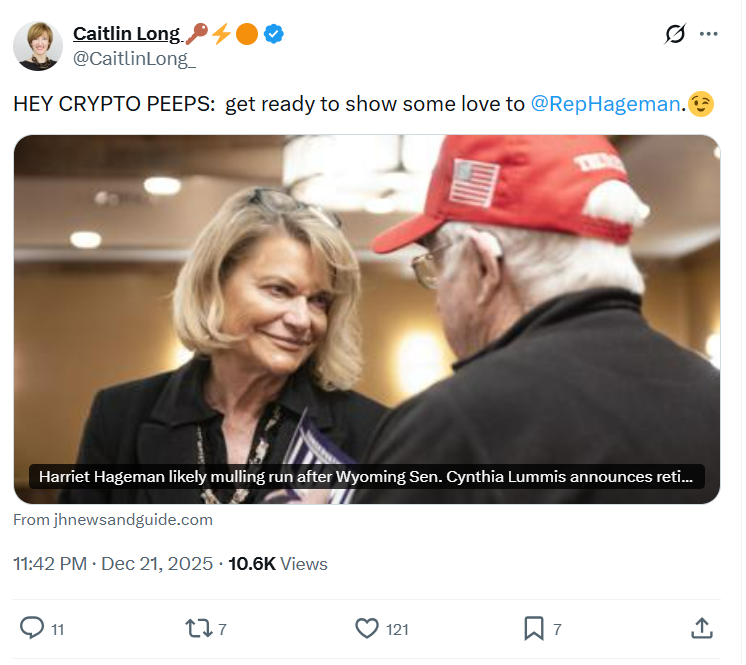
Introducing Harriet Hageman | Source: Caitlin Long

Related: Crypto among sectors ‘debanked’ by 9 major banks: US regulator

Long’s backing effectively introduces Hageman to crypto audiences as the preferred successor, even though the House member has not yet made digital assets a signature focus.

Wyoming’s 2026 Senate race is now poised to double as a test of whether the state wants to preserve its identity as home to the Senate’s most visible crypto advocate, or fold digital asset policy into a broader Trump‐era Republican agenda.


Domande pertinenti

QWhat action did Representative Harriet Hageman take that fueled speculation about a Senate run?

AShe posted a video with the caption 'Soon' on her social media account, breaking a months-long silence.

QWhy is Senator Cynthia Lummis's decision not to seek reelection significant for the crypto industry?

AShe is one of the digital asset industry's most outspoken allies, and her exit removes a guaranteed champion for crypto in the Senate.

QWhat major crypto legislation has Senator Lummis been involved in?

AShe co-sponsored the Responsible Financial Innovation Act and the ongoing US Clarity Act, which are widely viewed as advancing the blockchain industry.

QWho is Caitlin Long and what was her reaction to Hageman's potential Senate run?

ACaitlin Long is the founder of Custodia Bank and a key architect of Wyoming's blockchain-friendly laws. She praised Hageman as 'salt of the earth' and endorsed her as the preferred successor.

QWhat will the 2026 Wyoming Senate race test, according to the article?

AIt will test whether the state wants to preserve its identity as home to the Senate's most visible crypto advocate or fold digital asset policy into a broader Trump-era Republican agenda.

Letture associate

Dalio's Latest Warning: Don't Get Carried Away by AI, Real Returns on US Stocks in the Next 5-10 Years Could Be -5% to -10%

Ray Dalio, founder of Bridgewater Associates, warns investors against excessive concentration in AI stocks. He argues the current market, dominated by a few AI giants, mirrors historical patterns where revolutionary new technologies lead to high risk, volatility, and uncertainty. While acknowledging AI's transformative potential, Dalio emphasizes that most investors fail at this stage of the cycle by over-concentrating in a handful of leading companies. He cites inherent risks: companies cannot accurately forecast investment needs or external shocks (e.g., monetary policy, geopolitics, taxes), face potential disruption from future technologies and international competition (notably from China), and experience significant price swings. Dalio's core advice is diversification, calling it his "Holy Grail of Investing." He presents a mathematical case that a well-diversified portfolio of 15-20 uncorrelated, good bets offers a superior risk-adjusted return compared to a concentrated position. Dalio also offers a cautious outlook, suggesting U.S. stocks may deliver real returns of -5% to -10% over the next 5-10 years based on valuation and bubble indicators. He concludes that in the face of high uncertainty, the prudent strategy is not to avoid betting entirely, but to avoid large, concentrated bets where one lacks sufficient informational edge. Instead, investors should build a strategically balanced, diversified portfolio.

marsbit51 min fa

Dalio's Latest Warning: Don't Get Carried Away by AI, Real Returns on US Stocks in the Next 5-10 Years Could Be -5% to -10%

marsbit51 min fa

Rain Valuation Approaches $20 Billion: The Battle for U-Cards Extends to Rewards Systems

Rain, a stablecoin payments infrastructure company, is shifting the competitive focus for U Cards from simple issuance to user retention and repeated usage. On June 15, Rain launched "Rain Rewards," an embedded loyalty program capability within its card-issuing infrastructure. This allows partner businesses—like fintech platforms and neobanks—to configure branded loyalty points, earning rules, redemptions, and merchant promotions directly within their card products. The system, built from the 2025 acquisition of Uptop, ensures points are only issued upon final transaction settlement, preventing liabilities from refunds. Trials, such as with Avalanche Card, reportedly boosted spending by 25% among enrolled users. Founded by Farooq Malik and Charles Yoo-Naut, Rain evolved from a tool for managing Web3 company expenses into a full-stack enterprise platform. It is a Principal Member of Visa and Mastercard, enabling partners to issue stablecoin-backed cards and wallets while leveraging traditional payment networks. Notably, the popular U Card Plasma One is issued by Rain under Visa's authority. Rain also integrates with Visa's stablecoin settlement pilot, using USDC for network settlement. Rain's rapid funding reflects growing institutional interest in stablecoin payment infrastructure. It raised a $245 million Series A in March 2025, a $58 million Series B in August 2025, and a $250 million Series C in January of this year, reaching a $19.5 billion valuation. Annualized transaction volume exceeds $3 billion, serving over 200 partners including Western Union and Nuvei. Beyond cards, Rain is expanding into programmable payments. Its June 2026 "Agent Control Layer" allows businesses to set spending rules—like merchant categories, amounts, and frequency—for AI agents before transactions occur. This positions Rain not as a single product but as an operating system for stablecoin payments, handling everything from card issuance and wallet management to rewards, on/off-ramps, and automated compliance. The goal is to enable seamless, often invisible, real-world spending of on-chain assets.

Foresight News54 min fa

Rain Valuation Approaches $20 Billion: The Battle for U-Cards Extends to Rewards Systems

Foresight News54 min fa

Google TPU Shipments Revised Up by 50%

Recent industry research indicates a significant upward revision in the shipments of Google's TPU (Tensor Processing Unit) chips. Previous expectations for 2027 were set at around 10 million units, but new estimates now point to 15 million units, a 50% increase. This substantial boost directly translates to higher demand across the entire supporting supply chain. Google's TPU clusters utilize a standardized all-optical interconnect architecture. Consequently, key hardware components are deeply integrated and scaled in fixed ratios with the chips. The 15 million TPU target will drive corresponding demand increases for NPO optical engines (roughly a 1:1 match), 1.6T optical modules, OCS optical switches, high-end server power supplies, fiber optics & MPO connectors, and liquid cooling solutions. Among these, liquid cooling is highlighted as the sector experiencing the most significant transformation and offering the most stable potential for excess returns. As next-generation TPU chips reach power levels where traditional air cooling is insufficient, liquid cooling becomes essential. 2026 is forecasted as the first year of substantial adoption for Google's liquid cooling solutions. This shift, coupled with delivery and capacity bottlenecks faced by incumbent overseas manufacturers, is creating a prime window for domestic Chinese suppliers to enter and secure Google's core supply chain. The market size for Google-specific liquid cooling is projected to potentially triple from a baseline of hundreds of billions to around 300 billion units by 2028. The logic for the fiber optic sector is also being rewritten. Once considered a cyclical commodity tied to telecom operator procurement, fiber is now a strategic and scarce resource for AI Data Centers (AIDC). A severe supply-demand imbalance, driven by the long lead time for preform production (18-24 months) and surging demand from cloud giants, is supporting strong performance. Chinese fiber manufacturers are well-positioned to capture a significant share of global AIDC demand, with exports potentially reaching 200-300 million core kilometers in 2026. Overall, the investment focus within the AI computing industry is shifting from pure "chip performance speculation" towards the more certain incremental growth in computing infrastructure and its supporting ecosystem. The upward revision in Google TPU shipments, along with the potential for further doubling by 2028, is seen as solidifying performance visibility for the entire supporting supply chain over the next two years.

marsbit2 h fa

Google TPU Shipments Revised Up by 50%

marsbit2 h fa

Trading

Spot
Futures

Articoli Popolari

Come comprare OPEN

Benvenuto in HTX.com! Abbiamo reso l'acquisto di OpenLedger (OPEN) semplice e conveniente. Segui la nostra guida passo passo per intraprendere il tuo viaggio nel mondo delle criptovalute.Step 1: Crea il tuo Account HTXUsa la tua email o numero di telefono per registrarti il tuo account gratuito su HTX. Vivi un'esperienza facile e sblocca tutte le funzionalità,Crea il mio accountStep 2: Vai in Acquista crypto e seleziona il tuo metodo di pagamentoCarta di credito/debito: utilizza la tua Visa o Mastercard per acquistare immediatamente OpenLedger OPEN.Bilancio: Usa i fondi dal bilancio del tuo account HTX per fare trading senza problemi.Terze parti: abbiamo aggiunto metodi di pagamento molto utilizzati come Google Pay e Apple Pay per maggiore comodità.P2P: Fai trading direttamente con altri utenti HTX.Over-the-Counter (OTC): Offriamo servizi su misura e tassi di cambio competitivi per i trader.Step 3: Conserva OpenLedger (OPEN)Dopo aver acquistato OpenLedger (OPEN), conserva nel tuo account HTX. In alternativa, puoi inviare tramite trasferimento blockchain o scambiare per altre criptovalute.Step 4: Scambia OpenLedger (OPEN)Scambia facilmente OpenLedger (OPEN) nel mercato spot di HTX. Accedi al tuo account, seleziona la tua coppia di trading, esegui le tue operazioni e monitora in tempo reale. Offriamo un'esperienza user-friendly sia per chi ha appena iniziato che per i trader più esperti.

152 Totale visualizzazioniPubblicato il 2024.12.12Aggiornato il 2026.06.02

Come comprare OPEN

Discussioni

Benvenuto nella Community HTX. Qui puoi rimanere informato sugli ultimi sviluppi della piattaforma e accedere ad approfondimenti esperti sul mercato. Le opinioni degli utenti sul prezzo di OPEN OPEN sono presentate come di seguito.

活动图片











