Galaxy predicts stablecoins will overtake ACH transaction volume in 2026

cointelegraphPubblicato 2025-12-19Pubblicato ultima volta 2025-12-19

Introduzione

Galaxy Research forecasts that stablecoins will surpass the U.S. Automated Clearing House (ACH) system in transaction volume by 2026, driven by regulatory clarity and increasing adoption. Stablecoins already exceed major credit card networks like Visa and currently process about half of ACH volumes. The stablecoin market, valued at around $309 billion, is dominated by USDT and USDC, but new entrants like Western Union, Sony Bank, and SoFi are launching their own dollar-pegged stablecoins. Galaxy also predicts Bitcoin could reach $250,000 by late 2027, with potential new all-time highs in 2026. The report highlights the GENIUS Act’s expected implementation in early 2026 as a key growth catalyst.

Stablecoins could process more transaction volume than the US Automated Clearing House system in 2026, as regulatory clarity and rising adoption expand their usage, according to a new forecast.

Galaxy Research, the research arm of digital asset company Galaxy Digital, pointed to existing transaction data and regulatory developments to support its prediction, noting that “stablecoin transactions already eclipse major credit card networks such as Visa and now process roughly half the transaction volume of the automated clearing house (ACH) system.”

Thad Pinakiewicz, vice president of research, said stablecoin supply has continued to grow at a 30%–40% compound annual growth rate, with transaction volumes rising alongside issuance. Galaxy also cited the expected implementation of definitions under the GENIUS Act in early 2026 as a factor supporting further growth in stablecoin usage.
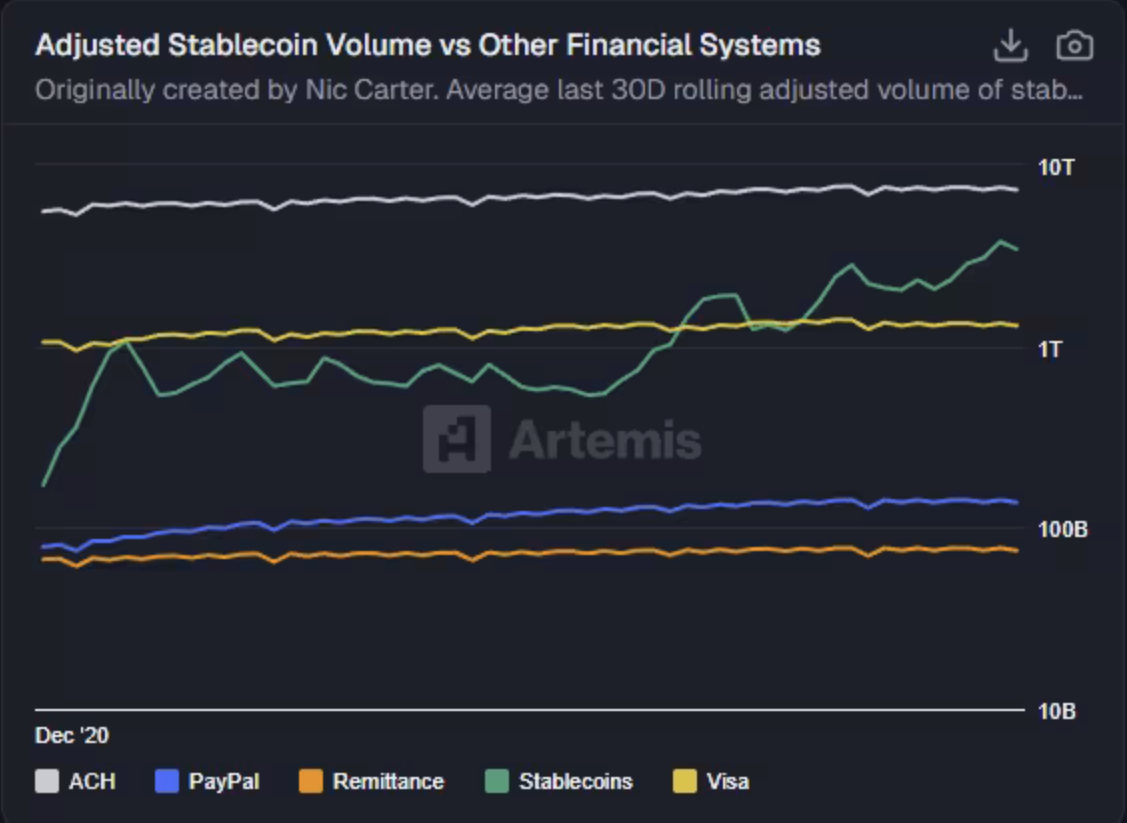
Stablecoin volume vs. other financial systems. Source: Galaxy Digital

The paper also brings predictions for the price of Bitcoin (BTC), writing that it could reach $250,000 by the end of 2027. According to Galaxy Research head of firmwide research Alex Thorn, 2026 is “too chaotic to predict, though Bitcoin making new all-time highs in 2026 is still possible.”

Related: Coinbase ‘cautiously optimistic’ on 2026 as crypto nears institutional inflection point

Dollar-pegged stablecoin market expands

According to data from DefiLlama, the stablecoin market cap currently stands at about $309 billion. While Tether’s USDt (USDT) and Circle’s USDC (USDC) continue to dominate, a growing number of financial institutions and payments companies have entered the stablecoins race in recent months.
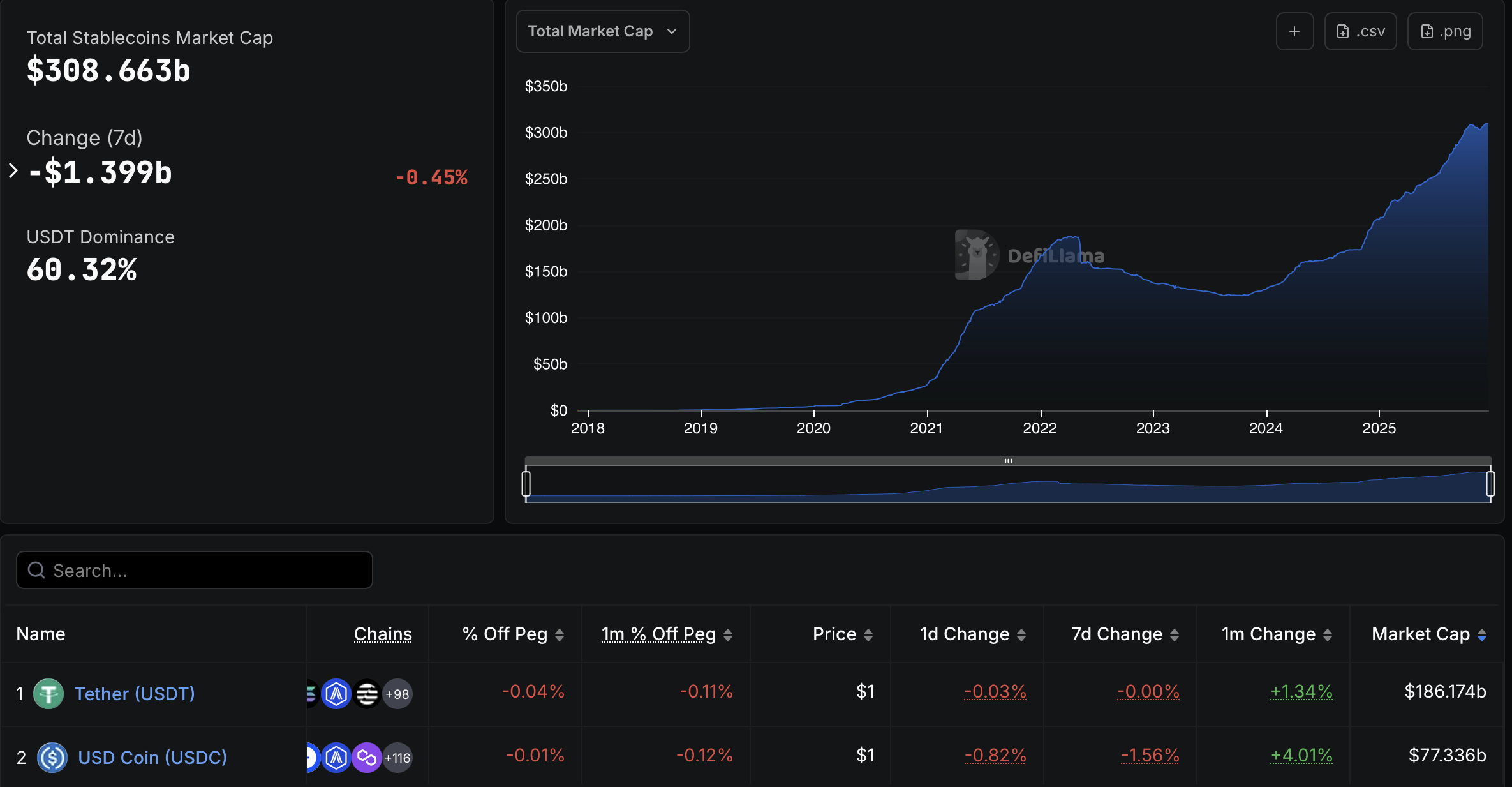
Stablecoin market cap. Source: DefiLlama

In October, Western Union announced plans to launch its own US dollar-pegged stablecoin, the US Dollar Payment Token, which will be built on the Solana blockchain and issued by Anchorage Digital Bank as part of a broader digital asset settlement network.

Sony Bank was reported to be preparing a US dollar-pegged stablecoin for use across Sony’s US ecosystem, including PlayStation games, subscriptions and anime content. The stablecoin is expected to launch in 2026.

On Thursday, SoFi Technologies launched SoFiUSD, a fully reserved US dollar stablecoin issued by its banking subsidiary, SoFi Bank. The company said the token will debut on Ethereum and is designed to support low-cost settlement for banks, fintechs and enterprise platforms.

Galaxy Research associate Jianing Wu said she expects TradFi-partnered stablecoins will consolidate in 2026, as users and merchants are unlikely to adopt a long list of digital dollars and will instead favor one or two with the “broadest acceptance.”

Magazine: Quantum attacking Bitcoin would be a waste of time: Kevin O’Leary

Domande pertinenti

QAccording to Galaxy Research, when are stablecoins predicted to surpass ACH transaction volume?

AStablecoins are predicted to surpass the US Automated Clearing House (ACH) transaction volume in 2026.

QWhat is the current stablecoin market capitalization, and which two stablecoins dominate the market?

AThe stablecoin market cap currently stands at about $309 billion, and it is dominated by Tether's USDt (USDT) and Circle's USDC (USDC).

QWhat key regulatory development does Galaxy cite as a factor supporting stablecoin growth in 2026?

AGalaxy cites the expected implementation of definitions under the GENIUS Act in early 2026 as a key factor supporting further growth in stablecoin usage.

QWhich major financial services company announced plans to launch a stablecoin on the Solana blockchain in October?

AWestern Union announced plans to launch its own US dollar-pegged stablecoin, the US Dollar Payment Token, on the Solana blockchain in October.

QWhat Bitcoin price prediction does the Galaxy Research paper make for the end of 2027?

AThe Galaxy Research paper predicts that Bitcoin (BTC) could reach $250,000 by the end of 2027.

Letture associate

Uncovering the Truth About Agent Commerce, Payments, and Infrastructure

Decoding Agent Commerce, Payments, and Infrastructure: The Reality Over the past year, I've been building infrastructure for the Agent economy, engaging with major players like Stripe, Visa, Coinbase, Google, and dozens of startups. A clear conclusion emerges: true, large-scale demand does not yet exist. Startups face structural challenges. Data points illustrate this gap. Stripe's Agent commerce platform has over 1,000 merchants but only single-digit transacting agents. Visa's Agent payment token requires 9-month KYC and a $250M revenue threshold, accessible only to giants like Amazon. On-chain analysis reveals actual daily Agent transaction volume is around $17k, half of which are test transactions. The article analyzes four potential markets: **1. Agent-to-Merchant (A2M):** Current AI shopping UX is often inferior to traditional e-commerce for visual, comparison-heavy purchases (clothing, electronics). Chat interfaces are a step back. Real merchant interest is defensive "Agent Engine Optimization," fearing future obsolescence, not current demand. Potential exists in high-frequency, low-decision purchases (e.g., food delivery) or simplifying terrible UX (complex checkouts, non-native shoppers), but these require massive consumer distribution channels dominated by giants like DoorDash and Amazon. **2. Agent-to-API (A2A):** Developers already have subscriptions and billing for core APIs (compute, data). The argument for micro-payments via crypto for sub-dollar API calls is addressed by pre-paid balances today. The deeper issue is supplier resistance; major SaaS firms rely on enterprise contracts, not fractional cent pricing. Opportunity lies in the long tail of niche services, but this is a smaller market catering to developers, a historically low-paying group. **3. Agent-to-Agent (A2A):** This remains a theoretical long-term vision with near-zero current transaction volume. It involves unique challenges: discovery, trust, negotiation, dispute resolution. When it materializes, it will require a fundamentally new settlement infrastructure for high-speed, variable-value, multi-party transactions. It's a real long-term bet, but not the current market. **4. Agent-to-Finance (A2F):** This is the only category with existing, paying demand. Integrating AI into financial workflows (trading, portfolio management) is a natural evolution and enables new capabilities like autonomous rebalancing. However, competition favors incumbents with regulatory licenses, compliance infrastructure, and existing client relationships. **The Real Issue:** Why is infrastructure still being built? Incumbents can afford long-term bets, and payment companies see every problem as a nail for their payment hammer. However, payment is just one piece. The core challenge is *coordination*—orchestrating work between Agents and humans, verifying outcomes, and settling results. Payment is part of settlement, which is part of coordination. Companies that solve the coordination problem will subsume payments, not the other way around. Startups lack the infinite runway of giants and must find today's real market, which, after a year of exploration, lies outside these four categories—in an area with real, growing, and underserved activity.

marsbit2 h fa

Uncovering the Truth About Agent Commerce, Payments, and Infrastructure

marsbit2 h fa

Trading

Spot
Futures

Articoli Popolari

Come comprare ACH

Benvenuto in HTX.com! Abbiamo reso l'acquisto di Alchemy Pay (ACH) semplice e conveniente. Segui la nostra guida passo passo per intraprendere il tuo viaggio nel mondo delle criptovalute.Step 1: Crea il tuo Account HTXUsa la tua email o numero di telefono per registrarti il tuo account gratuito su HTX. Vivi un'esperienza facile e sblocca tutte le funzionalità,Crea il mio accountStep 2: Vai in Acquista crypto e seleziona il tuo metodo di pagamentoCarta di credito/debito: utilizza la tua Visa o Mastercard per acquistare immediatamente Alchemy PayACH.Bilancio: Usa i fondi dal bilancio del tuo account HTX per fare trading senza problemi.Terze parti: abbiamo aggiunto metodi di pagamento molto utilizzati come Google Pay e Apple Pay per maggiore comodità.P2P: Fai trading direttamente con altri utenti HTX.Over-the-Counter (OTC): Offriamo servizi su misura e tassi di cambio competitivi per i trader.Step 3: Conserva Alchemy Pay (ACH)Dopo aver acquistato Alchemy Pay (ACH), conserva nel tuo account HTX. In alternativa, puoi inviare tramite trasferimento blockchain o scambiare per altre criptovalute.Step 4: Scambia Alchemy Pay (ACH)Scambia facilmente Alchemy Pay (ACH) nel mercato spot di HTX. Accedi al tuo account, seleziona la tua coppia di trading, esegui le tue operazioni e monitora in tempo reale. Offriamo un'esperienza user-friendly sia per chi ha appena iniziato che per i trader più esperti.

138 Totale visualizzazioniPubblicato il 2024.12.10Aggiornato il 2026.06.02

Come comprare ACH

Discussioni

Benvenuto nella Community HTX. Qui puoi rimanere informato sugli ultimi sviluppi della piattaforma e accedere ad approfondimenti esperti sul mercato. Le opinioni degli utenti sul prezzo di ACH ACH sono presentate come di seguito.

活动图片














