Các chỉ số onchain của Ronin và ZKsync giảm mạnh nhất vào năm 2025

cointelegraphPubblicato 2025-12-16Pubblicato ultima volta 2025-12-16

Introduzione

Dữ liệu onchain từ Nansen cho thấy hoạt động trên nhiều blockchain chính giảm mạnh trong năm 2025. Ronin ghi nhận mức sụt giảm lớn nhất với 70% địa chỉ hoạt động, chủ yếu do game Pixels mất dần sức hút. ZKsync cũng giảm 90% giao dịch sau đợt airdrop năm 2024. Ngược lại, Ethereum tăng 25% địa chỉ hoạt động và hơn 20% giao dịch. Solana dẫn đầu về địa chỉ hoạt động với hơn 1 tỷ, trong khi BNB Chain tăng trưởng 159%. Các mạng như TON và Scroll sụt giảm sau giai đoạn tăng trưởng nhờ airdrop và ứng dụng viral. Dữ liệu cho thấy hoạt động onchain biến động mạnh theo xu hướng ngắn hạn, nhưng các hệ thống như Solana, Base và BNB Chain vẫn duy trì được người dùng ổn định sau cơn sốt.

Theo dữ liệu từ Nansen, hoạt động onchain đã giảm mạnh trên một số mạng lưới lớn, với 11 blockchain ghi nhận sự sụt giảm về địa chỉ hoạt động trong năm qua.

Ronin giảm nhiều nhất ở mức 70%, trong khi Bitcoin ghi nhận mức giảm 7,2%. Một số mạng lớp 2 của Ethereum cũng có mặt trong danh sách này.

Dữ liệu từ Nansen cũng cho thấy sự sụt giảm trong hoạt động giao dịch trên nhiều mạng lưới tương tự. ZKsync ghi nhận một trong những mức giảm mạnh nhất, với số giao dịch giảm 90%.

Trong khi đó, lớp cơ sở của Ethereum ghi nhận mức tăng 25% về địa chỉ hoạt động và hơn 20% về số giao dịch, ngay cả khi các cuộc tranh luận xung quanh lộ trình tập trung vào rollup của Ethereum và những lo ngại về sự phân mảnh thanh khoản trên các mạng lớp 2 vẫn tiếp diễn.
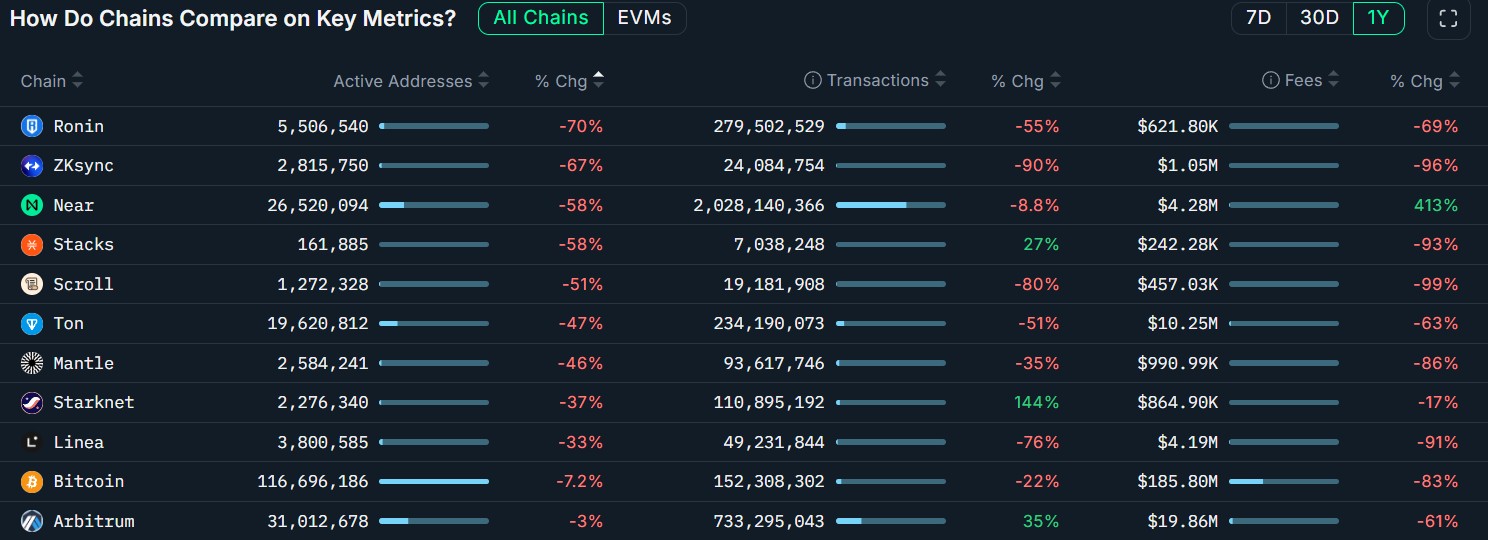
Ronin và các chuỗi lớp 2 của Ethereum thống trị mức giảm hoạt động trong khi Bitcoin lẻn vào danh sách. Nguồn: Nansen

Các mạng lưới có mức sụt giảm sử dụng lớn nhất

Pixels là một trò chơi phổ biến đã chuyển sang Ronin từ Polygon vào nửa cuối năm 2023. Vào thời điểm đó, Ronin có khoảng 20.000 người dùng hoạt động hàng ngày trước khi sự xuất hiện của Pixels làm tăng mạnh hoạt động, trong một thời gian ngắn biến Ronin thành chuỗi hoạt động nhiều thứ hai tính theo người dùng hàng ngày.

Đến tháng 12 năm 2024, Pixels ghi nhận khoảng 300.000 người dùng hoạt động hàng ngày theo DappRadar. Kể từ đó, độ phổ biến của trò chơi đã giảm, và hoạt động onchain của Ronin cũng giảm theo, cho thấy sự phụ thuộc của mạng lưới này vào các trò chơi ăn khách.
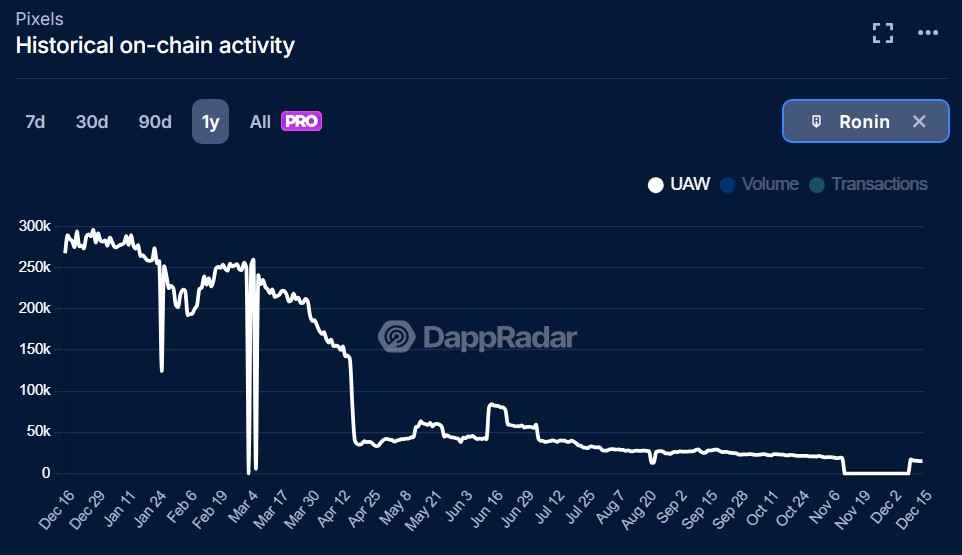
Hoạt động của Pixels giảm trong suốt năm 2025. Nguồn: DappRadar

Một số mạng lớp 2 của Ethereum cũng trải qua sự sụt giảm về mức độ sử dụng khi hoạt động liên quan đến airdrop hạ nhiệt. Đợt nhận token airdrop của ZKsync bắt đầu vào tháng 6 năm 2024. Mạng lưới này cho biết gần 700.000 ví đủ điều kiện trong khi phải đối mặt với chỉ trích về bộ lọc Sybil của mình. Dữ liệu từ Nansen cho thấy hơn 40% các ví nhận airdrop hàng đầu đã ngay lập tức bán phần phân bổ của họ. Scroll cũng xuất hiện trong danh sách sau đợt airdrop vào tháng 10 năm 2024, sau đó hoạt động onchain chậm lại.

Arbitrum chứng kiến số địa chỉ hoạt động giảm 3%, mặc dù với khoảng 31 triệu người dùng, nó vẫn nằm trong top 10 mạng lưới hoạt động nhiều nhất. Rollup của Ethereum đã thực hiện airdrop vào năm 2023, và khối lượng giao dịch của nó tăng 36% trong năm qua lên khoảng 734,5 triệu, vượt qua 507 triệu giao dịch của Ethereum. Arbitrum thu hút hoạt động từ các tài sản được token hóa, bao gồm 500 cổ phiếu Mỹ được đóng dấu trên mạng bởi Robinhood.

Related: Cách sử dụng crypto vào năm 2025: YouTube, thẻ Pokémon và hơn thế nữa

Base và Optimism nổi bật trong số các mạng lớp 2 của Ethereum. Cả hai đều ghi nhận mức tăng về địa chỉ hoạt động và khối lượng giao dịch. Base không có token gốc và chưa từng thực hiện airdrop. Hoạt động onchain tăng lên cùng với sự quan tâm đến các lĩnh vực như memecoins, các ứng dụng liên quan đến AI và các sàn giao dịch phi tập trung.

Solana ghi nhận số địa chỉ hoạt động nhiều nhất trong ngành với hơn 1 tỷ, tiếp theo là Tron và Ethereum. BNB Chain ghi nhận mức tăng 159% về địa chỉ hoạt động, trong khi Bitcoin là mạng lưới duy nhất trong top 5 ghi nhận mức giảm, cùng với mức giảm 22% về giao dịch.
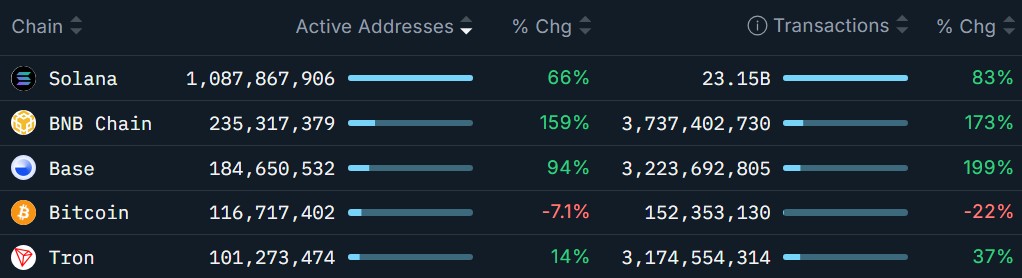
Hoạt động memecoin đã hạ nhiệt, nhưng Solana vẫn dẫn đầu ngành về hoạt động onchain. Nguồn: Nansen

Những gì mức giảm cho thấy và không cho thấy

Dữ liệu cho thấy mối quan hệ không nhất quán giữa mức độ sử dụng onchain và giá token. Giá của Solana giảm trong năm qua bất chấp mức tăng 66% về địa chỉ hoạt động, trong khi giá token BNB (BNB) tăng cùng với hoạt động mạng tăng lên.
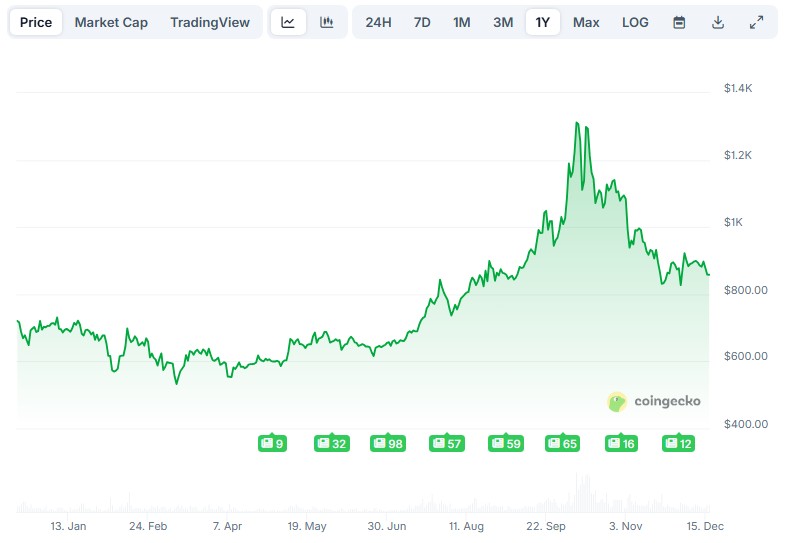
BNB tăng gần 20% trong năm qua. Nguồn: CoinGecko

Những mức giảm theo năm không nhất thiết cho thấy các vấn đề nghiêm trọng đối với các mạng lưới liên quan. Hoạt động onchain có thể dao động mạnh khi các ứng dụng di chuyển, các chương trình khuyến khích kết thúc hoặc người dùng chuyển đổi giữa các chuỗi, đặc biệt là ở các mạng lưới mới hơn vẫn đang thiết lập các trường hợp sử dụng cốt lõi.

Blockchain liên kết với Telegram The Open Network (TON) cũng ghi nhận mức giảm 47% về địa chỉ hoạt động và 51% về giao dịch, một sự đảo chiều sau mức tăng trưởng vượt bậc vào năm 2024. Các trò chơi nhỏ dựa trên Telegram đã thúc đẩy phần lớn hoạt động trước đó, thu hút người dùng vượt ra ngoài đối tượng khán giả crypto-native điển hình của nền tảng.

Related: Bitcoin tách biệt khỏi cổ phiếu vào nửa cuối năm 2025

Hamster Kombat là một trong những ví dụ nổi bật nhất. Trò chơi dựa trên thao tác gõ đã hạ thấp rào cản gia nhập thông qua cơ chế đơn giản và thu hút sự tham gia mạnh mẽ từ những người dùng kỳ vọng vào một đợt airdrop token trong tương lai. Theo CEO Telegram Pavel Durov, trò chơi viral này đã thu hút 239 triệu người dùng trong vòng ba tháng, với hơn 130 triệu người đủ điều kiện cho đợt airdrop vào cuối tháng Chín.

Dữ liệu từ Nansen cho thấy địa chỉ hoạt động của TON đạt đỉnh khoảng 2,5 triệu mỗi ngày vào ngày 30 tháng 9. Kể từ đó, hoạt động đã giảm trở lại khi sự tham gia liên quan đến Hamster Kombat hạ nhiệt, làm nổi bật cách các đợt tăng đột biến ngắn hạn có thể làm biến dạng so sánh theo năm.
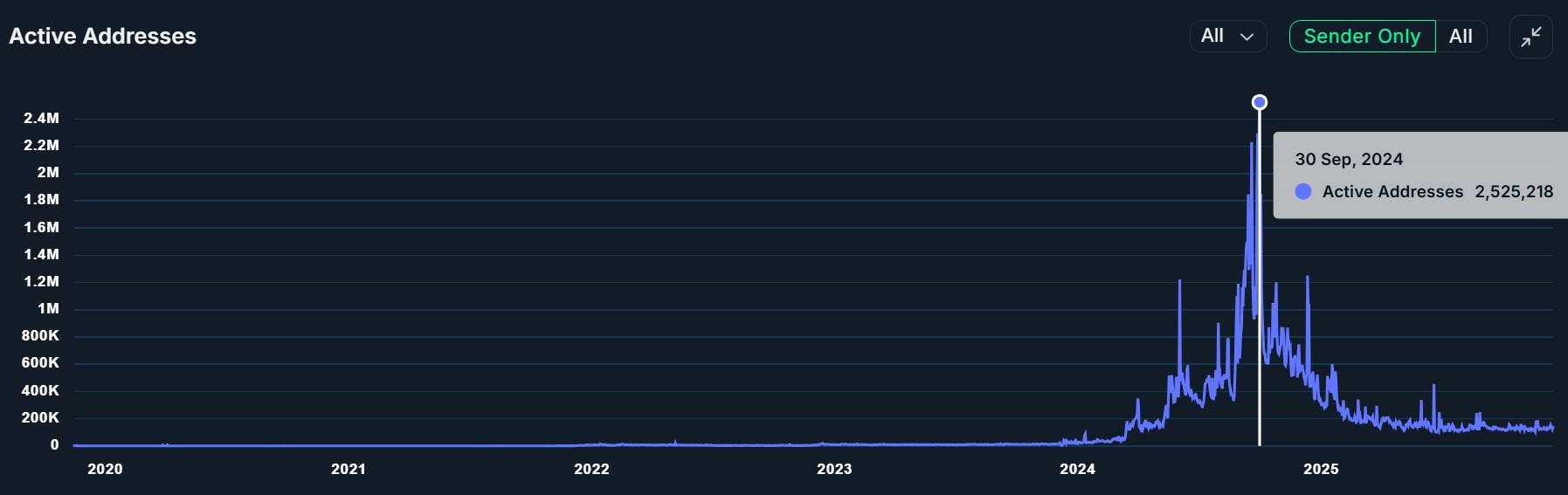
Hamster Kombat đẩy hoạt động của Ton lên những kỷ lục mới. Nguồn: Nansen

Một vài chuỗi duy trì được việc sử dụng sau cơn sốt

Dữ liệu blockchain năm qua cho thấy hoạt động onchain chuyển dịch nhanh chóng giữa các mạng lưới thay vì neo đậu vào bất kỳ chuỗi đơn lẻ nào. Việc sử dụng giảm mạnh nhất trên các blockchain nơi hoạt động đã tập trung xung quanh một số ít ứng dụng, chương trình khuyến khích hoặc khoảnh khắc viral.

Đồng thời, những mức giảm đó không tự động báo hiệu sự thất bại rộng hơn của hệ sinh thái. Trong một số trường hợp, hoạt động hạ nhiệt sau những giai đoạn tăng trưởng vượt bậc, làm nổi bật cách so sánh theo năm có thể bị bóp méo bởi các chu kỳ cường điệu, airdrop hoặc các ứng dụng ngắn hạn.

Solana cung cấp một sự tương phản hữu ích. Trong khi hoạt động driven bởi memecoin bùng nổ suốt năm 2024 và đầu năm 2025 trước khi hạ nhiệt vào cuối năm, đợt tăng đột biến cũng mang lại người dùng, thanh khoản và các ứng dụng tiếp tục hỗ trợ mạng lưới.
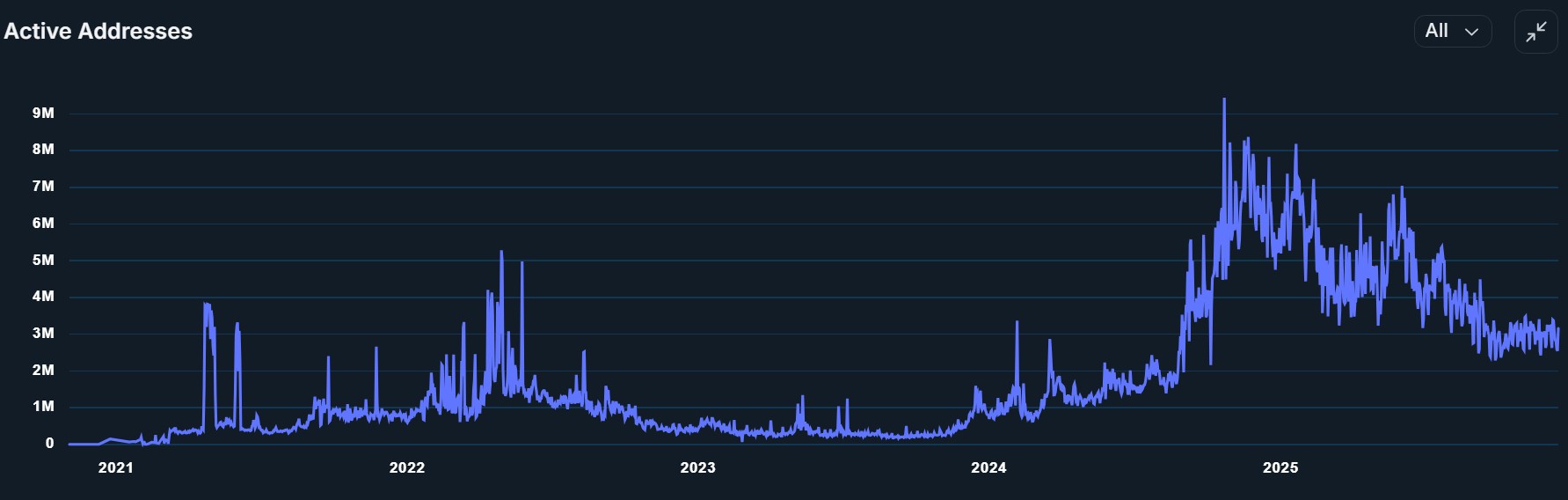
Cơn sốt memecoin của Solana đã mang lại những địa chỉ mới ở lại sau cơn sốt. Nguồn: Nansen

Địa chỉ hoạt động hàng ngày của Solana đạt đỉnh trên 9 triệu vào ngày 22 tháng 10 năm 2024, trong thời kỳ đỉnh cao của giao dịch memecoin. Đến tháng 12, người dùng hàng ngày dao động trong khoảng 2 triệu đến 3 triệu. Mặc dù đó là một sự rút lui mạnh so với mức đỉnh, hoạt động vẫn duy trì cao hơn so với trước cơn sốt.

Phần lớn sự sụt giảm hoạt động onchain trong năm qua được driven bởi việc tìm kiếm lợi nhuận ngắn hạn, nhưng các mạng lưới như Solana, BNB Chain và Base cho thấy dấu hiệu duy trì việc sử dụng vượt ra ngoài các đợt viral, khiến chúng khác biệt với các chuỗi chứng kiến sự đảo chiều mạnh hơn.

Magazine: Câu hỏi lớn: Bitcoin có tồn tại sau một cuộc mất điện 10 năm?

Crypto di tendenza

Domande pertinenti

QMạng nào ghi nhận mức giảm hoạt động onchain lớn nhất vào năm 2025 theo dữ liệu Nansen?

ARonin ghi nhận mức giảm mạnh nhất với 70% số địa chỉ hoạt động giảm, trong khi ZKsync ghi nhận giao dịch giảm 90%.

QTại sao hoạt động trên mạng Ronin lại suy giảm mạnh?

AHoạt động trên Ronin suy giảm chủ yếu do sự sụt giảm phổ biến của trò chơi Pixels - tựa game đã từng di chuyển từ Polygon sang Ronin và từng đưa Ronin trở thành chuỗi hoạt động nhiều thứ hai theo người dùng hàng ngày.

QMạng lớp-2 Ethereum nào duy trì được tăng trưởng tích cực trong bối cảnh chung suy giảm?

ABase và Optimism là hai mạng lớp-2 của Ethereum vẫn ghi nhận tăng trưởng về cả địa chỉ hoạt động và khối lượng giao dịch, trong đó Base không có token gốc và chưa từng thực hiện airdrop.

QTại sao dữ liệu onchain không phải lúc nào cũng phản ánh chính xác hiệu suất của token?

ATheo phân tích, không có mối quan hệ nhất quán giữa hoạt động onchain và giá token. Ví dụ: Solana giảm giá dù địa chỉ hoạt động tăng 66%, trong khi BNB tăng giá cùng với hoạt động mạng gia tăng.

QỨng dụng nào đã đẩy hoạt động của TON (The Open Network) lên mức kỷ lục trước khi suy giảm?

AHamster Kombat - trò chơi tap-to-earn trên Telegram - đã thu hút 239 triệu người dùng và đẩy địa chỉ hoạt động hàng ngày của TON lên ~2.5 triệu vào cuối tháng 9/2024 trước khi hoạt động giảm dần.

Letture associate

Behind the AI Scorecards Lies a Chinese 'Question Setter'

Behind the AI scorecards that dominate industry discussions—benchmarks like MMLU-Pro, MMMU, and MMMU-Pro—stands a Chinese-Canadian researcher: Wenhu Chen. As an assistant professor at the University of Waterloo and founder of the TIGER Lab, Chen has become a key "exam-setter" for evaluating large language and multimodal models. Chen first gained broader recognition with MMLU-Pro, a more challenging and stable update to the popular MMLU benchmark. As top models like OpenAI’s o3 began achieving near-perfect scores on the original MMLU, it became difficult to distinguish their true capabilities. MMLU-Pro introduced more complex reasoning questions, expanded answer choices, and filtered out ambiguous or simple items, effectively reintroducing differentiation among state-of-the-art models. His work on MMMU addressed the evaluation of multimodal models, requiring them to integrate visual information (like charts, diagrams, or tables) with textual knowledge across diverse academic subjects. Even the strongest models initially scored only around 56-59%, highlighting significant room for improvement in genuine multimodal reasoning. MMMU-Pro further refined this by preventing models from bypassing visual cues. Chen’s research focus has long been on complex information understanding and reasoning. His background—including a PhD at UC Santa Barbara, research at Google/DeepMind on Gemini, and now a role in Meta’s superintelligence lab—provides deep insight into model development and their potential weaknesses. His TIGER Lab also builds models (e.g., for video understanding and generation), ensuring his evaluation benchmarks are grounded in practical challenges. While AI headlines often spotlight company leaders and product launches, Chen’s work exemplifies the critical, behind-the-scenes contributions of researchers crafting the rigorous standards that define and drive progress in AI capabilities.

marsbit6 min fa

Behind the AI Scorecards Lies a Chinese 'Question Setter'

marsbit6 min fa

STRC Unpegged by 11%, Can Strategy's Perpetual Motion Machine Keep Turning?

STRC, the perpetual preferred stock of MicroStrategy, is experiencing a persistent de-pegging from its target par value of $100, with the discount recently widening to over 11%. This de-anchoring challenges the core design of STRC, which was intended as a stable, income-oriented security operating near $100. As a crucial funding engine for MicroStrategy's Bitcoin acquisition strategy, STRC's price reflects market confidence in the company's entire capital model. The company's "capital flywheel" relies on issuing STRC at or above $100 via an At-the-Market (ATM) program to raise cash for buying Bitcoin, thereby boosting company equity and theoretically supporting STRC's value. A monthly adjustable dividend mechanism was designed to maintain this peg. Despite raising the dividend to 11.5% and increasing payment frequency, the de-pegging persists. Market concerns extend beyond technical factors like leveraged arbitrage unwinding. Analysts point to MicroStrategy's limited cash reserves relative to its ~$1.7 billion annual dividend obligation for preferred shares. While the company counters that its vast Bitcoin holdings could cover decades of payments, this argument hinges on the potential need to sell Bitcoin—a shift from its longstanding "hodl" narrative. The company's recent sale of a small amount of BTC, framed as a test, amplified these liquidity and strategy concerns. If STRC remains discounted, impairing MicroStrategy's ability to raise cheap capital, fears may grow that the company could sell more Bitcoin to meet obligations. This scenario could transform MicroStrategy from a major market buyer into a potential seller, posing significant downside risk for Bitcoin. The re-pegging of STRC is thus a key indicator for the health of MicroStrategy's capital structure and its market impact.

Odaily星球日报20 min fa

STRC Unpegged by 11%, Can Strategy's Perpetual Motion Machine Keep Turning?

Odaily星球日报20 min fa

Silicon Valley's Most Sought-After New Role Has Emerged

Silicon Valley's New Most Wanted Job: The Rise of the Forward Deployment Engineer The AI industry is witnessing a significant shift. The focus has moved from developing cutting-edge models to deploying them effectively within enterprises. This has made the "Forward Deployment Engineer" (FDE) a critical and highly sought-after role at major firms like OpenAI, Anthropic, and Google. For the past three years, the industry prioritized model scientists. However, companies are now facing a harsh reality: purchasing powerful AI tools does not guarantee productivity gains or organizational change. The biggest hurdle is not the technology itself, but integrating it into complex legacy systems, workflows, and corporate cultures. This includes challenges like data silos, compliance requirements, and internal resistance. The FDE role, pioneered by Palantir Technologies, addresses this "last-mile" problem. FDEs are deployed on-site with clients for extended periods. Their job is to deeply understand the client's specific organizational structure, processes, and pain points, then tailor and implement the AI solution accordingly. They combine skills in technology, project management, and organizational change. A clear signal of this trend emerged in May 2026 when three AI giants made major moves. Anthropic launched a $1.5B joint venture for enterprise deployment. OpenAI formed an independent deployment subsidiary, DeployCo, with over $4B in commitments and acquired a deployment consultancy. Google Cloud's CEO publicly announced a large-scale recruitment drive for FDEs. This shift represents a fundamental change in the software business model: from selling tools to selling guaranteed outcomes. FDEs are the agents of this change, responsible for delivering a working system within the production environment, not just a demo. Real-world cases, such as challenges at Goldman Sachs (compliance barriers) and Target (internal cultural resistance), illustrate that the primary obstacles to AI adoption are organizational, not technical. An FDE's value lies in navigating these human and procedural complexities to facilitate a successful "AI migration." In essence, as core AI technology becomes more accessible and affordable, the true premium is shifting to the human expertise required to understand organizations and drive change—making the FDE role pivotal for the next phase of the AI revolution.

marsbit20 min fa

Silicon Valley's Most Sought-After New Role Has Emerged

marsbit20 min fa

When the World Cup Collides with Agents: From Web2 to Web3, How Are Wallets Evolving into Agentic Wallets?

World Cup as a Catalyst for Agentic Wallets: From Web2 to Web3 This article explores how the World Cup provides a real-world scenario for observing the evolution of digital wallets from simple asset managers towards "Agentic Wallets"—intelligent, AI-powered interfaces. Using the example of prediction markets like Polymarket, it illustrates how AI Agents can lower the barrier to Web3 interaction. Instead of navigating complex DApps, users can express intent in natural language (e.g., "I think Portugal will win") within platforms like Discord or web pages. The Agent then interprets this intent, finds the relevant market, and seamlessly guides the user through the on-chain transaction via their wallet. The core shift is from wallets as mere "function menus" for signing transactions to "intent interpreters" that understand user goals. The article highlights parallel developments in traditional finance, such as Mastercard's "Agent Pay" and WeChat Pay's AI tests, which focus on granting AI controlled, authorized, and auditable payment capabilities. This underscores a broader trend of AI entering the financial layer. However, the article emphasizes that the primary challenge for Agentic Wallets in Web3 is not automation but establishing clear security boundaries. Unlike traditional systems with chargebacks, on-chain transactions are often irreversible. Therefore, future wallets must ensure users retain ultimate control and comprehension. They need to transparently communicate an Agent's permissions, spending limits, authorized durations, and provide easy ways to pause or revoke access. The World Cup experiments represent early steps toward wallets that are not just applications but ubiquitous, intelligent interfaces that simplify Web3 while keeping users securely in control.

marsbit1 h fa

When the World Cup Collides with Agents: From Web2 to Web3, How Are Wallets Evolving into Agentic Wallets?

marsbit1 h fa

Options Don't Work in DeFi? Vitalik Might Not Agree

For years, the prevailing view has been that options struggle to gain traction in DeFi due to complexity, fragmented liquidity, and lack of natural demand compared to products like perpetual futures. However, a recent algorithmic stablecoin design proposed by Vitalik Buterin presents a different perspective, using options not as a standalone trading product, but as foundational infrastructure for other financial instruments. In this design, one unit of ETH is split into two components: a "stable" side (P) that retains value up to a specified strike price, and an "upside" side (N) that captures all appreciation above that strike. Combined, they always equal one ETH, eliminating debt, margin, and liquidation risks inherent in typical collateralized debt position (CDP) stablecoins. The stable component essentially mimics the payoff of a covered call option. To function as a stablecoin, this structure requires continuously rolling deep in-the-money calls, which introduces challenges like rollover slippage, predictable transaction flow vulnerable to front-running, and persistent liquidity needs. A core hurdle is finding consistent buyers for the leveraged ETH upside exposure (N). While it offers leverage without funding rates or liquidation, it must compete with simpler alternatives like direct call options or perpetuals. The system's scalability depends on a sustained demand for this specific form of leverage. The author draws parallels to their experience with Rysk, where earlier versions of DeFi options protocols struggled. The breakthrough came with Rysk V12, which aligns incentives: asset holders generate yield by selling covered calls against their holdings, while market makers efficiently acquire the desired option exposure. This demonstrates that options can find product-market fit when embedded as a risk distribution and pricing engine within structured products, stablecoins, or yield-generating assets, rather than marketed as a complex direct trading instrument. Vitalik's proposal reinforces this architectural approach—using fully collateralized, non-custodial, and physically settled options as a fundamental building block. The real opportunity for options in DeFi may lie not in becoming the next perpetual swap, but in powering the next generation of on-chain financial products.

marsbit2 h fa

Options Don't Work in DeFi? Vitalik Might Not Agree

marsbit2 h fa

Trading

Spot
Futures

Articoli Popolari

Cosa è $S$

Comprendere SPERO: Una Panoramica Completa Introduzione a SPERO Mentre il panorama dell'innovazione continua a evolversi, l'emergere delle tecnologie web3 e dei progetti di criptovaluta gioca un ruolo fondamentale nel plasmare il futuro digitale. Un progetto che ha attirato l'attenzione in questo campo dinamico è SPERO, denotato come SPERO,$$s$. Questo articolo mira a raccogliere e presentare informazioni dettagliate su SPERO, per aiutare gli appassionati e gli investitori a comprendere le sue basi, obiettivi e innovazioni nei domini web3 e crypto. Che cos'è SPERO,$$s$? SPERO,$$s$ è un progetto unico all'interno dello spazio crypto che cerca di sfruttare i principi della decentralizzazione e della tecnologia blockchain per creare un ecosistema che promuove l'impegno, l'utilità e l'inclusione finanziaria. Il progetto è progettato per facilitare interazioni peer-to-peer in modi nuovi, fornendo agli utenti soluzioni e servizi finanziari innovativi. Al suo interno, SPERO,$$s$ mira a responsabilizzare gli individui fornendo strumenti e piattaforme che migliorano l'esperienza dell'utente nello spazio delle criptovalute. Questo include la possibilità di metodi di transazione più flessibili, la promozione di iniziative guidate dalla comunità e la creazione di percorsi per opportunità finanziarie attraverso applicazioni decentralizzate (dApps). La visione sottostante di SPERO,$$s$ ruota attorno all'inclusività, cercando di colmare le lacune all'interno della finanza tradizionale mentre sfrutta i vantaggi della tecnologia blockchain. Chi è il Creatore di SPERO,$$s$? L'identità del creatore di SPERO,$$s$ rimane piuttosto oscura, poiché ci sono risorse pubblicamente disponibili limitate che forniscono informazioni dettagliate sul suo fondatore o fondatori. Questa mancanza di trasparenza può derivare dall'impegno del progetto per la decentralizzazione—un ethos che molti progetti web3 condividono, dando priorità ai contributi collettivi rispetto al riconoscimento individuale. Centrando le discussioni attorno alla comunità e ai suoi obiettivi collettivi, SPERO,$$s$ incarna l'essenza dell'empowerment senza mettere in evidenza individui specifici. Pertanto, comprendere l'etica e la missione di SPERO rimane più importante che identificare un creatore singolo. Chi sono gli Investitori di SPERO,$$s$? SPERO,$$s$ è supportato da una varietà di investitori che vanno dai capitalisti di rischio agli investitori angelici dedicati a promuovere l'innovazione nel settore crypto. Il focus di questi investitori generalmente si allinea con la missione di SPERO—dando priorità a progetti che promettono avanzamenti tecnologici sociali, inclusività finanziaria e governance decentralizzata. Queste fondazioni di investitori sono tipicamente interessate a progetti che non solo offrono prodotti innovativi, ma contribuiscono anche positivamente alla comunità blockchain e ai suoi ecosistemi. Il supporto di questi investitori rafforza SPERO,$$s$ come un concorrente degno di nota nel dominio in rapida evoluzione dei progetti crypto. Come Funziona SPERO,$$s$? SPERO,$$s$ impiega un framework multifunzionale che lo distingue dai progetti di criptovaluta convenzionali. Ecco alcune delle caratteristiche chiave che sottolineano la sua unicità e innovazione: Governance Decentralizzata: SPERO,$$s$ integra modelli di governance decentralizzati, responsabilizzando gli utenti a partecipare attivamente ai processi decisionali riguardanti il futuro del progetto. Questo approccio favorisce un senso di proprietà e responsabilità tra i membri della comunità. Utilità del Token: SPERO,$$s$ utilizza il proprio token di criptovaluta, progettato per servire varie funzioni all'interno dell'ecosistema. Questi token abilitano transazioni, premi e la facilitazione dei servizi offerti sulla piattaforma, migliorando l'impegno e l'utilità complessivi. Architettura Stratificata: L'architettura tecnica di SPERO,$$s$ supporta la modularità e la scalabilità, consentendo un'integrazione fluida di funzionalità e applicazioni aggiuntive man mano che il progetto evolve. Questa adattabilità è fondamentale per mantenere la rilevanza nel panorama crypto in continua evoluzione. Coinvolgimento della Comunità: Il progetto enfatizza iniziative guidate dalla comunità, impiegando meccanismi che incentivano la collaborazione e il feedback. Nutrendo una comunità forte, SPERO,$$s$ può affrontare meglio le esigenze degli utenti e adattarsi alle tendenze di mercato. Focus sull'Inclusione: Offrendo basse commissioni di transazione e interfacce user-friendly, SPERO,$$s$ mira ad attrarre una base utenti diversificata, inclusi individui che potrebbero non aver precedentemente interagito nello spazio crypto. Questo impegno per l'inclusione si allinea con la sua missione generale di empowerment attraverso l'accessibilità. Cronologia di SPERO,$$s$ Comprendere la storia di un progetto fornisce preziose intuizioni sulla sua traiettoria di sviluppo e sui traguardi. Di seguito è riportata una cronologia suggerita che mappa eventi significativi nell'evoluzione di SPERO,$$s$: Fase di Concettualizzazione e Ideazione: Le idee iniziali che formano la base di SPERO,$$s$ sono state concepite, allineandosi strettamente con i principi di decentralizzazione e focus sulla comunità all'interno dell'industria blockchain. Lancio del Whitepaper del Progetto: Dopo la fase concettuale, è stato rilasciato un whitepaper completo che dettaglia la visione, gli obiettivi e l'infrastruttura tecnologica di SPERO,$$s$ per suscitare interesse e feedback dalla comunità. Costruzione della Comunità e Prime Interazioni: Sono stati effettuati sforzi attivi di outreach per costruire una comunità di early adopters e potenziali investitori, facilitando discussioni attorno agli obiettivi del progetto e ottenendo supporto. Evento di Generazione del Token: SPERO,$$s$ ha condotto un evento di generazione del token (TGE) per distribuire i propri token nativi ai primi sostenitori e stabilire una liquidità iniziale all'interno dell'ecosistema. Lancio della Prima dApp: La prima applicazione decentralizzata (dApp) associata a SPERO,$$s$ è stata attivata, consentendo agli utenti di interagire con le funzionalità principali della piattaforma. Sviluppo Continuo e Partnership: Aggiornamenti e miglioramenti continui alle offerte del progetto, inclusi partnership strategiche con altri attori nello spazio blockchain, hanno plasmato SPERO,$$s$ in un concorrente competitivo e in evoluzione nel mercato crypto. Conclusione SPERO,$$s$ rappresenta una testimonianza del potenziale del web3 e delle criptovalute di rivoluzionare i sistemi finanziari e responsabilizzare gli individui. Con un impegno per la governance decentralizzata, il coinvolgimento della comunità e funzionalità progettate in modo innovativo, apre la strada verso un panorama finanziario più inclusivo. Come per qualsiasi investimento nello spazio crypto in rapida evoluzione, si incoraggiano potenziali investitori e utenti a ricercare approfonditamente e a impegnarsi in modo riflessivo con gli sviluppi in corso all'interno di SPERO,$$s$. Il progetto mostra lo spirito innovativo dell'industria crypto, invitando a ulteriori esplorazioni delle sue innumerevoli possibilità. Mentre il percorso di SPERO,$$s$ è ancora in fase di sviluppo, i suoi principi fondamentali potrebbero effettivamente influenzare il futuro di come interagiamo con la tecnologia, la finanza e tra di noi in ecosistemi digitali interconnessi.

79 Totale visualizzazioniPubblicato il 2024.12.17Aggiornato il 2024.12.17

Cosa è $S$

Cosa è AGENT S

Agent S: Il Futuro dell'Interazione Autonoma in Web3 Introduzione Nel panorama in continua evoluzione di Web3 e criptovalute, le innovazioni stanno costantemente ridefinendo il modo in cui gli individui interagiscono con le piattaforme digitali. Uno di questi progetti pionieristici, Agent S, promette di rivoluzionare l'interazione uomo-computer attraverso il suo framework agentico aperto. Aprendo la strada a interazioni autonome, Agent S mira a semplificare compiti complessi, offrendo applicazioni trasformative nell'intelligenza artificiale (AI). Questa esplorazione dettagliata approfondirà le complessità del progetto, le sue caratteristiche uniche e le implicazioni per il dominio delle criptovalute. Cos'è Agent S? Agent S si presenta come un innovativo framework agentico aperto, progettato specificamente per affrontare tre sfide fondamentali nell'automazione dei compiti informatici: Acquisizione di Conoscenze Specifiche del Dominio: Il framework apprende in modo intelligente da varie fonti di conoscenza esterne ed esperienze interne. Questo approccio duale gli consente di costruire un ricco repository di conoscenze specifiche del dominio, migliorando le sue prestazioni nell'esecuzione dei compiti. Pianificazione su Lungo Orizzonte di Compiti: Agent S impiega una pianificazione gerarchica potenziata dall'esperienza, un approccio strategico che facilita la suddivisione e l'esecuzione efficiente di compiti complessi. Questa caratteristica migliora significativamente la sua capacità di gestire più sottocompiti in modo efficiente ed efficace. Gestione di Interfacce Dinamiche e Non Uniformi: Il progetto introduce l'Interfaccia Agente-Computer (ACI), una soluzione innovativa che migliora l'interazione tra agenti e utenti. Utilizzando Modelli Linguistici Multimodali di Grandi Dimensioni (MLLM), Agent S può navigare e manipolare senza sforzo diverse interfacce grafiche utente. Attraverso queste caratteristiche pionieristiche, Agent S fornisce un framework robusto che affronta le complessità coinvolte nell'automazione dell'interazione umana con le macchine, preparando il terreno per innumerevoli applicazioni nell'AI e oltre. Chi è il Creatore di Agent S? Sebbene il concetto di Agent S sia fondamentalmente innovativo, informazioni specifiche sul suo creatore rimangono elusive. Il creatore è attualmente sconosciuto, il che evidenzia sia la fase embrionale del progetto sia la scelta strategica di mantenere i membri fondatori sotto anonimato. Indipendentemente dall'anonimato, l'attenzione rimane sulle capacità e sul potenziale del framework. Chi sono gli Investitori di Agent S? Poiché Agent S è relativamente nuovo nell'ecosistema crittografico, informazioni dettagliate riguardanti i suoi investitori e sostenitori finanziari non sono documentate esplicitamente. La mancanza di approfondimenti pubblicamente disponibili sulle fondazioni di investimento o sulle organizzazioni che supportano il progetto solleva interrogativi sulla sua struttura di finanziamento e sulla roadmap di sviluppo. Comprendere il supporto è cruciale per valutare la sostenibilità del progetto e il suo potenziale impatto sul mercato. Come Funziona Agent S? Al centro di Agent S si trova una tecnologia all'avanguardia che gli consente di funzionare efficacemente in contesti diversi. Il suo modello operativo è costruito attorno a diverse caratteristiche chiave: Interazione Uomo-Computer Simile a Quella Umana: Il framework offre una pianificazione AI avanzata, cercando di rendere le interazioni con i computer più intuitive. Mimando il comportamento umano nell'esecuzione dei compiti, promette di elevare le esperienze degli utenti. Memoria Narrativa: Utilizzata per sfruttare esperienze di alto livello, Agent S utilizza la memoria narrativa per tenere traccia delle storie dei compiti, migliorando così i suoi processi decisionali. Memoria Episodica: Questa caratteristica fornisce agli utenti una guida passo-passo, consentendo al framework di offrire supporto contestuale mentre i compiti si sviluppano. Supporto per OpenACI: Con la capacità di funzionare localmente, Agent S consente agli utenti di mantenere il controllo sulle proprie interazioni e flussi di lavoro, allineandosi con l'etica decentralizzata di Web3. Facile Integrazione con API Esterne: La sua versatilità e compatibilità con varie piattaforme AI garantiscono che Agent S possa adattarsi senza problemi agli ecosistemi tecnologici esistenti, rendendolo una scelta attraente per sviluppatori e organizzazioni. Queste funzionalità contribuiscono collettivamente alla posizione unica di Agent S all'interno dello spazio crittografico, poiché automatizza compiti complessi e multi-fase con un intervento umano minimo. Man mano che il progetto evolve, le sue potenziali applicazioni in Web3 potrebbero ridefinire il modo in cui si svolgono le interazioni digitali. Cronologia di Agent S Lo sviluppo e le tappe di Agent S possono essere riassunti in una cronologia che evidenzia i suoi eventi significativi: 27 Settembre 2024: Il concetto di Agent S è stato lanciato in un documento di ricerca completo intitolato “Un Framework Agentico Aperto che Usa i Computer Come un Umano”, mostrando le basi per il progetto. 10 Ottobre 2024: Il documento di ricerca è stato reso pubblicamente disponibile su arXiv, offrendo un'esplorazione approfondita del framework e della sua valutazione delle prestazioni basata sul benchmark OSWorld. 12 Ottobre 2024: È stata rilasciata una presentazione video, fornendo un'idea visiva delle capacità e delle caratteristiche di Agent S, coinvolgendo ulteriormente potenziali utenti e investitori. Questi indicatori nella cronologia non solo illustrano i progressi di Agent S, ma indicano anche il suo impegno per la trasparenza e il coinvolgimento della comunità. Punti Chiave su Agent S Man mano che il framework Agent S continua a evolversi, diversi attributi chiave si distinguono, sottolineando la sua natura innovativa e il potenziale: Framework Innovativo: Progettato per fornire un uso intuitivo dei computer simile all'interazione umana, Agent S porta un approccio nuovo all'automazione dei compiti. Interazione Autonoma: La capacità di interagire autonomamente con i computer attraverso GUI segna un passo avanti verso soluzioni informatiche più intelligenti ed efficienti. Automazione di Compiti Complessi: Con la sua metodologia robusta, può automatizzare compiti complessi e multi-fase, rendendo i processi più veloci e meno soggetti a errori. Miglioramento Continuo: I meccanismi di apprendimento consentono ad Agent S di migliorare dalle esperienze passate, migliorando continuamente le sue prestazioni e la sua efficacia. Versatilità: La sua adattabilità attraverso diversi ambienti operativi come OSWorld e WindowsAgentArena garantisce che possa servire un'ampia gamma di applicazioni. Man mano che Agent S si posiziona nel panorama di Web3 e delle criptovalute, il suo potenziale per migliorare le capacità di interazione e automatizzare i processi segna un significativo avanzamento nelle tecnologie AI. Attraverso il suo framework innovativo, Agent S esemplifica il futuro delle interazioni digitali, promettendo un'esperienza più fluida ed efficiente per gli utenti in vari settori. Conclusione Agent S rappresenta un audace passo avanti nell'unione tra AI e Web3, con la capacità di ridefinire il modo in cui interagiamo con la tecnologia. Sebbene sia ancora nelle sue fasi iniziali, le possibilità per la sua applicazione sono vaste e coinvolgenti. Attraverso il suo framework completo che affronta sfide critiche, Agent S mira a portare le interazioni autonome al centro dell'esperienza digitale. Man mano che ci addentriamo nei regni delle criptovalute e della decentralizzazione, progetti come Agent S giocheranno senza dubbio un ruolo cruciale nel plasmare il futuro della tecnologia e della collaborazione uomo-computer.

551 Totale visualizzazioniPubblicato il 2025.01.14Aggiornato il 2025.01.14

Cosa è AGENT S

Come comprare S

Benvenuto in HTX.com! Abbiamo reso l'acquisto di Sonic (S) semplice e conveniente. Segui la nostra guida passo passo per intraprendere il tuo viaggio nel mondo delle criptovalute.Step 1: Crea il tuo Account HTXUsa la tua email o numero di telefono per registrarti il tuo account gratuito su HTX. Vivi un'esperienza facile e sblocca tutte le funzionalità,Crea il mio accountStep 2: Vai in Acquista crypto e seleziona il tuo metodo di pagamentoCarta di credito/debito: utilizza la tua Visa o Mastercard per acquistare immediatamente SonicS.Bilancio: Usa i fondi dal bilancio del tuo account HTX per fare trading senza problemi.Terze parti: abbiamo aggiunto metodi di pagamento molto utilizzati come Google Pay e Apple Pay per maggiore comodità.P2P: Fai trading direttamente con altri utenti HTX.Over-the-Counter (OTC): Offriamo servizi su misura e tassi di cambio competitivi per i trader.Step 3: Conserva Sonic (S)Dopo aver acquistato Sonic (S), conserva nel tuo account HTX. In alternativa, puoi inviare tramite trasferimento blockchain o scambiare per altre criptovalute.Step 4: Scambia Sonic (S)Scambia facilmente Sonic (S) nel mercato spot di HTX. Accedi al tuo account, seleziona la tua coppia di trading, esegui le tue operazioni e monitora in tempo reale. Offriamo un'esperienza user-friendly sia per chi ha appena iniziato che per i trader più esperti.

1.1k Totale visualizzazioniPubblicato il 2025.01.15Aggiornato il 2026.06.02

Come comprare S

Discussioni

Benvenuto nella Community HTX. Qui puoi rimanere informato sugli ultimi sviluppi della piattaforma e accedere ad approfondimenti esperti sul mercato. Le opinioni degli utenti sul prezzo di S S sono presentate come di seguito.

活动图片