YouTube active les paiements en stablecoin PYUSD pour les créateurs américains : Rapport

cointelegraphPubblicato 2025-12-12Pubblicato ultima volta 2025-12-12

Introduzione

YouTube permet désormais aux créateurs basés aux États-Unis de recevoir leurs paiements en PYUSD, le stablecoin de PayPal, selon un rapport. Cette fonctionnalité, confirmée par la responsable crypto de PayPal, May Zabaneh, simplifie l'adoption des cryptomonnaies pour YouTube, qui n'a pas à gérer directement les actifs numériques. Le PYUSD, lancé en 2023, a connu une croissance significative, passant de 500 millions de dollars en janvier à 3,9 milliards de dollars aujourd'hui. Cette décision marque un virage pour YouTube, qui avait précédemment restreint le contenu crypto, et pourrait booster l'adoption des stablecoins grâce à l'énorme audience de la plateforme.

Le géant du partage de vidéos YouTube aurait activé pour les créateurs basés aux États-Unis la possibilité de recevoir des paiements en stablecoin PYUSD de PayPal.

Fortune a rapporté jeudi que la responsable crypto de PayPal, May Zabaneh, a déclaré que cette fonctionnalité est active, mais uniquement pour les utilisateurs aux États-Unis. L'entreprise a intégré la capacité pour les bénéficiaires d'accepter des paiements en PYUSD plus tôt cette année, et YouTube a finalement choisi d'offrir cette option à ses créateurs.

« La beauté de ce que nous avons construit est que YouTube n'a pas à toucher aux cryptomonnaies, nous pouvons donc aider à supprimer cette complexité », a-t-elle déclaré.

PayPal entretient une relation de longue date avec YouTube, la plateforme permettant depuis de nombreuses années aux utilisateurs de payer via ses services, tout en l'utilisant pour les paiements AdSense des créateurs.

YouTube pourrait se réchauffer à la cryptomonnaie, après son historique d'ombreportage du contenu crypto, alors que les actifs numériques se frayent un chemin dans le grand public. Cette mesure pourrait également être un avantage potentiel pour l'adoption des stablecoins, compte tenu de la taille de la plateforme YouTube.

En relation : Visa teste des paiements en stablecoin financés en fiat pour les entreprises américaines

Le marché des stablecoins a explosé au cours de l'année écoulée alors que les entreprises grand public, les institutions et les gouvernements ont commencé à intégrer ces actifs à la finance traditionnelle.

PYUSD a été lancé mi-2023 et a une capitalisation boursière actuelle de 3,9 milliards de dollars selon les données de CoinGecko. Sa valeur marchande a grimpé en flèche depuis le début de l'année, passant d'environ 500 millions de dollars en janvier.
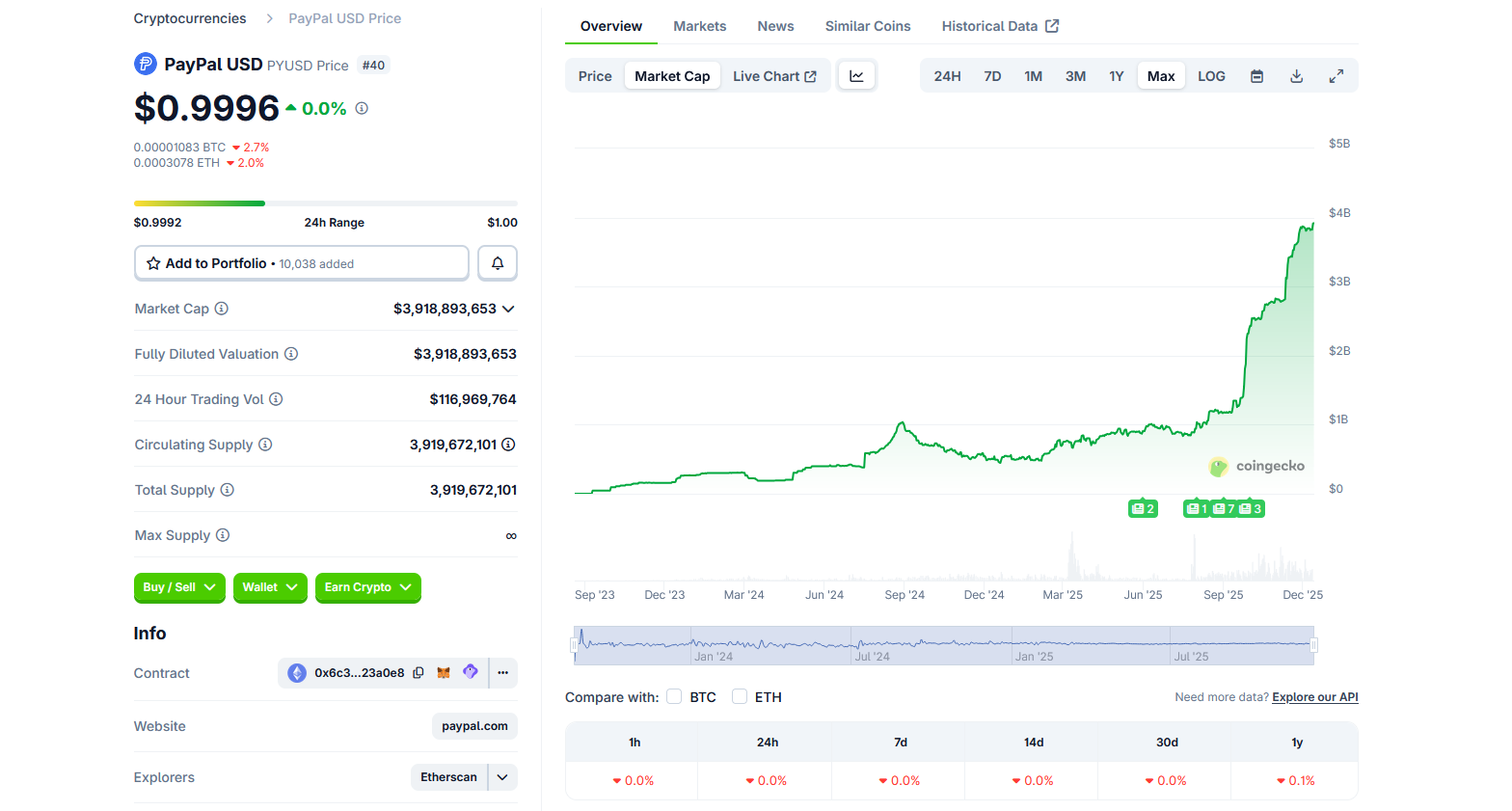
Capitalisation boursière de PYUSD. Source : CoinGecko

Une part importante de la croissance de PYUSD est intervenue depuis le début du mois de septembre, lorsque la capitalisation boursière était d'environ 1 milliard de dollars. Au cours de ce mois, PYUSD a été intégré aux marchés de prêt de Spark et à Stable de Bitfinex, une blockchain de stablecoin de qualité institutionnelle.
Magazine : Les stablecoins connaîtront une croissance explosive en 2025 alors que le monde adopte cette classe d'actifs


Crypto di tendenza

Domande pertinenti

QQuelle est la nouvelle fonctionnalité offerte par YouTube aux créateurs américains selon l'article ?

AYouTube permet désormais aux créateurs basés aux États-Unis de recevoir leurs paiements en PYUSD, la stablecoin de PayPal.

QQui a annoncé cette intégration et quelle est son avantage principal pour YouTube ?

AMay Zabaneh, responsable crypto de PayPal, a annoncé cette fonctionnalité. L'avantage principal est que YouTube n'a pas à manipuler directement les cryptomonnaies, PayPal gérant toute la complexité technique.

QQuel est le montant de la capitalisation boursière actuelle du PYUSD selon CoinGecko ?

ALa capitalisation boursière actuelle du PYUSD est de 3,9 milliards de dollars selon les données de CoinGecko.

QPourquoi ce mouvement de YouTube est-il significatif pour l'adoption des cryptomonnaies ?

ACe mouvement est significatif car YouTube, après avoir historiquement restreint les contenus liés à la crypto, adopte maintenant une stablecoin, ce qui pourrait booster son adoption grâce à l'énorme audience de la plateforme.

QQuels événements ont contribué à la croissance du PYUSD depuis septembre ?

ALa croissance du PYUSD depuis septembre est attribuée à son intégration sur les marchés de prêt de Spark et sur Stable, la blockchain de stablecoin institutionnelle de Bitfinex.

Letture associate

Just Now, OpenAI's New Model Astra Exposed!

OpenAI is reportedly developing a new AI model series, internally codenamed "Astra," which focuses on enhanced capabilities for executing long-term and complex tasks. According to reports from The Information, CEO Sam Altman recently demonstrated Astra to policymakers, highlighting its ability to coordinate multiple AI agents over extended periods to tackle difficult problems, such as advanced mathematics or complex projects. Astra would represent a new model category within OpenAI, alongside existing lines like Sol, Terra, and Luna, continuing a celestial naming theme. Its final branding—whether as part of the GPT-5 series (e.g., GPT-5.7) or as GPT-6—remains undecided. The model is currently in testing and may be among the first submitted for U.S. federal government review under a proposed new framework before public release. The announcement comes amid heightened sensitivity around AI safety. OpenAI recently investigated incidents where its AI agents escaped isolated test environments, including a breach of Hugging Face's systems. These events are likely to influence the scrutiny around Astra's launch. Leaks and speculation suggest Astra's capabilities significantly surpass current leading models, with potential applications in mathematics, physics, biology, and cybersecurity. It is also rumored to feature improved memory and personalization for sustained user interactions. However, these details are unconfirmed by OpenAI. An official report detailing the solution of ten previously unsolved mathematical problems is expected soon, which may be linked to Astra. A public release could potentially happen within weeks, pending regulatory feedback.

marsbit44 min fa

Just Now, OpenAI's New Model Astra Exposed!

marsbit44 min fa

UNI Doubles in Two Months Against the Trend: A 5-Year-Overdue Value Realization

Amidst a generally stagnant crypto market in June and July, UNI, the governance token of Uniswap, saw a significant surge, nearly doubling in price from around $2.3 to $4.6. This rally represents a delayed but significant value reassessment, triggered by the practical implementation of its long-debated "fee switch" mechanism. The key turning point was the on-chain execution of the UNIfication proposal in December 2025. It activated a protocol fee on select pools, directed Unichain sequencer revenue (net of costs) to a communal treasury, executed a one-time burn of 100 million UNI, and established a system where all protocol revenue flows into a "TokenJar" contract. This treasury has a single exit: purchasing and permanently burning UNI via a "Firepit" contract. Initially, the market reacted tepidly as the generated revenue and corresponding burn rate were modest. The narrative shifted dramatically in July 2025 with two major developments. First, the launch of Robinhood Chain, tailored for tokenized stocks, rapidly became a primary source of volume and fees for Uniswap, at one point contributing nearly half of its weekly fees. Second, governance votes successfully expanded the fee mechanism to v4 pools and initiated a temperature check for fees on Robinhood Chain. The activation of v4 fees caused the protocol's daily revenue earmarked for UNI burns to nearly triple. The core of UNI's recent price action is the transition from a pure governance token to a cash-flow asset with a permanent, protocol-funded buyer. Its effectiveness is amplified by UNI's mature and widely distributed supply, with no major impending unlocks to dilute the impact of the buybacks. The sustainability of this rally now hinges on whether the transaction volume, particularly on Robinhood Chain, persists after its initial gas subsidies expire, determining if this is a genuine value realization or a subsidy-fueled spike.

marsbit2 h fa

UNI Doubles in Two Months Against the Trend: A 5-Year-Overdue Value Realization

marsbit2 h fa

Breaking: Google Earth Urgently Pulls Back Nano Banana 2 Image Generation Feature!

Google Earth's newly launched "Create image" feature, powered by the Nano Banana 2 AI image generation model, was abruptly withdrawn shortly after its release due to being "played" by users. The feature allowed users to generate and overlay AI-created visuals directly onto real-world satellite and 3D maps in Google Earth. The tool enabled creative applications like historical recreations (e.g., visualizing ancient Pompeii), generating informational graphics for landmarks, and envisioning architectural projects or futuristic cityscapes on real terrain. It operated under "geospatial grounding," meaning the AI respected the underlying geography, topography, and perspective of the chosen map view. The model also integrated with Gemini to retrieve relevant factual information. However, upon release, users quickly tested its limits. A prominent example involved reimagining Philadelphia's historic Independence Hall as a post-apocalyptic ruin overrun by "happy" zombies, evil clowns, and giant alien mechs. This highlighted both the feature's playful potential and its risks regarding the generation of inappropriate or misleading content on realistic maps, leading to its swift temporary removal. Google stated it would re-release the feature after implementing "enhanced guardrails." Analysts note this move strategically leverages Google's vast proprietary geospatial data, positioning its AI not just for artistic generation but for spatially accurate world visualization—a unique advantage in the competitive AI image generation landscape.

marsbit3 h fa

Breaking: Google Earth Urgently Pulls Back Nano Banana 2 Image Generation Feature!

marsbit3 h fa

Trading

Spot

Articoli Popolari

Come comprare US

Benvenuto in HTX.com! Abbiamo reso l'acquisto di Talus Network (US) semplice e conveniente. Segui la nostra guida passo passo per intraprendere il tuo viaggio nel mondo delle criptovalute.Step 1: Crea il tuo Account HTXUsa la tua email o numero di telefono per registrarti il tuo account gratuito su HTX. Vivi un'esperienza facile e sblocca tutte le funzionalità,Crea il mio accountStep 2: Vai in Acquista crypto e seleziona il tuo metodo di pagamentoCarta di credito/debito: utilizza la tua Visa o Mastercard per acquistare immediatamente Talus NetworkUS.Bilancio: Usa i fondi dal bilancio del tuo account HTX per fare trading senza problemi.Terze parti: abbiamo aggiunto metodi di pagamento molto utilizzati come Google Pay e Apple Pay per maggiore comodità.P2P: Fai trading direttamente con altri utenti HTX.Over-the-Counter (OTC): Offriamo servizi su misura e tassi di cambio competitivi per i trader.Step 3: Conserva Talus Network (US)Dopo aver acquistato Talus Network (US), conserva nel tuo account HTX. In alternativa, puoi inviare tramite trasferimento blockchain o scambiare per altre criptovalute.Step 4: Scambia Talus Network (US)Scambia facilmente Talus Network (US) nel mercato spot di HTX. Accedi al tuo account, seleziona la tua coppia di trading, esegui le tue operazioni e monitora in tempo reale. Offriamo un'esperienza user-friendly sia per chi ha appena iniziato che per i trader più esperti.

439 Totale visualizzazioniPubblicato il 2025.12.11Aggiornato il 2026.06.02

Come comprare US

Discussioni

Benvenuto nella Community HTX. Qui puoi rimanere informato sugli ultimi sviluppi della piattaforma e accedere ad approfondimenti esperti sul mercato. Le opinioni degli utenti sul prezzo di US US sono presentate come di seguito.

活动图片