DeFi Loses $678 Million To Hackers In Q2 2022, New Report Reveals

BitcoinistPubblicato 2022-07-12Pubblicato ultima volta 2022-07-12

Introduzione

The cryptocurrency market has suffered greatly, particularly since Bitcoin had its worst quarter in 11 years. According to data releasedby...

The cryptocurrency market has suffered greatly, particularly since Bitcoin had its worst quarter in 11 years. According to data releasedby Immunefi, a leading bug bounty and security services platform, the Decentralize Finance (DeFi) ecosystem lost $678 million, in the second quarter of 2022.
Immunefi Says Loss Is x1.5 Of Q2 2021
DeFi, an emerging financial technology that stands for decentralized finance, has lost almost $680 million to bad actors since the last quarter.
According to the blockchain security platform Immunefi, fraudulent founders and black hat hackers attacked several crypto protocols in the second quarter of 2022 for a total of $670,698,280. In contrast to the prior quarter, hacks on DeFi protocols rather than cross-chain bridges were the primary cause of losses.
Four projects: Beanstalk ($182 million); Harmony’s Horizon Bridge ($100 million); Mirror Protocol ($90 million); and Fei Protocol ($80 million) accounted for the bulk of the money lost in the second quarter.
According to the Immunefi report, it looked at all instances in which blackhat hackers allegedly attacked different crypto protocols, as well as alleged incidents of fake protocols and founders who allegedly rug pulled in Q2 2022. When compared to Q2 2021, when hackers and fraudsters took $440,021,559, these figures show an almost 1.5x increase.
Immunefi


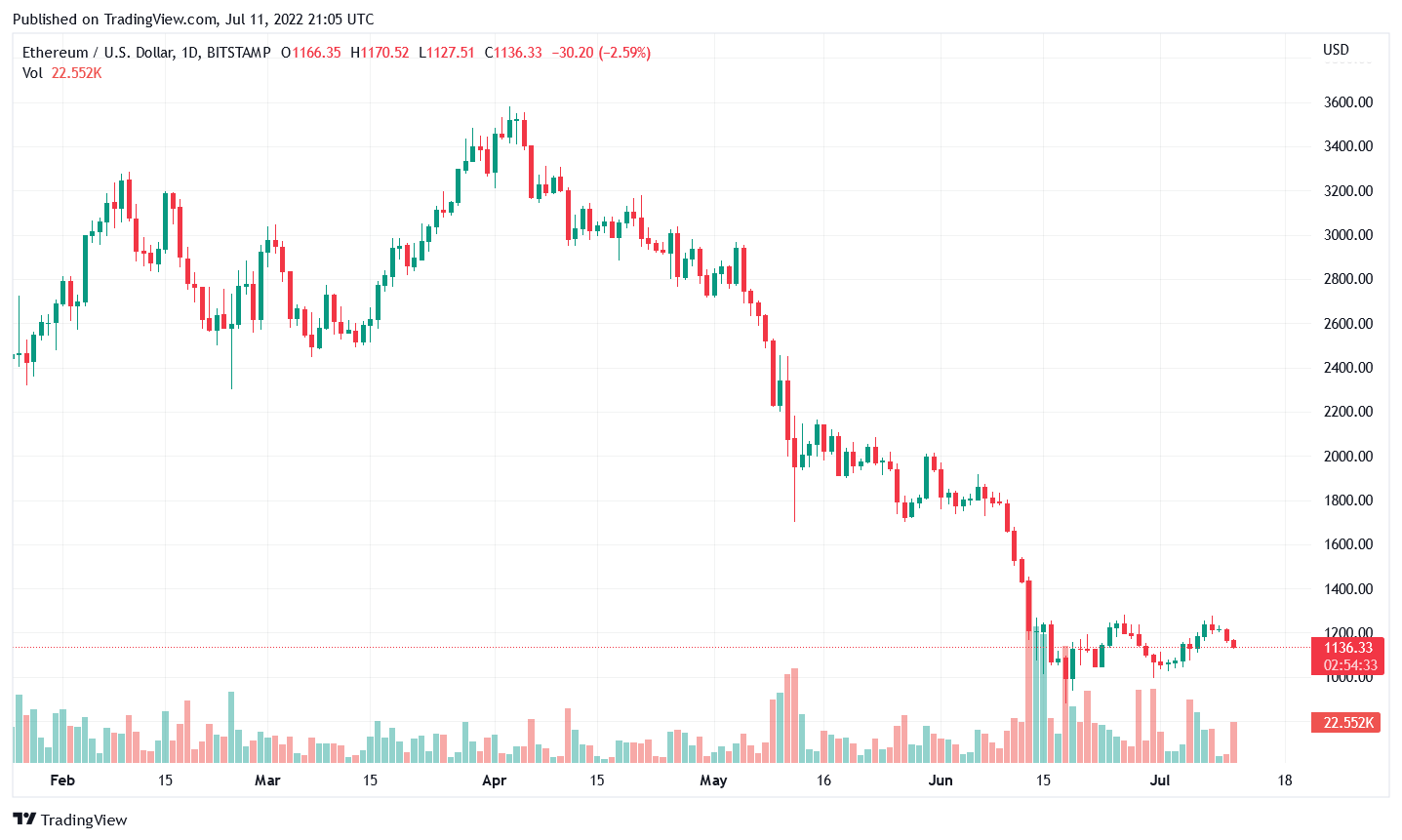
ETH/USD hovers around $1k. Source: TradingView
More than $1.2 billion was stolen from the cryptocurrency ecosystem between January and March. The most prominent cases include the $326 million attack on the Solana’s Wormhole bridge and the approximately $550 million exploitation of Axie Infinity’s Ronin Network.
The frequency of hacks has increased while the amount of funds stolen has doubled from the year’s beginning. 25 attacks were reported in Q1 2022, while 50 occurred in the previous quarter. A whitehat hacker received $6 million from Aurora last month for revealing a flaw that might have endangered $100 million in assets. According to ImmuneFi, the reward was the second-largest ever given out for a crypto vulnerability.
DeFi TVL Lost $156 Billion In The Same Quarter
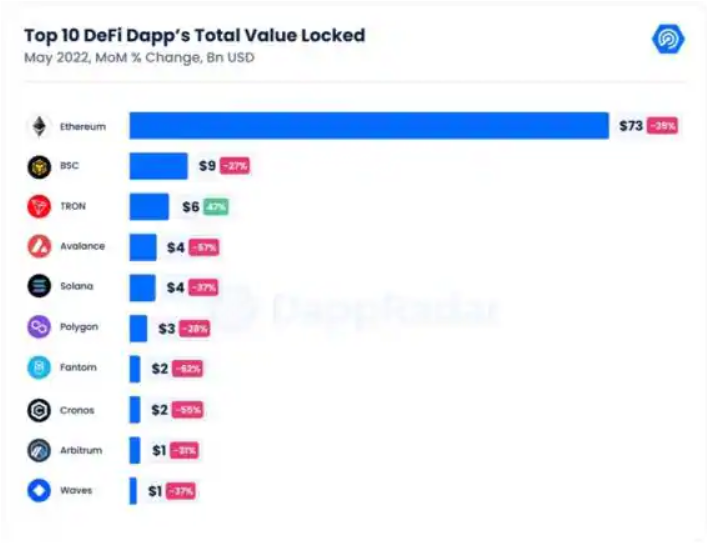
According to the Blockchain Industry Report for May 2022 published by DappRadar, Bitcoin and Ethereum have lost 25% and 40% of their value since Terra’s collapse. 
At the time of writing, the TVL had a value of $77.94 billion. The company with the largest TVL, MakerDAO, has $7.66 billion to its credit. In the past 30 days, it has decreased by more than 19 percent. AAVE and WBTC are the next two, contributing $6.68 billion and $5.52 billion respectively. In comparison to the previous 30 days, they are both down more than 30%. 25.5% of the TVL is made up of the trio.
Immunefi


In the second quarter of 2022, the Ethereum blockchain lost 63.25 percent of its TVL. It had a value of $125.49 billion at the start of the quarter, and at the conclusion it was $46.11 billion.


Letture associate

The Brutal Truth Behind CARDS' $535M FDV: Only $43M in Net Revenue and Halved Profit Margins

The article titled "The Brutal Truth Behind CARDS' $535 Million FDV: Only $43 Million Net Revenue, Profit Margins Halved" provides a critical analysis of Collector Crypt (CC), a platform combining physical collectible cards with NFTs in a gacha-style system. Key findings include: * CC has generated $635 million in total user deposits. However, 90.6% ($576 million) is instantly returned to users via automatic card buybacks, resulting in only $43 million in net platform revenue (6.7% retention). * Activity is highly concentrated among dozens of high-frequency wallets, with an average of only ~420 daily active players. * There is minimal secondary market activity for the cards (under $5 million total), indicating the platform functions more as a gambling casino than a collector's marketplace. eBay sales as a percentage of gacha volume have declined for six consecutive quarters. * Despite a tripling in transaction volume, net profit margins have been halved from 11.2% to 5.8% as activity shifts to higher-priced card packs with lower margins. * Value captured by the CARDS token is minimal: only $140,000 (from burns and recent buybacks), representing just 3.4% of CC's cumulative net revenue. In contrast, wallets linked to operational infrastructure have off-ramped $45.7 million in USDC. * The token's ~$535 million Fully Diluted Valuation (FDV) represents a 7.3x multiple of annualized net revenue. Only 20.5% of the token supply is floating, with 72% allocated to insiders and locked until November 2027. The conclusion is that CC has found product-market fit as a high-speed gambling platform for a niche user base, not as a growing collector economy. The token currently captures a negligible share of the platform's revenue.

Foresight News23 min fa

The Brutal Truth Behind CARDS' $535M FDV: Only $43M in Net Revenue and Halved Profit Margins

Foresight News23 min fa

BitTorrent Launches BTTInferGrid: The Decentralized Infrastructure Layer for Scalable AI Inference

BitTorrent has launched BTTInferGrid, a decentralized GPU computing network designed to meet the surging demand for AI inference workloads. The platform aggregates global idle GPU resources into an open-access, verifiable, and pay-as-you-go infrastructure, aiming to solve the cost, scalability, and supply bottlenecks of traditional centralized cloud providers. BTTInferGrid addresses a key market shift, as industry forecasts indicate over 70% of future AI compute will be for inference—a continuous operational cost. It tackles centralization issues like inflexible resource allocation during volatile demand, prohibitive GPU pricing, and the underutilization of fragmented global compute capacity. The platform establishes a direct corridor between AI developers and idle hardware. On the supply side, it allows providers to monetize underutilized GPUs through tokenized incentives. On the demand side, it offers developers cost-efficient, on-demand inference with on-chain verification. Key differentiators include permissionless access for providers, verifiable service quality through blockchain validation, and a sustainable, demand-driven economic model. Built on BitTorrent's proven DePIN expertise from the BitTorrent File System (BTFS), BTTInferGrid follows a phased roadmap. It begins with network bootstrapping in 2026, focusing on scaling GPU nodes, and aims to evolve into a foundational Web3 AI infrastructure layer by 2028, supporting diverse model architectures and decentralized fine-tuning.

TheNewsCrypto59 min fa

BitTorrent Launches BTTInferGrid: The Decentralized Infrastructure Layer for Scalable AI Inference

TheNewsCrypto59 min fa

Trading

Spot
Futures
活动图片