Anchored, But Under Strain

insights.glassnodePubblicato 2025-12-10Pubblicato ultima volta 2025-12-10

Introduzione

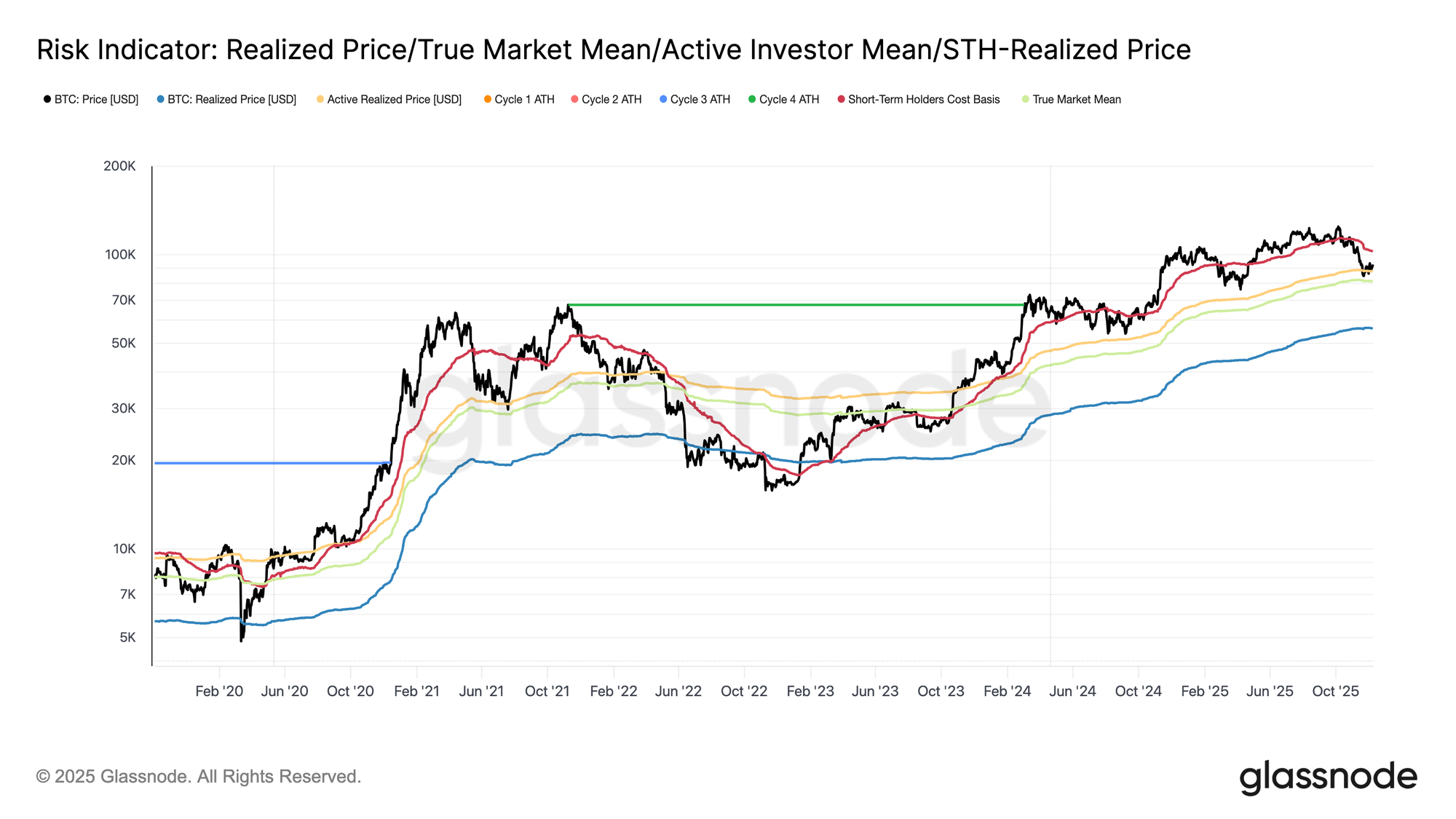
Bitcoin remains structurally fragile, trading between the STH-Cost Basis at $102.7k and the True Market Mean at $81.3k. On-chain conditions are weakening, with rising unrealized and realized losses, alongside elevated selling from long-term holders. Despite some demand absorbing this pressure, reclaiming key levels like the 0.75 cost-basis quantile ($95k) is crucial for a bullish reversal. Off-chain activity reflects caution: ETF flows are negative, spot and futures liquidity are subdued, and options markets show heightened demand for short-term downside protection ahead of the FOMC meeting. Traders are accumulating volatility, anticipating a near-term move. Post-FOMC, volatility may compress, but the market remains range-bound, balancing persistent sell pressure against patient demand.

Bitcoin enters the week still confined within a structurally fragile range, bounded by the STH-Cost Basis at $102.7k and the True Market Mean at $81.3k. Last week, we underscored weakening on-chain conditions, thinning demand, and a cautious derivatives landscape that collectively echo the early-2022 setup.

Although price has held marginally above the True Market Mean, unrealized losses continue to expand, realized losses are rising, and spending by long-term investors remains elevated. The key upper thresholds to reclaim are the 0.75 cost-basis quantile at $95k, followed by the STH-Cost Basis. Until then, the True Market Mean remains the most probable bottom-formation zone, barring a new macro shock.
Live Chart

Time Works Against the Bulls

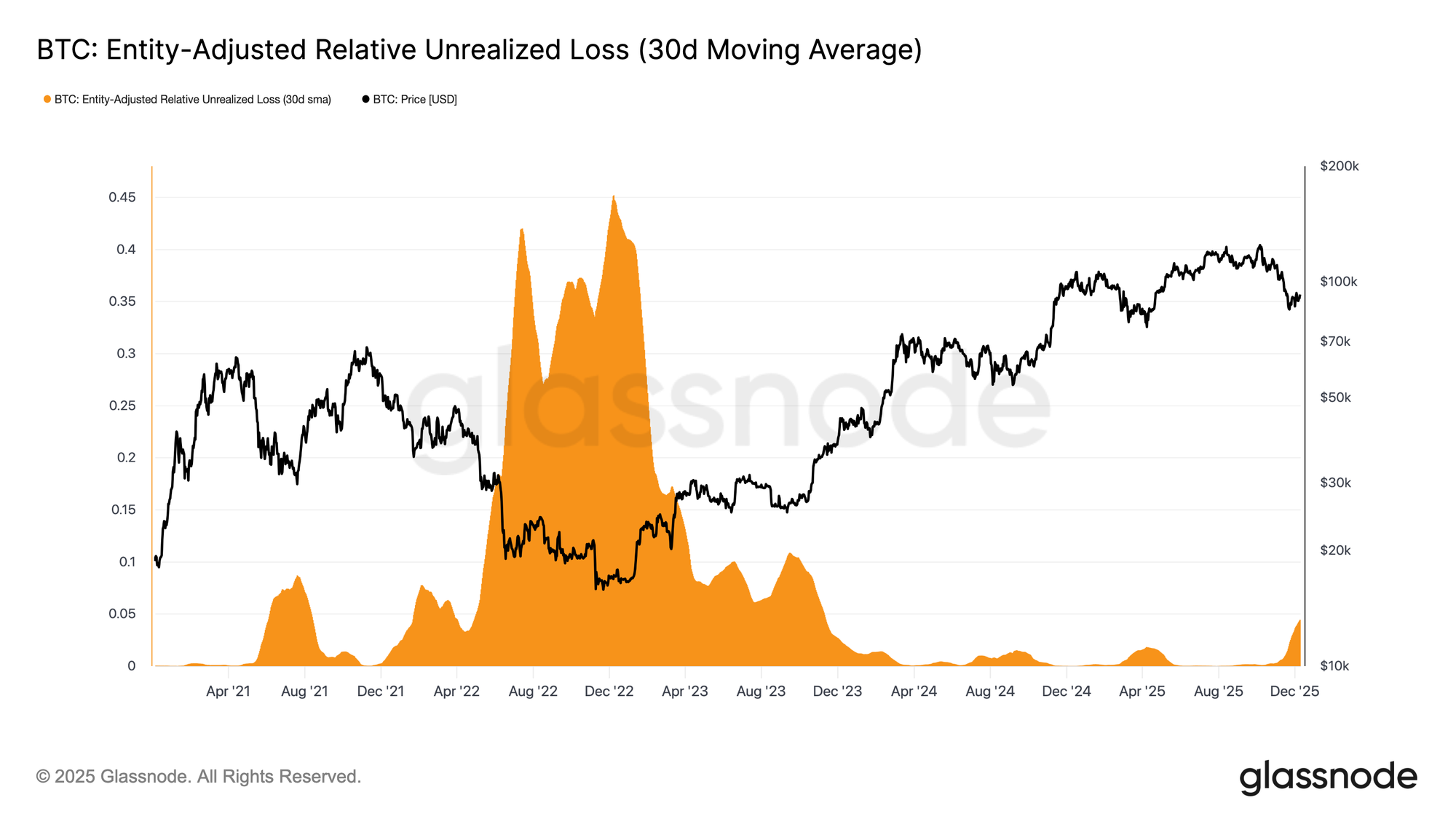
Remaining in a mild bearish phase reflects the tension between modest capital inflows and persistent sell pressure from top buyers. As the market holds within a weak but bounded range, time becomes a negative force, making unrealized losses harder for investors to endure and increasing the likelihood of loss realization.

The Relative Unrealized Loss (30D-SMA) has climbed to 4.4% after nearly two years below 2%, marking a shift from a euphoric phase to one of elevated stress and uncertainty. This hesitation now defines the range, and resolving it will require a renewed wave of liquidity and demand to rebuild confidence.
Live Chart

Losses Rising

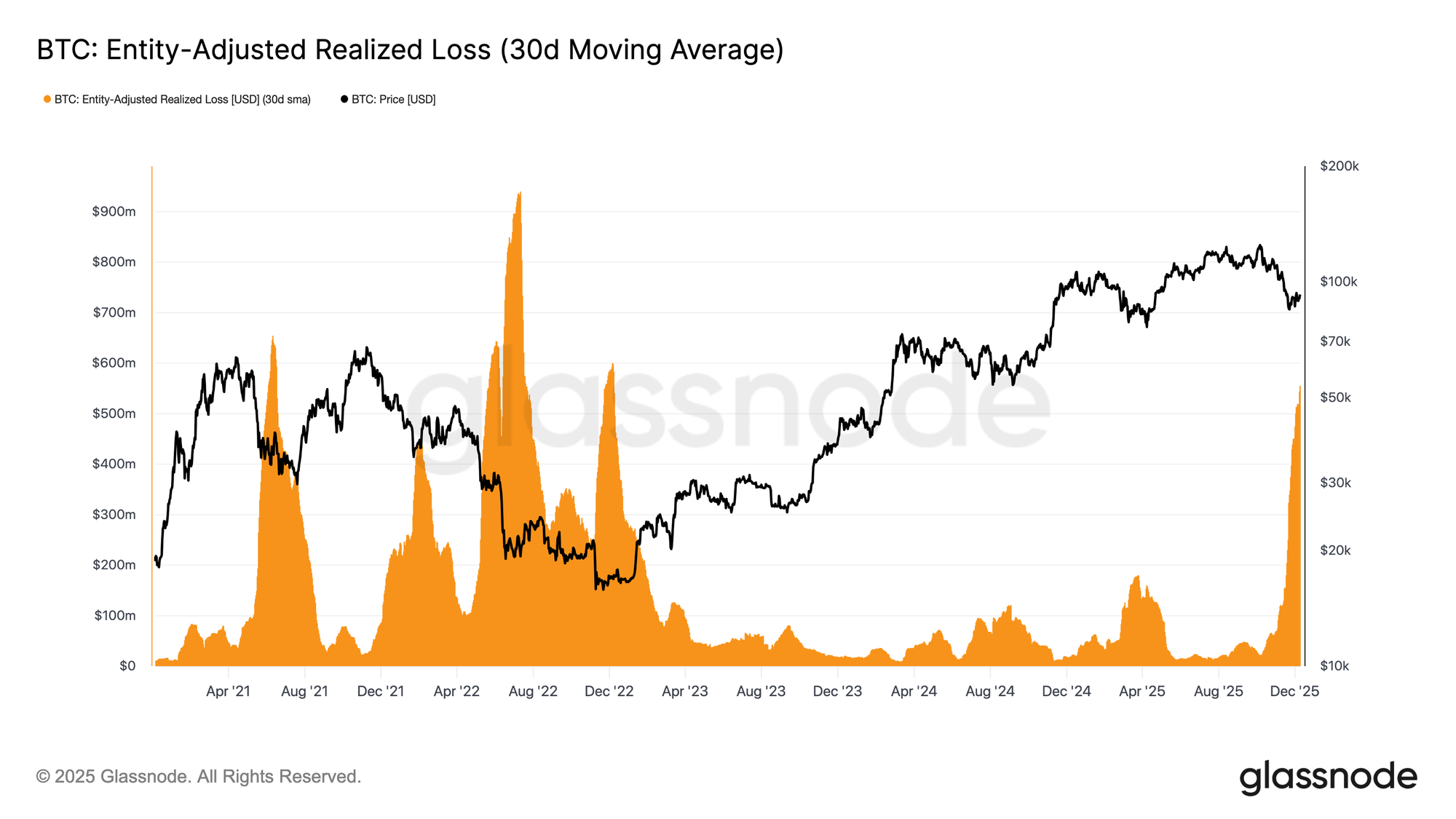
This time-driven pressure is further evident in spending behavior. Even as Bitcoin has rebounded from the November 22 low to roughly $92.7k, the 30D-SMA Entity-Adjusted Realized Loss has continued climbing, reaching $555 million per day, the highest level since the FTX collapse.

Such elevated loss realization during a moderate price recovery reflects mounting frustration among top buyers who are capitulating into strength rather than holding through the rebound.
Live Chart

Holding Back the Reversal

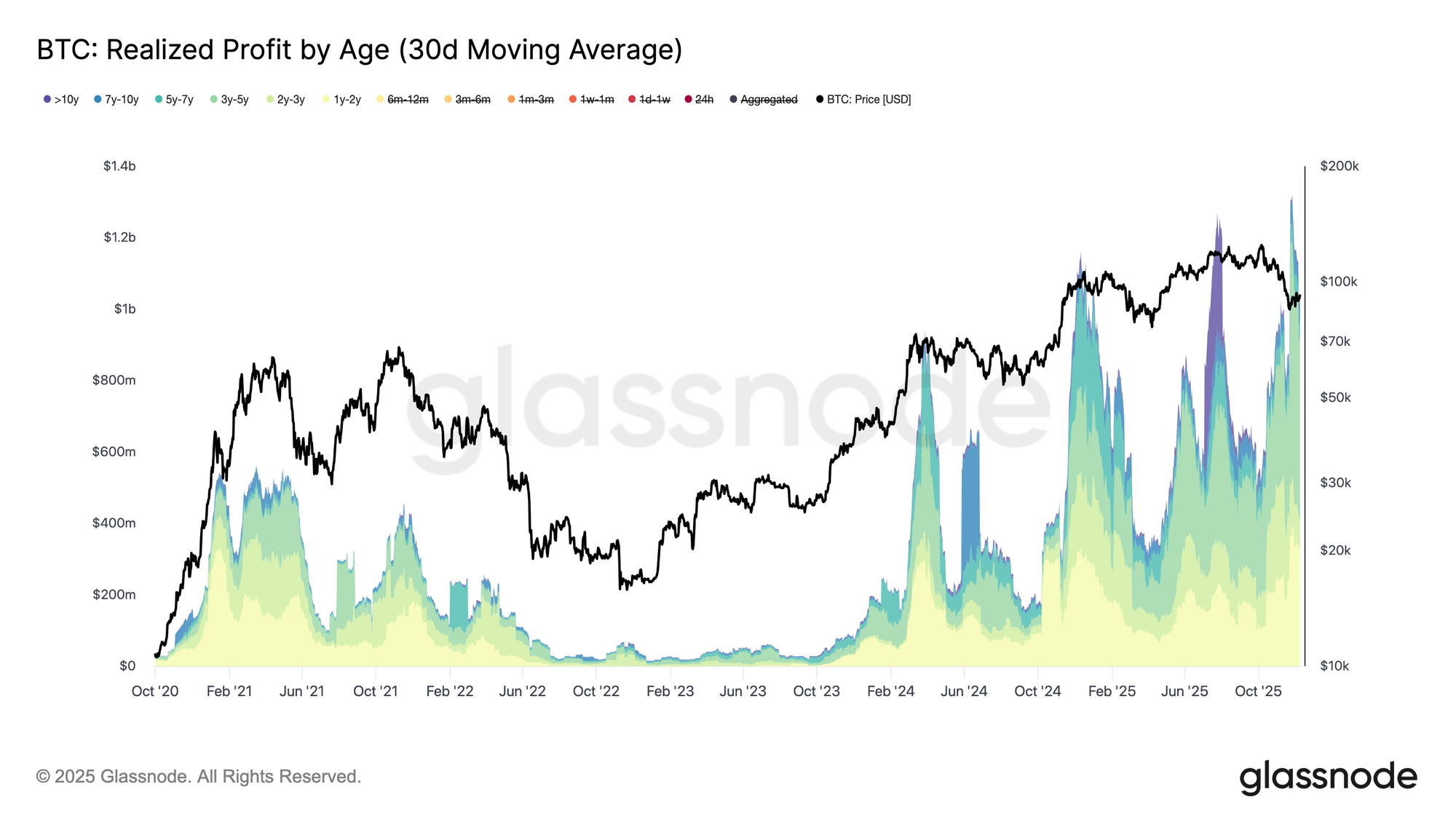
Rising realized losses are further anchoring the recovery, especially as they coincide with a surge in realized profit from seasoned investors. During the recent bounce, >1-year holders increased their realized profit (30D-SMA) above $1B per day, peaking at a new ATH of over $1.3B. Together, these two forces—time-driven capitulation by top buyers and heavy profit-taking by long-term holders ,explain why the market continues to struggle reclaiming the STH-Cost Basis.

Yet, despite this significant sell pressure, price has stabilized and even slightly recovered above the True Market Mean, signalling persistent and patient demand absorbing distribution. In the short term, if seller exhaustion begins to emerge, this underlying buy pressure could drive a retest of the 0.75 quantile (~$95k) and potentially the STH-Cost Basis.
Live Chart

Off-Chain Insights

ETF Woes

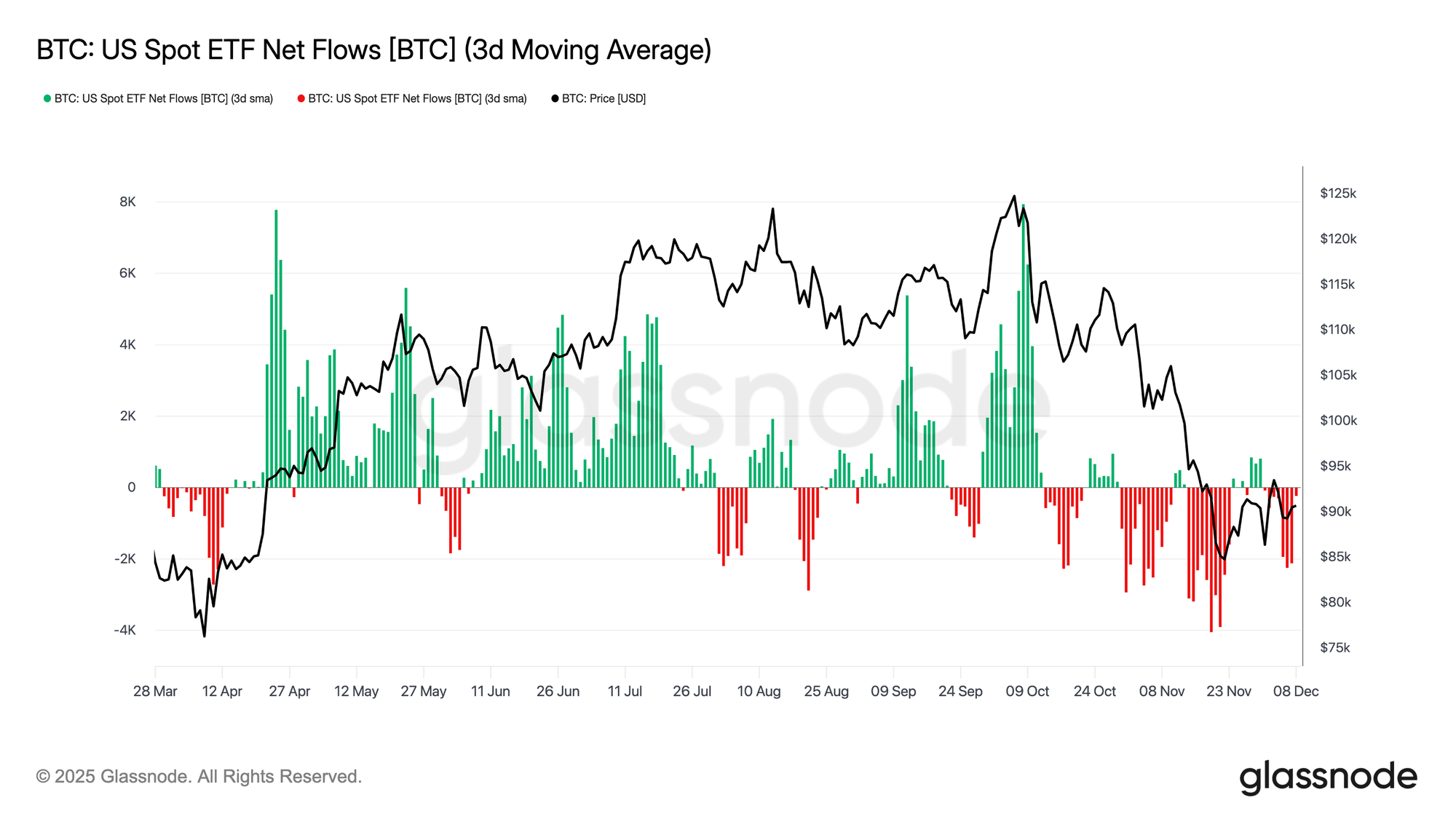
Turning to spot markets, US Bitcoin ETFs logged another quiet week, with the 3-day average of net flows remaining consistently below zero. This extends the cooling trend that began in late November and marks a clear departure from the robust inflow regime that supported price appreciation earlier in the year. Redemptions have been steady across several major issuers, underscoring a more risk-averse stance among institutional allocators as broader market conditions remain unsettled.

As a result, the spot market is operating with a thinner demand buffer, reducing immediate buy-side support and leaving price more vulnerable to macro catalysts and volatility shocks.
Live Chart

Liquidity Remains Subdued

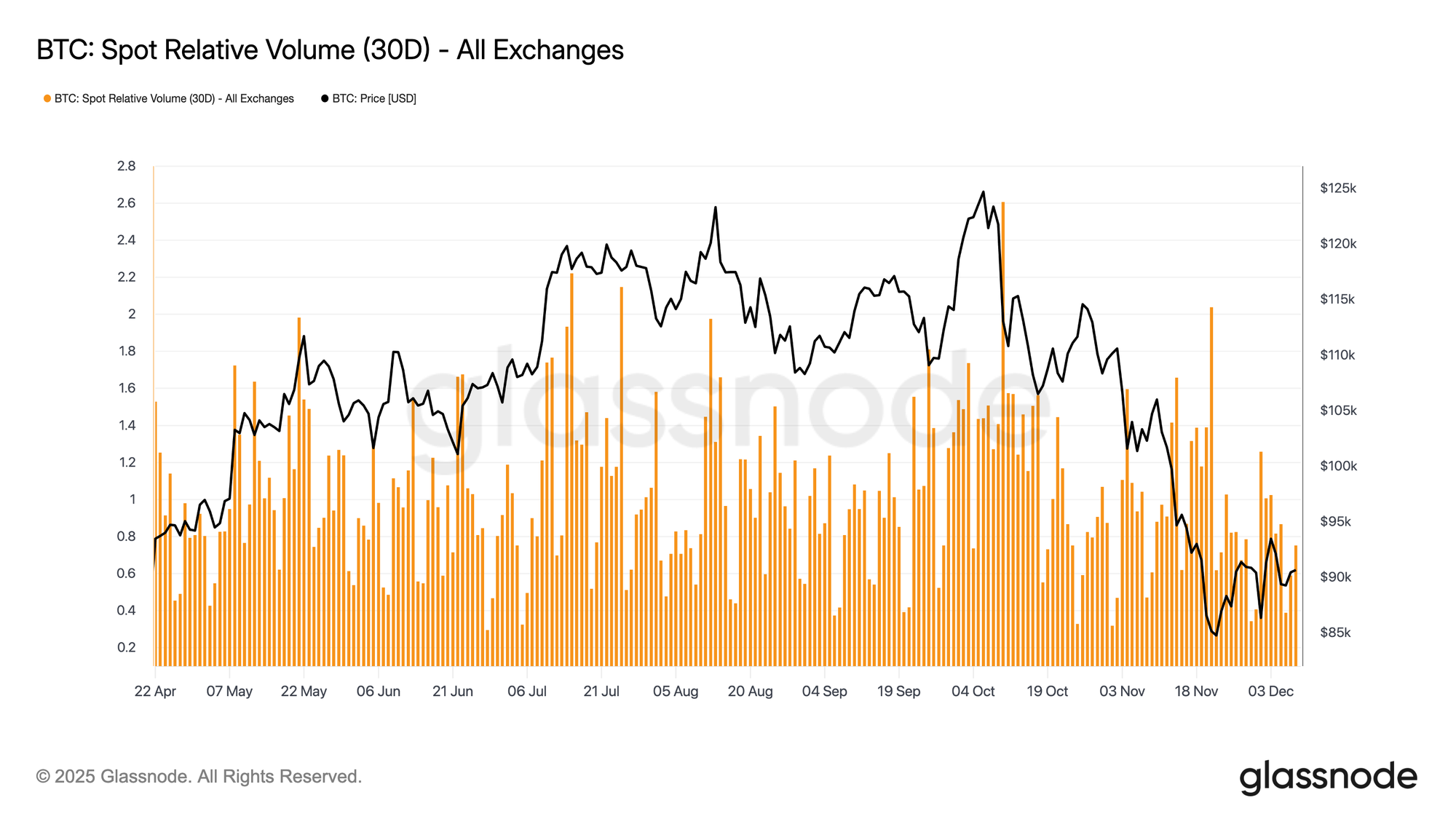
In parallel with softer ETF flows, Bitcoin’s spot relative volume continues to sit near the lower bound of its 30-day range. Trading activity has weakened through November and into December, mirroring the price decline and signalling a retreat in market participation. The contraction in volume reflects a more defensive positioning across the board, with fewer liquidity-driven flows available to absorb volatility or sustain directional moves.

With spot markets running quieter, attention now turns to the upcoming FOMC meeting, which could act as a catalyst for renewed participation depending on the policy tone.
Live Chart

Futures Ghost Town

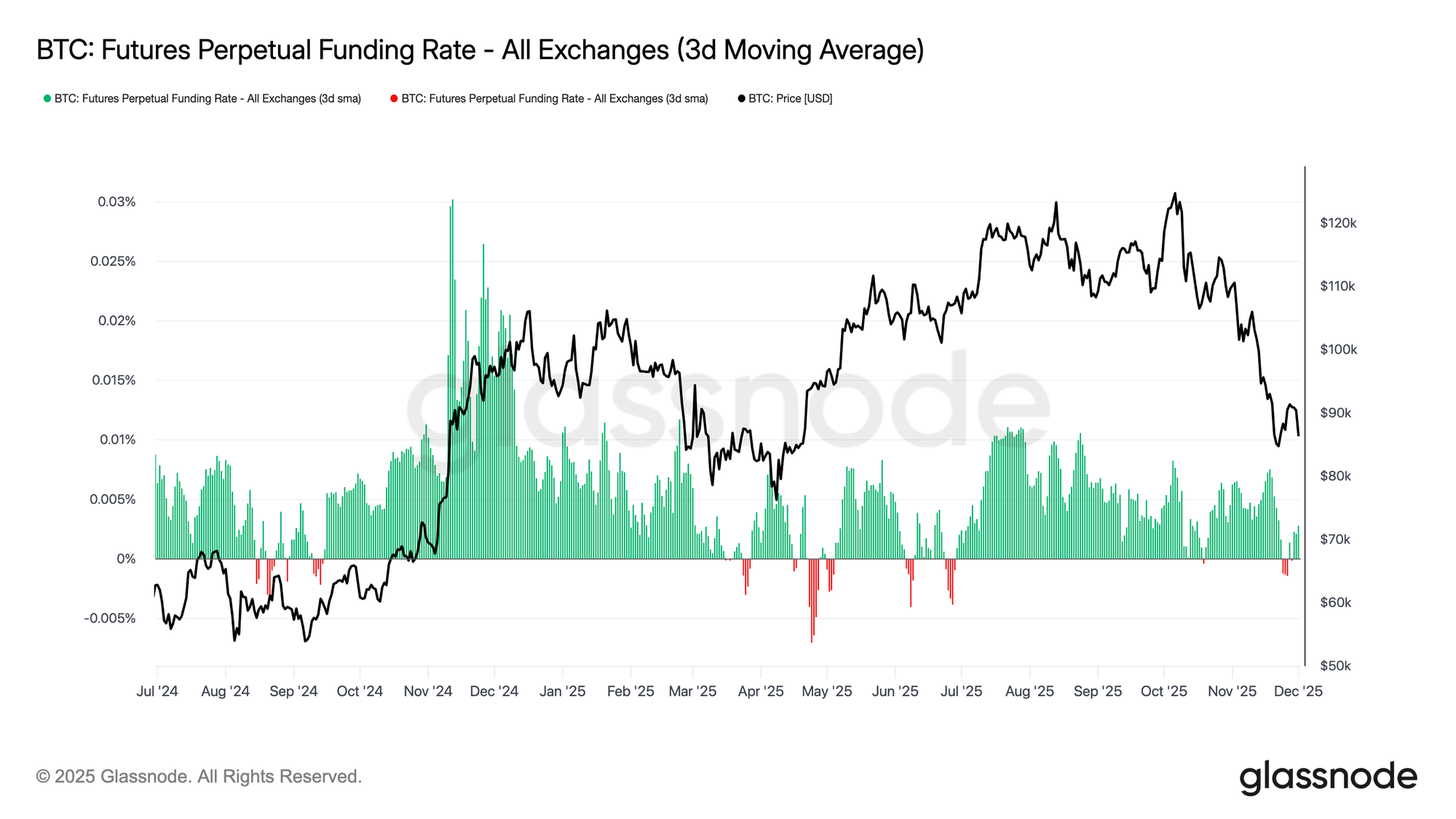
Extending this theme of muted participation, futures markets also show limited appetite for leverage, with Open Interest failing to meaningfully rebuild and funding rates pinned near neutral. These dynamics highlight a derivatives environment defined more by caution than conviction.

Across perpetual markets, funding hovered around zero to slightly negative during the week, underscoring the continued retreat in speculative long positioning. Traders remain balanced or defensive, contributing little directional pressure via leverage.

With derivatives activity subdued, price discovery tilts more heavily toward spot flows and macro catalysts rather than speculative expansion.
Live Chart

IV Pops at the Front End

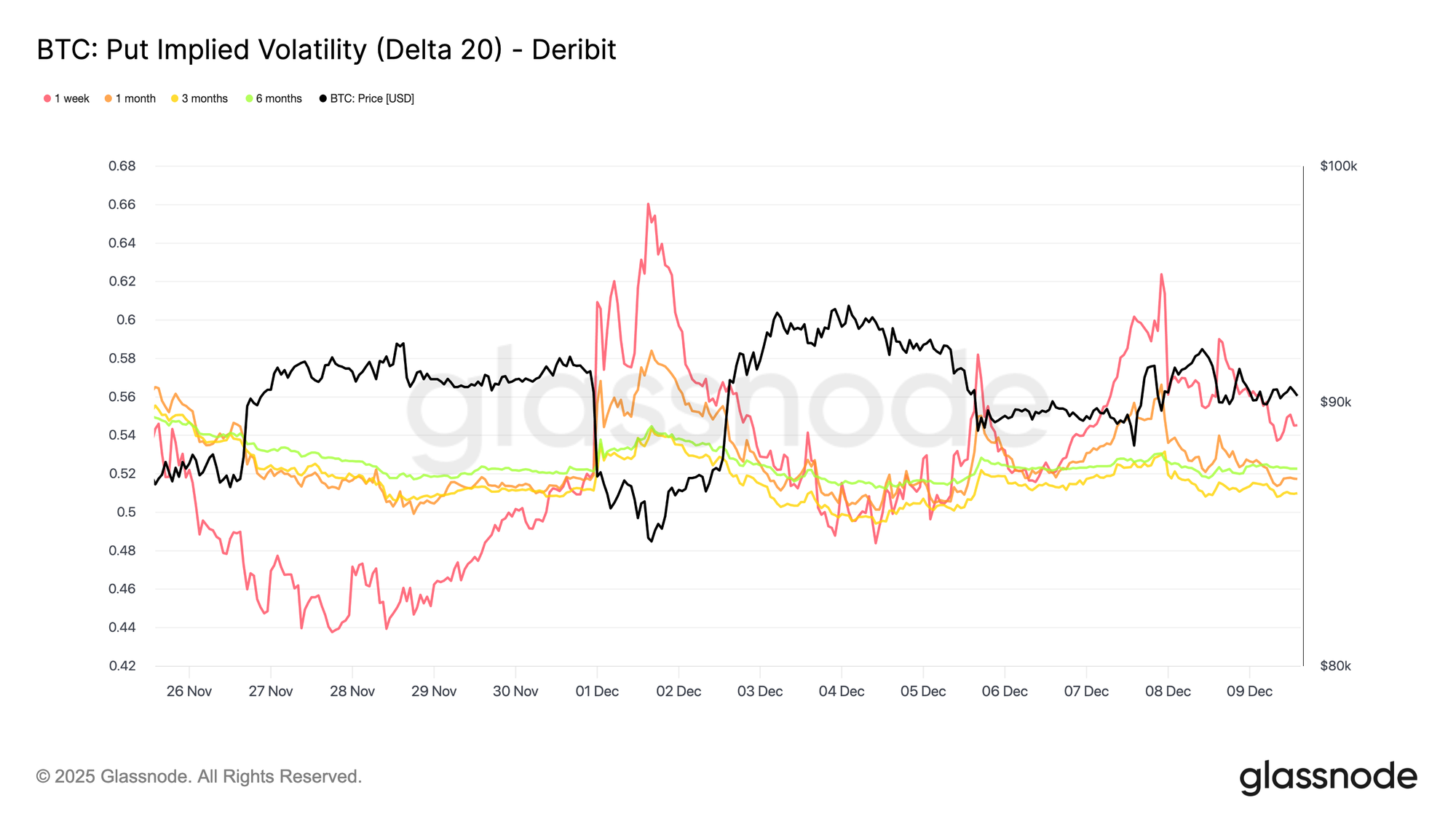
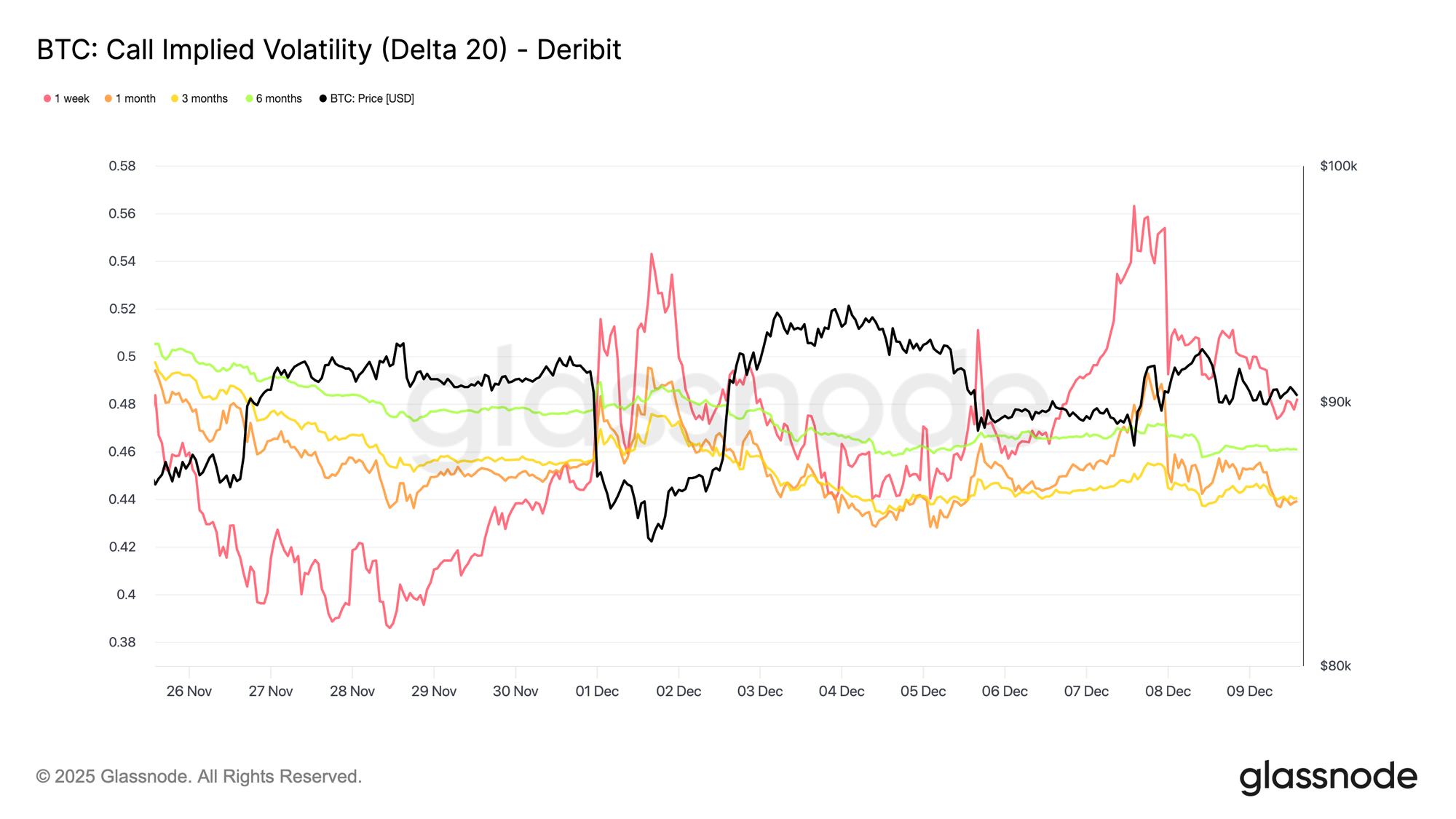
Turning to the options market, Bitcoin’s muted spot action contrasts sharply with a sudden rise in short-dated implied volatility, as traders position for a larger move. Interpolated Implied Volatility, which estimates IV at fixed deltas rather than relying on listed strikes, reveals a clearer structure of how risk is being priced across maturities.

On the 20-Delta CALL, the one-week tenor jumped by roughly ten vol points from last week, while longer maturities stayed relatively flat. The same pattern appears on the 20-Delta PUT, with short-dated downside IV lifting as longer expiries remain quiet.

Overall, traders are accumulating volatility precisely where they expect stress, preferring to own convexity rather than fade it ahead of the December 10 FOMC meeting.
Live Chart
Live Chart

Downside Demand Returns

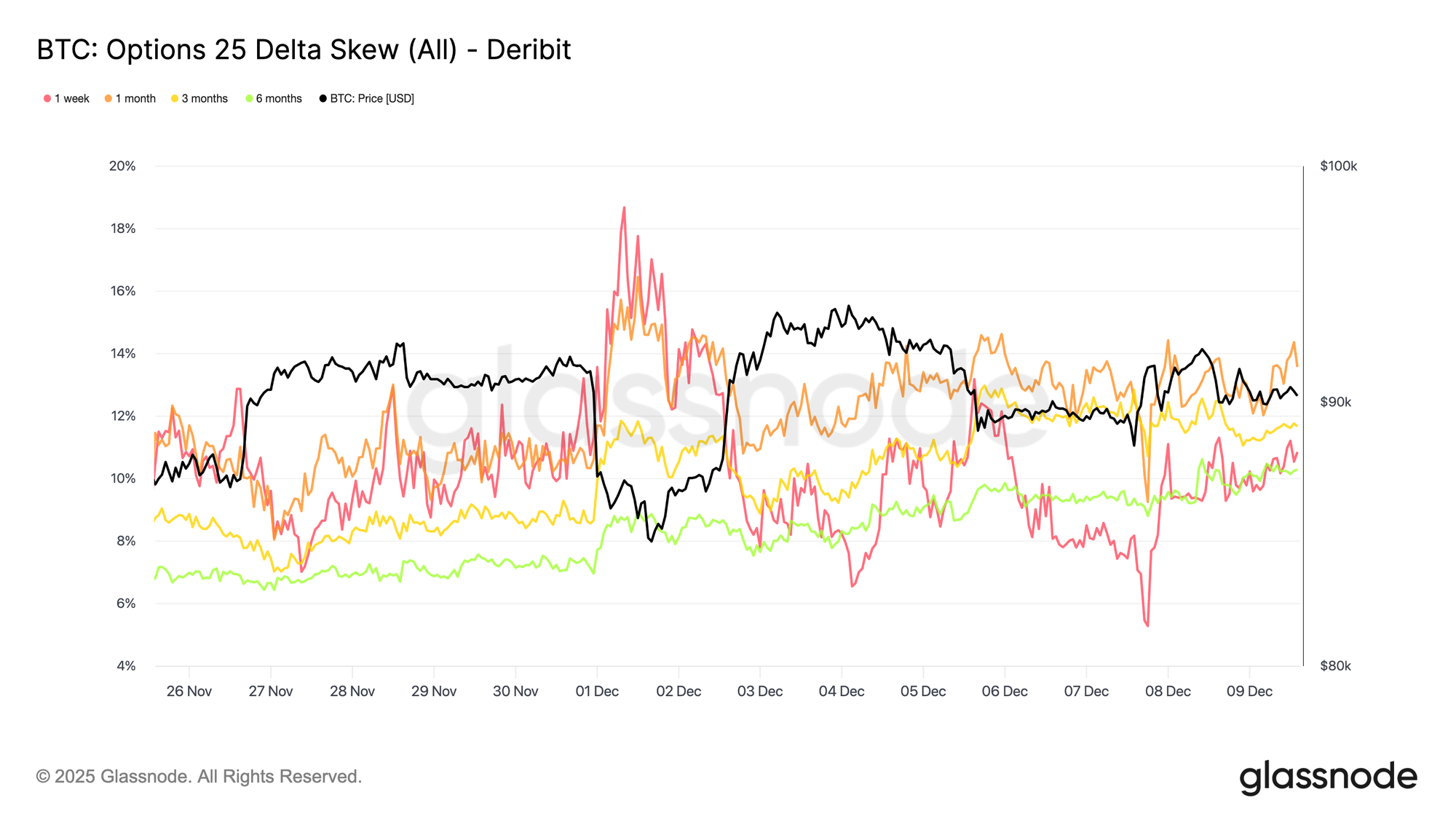
Complementing the rise in front-end volatility, downside protection is once again commanding a premium. The 25-delta skew, which measures the relative cost of puts versus calls at the same delta, has climbed to roughly 11 percent in the one-week tenor, indicating a clear pickup in demand for short-dated downside insurance ahead of the FOMC meeting.

Skew remains tightly clustered across maturities, ranging from 10.3 percent to 13.6 percent. This compression suggests that the preference for put protection is broad-based across the curve, reflecting a consistent hedging bias rather than isolated stress confined to the front end.
Live Chart

Skew Index Shows a Different Tone

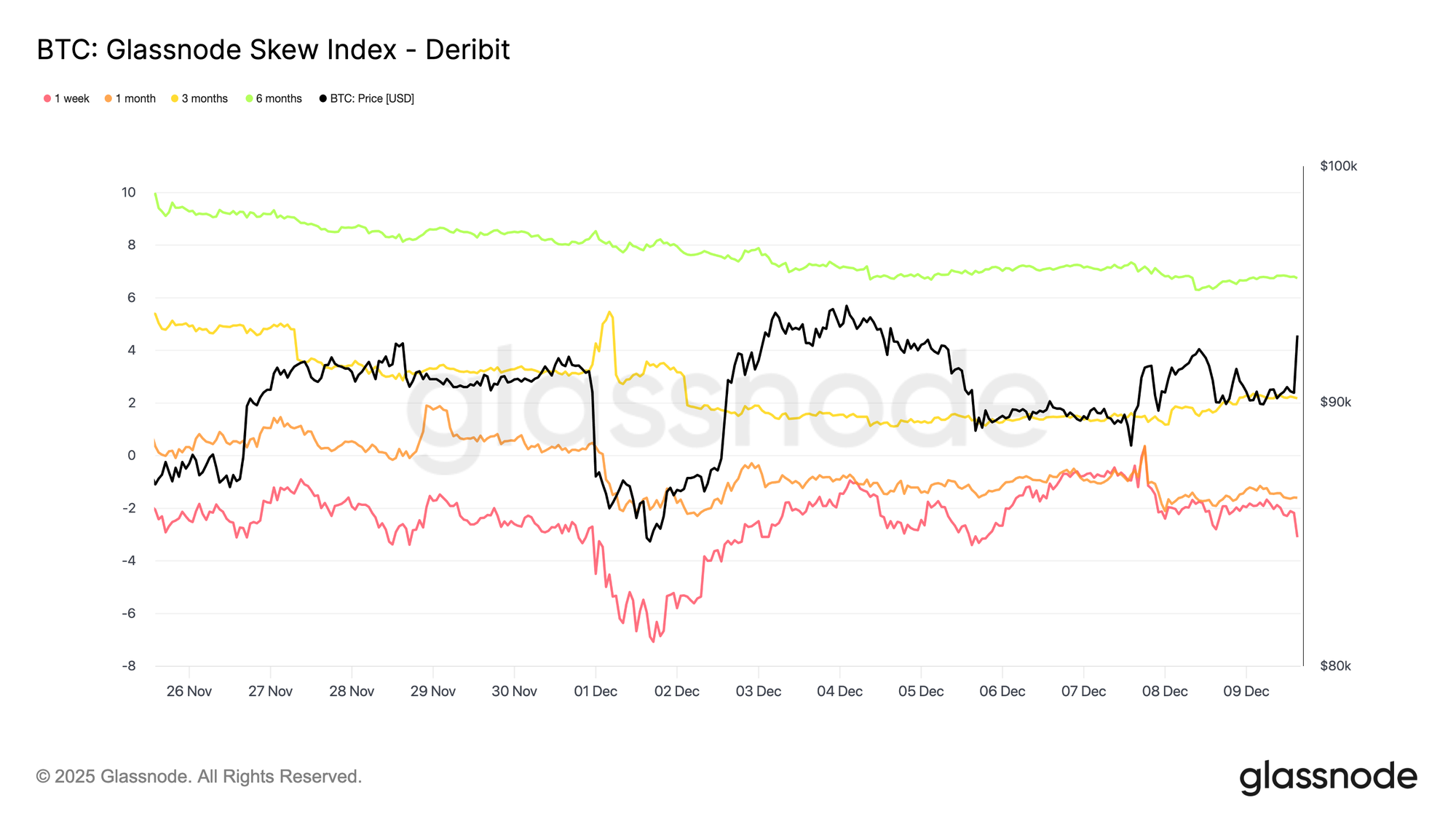
Adding another layer to the options picture, the skew index presents a more nuanced signal compared with the 25-delta skew. Because it is weighted toward low-delta options, it captures pricing across the full downside wing. The one-week and one-month readings sit in put territory, yet the three-month and six-month values, around 2.2 percent and 6.7 percent, fall into call territory, since the index is calculated as calls minus puts.

This creates a notable divergence: the 25-delta skew leans bearish across maturities, while the longer-dated skew index shows upside variance being priced more richly than downside. In essence, traders are not bidding deep OTM downside protection in the longer tenors, even though mid-delta puts remain supported. The surface therefore signals short-term caution, but a more balanced to mildly bullish tone further out the curve, a pattern typical in crypto where participants often hold far-OTM calls for asymmetric upside.
Live Chart

Volatility Accumulation

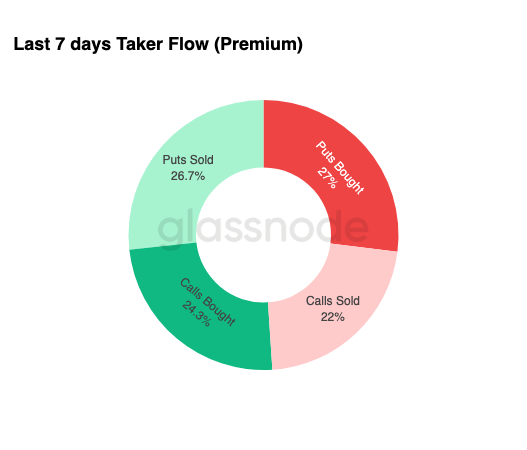
Rounding out the options landscape, weekly flow data reinforces a clear pattern: traders are buying volatility, not selling it. Premiums bought dominate total notional flow, with a slight lead from puts. This does not reflect a directional bias, but rather a regime of volatility accumulation. When traders purchase both wings, it signals hedging and convexity-seeking behaviour rather than sentiment-driven speculation.

Combined with rising implied volatility and a downside-leaning skew, the flow profile suggests that market participants are preparing for a volatility event with a bias toward the downside.
Live Chart

After FOMC

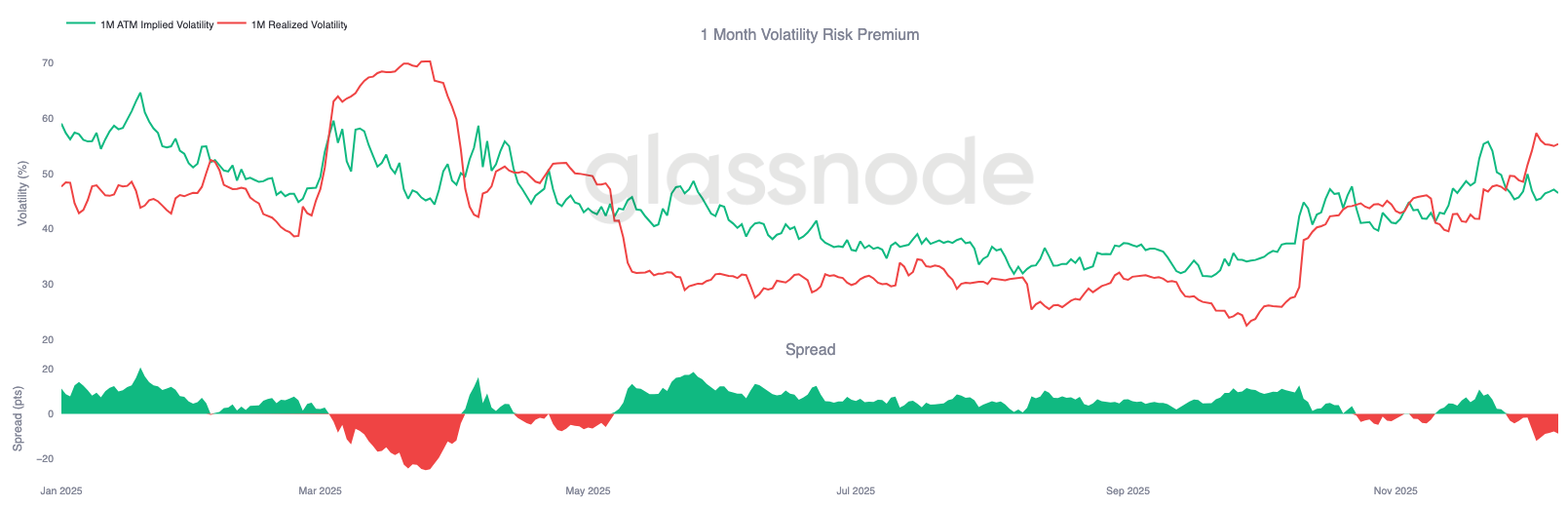
Looking ahead, implied volatility has already begun to ease, and historically, IV tends to compress further once the final major macro event of the year passes. With the December 10 FOMC meeting serving as the last meaningful catalyst, the market is preparing for a transition into a low-liquidity, mean-reverting environment.

After the announcement, gamma sellers typically re-enter, accelerating IV decay into year-end. Absent a hawkish surprise or a notable shift in guidance, the path of least resistance points toward lower implied volatility and a flatter surface through late December.
Live Chart

Conclusion

Bitcoin continues to trade within a structurally fragile environment where rising unrealized losses, elevated realized loss realization, and heavy profit-taking from long-term holders collectively anchor price action. Despite this persistent sell pressure, demand remains sufficiently resilient to keep price above the True Market Mean, suggesting patient buyers are still absorbing distribution. A short-term push toward the 0.75 quantile or even the STH Cost Basis remains possible if seller exhaustion begins to surface.

Off-chain conditions echo this cautious tone. ETF flows remain negative, spot liquidity is subdued, and futures markets lack speculative engagement. Options markets reinforce a defensive posture, with traders accumulating volatility, bidding short-dated downside protection, and positioning for a near-term volatility event ahead of the FOMC meeting.

Taken together, market structure suggests a weak but stable range, held up by patient demand yet constrained by persistent sell pressure. The short-term path hinges on whether liquidity improves and sellers relent, while the longer-term outlook depends on the market’s ability to reclaim key cost-basis thresholds and shift out of this time-driven, psychologically taxing phase.
Letture associate

AI Saved a Group of New Energy Investors

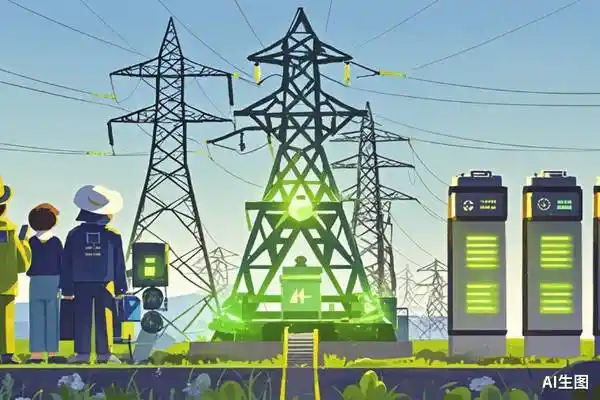
The article "AI Saves a Group of New Energy Investors" details a remarkable turnaround in the green energy investment sector, driven by its convergence with artificial intelligence infrastructure. After a prolonged downturn marked by valuation slumps and funding cold spells since 2022, the sector has experienced a dramatic resurgence in 2026. This shift is attributed to new policies, particularly the "AI-Energy Synergy" national strategy, which mandates green power and energy storage systems for new large-scale computing centers. This redefines green electricity and storage from traditional manufacturing into core, indispensable assets for AI's operational backbone, creating a new narrative where "computing power equals electricity, and green power equals assets." This paradigm change is reflected in surging market performance. Power stocks like Datang Power have seen massive gains, and green energy ETFs have recorded significant capital inflows. The IPO market is also active, with companies like Sige New Energy listing successfully. Investment and financing have accelerated sharply, with major expansion projects and large-scale IPOs like China Resources New Energy's record-breaking offering. Notably, some top projects have seen valuations rebound by approximately 60%. The article highlights that the previous industry trough became a prime investment window. With AI-driven demand predicted to create massive power shortfalls (e.g., a projected 55GW gap for data centers), sectors like energy storage, grid upgrades, and green power are seeing explosive growth. Investors are now prioritizing areas like power management, large-scale storage, virtual power plants, and supporting technologies like liquid cooling—the "pick-and-shovel" plays of the AI infrastructure boom. Examples like KKR's highly successful investment in cooling company CoolIT Systems underscore the lucrative opportunities. In conclusion, the integration with AI has sparked a fundamental revaluation of new energy assets. For investors who endured the sector's低谷, a harvest season has arrived, with the broader investment upswing seemingly just beginning.

marsbit3 min fa

AI Saved a Group of New Energy Investors

marsbit3 min fa

Learn Codex with the "Morning Briefing": Six Replicable Levels of Use

This article introduces a "Morning Briefing" as a simple, progressive framework for learning to effectively use Codex (an AI assistant), moving from basic information gathering to a more sophisticated, autonomous work partner. It outlines six actionable levels: **Level 1: Basic Information Query.** Start by simply asking Codex to check your Slack, Gmail, and Calendar to summarize what needs your attention today. **Level 2: Personalization with an Agents File.** Create a persistent file containing your default preferences for the briefing's format and content, so it's consistently useful. **Level 3: Automation.** Set the briefing to run automatically every weekday morning, creating a reliable starting point for your day. **Level 4: Project-Specific Briefings.** Instead of one overwhelming summary, create separate, dedicated threads for different projects (e.g., a launch, recruitment), each with its own focused briefing. **Level 5: Drafting Follow-Up Actions.** Elevate the briefing from a summary to an action starter by having it draft replies, prepare meeting notes, or highlight stalled decisions—ready for your review. **Level 6: Building a Memory System (Vault).** Integrate a knowledge vault (a structured file system) where important recurring information (project statuses, key people, decisions) is stored and updated. The briefing consults this vault to provide richer context and learns over time. The approach's strength is its incremental nature. Each level teaches a core Codex capability (connectors, personalization, automation, project context, assisted work, persistent memory) within a familiar, practical workflow, avoiding overwhelming theoretical concepts. It transforms a simple daily check-in into a personalized, evolving work operating system.

marsbit40 min fa

Learn Codex with the "Morning Briefing": Six Replicable Levels of Use

marsbit40 min fa

Trading

Spot
Futures

Articoli Popolari

Come comprare HPP

Benvenuto in HTX.com! Abbiamo reso l'acquisto di House Party Protocol (HPP) semplice e conveniente. Segui la nostra guida passo passo per intraprendere il tuo viaggio nel mondo delle criptovalute.Step 1: Crea il tuo Account HTXUsa la tua email o numero di telefono per registrarti il tuo account gratuito su HTX. Vivi un'esperienza facile e sblocca tutte le funzionalità,Crea il mio accountStep 2: Vai in Acquista crypto e seleziona il tuo metodo di pagamentoCarta di credito/debito: utilizza la tua Visa o Mastercard per acquistare immediatamente House Party ProtocolHPP.Bilancio: Usa i fondi dal bilancio del tuo account HTX per fare trading senza problemi.Terze parti: abbiamo aggiunto metodi di pagamento molto utilizzati come Google Pay e Apple Pay per maggiore comodità.P2P: Fai trading direttamente con altri utenti HTX.Over-the-Counter (OTC): Offriamo servizi su misura e tassi di cambio competitivi per i trader.Step 3: Conserva House Party Protocol (HPP)Dopo aver acquistato House Party Protocol (HPP), conserva nel tuo account HTX. In alternativa, puoi inviare tramite trasferimento blockchain o scambiare per altre criptovalute.Step 4: Scambia House Party Protocol (HPP)Scambia facilmente House Party Protocol (HPP) nel mercato spot di HTX. Accedi al tuo account, seleziona la tua coppia di trading, esegui le tue operazioni e monitora in tempo reale. Offriamo un'esperienza user-friendly sia per chi ha appena iniziato che per i trader più esperti.

96 Totale visualizzazioniPubblicato il 2026.04.29Aggiornato il 2026.04.29

Come comprare HPP

Cosa è GENIUS

I. Introduzione al Progetto1. Cos'è Genius?Genius (GENIUS) si posiziona come il "terminal on-chain definitivo", una piattaforma di trading decentralizzata focalizzata sulla privacy e sulla velocità. Integrando tecnologie di privacy di alto livello, mira a costruire un'infrastruttura di trading privacy di nuova generazione attraverso reti come BNB Chain, consentendo agli utenti di interagire on-chain con un'esperienza fluida paragonabile a quella degli exchange centralizzati.2. Come Funziona Genius?L'architettura tecnica principale di Genius è strutturata come segue:(1) Invisibile alla catena: Gli utenti non devono gestire manualmente approvazioni a più passaggi per operazioni cross-chain, wrapping di asset o gestione complessa del gas.(2) Trading senza Firma: Attraverso integrazioni come Turnkey, Genius consente trading istantaneo senza conferme a comparsa o autorizzazione per transazione.(3) Aggregatore di Aggregatori: Genius è alimentato da uno stack di aggregazione di prima classe integrato con oltre 150 DEX, vantando un'efficienza di quotazione superiore rispetto ai prodotti concorrenti.(4) Gestione degli Account: La piattaforma adotta un'architettura non custodiale e sfrutta Turnkey e Lit Protocol per la gestione delle chiavi, consentendo agli utenti di accedere in modo sicuro ai propri account tramite passkey.3. Chi Ha Creato Genius?Secondo i suoi Termini di Servizio ufficiali, Genius è stato sviluppato da Shuttle Labs, Inc. Basandosi sull'account ufficiale X del progetto, Ryan Myher è uno dei principali contributori che guidano l'iterazione del prodotto, inclusi sviluppi come il lancio del protocollo Ghost, oltre a un coinvolgimento più ampio della comunità.Il fondatore di Binance CZ ha ufficialmente aderito al progetto come consulente, con l'obiettivo di aiutare il team a costruire un'esperienza di trading on-chain più veloce e rispettosa della privacy.Inoltre, il progetto ha ricevuto un forte sostegno da YZi Labs, che ha investito in Genius e collabora con la Genius Foundation, responsabile della manutenzione del core Genius Bridge Protocol (GBP).4. Tokenomics di GeniusGENIUS è il token nativo dell'ecosistema Genius. Ad oggi, il progetto non ha rilasciato un documento completo di tokenomics.Basandosi sulle ultime divulgazioni ufficiali, Genius incorpora un meccanismo deflazionistico, e il 4,6% dell'offerta totale di token era già stato bruciato durante la fase di lancio iniziale.Sistema di Genius Points (GP):(1) Trade-to-Earn: La piattaforma ha stabilito un pool di ricompensa di 200 milioni di Genius Points, e gli utenti guadagnano GP per ogni trade eseguito tramite il terminale.(2) Livelli e Badge: Genius presenta un sistema di badge basato sulla progressione che va da Smart a God, con livelli superiori che sbloccano vantaggi e benefici aggiuntivi.(3) Rendimento Nativo: Gli utenti che detengono asset designati come usdGG nel dashboard possono guadagnare rendimento nativo direttamente senza dover passare attraverso staking complessi.(4) Incentivi per Referral: I referenti possono guadagnare rimborsi sulle commissioni superiori al 45% pagati in USDC, insieme a GP aggiuntivi.5. Cronologia & Traguardi ChiaveMarzo 2020: È stato creato l'account ufficiale X del progetto, segnando l'inizio della sua fase di preparazione iniziale.13 gennaio 2026: Genius ha annunciato un investimento multimilionario da YZi Labs e ha contemporaneamente confermato CZ come consulente per accelerare lo sviluppo della sua infrastruttura di trading privacy.18 aprile 2026: Il progetto ha annunciato che il protocollo di privacy Ghost sarebbe stato lanciato a breve.29 aprile 2026: Il protocollo Ghost è stato ufficialmente aperto ai suoi primi 50 tester, segnando l'inizio di una nuova era per il trading privacy su BNB Chain. Allo stesso tempo, il team ha confermato che il 4,6% dei token è stato bruciato.​II. Informazioni sul Token1) Informazioni di BaseNome del token: GENIUS (Genius)III. Link CorrelatiSito web:https://www.tradegenius.com/homeEsploratori:https://bscscan.com/address/0x1f12b85aac097e43aa1555b2881e98a51090e9a6Social:https://x.com/GeniusTerminalNota: L'introduzione al progetto proviene dai materiali pubblicati o forniti dal team ufficiale del progetto, che è solo a scopo di riferimento e non costituisce consulenza per gli investimenti. HTX non si assume responsabilità per eventuali perdite dirette o indirette risultanti.

226 Totale visualizzazioniPubblicato il 2026.04.29Aggiornato il 2026.05.12

Cosa è GENIUS

Come comprare GENIUS

Benvenuto in HTX.com! Abbiamo reso l'acquisto di Genius (GENIUS) semplice e conveniente. Segui la nostra guida passo passo per intraprendere il tuo viaggio nel mondo delle criptovalute.Step 1: Crea il tuo Account HTXUsa la tua email o numero di telefono per registrarti il tuo account gratuito su HTX. Vivi un'esperienza facile e sblocca tutte le funzionalità,Crea il mio accountStep 2: Vai in Acquista crypto e seleziona il tuo metodo di pagamentoCarta di credito/debito: utilizza la tua Visa o Mastercard per acquistare immediatamente GeniusGENIUS.Bilancio: Usa i fondi dal bilancio del tuo account HTX per fare trading senza problemi.Terze parti: abbiamo aggiunto metodi di pagamento molto utilizzati come Google Pay e Apple Pay per maggiore comodità.P2P: Fai trading direttamente con altri utenti HTX.Over-the-Counter (OTC): Offriamo servizi su misura e tassi di cambio competitivi per i trader.Step 3: Conserva Genius (GENIUS)Dopo aver acquistato Genius (GENIUS), conserva nel tuo account HTX. In alternativa, puoi inviare tramite trasferimento blockchain o scambiare per altre criptovalute.Step 4: Scambia Genius (GENIUS)Scambia facilmente Genius (GENIUS) nel mercato spot di HTX. Accedi al tuo account, seleziona la tua coppia di trading, esegui le tue operazioni e monitora in tempo reale. Offriamo un'esperienza user-friendly sia per chi ha appena iniziato che per i trader più esperti.

122 Totale visualizzazioniPubblicato il 2026.04.29Aggiornato il 2026.05.12

Come comprare GENIUS

Discussioni

Benvenuto nella Community HTX. Qui puoi rimanere informato sugli ultimi sviluppi della piattaforma e accedere ad approfondimenti esperti sul mercato. Le opinioni degli utenti sul prezzo di A A sono presentate come di seguito.

活动图片