Ethereum [ETH]: Analyzing how this resistance level can furnish an opportunity for investors

AmbcryptoPubblicato 2022-07-09Pubblicato ultima volta 2022-07-09

Introduzione

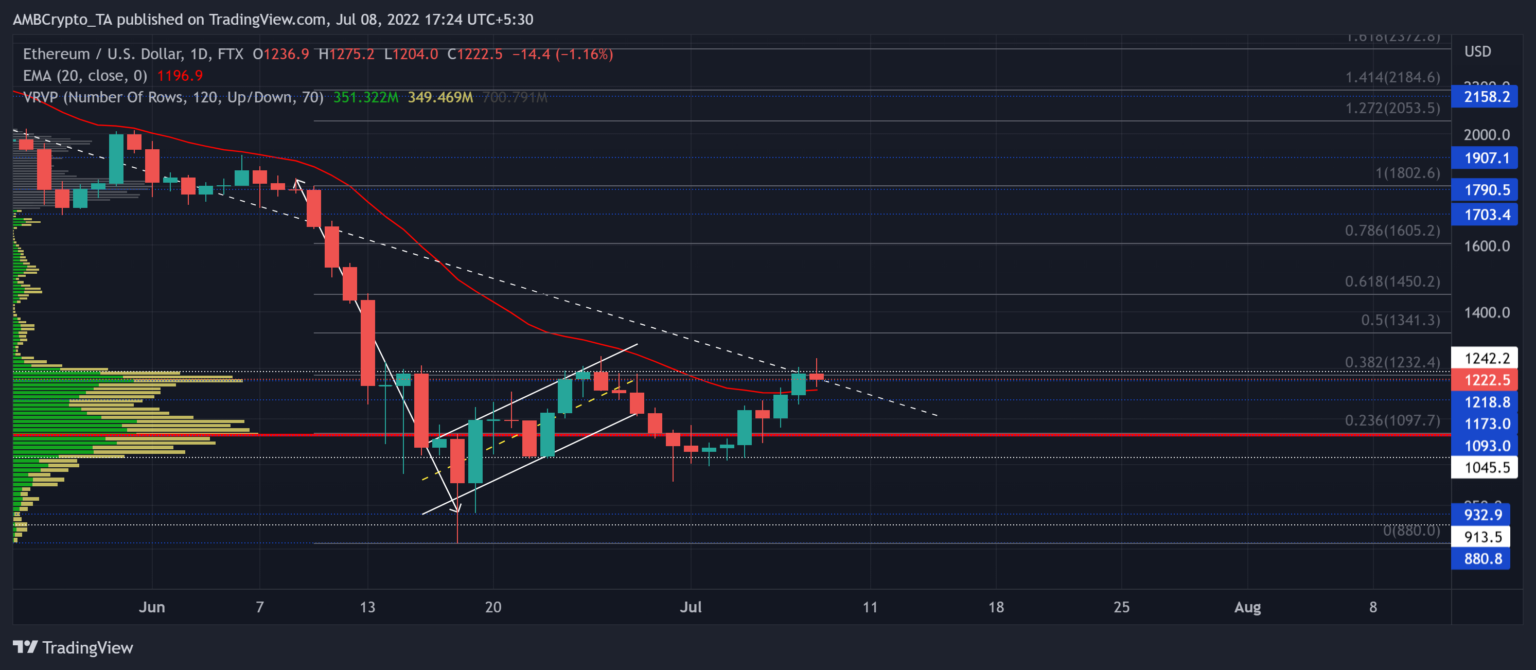
Over the last few days, Ethereum [ETH] saw an expected breakdown from its bearish flag pattern. Also, the trendline resistance (white, dashed) has kept the alt’s peaks under bearish control for over three months.

The 38.2% Fibonacci resistance has significantly impaired the buying efforts over the last three weeks. Over the last few days, Ethereum [ETH] saw an expected breakdown from its bearish flag pattern. Also, the trendline resistance (white, dashed) has kept the alt’s peaks under bearish control for over three months.

Should the current candlestick see a robust close below the 38.2% level, ETH could eye a further downside in the coming sessions. At press time, the alt was trading at $1,222.5, up by 3.47% in the last 24 hours.

ETH Daily Chart
Source: TradingView, ETH/USD

ETH’s three-month trendline resistance has delineated a steep plunge in the daily timeframe. To top it up, the 20 EMA (red) has undermined most of the bullish recovery efforts until recently.

The breakdown from the $2,700 zone has aggravated the selling power whilst the bulls strived to hold the $1,000-mark support. ETH lost nearly 70% of its value over the last few months (since early May). As a result, the alt gravitated toward its 17-month low on 18 June.

Should the 38.2% resistance inflict selling pressure, ETH could see a pullback toward the Point of Control (POC, red). In this case, potential shorting targets would rest near the $1,045 support.

Also, with the trendline resistance standing sturdy, the buyers could face a tough time overturning the $1,200 zone. A decline below the 20 EMA would expose ETH to a potential downside. Any bearish invalidations could aid the buyers in provoking a rather short-lived rally until the 50.2% level.

Rationale
Source: TradingView, ETH/USD

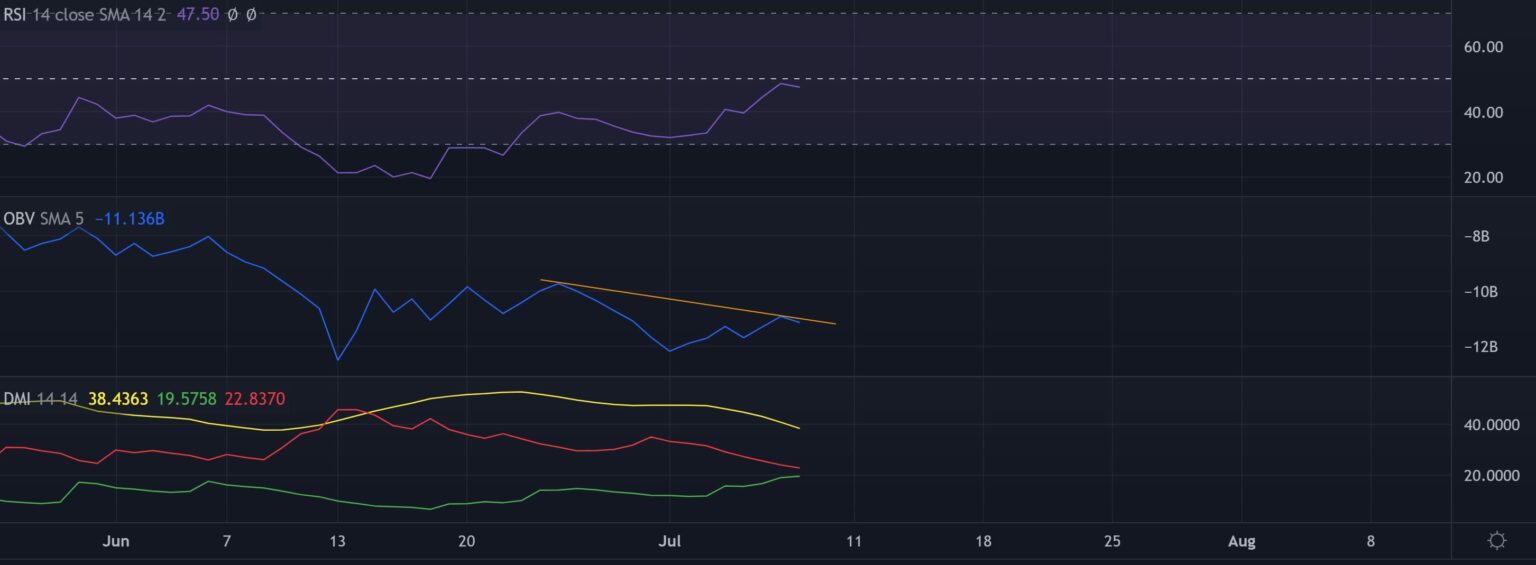
The Relative Strength Index (RSI) was yet to cross above the midline whilst depicting a relatively neutral stance. Its inability to find a close above the 50-mark could encourage the ongoing drawdowns on the chart. Traders should watch for a close above the midline to confirm higher chances of a bearish invalidation.

Further, the On-Balance Volume (OBV) saw lower peaks and revealed a slight decrease in the buying pressure over the last two weeks. Finally, any bullish crossover on the Directional Movement Index (DMI) could be detrimental for the short-sellers.

Conclusion

The bulls needed to ramp up the buying volumes near the 20 EMA to prevent a downside risk of nearly 14%. The traders/investors must be wary of the caveats laid forth by the indicators as discussed above.

Also, investors/traders need to watch out for Bitcoin’s movement. This is because ETH shares a whopping 98% 30-day correlation with the king coin.


Letture associate

Banking Giants Battle in the Tokenization Arena: Who Will Take the Lead?

**Banking Titans Battle in Tokenization: Who Leads the Pack?** Four major banks—JPMorgan Chase, Goldman Sachs, HSBC, and BNY Mellon—are heavily investing in tokenization infrastructure but have adopted distinct strategic paths. This analysis compares them across four key dimensions: verified transaction volume, product breadth, regulatory compliance, and underlying infrastructure model. JPMorgan's Onyx network stands out with over $1 trillion in cumulative cleared transaction volume, focusing deeply on niche areas like tokenized collateral management and intraday repo settlement. However, its closed private network limits market reach. Goldman Sachs Digital Assets Platform (GS DAP) leads in product diversity, having executed tokenized bond issuances for sovereign entities and supranational organizations, and launched tokenized money market funds. It is also a founding member of the Canton Network, a shared ledger for institutions, though its overall cleared volume is less publicly disclosed than JPMorgan's. HSBC's Orion platform carves a niche in cross-border tokenized securities and sustainable finance, exemplified by its tokenized gold product and its role in large-scale digital green bond issuances for the Hong Kong Monetary Authority. Its global network provides a unique advantage in Asia and emerging markets. BNY Mellon, as the world's largest custodian, plays a fundamentally different role by providing essential custody and asset servicing infrastructure for digital assets, notably supporting the Canton Network. It does not actively issue front-end tokenized products. In summary, no single bank dominates all fronts. JPMorgan leads in scale, Goldman in product breadth, HSBC in global cross-border positioning, and BNY Mellon in foundational custody services. The market is likely to see multiple parallel development paths. A key future challenge is avoiding fragmentation; the success of interoperability standards like those within Canton Network will be crucial to realizing blockchain's full efficiency gains across the entire financial ecosystem. The next 5-10 years will reveal which institution builds the most enduring competitive moat.

Foresight News25 min fa

Banking Giants Battle in the Tokenization Arena: Who Will Take the Lead?

Foresight News25 min fa

Focus: Five Leading AI Stocks on Nasdaq

The report analyzes five Nasdaq-listed AI infrastructure stocks—Micron (MU), MaxLinear (MXL), AMD, Lumentum (LITE), and Vicor (VICR)—as distinct plays within the AI capital expenditure chain, rather than a single "AI trade." While all benefit from AI data center spending, they differ in their specific roles (e.g., memory, computing, optics, power, connectivity), financial resilience, and risk profiles. The author argues that the key question is not whether the AI narrative remains intact, but whether capital expenditure translates into real orders, earnings justify valuations, and portfolios can withstand high volatility. Historical data shows these stocks have significantly outperformed benchmarks but also experienced deeper drawdowns (~28% to -32%), highlighting their high-beta, high-volatility nature. An investment framework is proposed: core positions (e.g., MU, AMD) for stocks with stronger fundamental evidence; satellite positions (e.g., LITE, VICR) for high-potential, high-volatility names; and cautious observation (e.g., MXL) for smaller-cap ideas with unproven financials. The emphasis is on disciplined, phased buying during pullbacks—only when price corrections align with intact fundamentals and available risk budget—rather than emotional "buy-the-dip" strategies. Overall, AI infrastructure offers long-term potential, but success requires strict position sizing, role definition for each holding, and preparedness for significant volatility.

marsbit1 h fa

Focus: Five Leading AI Stocks on Nasdaq

marsbit1 h fa

Trading

Spot
Futures
活动图片