Market Split on Bitcoin’s Next Move: $80K Support Debated as Metrics Flash Mixed Signals

bitcoinistPubblicato 2025-11-26Pubblicato ultima volta 2025-11-26

Introduzione

Bitcoin's (BTC) latest rebound from a seven-month low has revived debate over whether the market is nearing a deeper downturn...

Trusted Editorial content, reviewed by leading industry experts and seasoned editors. Ad Disclosure

Bitcoin’s (BTC) latest rebound from a seven-month low has revived debate over whether the market is nearing a deeper downturn or preparing for a fresh reversal.

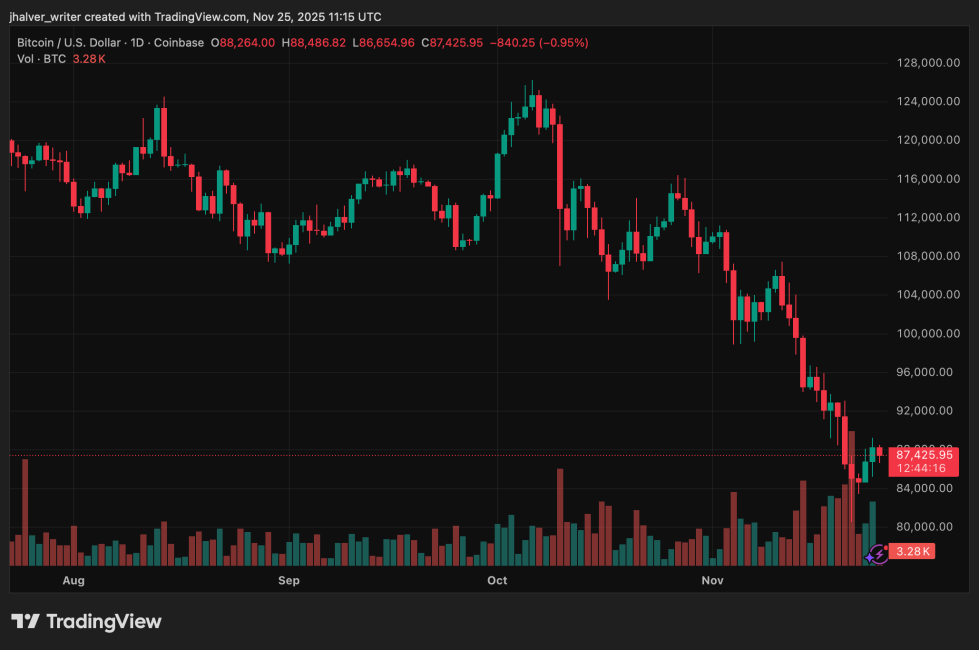
With the price hovering around the $87,000 range after a brief dip to $81,000, on-chain data, macro shifts, and ETF flows are painting a picture of both caution and opportunity.
Bitcoin BTC BTCUSD

BTC's price trends to the downside on the daily chart. Source: BTCUSD on Tradingview

Whales Accumulate as Retail Capitulates

New on-chain figures from Santiment reveal a sharp divergence between large and small Bitcoin holders.

Since November 11, wallets holding at least 100 BTC have surged, adding 91 new large addresses even as prices trended downward. This growing whale accumulation has historically appeared near long-term market bottoms, suggesting that strategic buying occurs during periods of weakness.

Conversely, wallets holding 0.1 BTC or less continue to decline, reflecting elevated fear among retail investors.

Santiment notes that heavy retail selling often sets the stage for later recoveries, once large entities absorb the supply and market pressure eases. The pattern mirrors earlier cycles in which deeper retail capitulation preceded major trend reversals.

Mixed Bitcoin (BTC) Technical Signals

Several key indicators are offering conflicting signals on Bitcoin’s next move. CryptoQuant data indicate that Bitcoin’s Sharpe Ratio is dipping into its “green zone,” suggesting that risk-adjusted returns are becoming more attractive, similar to levels observed before major uptrends in 2019, 2020, and 2022.

Capriole Investments’ “Bitcoin Heater” metric has also returned to deep green, suggesting strong potential for upside movement.

Yet not all metrics signal immediate recovery. The aSOPR (Adjusted Spent Output Profit Ratio), a reliable cyclical indicator, has spent nearly two years consolidating without reaching the “red line” levels that marked tops in previous bull runs.

Analysts warn that a decisive breakout of this long consolidation pattern is imminent, though the direction remains unknown.

Macro Forces and ETF Outflows Fuel Uncertainty

Arthur Hayes believes that Bitcoin may retest the low $80,000s but expects the $80K level to hold as firm support, especially as the Federal Reserve ends quantitative tightening on December 1.

Markets are also pricing in a 77% chance of an interest rate cut at the December 9–10 meeting, driving renewed optimism across risk assets.

However, institutional flows tell a different story. BlackRock’s Bitcoin ETF has recorded a staggering $2.35 billion in withdrawals this month, its largest outflow since launch. The wave of redemptions underscores weakening confidence among big-money players amid price volatility and macro uncertainty.

Even so, Bitcoin’s recent 1.3% recovery to $88K, alongside strong rebounds in Ethereum, XRP, and major altcoins, shows that buyers are stepping back in.

Analysts warn that volatility will remain elevated, however, if whale accumulation continues and macroeconomic conditions ease, Bitcoin may yet defend the crucial $80K support and attempt another push toward the $90K barrier.

Cover image from ChatGPT, BTCUSD chart from Tradingview

Editorial Process for bitcoinist is centered on delivering thoroughly researched, accurate, and unbiased content. We uphold strict sourcing standards, and each page undergoes diligent review by our team of top technology experts and seasoned editors. This process ensures the integrity, relevance, and value of our content for our readers.

Letture associate

A Game with No Winners: How to Break the Deadlock in the Altcoin Market?

The altcoin market is currently trapped in a "four-lose dilemma" due to flawed token distribution models. The prevalent low initial circulation strategy, designed to artificially maintain high fully diluted valuations (FDV), has backfired. It creates a scenario where centralized exchanges, token holders, project teams, and venture capitalists all ultimately suffer. Exchanges face community backlash from poor token performance, holders experience price collapse as supply unlocks, projects damage the industry's fundraising capacity, and VCs see their long-term investment channels deteriorate. Market responses, such as the 100% initial circulation of meme coins and the community-centric MetaDAO model, have failed to provide sustainable solutions, often creating new problems like extreme volatility or alienating talented founders. A potential path forward requires rebalancing interests: exchanges should shift from arbitrary lockups to KPI-based unlocks; holders should demand transparency and control over major decisions without micromanaging; projects must only issue tokens with clear utility and product-market fit; and VCs should stop forcing token launches on every project. The next 12 months will be challenging as the market absorbs the last wave of excess supply from the 2021-2022 funding boom. However, this digestion period, coupled with more selective token launches and evolving standards, could lead to a healthier market. The long-term viability of the altcoin model depends on avoiding a "lemon market" where only failing projects issue tokens, while successful ones opt for traditional equity. Despite current hardships, tokens retain unique advantages for driving growth and building loyal communities when implemented correctly.

marsbit21 min fa

A Game with No Winners: How to Break the Deadlock in the Altcoin Market?

marsbit21 min fa

Bitcoin ETF Two Years On: The Financialization Journey from Breakthrough to Convergence

Two years after the launch of Bitcoin spot ETFs, the financialization of Bitcoin has accelerated significantly, with total assets under management (AUM) reaching $124.85 billion. The top five ETFs—IBIT, GBTC, FBTC, ARKB, and BITB—account for 96.6% of the market, highlighting strong institutional dominance. Trading volume surpassed $2 trillion, with the second trillion taking only 8 months compared to 16 months for the first. Bitcoin ETFs have significantly outperformed Ethereum ETFs in net inflows, reinforcing Bitcoin’s leading position in the crypto ETF market. The approval of Bitcoin spot ETFs in January 2024 marked a milestone after over a decade of regulatory scrutiny, reflecting maturation in market infrastructure, custody, and investor protection frameworks. Unlike the first gold ETF, which took years to gain traction, Bitcoin ETFs achieved rapid adoption, accelerating liquidity and institutional participation. ETFs have simplified Bitcoin investment, enabling regulated, accessible exposure without direct asset management. Major institutions like BlackRock and Fidelity have facilitated broader acceptance, integrating Bitcoin into mainstream portfolios and retirement plans. However, financialization introduces challenges, including Bitcoin’s inherent volatility and ETF management fees. Beyond price speculation, alternative participation methods like cloud mining offer cost-stable Bitcoin acquisition and support network infrastructure. In summary, Bitcoin ETFs have fast-tracked Bitcoin into the traditional financial system, signaling the start of a broader institutional adoption phase. The journey is far from over, with more structured financial products expected to emerge.

marsbit43 min fa

Bitcoin ETF Two Years On: The Financialization Journey from Breakthrough to Convergence

marsbit43 min fa

Trading

Spot
Futures

Discussioni

Benvenuto nella Community HTX. Qui puoi rimanere informato sugli ultimi sviluppi della piattaforma e accedere ad approfondimenti esperti sul mercato. Le opinioni degli utenti sul prezzo di S S sono presentate come di seguito.

活动图片