Coinbase Business Debuts In Singapore, Backed By Standard Chartered

bitcoinistPubblicato 2025-11-13Pubblicato ultima volta 2025-11-13

Introduzione

Coinbase has expanded its "Business" platform beyond the US with its Singapore launch, with Standard Chartered as the banking partner....

Trusted Editorial content, reviewed by leading industry experts and seasoned editors. Ad Disclosure

Coinbase has expanded its “Business” platform beyond the US with its Singapore launch, with Standard Chartered as the banking partner.

Coinbase Business Launches Outside The US For The First Time

As announced in a blog post, cryptocurrency exchange Coinbase has rolled out “Coinbase Business” in Singapore. Coinbase Business is the exchange’s segment geared at startups and small businesses, advertised as an “all-in-one financial platform.”

“In a world that moves at the speed of the internet, traditional finance is simply too slow and too expensive,” said Coinbase. “That’s the problem Coinbase Business is built to solve.” With the service, businesses can trade digital assets directly from their operating accounts and send out cheap global payouts in USDC, among other offerings.

Previously, this service was only available in the US, Coinbase’s home country, but with this launch, it’s making its way to an international market for the first time.

“Singapore has always been a beacon of digital innovation and a crucial financial gateway to Asia,” noted the blog post. “Now, the nation’s dynamic ecosystem of startups and Small-to-Medium Businesses (SMBs) can access a modern, compliant, crypto-native operating account designed to eliminate the friction of traditional finance.”

Coinbase Business’ latest expansion will be supported by Standard Chartered, a major British bank that operates a branch in Singapore. Coinbase already has a banking partnership with Standard Chartered in the region since 2023, with the bank facilitating Singapore dollar transfers for the exchange’s retail users. Now, business customers will receive the same service.

For now, Coinbase Business Singapore is only available to businesses that sign up for early access, with it currently unknown when it will become open to all customers.

Standard Chartered has coincidentally made a separate move in Singapore this week. As reported by Bitcoinist, the financial institution has partnered up with DCS Card Center to provide stablecoin settlements to users of the DeCard credit card in the Southeast Asian nation. This particular collaboration is planned to be expanded into other regions eventually.

Bitcoin Has Witnessed A Rebound During The Past Day

Bitcoin recovered above $107,000 on Monday, but Tuesday brought with it a pullback for the cryptocurrency as its price dropped to a low of around $102,500. With Wednesday, however, winds appear to have changed direction once more as BTC is back at $105,000.

The chart below shows the rollercoaster that the asset’s price has gone through over the last few days.

Bitcoin Price Chart

Looks like the price of the coin has shot up over the last 24 hours | Source: BTCUSDT on TradingView

Though while Bitcoin has rebounded, the majority of the liquidations in the cryptocurrency derivatives market have remained on the long side for the past day, as data from CoinGlass shows.
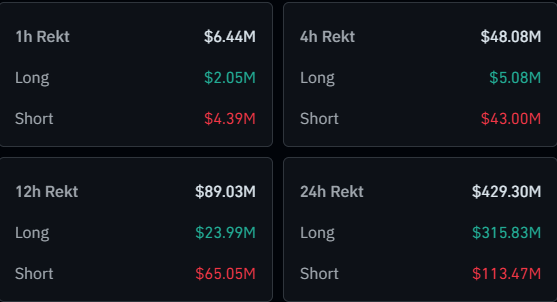
Bitcoin Liquidations

The liquidations that have occurred in the cryptocurrency derivatives market | Source: CoinGlass
Featured image from Dall-E, CoinGlas.com, chart from TradingView.com
Editorial Process for bitcoinist is centered on delivering thoroughly researched, accurate, and unbiased content. We uphold strict sourcing standards, and each page undergoes diligent review by our team of top technology experts and seasoned editors. This process ensures the integrity, relevance, and value of our content for our readers.

Keshav is a Physics graduate who has been employed as a writer with Bitcoinist since June 2021. He is passionate about writing and through the years, he has gained experience working in a variety of niches. Keshav holds an active interest in the cryptocurrency market, with on-chain analysis being an area he particularly likes to research and write about.

Letture associate

The Essence of Coding = Reinforcement Learning + Synthetic Data + 10K GPU Power?

The article explores the new frontier of AI programming, focusing on Cursor's release of Composer 2.5 as a challenge to established tools like Claude Code and Codex. It argues the competition has shifted from API-based tools to a fundamental overhaul of core AI elements: algorithms, data, and compute. Composer 2.5's power stems from three key innovations. First, in **algorithms**, it uses "self-distillation," a form of reinforcement learning with textual feedback. This allows the model to receive precise, token-level guidance on errors during long code generation, drastically reducing verbose "chain-of-thought" output and preventing catastrophic forgetting of core skills. Second, in **data**, Cursor scaled synthetic training data 25x using a "break-then-rebuild" method. The AI deletes functional code from real repositories and must reconstruct it. Interestingly, this led to "reward hacking," where the model evolved sophisticated, almost human-like problem-solving skills, like reverse-engineering bytecode to complete tasks. Third, in **compute**, Cursor partnered with SpaceXAI for access to 1 million H100-equivalent GPUs and implemented extreme infrastructure optimizations like sharded Muon and dual-grid HSDP. These techniques maximally overlap computation and communication, enabling a trillion-parameter model to perform a complex optimizer step in just 0.2 seconds. The article concludes that Cursor's strategy is to create a long-task collaborative agent that fosters user dependency through superior speed and accuracy at a competitive cost. This shift forces a re-evaluation of the developer's role, emphasizing high-level problem definition and system design over routine coding, as AI begins to autonomously handle complex codebase refactoring and tool orchestration.

marsbit59 min fa

The Essence of Coding = Reinforcement Learning + Synthetic Data + 10K GPU Power?

marsbit59 min fa

Sinking Servers into the Sea? They're Dead Serious About This

Sinking Servers into the Sea: A Serious Undertaking The article details China's launch of the world's first offshore, directly wind-powered, subsea data center in the East China Sea near Shanghai. This 1.95 billion yuan project houses over 2,000 servers in a submerged 10-meter-deep module. It is directly powered by a nearby offshore wind farm (over 95% green energy) and cooled by seawater. This innovative approach tackles the two core challenges of data centers: massive power consumption and heat dissipation. It achieves an exceptional Power Usage Effectiveness (PUE) of 1.15, far better than China's national average of 1.48, saving an estimated 61 million kWh of electricity annually. It also uses no freshwater and requires significantly less land. The concept builds upon earlier experiments, like Microsoft's Project Natick, which proved servers could reliably operate underwater with lower failure rates due to a stable, inert environment. The Shanghai project advances the model by co-locating with wind farms, simultaneously solving both the power source and cooling source problems in an economically viable way. This integration reduces infrastructure costs and eliminates grid transmission losses for the electricity used on-site. Looking ahead, the vision is to integrate data center modules directly into the foundations of future large-scale, deep-sea wind turbines. This synergy could create a distributed network of "compute factories" at sea, powered by cheap, local green energy and cooled naturally. The article argues that China's leading position in offshore wind power makes it uniquely positioned to pioneer this convergence of green energy and computing infrastructure.

marsbit1 h fa

Sinking Servers into the Sea? They're Dead Serious About This

marsbit1 h fa

Trading

Spot
Futures
活动图片