Stuck in Limbo

insights.glassnodePubblicato 2025-11-11Pubblicato ultima volta 2025-11-12

Executive Summary

  • Bitcoin remains in a mild bearish phase, trading between $97K and $111.9K, with resistance near $116K marked by top-buyers’ supply cluster.
  • Seller exhaustion and renewed accumulation near $100K provide short-term support but lack strong follow-through demand.
  • A dense supply cluster between $106K–$118K continues to cap rallies as investors exit near breakeven.
  • ETF flows have turned modestly negative, reflecting fading institutional demand and a cautious risk appetite.
  • Futures markets show muted funding rates and low open interest, signalling subdued speculative activity across both Bitcoin and altcoins.
  • Options traders maintain a defensive stance, with put protection concentrated around $100K, while the 25-delta skew remains a key gauge for sentiment shifts.
  • Overall, the market is consolidating within a defined range, awaiting stronger inflows or macro catalysts to break out of the current equilibrium.

Over the past week, Bitcoin briefly slipped below $100K, extending the broader downtrend that has persisted since early October. This move pushed the market into a mild bearish regime, with prices now trading beneath the short-term holder cost basis.

In this edition, we analyze the forces driving the rebound toward $106K using on-chain cost-basis models and accumulation–distribution dynamics. We then pivot to off-chain indicators, exploring ETFs, futures markets and options market sentiment to assess whether this recovery reflects genuine demand or a short-lived relief rally.

On-chain Insights

Grinding Lower

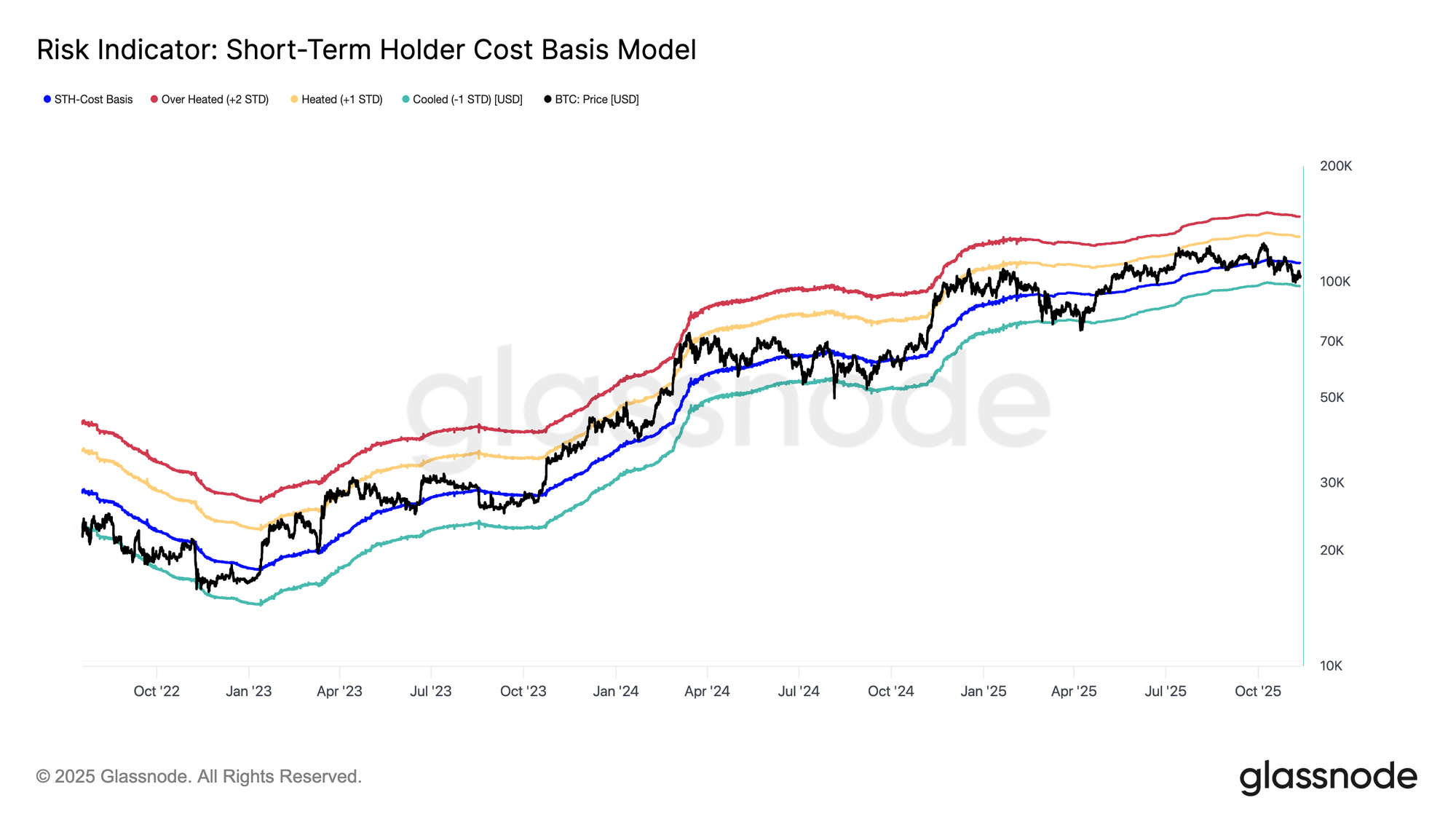
Since early October, with Bitcoin breaking below the short-term holder cost basis (🔵), a range suffering from the lack of conviction and low liquidity has been confirmed. Since then, price action has trended lower, approaching the -1 STD band near $97.5K.

This recent drawdown resembles the contraction phases seen during June–October 2024 and February–April 2025, where prices oscillated within a defined lower range before recovery. Consequently, unless Bitcoin reclaims the short-term holder cost basis (~$111.9K) as support, the probability of revisiting the lower bound of this range remains elevated.
Live Chart

Seller Exhaustion Near $100K

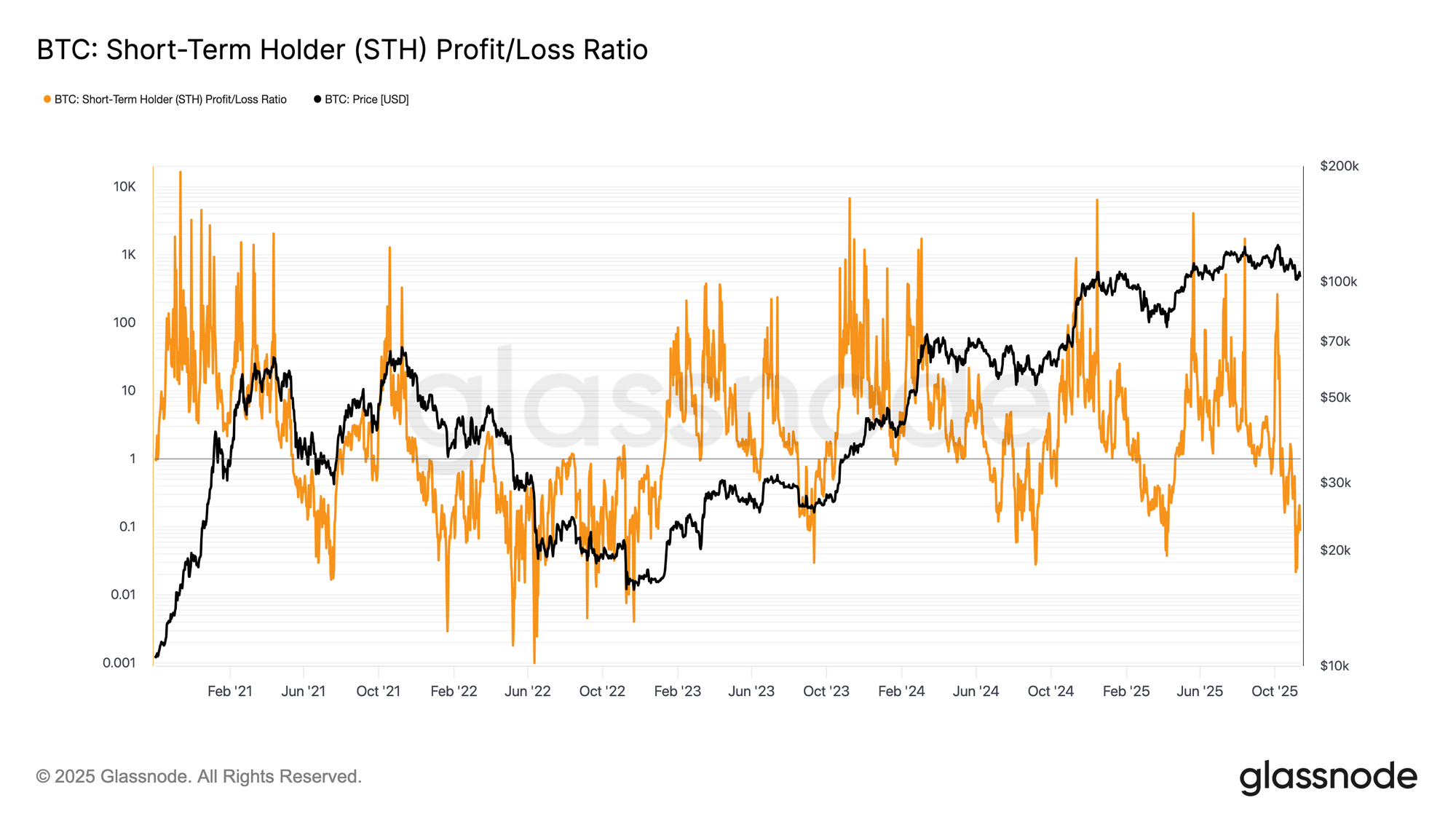
Building on this structural setup, the sub-$100K zone has emerged as a critical battleground where seller exhaustion is beginning to take shape. Much of the downward pressure stems from top buyers among short-term holders, who have been realizing heavy losses during the decline.

As Bitcoin tested $98K, the STH Realized Profit-Loss Ratio fell below 0.21, meaning over 80% of realized value came from coins sold at a loss. This intensity of capitulation briefly exceeded the last three major washouts of this cycle, underscoring how top-heavy the market has become and how pivotal the $100K level remains for near-term stability.
Live Chart

Fueling the Bounce Back

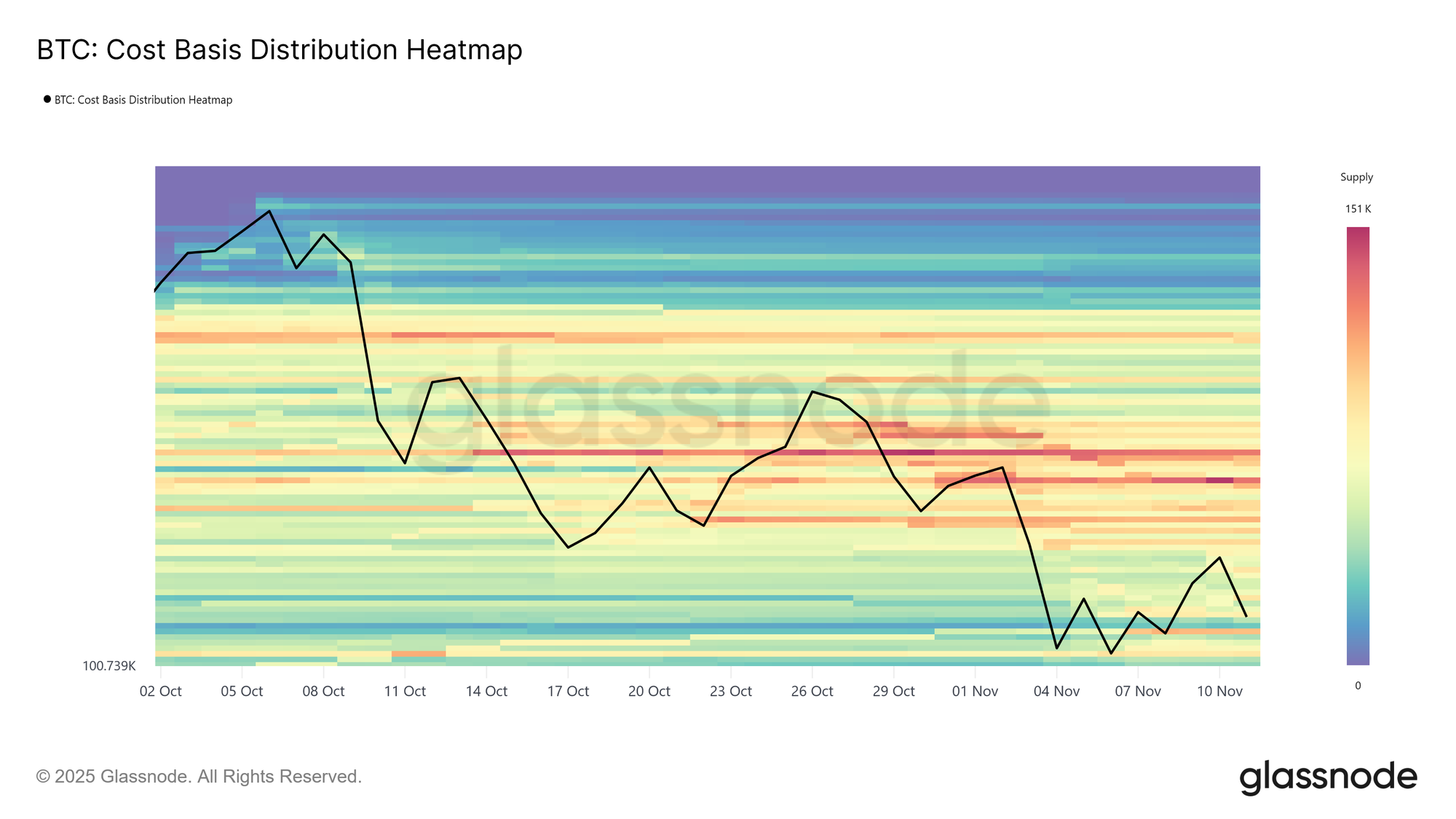
Turning to the demand side, the Cost Basis Distribution Heatmap reveals a clear buildup of realized supply around the sub-$100K zone, both before and after the rebound to $106K. The intensifying heat in this range signals renewed accumulation by buyers absorbing capitulation flows. This dynamic completes the picture; pairing seller exhaustion with steady accumulation, creating the foundation for a short-term recovery even within a broader bearish structure.

Conversely, a dense supply cluster between $106K and $118K continues to cap upward momentum, as many investors use this range to exit near breakeven. This overhang of latent supply creates a natural resistance zone where rallies may stall, suggesting that sustained recovery will require renewed inflows strong enough to absorb this wave of distribution.
Live Chart

Demand Fades, Resistance Builds

The current market structure confirms a continuation of the downtrend that began in early October. A dense supply zone above $106K continues to exert sell pressure, and reclaiming the short-term holder cost basis (~$111.9K) remains a key prerequisite for any sustainable shift toward recovery.

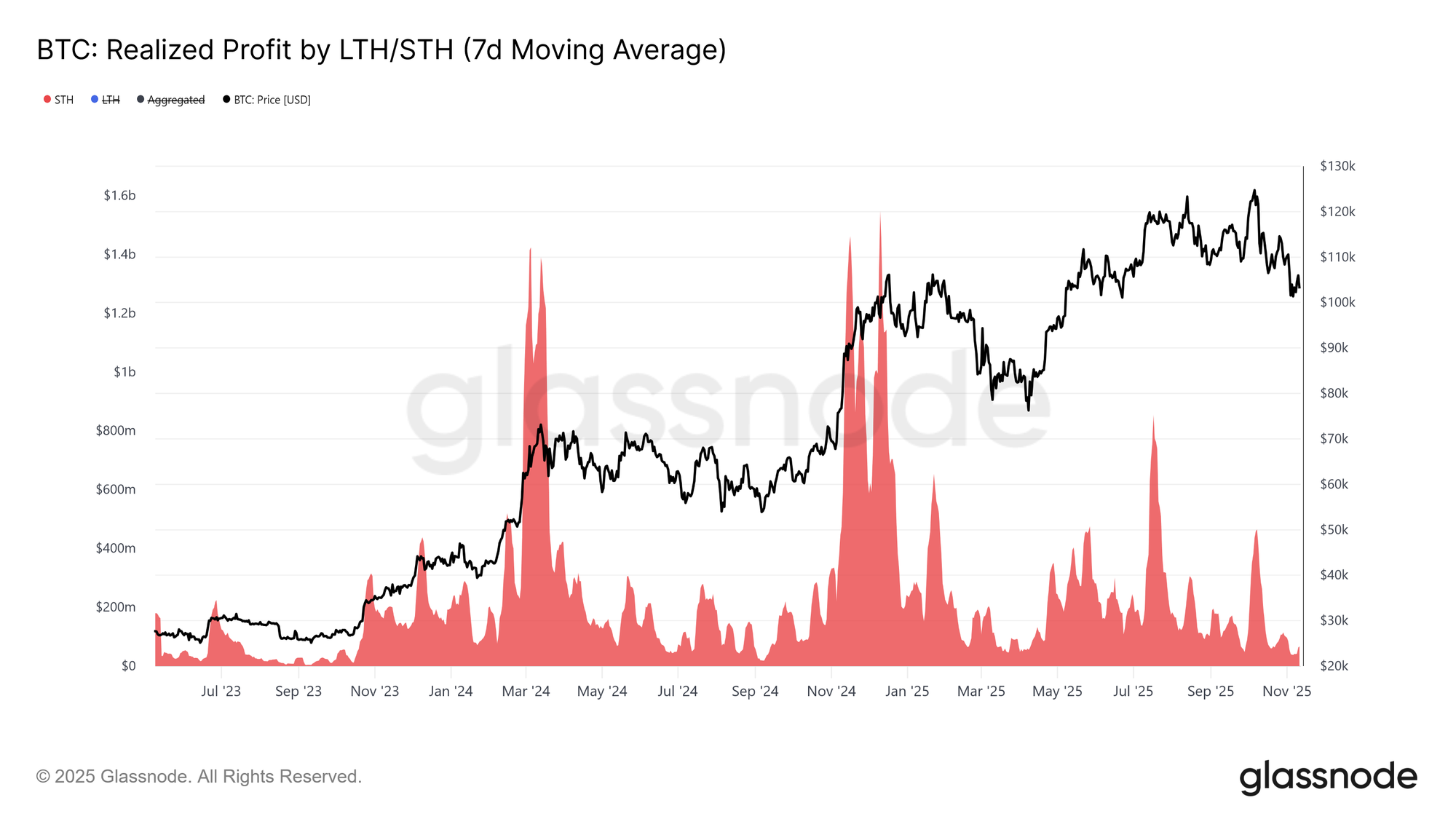
On the demand side, the Realized Profit of Short-Term Holders (a proxy for new investor momentum) has been notably weak since June 2025, reflecting a lack of fresh inflows. For Bitcoin to push through the $106K–$118K top-buyer cluster, this metric must reverse higher, signalling renewed conviction and stronger demand from new market entrants.
Live Chart

Off-Chain Insights

ETF Outflows Resurface

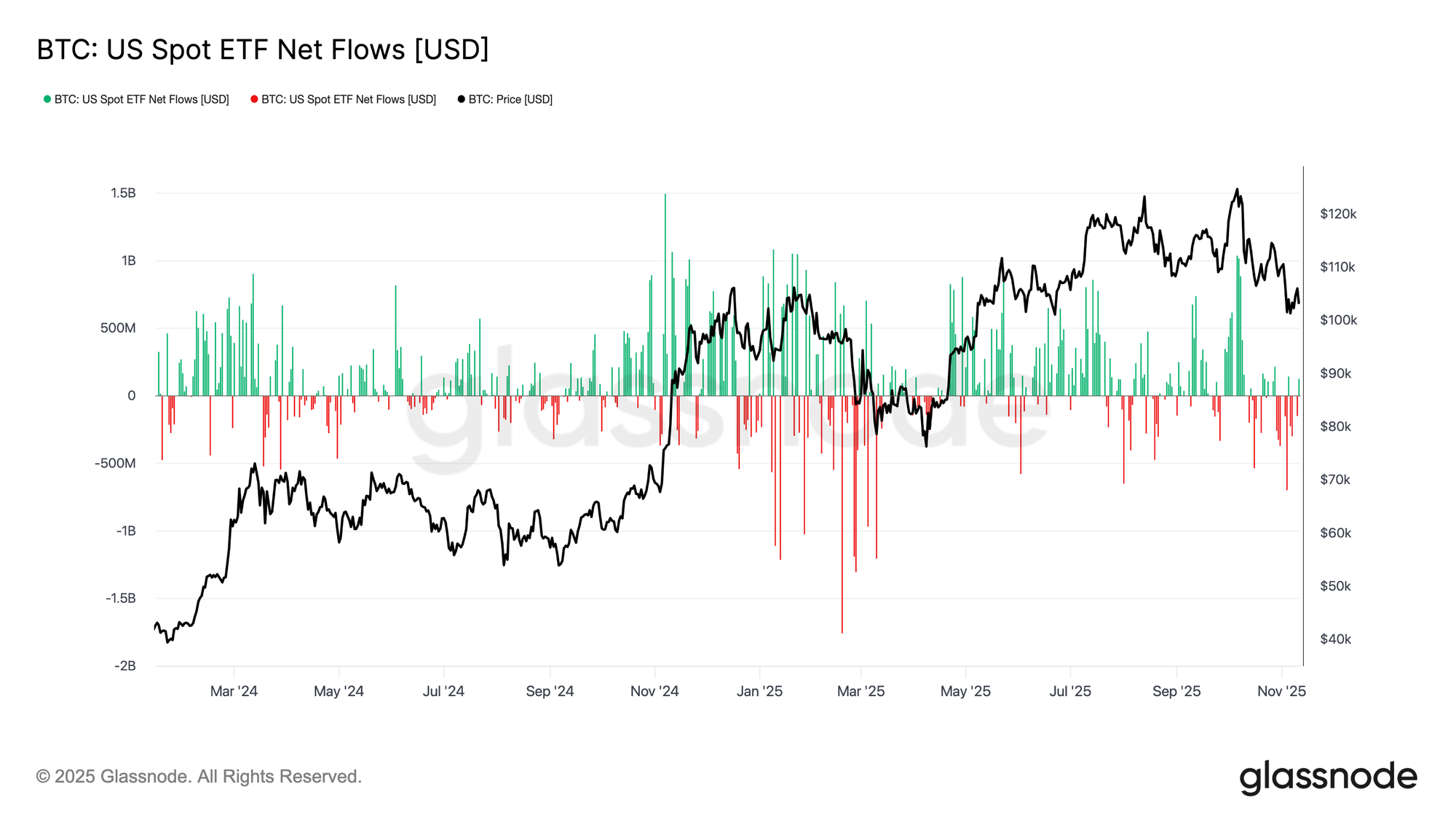
Transitioning to the off-chain section, we first gauge the U.S. spot Bitcoin ETF markets. US spot Bitcoin ETFs have shifted to modest outflows in recent weeks, mirroring muted price action and waning momentum. After strong mid-year inflows, aggregate demand has flattened, suggesting a pause in institutional accumulation.

Historically, such neutral flow regimes align with market consolidation, where conviction rebuilds before the next directional move. A decisive return of inflows would signal renewed institutional confidence, while prolonged outflows could reinforce a more defensive market tone.
Live Chart

Leverage Dries Up

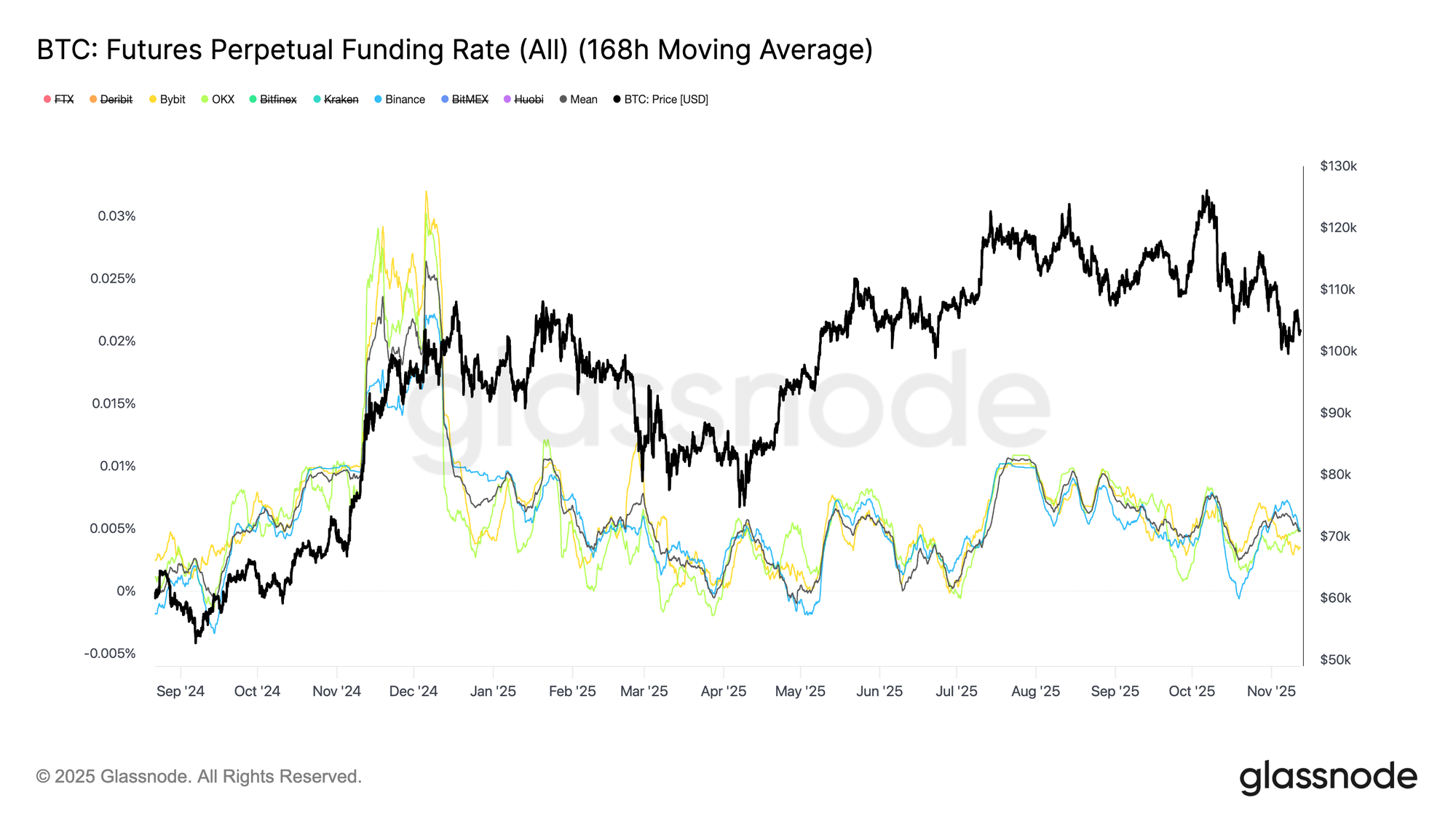
Bitcoin perpetual futures funding rates remain subdued across major exchanges, highlighting the lack of speculative appetite in derivatives markets. Since the leverage flush in October, both funding rates and open interest have drifted lower, signalling that traders are staying cautious with limited directional exposure.

This absence of aggressive positioning reflects a phase of market hesitation, often seen before volatility re-emerges. For now, the derivatives landscape remains quiet and balanced, leaning toward neutral sentiment rather than speculation-driven momentum.
Live Chart

Speculation Cools Broadly

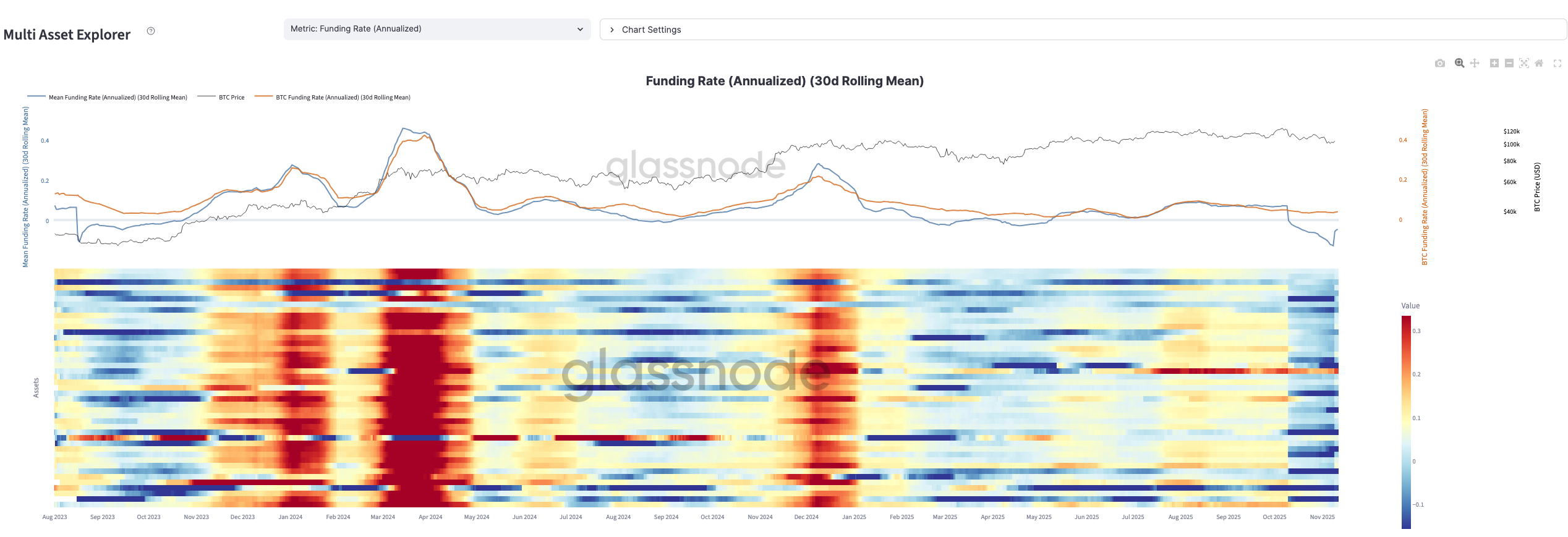
Speculators’ reluctance to use leverage for directional bets extends beyond Bitcoin. Using our newly launched Multi-Asset Explorer, we can assess key futures indicators, funding rates and open interest across the top 100 digital assets.

The first heatmap shows a clear cooling in market-wide funding intensity since mid-year, interrupted only by brief spikes. This broad moderation suggests that traders have de-risked, with leverage and conviction subdued across both Bitcoin and altcoins. Overall, derivatives sentiment remains cautious, and liquidity continues to thin across the board.
Live Chart

Open interest trends across digital asset futures reveal a sharp decline in speculative engagement, most evident in altcoin markets. The heatmap shows a sustained dominance of blue tones, reflecting ongoing contraction in open interest and a clear absence of risk appetite.

While Bitcoin maintains relatively stable positioning, leverage in altcoins has unwound to near cycle lows, with little sign of fresh capital rotation. This pattern underscores a defensive stance among traders, prioritizing capital preservation over speculation. In essence, altcoin derivatives activity has thinned materially—positioning remains light, conviction low, and market attention firmly centred on Bitcoin.

Live Chart

Put Protection Still in Demand

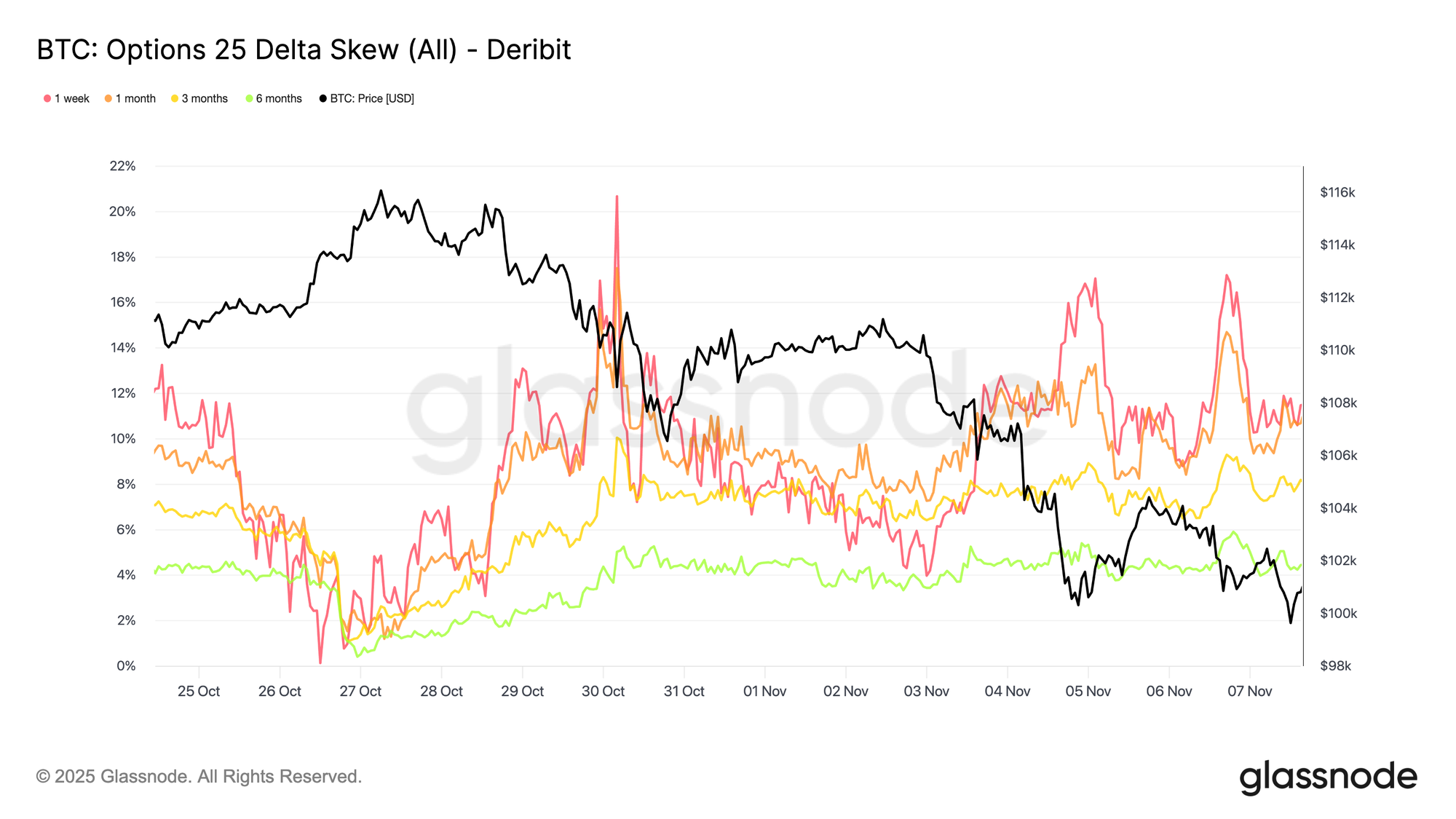
Put protection remains elevated, indicating traders continue to pay a premium for downside insurance. Hedging remains the dominant theme, with short-term expiries pricing roughly 11% implied volatility skew in favour of puts. Three-month and six-month expiries show a softer bias, with 8 and 4 volatility points of downside preference, respectively.

For now, the absence of a clear catalyst limits the potential for skew to shift in favor of calls. The options market continues to price in a retest of the $100K level and a potential break below. However, what will ultimately matter is how the market reacts if that test occurs, rather than the mere pricing of the event.
Live Chart

Implied Volatility in a Range

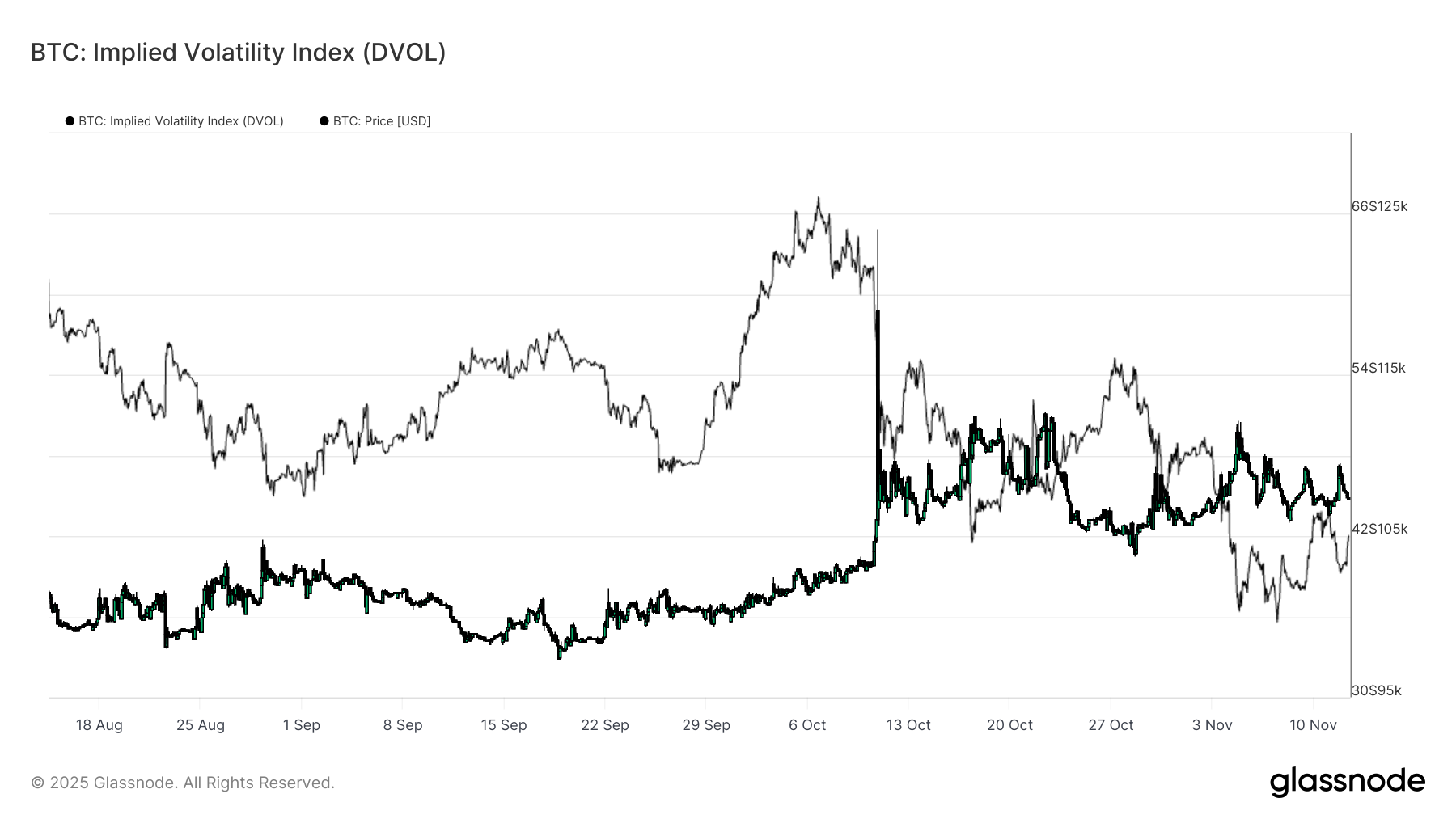
Transitioning from skew to volatility, the broader volatility environment has settled into a holding pattern. The DVOL, Bitcoin’s implied volatility index that measures the market’s expectation of future volatility derived from options prices, remains elevated but range-bound.

Since the October 10 liquidation event, volatility has shifted to a higher regime, oscillating between 40 and 50. This range suggests that the market has adjusted to a higher baseline of uncertainty without entering a state of panic. Volatility remains supported by macroeconomic risk factors and cautious sentiment; however, the absence of further expansion points to consolidation rather than capitulation.
Live Chart

The $100K Line of Defense

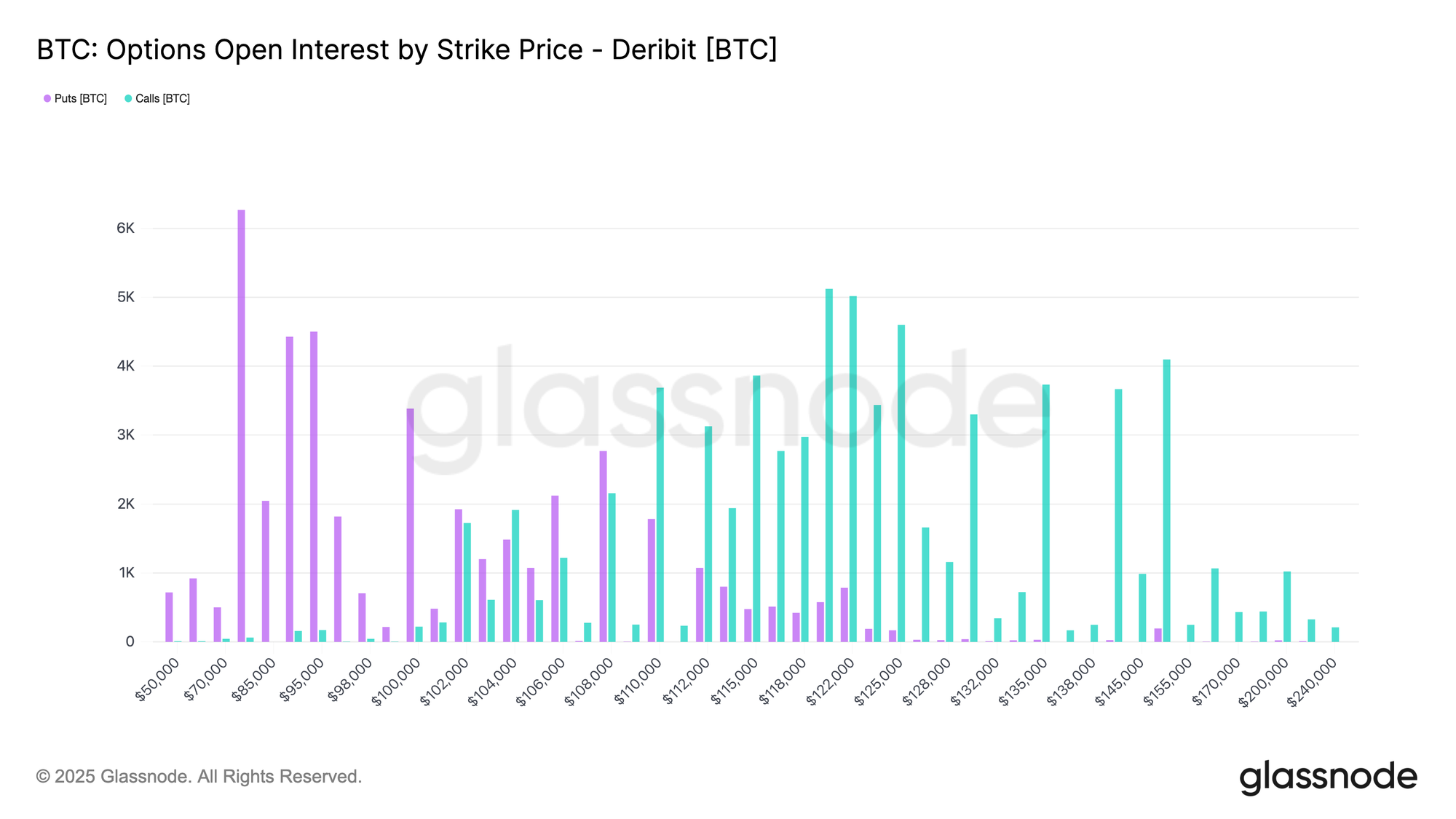
Looking at the end-of-November expiry, open interest clusters heavily around and just below the $100K strike, making it a critical battleground. A decisive break below this level could trigger dealer hedging flows that amplify downside volatility.

If spot retests the $100K area, brief intraday dips below are possible, but a sustained close beneath this threshold would likely mark a shift toward extreme bearish sentiment and potentially ignite another wave of volatility.
Live Chart

Flows Reflect Short-Term Protection Bias

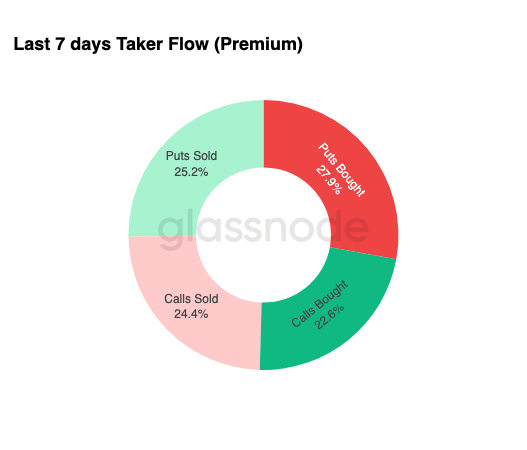
Finally, option flows over the past week reinforce this cautious positioning. Activity was concentrated on the put side, with notable buying between the 108K and 95K strikes.

Some flows reflected outright long protection, such as the 100K strike expiring November 28, while others were structured as calendar spreads, for example, buying the 108K November expiry while selling the 108K December expiry. This pattern effectively captures the current stance; traders anticipate near-term turbulence but remain neutral to moderately optimistic over the longer term.
Live Chart

Options Traders’ Psychology

The next potential catalyst is the resolution of the U.S. government shutdown, an outcome that would likely be welcomed by markets. However, ongoing tariff tensions are expected to keep volatility elevated through Q4. Until the December 10 FOMC meeting, risk appetite is likely to remain muted, as the event is broadly perceived as neutral.

For traders, the 25-delta skew remains the primary gauge for tracking shifts in sentiment. A sustained flattening or reversal toward call bias would signal that market participants are beginning to regain confidence in the upside.

Conclusion

Bitcoin continues to trade within a mild bearish range, defined by strong resistance between $106K–$118K and key structural support near $97.5K–$100K. The market remains under the influence of top-heavy supply, with short-term holders still realizing losses. On-chain data highlighted a brief accumulation near $100K, suggesting localized support, yet without a decisive reclaim of the short-term holders’ cost basis (~$111.9), upside momentum is likely to stay constrained.

Off-chain indicators also echo this cautious tone. ETF outflows, muted funding rates, and low open interest point to subdued speculative engagement, while options traders continue to favor downside protection around the $100K line.

Overall, both on-chain and off-chain signals portray a market in a state of consolidation, stabilizing yet not yet ready to confirm a bullish reversal. Until renewed inflows or a clear macro catalyst emerge, Bitcoin appears bound to oscillate within this $97K–$111.9K corridor, with $100K remaining the psychological line of defence.


Disclaimer: This report does not provide any investment advice. All data is provided for informational and educational purposes only. No investment decision shall be based on the information provided here, and you are solely responsible for your own investment decisions.

Exchange balances presented are derived from Glassnode’s comprehensive database of address labels, which are amassed through both officially published exchange information and proprietary clustering algorithms. While we strive to ensure the utmost accuracy in representing exchange balances, it is important to note that these figures might not always encapsulate the entirety of an exchange’s reserves, particularly when exchanges refrain from disclosing their official addresses. We urge users to exercise caution and discretion when utilizing these metrics. Glassnode shall not be held responsible for any discrepancies or potential inaccuracies. 

Please read our Transparency Notice when using exchange data.

Letture associate

SpaceX IPO Rush: A Capital Feast That Could Reshape the Landscape of AI and Crypto

SpaceX's potential IPO is emerging as a pivotal event that could reshape the landscape for both AI and Crypto markets. Far more than a traditional aerospace offering, SpaceX represents the core of Musk's future-tech ecosystem, with its Starlink satellite network positioning it as a global digital infrastructure company. This shift could redefine the foundational layers of the internet, communication, and data flow. Historically, major tech capital market movements, like AI booms or Bitcoin ETF approvals, have profoundly influenced crypto cycles. The SpaceX IPO could trigger a similar "super-narrative" fusion, boosting investor sentiment toward future digital infrastructure. This is particularly relevant for Crypto, which aims to build decentralized versions of such global systems. Key crypto sectors likely to benefit include: * **DePIN (Decentralized Physical Infrastructure Networks):** Projects like Render, Filecoin, and Helium, which incentivize real-world infrastructure for compute, storage, and connectivity. * **AI Crypto:** Platforms such as Bittensor and Fetch.ai, which leverage blockchain for decentralized AI computation, data markets, and agent economies. * **On-chain Payments & SocialFi:** Ecosystems like Solana and Ton, which could gain traction if Musk's X platform integrates digital payments and stablecoins. Ultimately, the IPO symbolizes a broader capital re-evaluation of core digital-age assets—networks, AI, data, and decentralized systems—aligning closely with crypto's long-term vision. It may act as a catalyst, redirecting global tech investment flows toward the crypto space as the next chapter in digital infrastructure unfolds.

marsbit26 min fa

SpaceX IPO Rush: A Capital Feast That Could Reshape the Landscape of AI and Crypto

marsbit26 min fa

KUN and Pharos Network Forge Strategic Partnership to Jointly Drive Innovation in RealFi, RWA, and Cross-Border Payment Infrastructure

Hong Kong. Layer 1 infrastructure Pharos Network and licensed digital payment expert KUN have signed a strategic MoU. They will integrate Pharos's institutional blockchain with KUN's licensed global payment rails to drive the tokenization of supply chain credit assets and enable more efficient global settlement on-chain. **Background:** Emerging market SMEs face severe working capital challenges due to slow, costly traditional trade finance, often waiting 30-90 days for payment after delivery. While RWA tokenization is a focus, few projects effectively connect underlying infrastructure to real commerce and licensed payment networks. **Collaboration Focus:** The partnership aims to bridge this gap by bringing supply chain credit and B2B cross-border payments on-chain compliantly. Initial priorities include: * Tokenizing supply chain credit assets to unlock liquidity. * Enabling native on-chain settlement of digital assets. * Exploring enterprise virtual card solutions. * Providing compliant on-chain financial services for verticals like commodities, trade, B2B e-commerce, and Web3. **Executive Quotes:** * Wish Wu, Co-founder & CEO of Pharos Network, highlighted KUN's trusted, licensed payment network as a perfect fit for bringing supply chain assets and cross-border capital flows on-chain accessibly. * Dr. Louis Liu, Founder & CEO of KUN, stated that settlement certainty is RealFi's final hurdle. Bridging KUN's payment rails with Pharos's infrastructure will help convert on-chain assets into real-world liquidity with institutional-grade trust. They will also explore AI-driven optimization for global capital flows. Pharos mainnet is live with over 50 dApps. This partnership strengthens its position as RealFi infrastructure by linking licensed payment systems with on-chain finance.

marsbit26 min fa

KUN and Pharos Network Forge Strategic Partnership to Jointly Drive Innovation in RealFi, RWA, and Cross-Border Payment Infrastructure

marsbit26 min fa

Deconstructing Anthropic: The Best AI Company May Also Be an Organizational Invention

Anthropic has emerged as one of the most notable AI companies, distinguished by its strategic focus and unique organizational culture. Strategically, Anthropic demonstrated exceptional foresight by prioritizing coding early on, recognizing it as a critical path for model learning, commercial value, and accelerating AGI research. Unlike OpenAI's expansive, multi-front approach, Anthropic maintained rigorous focus on scaling language models and the coding vertical, avoiding distractions like multimodal development. This discipline stemmed partly from resource constraints but also from the conviction of its leadership, particularly co-founder Dario Amodei, who exhibits a strong, independent strategic vision. Organizationally, Anthropic’s culture is its “secret sauce.” It is characterized by a strong, mission-oriented focus on AI safety, high trust, low ego among employees, and a distinct humanistic ethos. This culture has resulted in remarkably low talent attrition and high retention rates. Key practices sustaining this culture include stringent cultural screening in hiring, high-context transparency and writing practices led by leadership, a founding structure of seven co-founders with equal equity to diffuse values, and a deliberate “one team” approach that minimizes internal silos and hierarchy. This culture is both a reaction to the political dynamics its founders experienced at previous companies and a functional necessity for the data-intensive, collaborative “dirty work” required to excel in coding and agentic AI. While OpenAI remains a formidable competitor with greater resources and exploration, Anthropic’s success illustrates how focus, cultural cohesion, and a steadfast mission can be powerful drivers in the AI race.

marsbit52 min fa

Deconstructing Anthropic: The Best AI Company May Also Be an Organizational Invention

marsbit52 min fa

Why Are the Most Believers in AGI Buying NVIDIA Put Options?

The article analyzes the significant, market-moving 13F filing for Q1 2026 by Situational Awareness LP (SALP), a fund managed by former OpenAI researcher Leopold Aschenbrenner. While Aschenbrenner is a prominent believer in the accelerated arrival of AGI and has built the fund as a focused bet on AI infrastructure, the filing revealed large new put option positions (totaling billions in notional value) on key AI/semiconductor names like Nvidia, SMH ETF, Broadcom, and AMD. The article argues this is not a bearish turn on AI but a sophisticated hedging strategy. Given the macro backdrop in late March (rising oil prices, inflation concerns, higher-for-longer interest rates), the fund is managing volatility in its high-beta, high-valuation portfolio of AI infrastructure plays (like Bloom Energy, CoreWeave, Core Scientific). The puts act as "insurance" against a potential systemic pullback in the AI trade. Simultaneously, SALP maintained or added to core long positions in companies tied to power, data centers, compute, and storage—the "bottlenecks" expected to capture AI capital spending. It trimmed or exited some Q1 winners (e.g., Lumentum) and reduced leverage (e.g., selling CoreWeave calls), suggesting a rotation from crowded, high-momentum trades towards assets with clearer long-term fundamental pathways. The key takeaway is an evolution in the AI investment theme: from a broad, linear rally to a more discerning, "show-me-the-money" phase. The focus shifts from simply buying the AI narrative to identifying companies that can convert capex into tangible revenue, while actively managing portfolio risk in a volatile macro environment. The strategy reflects a move from unilateral bullishness to "offense with defense."

marsbit1 h fa

Why Are the Most Believers in AGI Buying NVIDIA Put Options?

marsbit1 h fa

Trading

Spot
Futures

Articoli Popolari

Come comprare HPP

Benvenuto in HTX.com! Abbiamo reso l'acquisto di House Party Protocol (HPP) semplice e conveniente. Segui la nostra guida passo passo per intraprendere il tuo viaggio nel mondo delle criptovalute.Step 1: Crea il tuo Account HTXUsa la tua email o numero di telefono per registrarti il tuo account gratuito su HTX. Vivi un'esperienza facile e sblocca tutte le funzionalità,Crea il mio accountStep 2: Vai in Acquista crypto e seleziona il tuo metodo di pagamentoCarta di credito/debito: utilizza la tua Visa o Mastercard per acquistare immediatamente House Party ProtocolHPP.Bilancio: Usa i fondi dal bilancio del tuo account HTX per fare trading senza problemi.Terze parti: abbiamo aggiunto metodi di pagamento molto utilizzati come Google Pay e Apple Pay per maggiore comodità.P2P: Fai trading direttamente con altri utenti HTX.Over-the-Counter (OTC): Offriamo servizi su misura e tassi di cambio competitivi per i trader.Step 3: Conserva House Party Protocol (HPP)Dopo aver acquistato House Party Protocol (HPP), conserva nel tuo account HTX. In alternativa, puoi inviare tramite trasferimento blockchain o scambiare per altre criptovalute.Step 4: Scambia House Party Protocol (HPP)Scambia facilmente House Party Protocol (HPP) nel mercato spot di HTX. Accedi al tuo account, seleziona la tua coppia di trading, esegui le tue operazioni e monitora in tempo reale. Offriamo un'esperienza user-friendly sia per chi ha appena iniziato che per i trader più esperti.

97 Totale visualizzazioniPubblicato il 2026.04.29Aggiornato il 2026.04.29

Come comprare HPP

Cosa è GENIUS

I. Introduzione al Progetto1. Cos'è Genius?Genius (GENIUS) si posiziona come il "terminal on-chain definitivo", una piattaforma di trading decentralizzata focalizzata sulla privacy e sulla velocità. Integrando tecnologie di privacy di alto livello, mira a costruire un'infrastruttura di trading privacy di nuova generazione attraverso reti come BNB Chain, consentendo agli utenti di interagire on-chain con un'esperienza fluida paragonabile a quella degli exchange centralizzati.2. Come Funziona Genius?L'architettura tecnica principale di Genius è strutturata come segue:(1) Invisibile alla catena: Gli utenti non devono gestire manualmente approvazioni a più passaggi per operazioni cross-chain, wrapping di asset o gestione complessa del gas.(2) Trading senza Firma: Attraverso integrazioni come Turnkey, Genius consente trading istantaneo senza conferme a comparsa o autorizzazione per transazione.(3) Aggregatore di Aggregatori: Genius è alimentato da uno stack di aggregazione di prima classe integrato con oltre 150 DEX, vantando un'efficienza di quotazione superiore rispetto ai prodotti concorrenti.(4) Gestione degli Account: La piattaforma adotta un'architettura non custodiale e sfrutta Turnkey e Lit Protocol per la gestione delle chiavi, consentendo agli utenti di accedere in modo sicuro ai propri account tramite passkey.3. Chi Ha Creato Genius?Secondo i suoi Termini di Servizio ufficiali, Genius è stato sviluppato da Shuttle Labs, Inc. Basandosi sull'account ufficiale X del progetto, Ryan Myher è uno dei principali contributori che guidano l'iterazione del prodotto, inclusi sviluppi come il lancio del protocollo Ghost, oltre a un coinvolgimento più ampio della comunità.Il fondatore di Binance CZ ha ufficialmente aderito al progetto come consulente, con l'obiettivo di aiutare il team a costruire un'esperienza di trading on-chain più veloce e rispettosa della privacy.Inoltre, il progetto ha ricevuto un forte sostegno da YZi Labs, che ha investito in Genius e collabora con la Genius Foundation, responsabile della manutenzione del core Genius Bridge Protocol (GBP).4. Tokenomics di GeniusGENIUS è il token nativo dell'ecosistema Genius. Ad oggi, il progetto non ha rilasciato un documento completo di tokenomics.Basandosi sulle ultime divulgazioni ufficiali, Genius incorpora un meccanismo deflazionistico, e il 4,6% dell'offerta totale di token era già stato bruciato durante la fase di lancio iniziale.Sistema di Genius Points (GP):(1) Trade-to-Earn: La piattaforma ha stabilito un pool di ricompensa di 200 milioni di Genius Points, e gli utenti guadagnano GP per ogni trade eseguito tramite il terminale.(2) Livelli e Badge: Genius presenta un sistema di badge basato sulla progressione che va da Smart a God, con livelli superiori che sbloccano vantaggi e benefici aggiuntivi.(3) Rendimento Nativo: Gli utenti che detengono asset designati come usdGG nel dashboard possono guadagnare rendimento nativo direttamente senza dover passare attraverso staking complessi.(4) Incentivi per Referral: I referenti possono guadagnare rimborsi sulle commissioni superiori al 45% pagati in USDC, insieme a GP aggiuntivi.5. Cronologia & Traguardi ChiaveMarzo 2020: È stato creato l'account ufficiale X del progetto, segnando l'inizio della sua fase di preparazione iniziale.13 gennaio 2026: Genius ha annunciato un investimento multimilionario da YZi Labs e ha contemporaneamente confermato CZ come consulente per accelerare lo sviluppo della sua infrastruttura di trading privacy.18 aprile 2026: Il progetto ha annunciato che il protocollo di privacy Ghost sarebbe stato lanciato a breve.29 aprile 2026: Il protocollo Ghost è stato ufficialmente aperto ai suoi primi 50 tester, segnando l'inizio di una nuova era per il trading privacy su BNB Chain. Allo stesso tempo, il team ha confermato che il 4,6% dei token è stato bruciato.​II. Informazioni sul Token1) Informazioni di BaseNome del token: GENIUS (Genius)III. Link CorrelatiSito web:https://www.tradegenius.com/homeEsploratori:https://bscscan.com/address/0x1f12b85aac097e43aa1555b2881e98a51090e9a6Social:https://x.com/GeniusTerminalNota: L'introduzione al progetto proviene dai materiali pubblicati o forniti dal team ufficiale del progetto, che è solo a scopo di riferimento e non costituisce consulenza per gli investimenti. HTX non si assume responsabilità per eventuali perdite dirette o indirette risultanti.

227 Totale visualizzazioniPubblicato il 2026.04.29Aggiornato il 2026.05.12

Cosa è GENIUS

Come comprare GENIUS

Benvenuto in HTX.com! Abbiamo reso l'acquisto di Genius (GENIUS) semplice e conveniente. Segui la nostra guida passo passo per intraprendere il tuo viaggio nel mondo delle criptovalute.Step 1: Crea il tuo Account HTXUsa la tua email o numero di telefono per registrarti il tuo account gratuito su HTX. Vivi un'esperienza facile e sblocca tutte le funzionalità,Crea il mio accountStep 2: Vai in Acquista crypto e seleziona il tuo metodo di pagamentoCarta di credito/debito: utilizza la tua Visa o Mastercard per acquistare immediatamente GeniusGENIUS.Bilancio: Usa i fondi dal bilancio del tuo account HTX per fare trading senza problemi.Terze parti: abbiamo aggiunto metodi di pagamento molto utilizzati come Google Pay e Apple Pay per maggiore comodità.P2P: Fai trading direttamente con altri utenti HTX.Over-the-Counter (OTC): Offriamo servizi su misura e tassi di cambio competitivi per i trader.Step 3: Conserva Genius (GENIUS)Dopo aver acquistato Genius (GENIUS), conserva nel tuo account HTX. In alternativa, puoi inviare tramite trasferimento blockchain o scambiare per altre criptovalute.Step 4: Scambia Genius (GENIUS)Scambia facilmente Genius (GENIUS) nel mercato spot di HTX. Accedi al tuo account, seleziona la tua coppia di trading, esegui le tue operazioni e monitora in tempo reale. Offriamo un'esperienza user-friendly sia per chi ha appena iniziato che per i trader più esperti.

122 Totale visualizzazioniPubblicato il 2026.04.29Aggiornato il 2026.05.12

Come comprare GENIUS

Discussioni

Benvenuto nella Community HTX. Qui puoi rimanere informato sugli ultimi sviluppi della piattaforma e accedere ad approfondimenti esperti sul mercato. Le opinioni degli utenti sul prezzo di A A sono presentate come di seguito.

活动图片