В России возобновится сезонный запрет на майнинг. Кого он затронет

RBK-cryptoPubblicato 2025-11-12Pubblicato ultima volta 2025-11-12

На части территорий Бурятии и Забайкалья начнут действовать ограничения на добычу криптовалют, вводимые на отопительный период

15 ноября в России возобновится сезонный запрет на майнинг. Правительство имеет право устанавливать ограничения на добычу криптовалют на отдельных территориях, как полные, так и частичные.

До весны 2031 года круглогодичный запрет введен в 11 регионах, включая республики Северного Кавказа, Донецкую и Луганскую народные республики, Запорожскую, Херсонскую области и юг Иркутской. А на территории Бурятии и Забайкальского края через три дня начнут действовать ограничения на добычу криптовалюты, вводимые на отопительный период.

Ограничения вступили в силу 1 января 2025 года. Сначала в Иркутской области они также были сезонными, но губернатор региона Игорь Кобзев добился введения круглогодичного запрета. Повторять это в соседних Бурятии и Забайкалье правительство не посчитало нужным.

По оценкам экспертов, ограничение майнинга в энергодефицитных регионах до 2031 года стало болезненным для части площадок, но повысило предсказуемость для системы в целом и изменило логику выбора локаций под майнинг. Акцент смещается на профицитные узлы, где есть возможность долгосрочного подключения без сезонных рисков, отмечают в отрасли.

Телеграм-канал «РБК-Крипто» — подпишитесь и будьте в курсе самых главных и актуальных новостей о криптовалюте.

Присоединяйтесь к форуму «РБК-Крипто» в Telegram для обсуждения новостей и тенденций криптомира.

По данным Ассоциации промышленного майнинга, Россия занимает второе место в мире по объему майнинга. На ее долю летом приходилось более 16% глобального хешрейта (вычислительной мощности).

Майнинг в России был легализован чуть более года назад, 1 ноября 2024 года. С тех пор в отрасли сформировалась тенденция к вертикализации: крупные игроки переходят к модели, включающей собственную генерацию электроэнергии.

Год назад в России узаконили майнинг. Что изменилось и что дальше

Тенденция развивается не только в России. Глава крупнейшего американского майнера MARA Фред Тиль заявил, что «дни, когда у майнеров есть возможность работать от сети, сочтены». По его оценкам, через 2,5 года останутся на плаву только те компании, которые генерируют собственную электроэнергию или частично переходят на ИИ-вычисления.

В Майами открыли памятник создателю биткоина Сатоши Накамото

JPMorgan токенизировал депозиты и запустил JPM Coin. Что это такое

Рост старых криптовалют оказался краткосрочным. Что нужно для альтсезона
Letture associate

Breaking News: Musk Delivers the Most Powerful Grok 4.5, Slashes Price of Top-tier Opus Intelligence Drastically

**Elon Musk Launches Grok 4.5: A Cost-Effective, High-Performance AI Rival** SpaceXAI, in collaboration with Cursor, has released Grok 4.5, its new flagship AI model designed specifically for coding and agentic tasks. Trained on tens of thousands of NVIDIA GB300 GPUs using massive, high-quality data filtered from trillions of Cursor developer interactions, the model emphasizes "per-token intelligence." In benchmark performance, Grok 4.5 is highly competitive. It scores 64.7% on SWE Bench Pro (surpassing GPT-5.5's 58.6% and Opus 4.7's 64.3%), 83.3% on Terminal Bench 2.1 (nearly matching GPT-5.5), and 62.0% on DeepSWE 1.0 (beating Opus 4.8). Overall, it ranks fourth in AAAI official tests and first in the Harvey legal agent benchmark. The model's key advantage is its combination of speed, efficiency, and low cost. It generates responses at 80 tokens per second and, crucially, uses far fewer tokens to complete tasks—4.2 times fewer than Opus 4.8 on SWE Bench Pro. It is priced at $2 per million input tokens and $6 per million output tokens, significantly undercutting competitors. Musk stated it is "roughly equivalent to Opus 4.7, but much faster." Early user tests show Grok 4.5 can generate functional code for applications like 3D solar system simulators and basic games from simple prompts, though some note it still lags behind top models in certain creative tasks. Musk has hinted at a major update next month, leveraging real-world engineering data from his companies, with an even larger 2-trillion parameter version reportedly in development. Grok 4.5 positions itself not as the absolute strongest model, but as a highly efficient and affordable alternative in the top tier.

marsbit5 min fa

Breaking News: Musk Delivers the Most Powerful Grok 4.5, Slashes Price of Top-tier Opus Intelligence Drastically

marsbit5 min fa

Today, The Hong Kong Exchange Was Once Again Overwhelmed

Hong Kong's stock exchange witnessed an exceptionally busy day on July 9, with a record seven companies conducting initial public offerings (IPOs) simultaneously. The list included major firms such as Luxshare Precision, which launched the largest Hong Kong IPO of the year, and other notable names like Tri-Ring Group and Qiyunshan Food. However, the market reception was sharply divided on the first trading day. While Qiyunshan Food's shares surged over 110%, several other newcomers, including Luxshare Precision, Dingtai High-Tech, and Rigol Technologies, opened below their issue prices, with some falling nearly 20%. This event highlights a broader, bustling IPO scene in Hong Kong for 2024, with 82 Chinese companies listing in the first half alone—more than double the figure from the same period last year. A significant portion of this activity comes from dual "A+H" listings, where mainland China-listed firms seek secondary listings in Hong Kong. These larger companies have accounted for nearly 60% of total fundraising. Despite the high volume, recent trends show a cooling market sentiment for many new listings. Several IPOs in early July, including that of Tongrentang Healthcare, debuted with significant losses, indicating increased investor caution and selectivity. The market narrative is shifting, with capital increasingly concentrating on high-growth sectors like artificial intelligence, robotics, and semiconductors, while traditional manufacturing and consumer goods face greater pressure and volatility. This divergence underscores a market where success is no longer guaranteed by merely listing, but depends heavily on a company's growth prospects and sector appeal.

marsbit9 min fa

Today, The Hong Kong Exchange Was Once Again Overwhelmed

marsbit9 min fa

Glassnode: Crypto Market Enters Later Stages of Bottoming Phase

Glassnode: Crypto Market Enters Later Stages of Bottom Formation Bitcoin has traded below the true market average and the short-term holder cost basis for five consecutive months, indicating a deep undervaluation. On-chain data reveals a significant shift in selling pressure, with long-term holders now accounting for 43% of all realized losses. Daily realized losses for this group recently peaked at $280 million, the highest level since December 2022. While this large-scale capitulation is a hallmark of bear market bottoms, a sustained decline in this metric is a prerequisite for a sustained recovery. Institutional demand remains weak. US spot Bitcoin ETFs continue to see monthly net outflows, although the pace has moderated from June's peak. Furthermore, average daily ETF trading volumes have contracted by approximately 80% from their October 2025 peak, reflecting subdued institutional participation. Derivatives markets present a mixed picture. Overall positioning has shifted to cautiously bullish, with the put/call ratio dropping to a yearly low. However, the options volatility skew remains elevated, signaling that traders are still paying a premium for downside protection. The spot price also trades below the gamma "max pain" level. In summary, multiple indicators suggest the market is in the later phases of a bottoming process, characterized by long-term holder capitulation and weak institutional inflows. However, key confirmation signals for a durable trend reversal—a sustained drop in long-term holder selling pressure, stabilization of ETF flows, and a price recovery above key cost bases—are still pending.

Foresight News35 min fa

Glassnode: Crypto Market Enters Later Stages of Bottoming Phase

Foresight News35 min fa

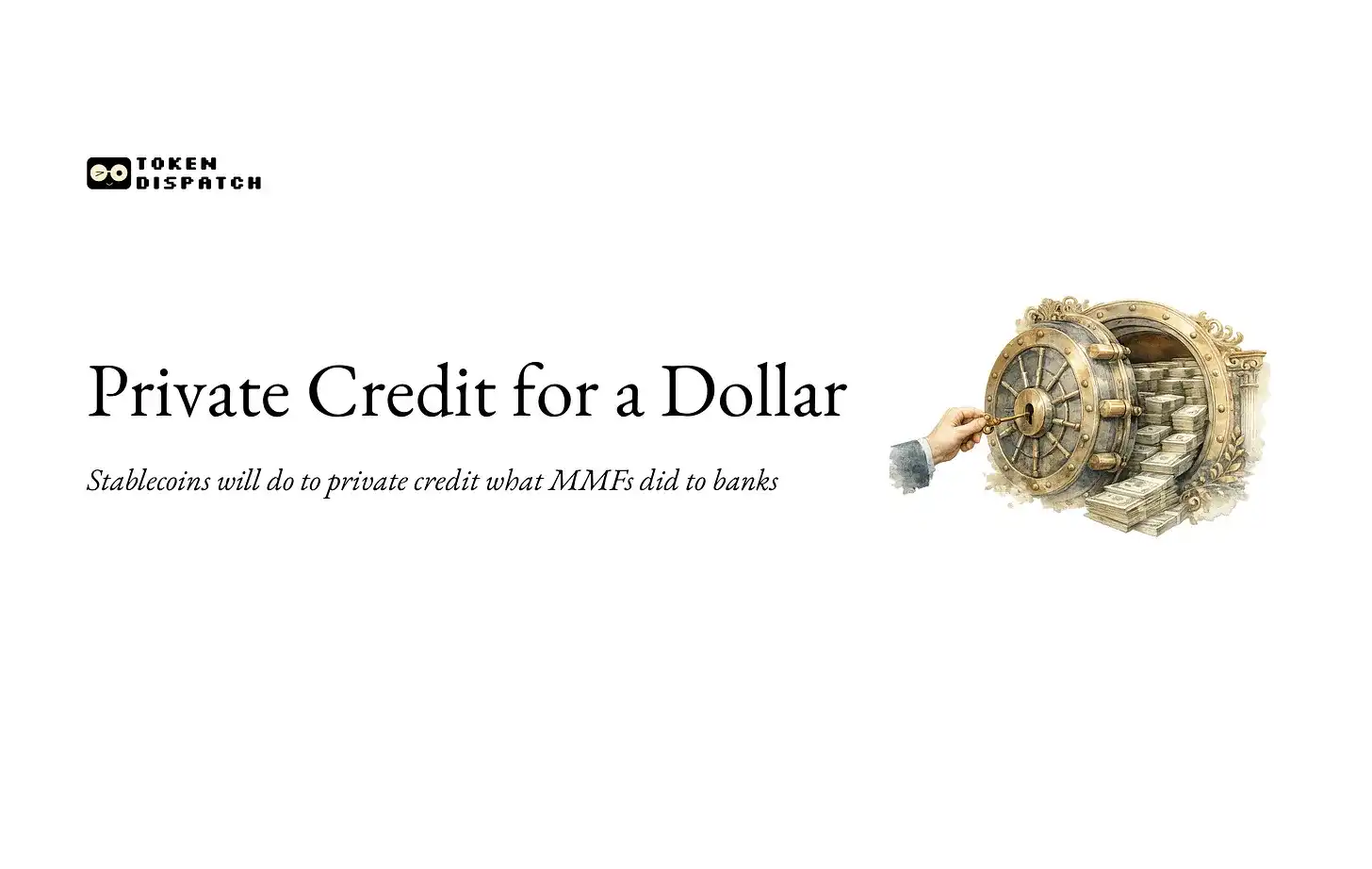
Private Credit in US Dollar

Stablecoins are evolving into a new type of money market fund, channeling crypto deposits into the $2 trillion private credit market. This mirrors the 1970s innovation where money market funds pooled small deposits to buy high-yield government securities, bypassing bank restrictions. Today, platforms like Apollo's ACRED tokenized fund and Figure's on-chain lending system allow stablecoin holders to access institutional private credit strategies with no minimum investment, offering yields of 8-12%. On-chain tokenization enables greater liquidity and DeFi composability (e.g., using tokens as collateral for leveraged positions) compared to traditional, locked-up private credit funds. Consequently, on-chain private credit has grown 15x in a year to $5.87 billion, though it remains a tiny fraction (0.3%) of the global market. However, this model carries significant risks, as illustrated by the failure of Goldfinch. Launched in 2021, it directed crypto deposits to motorcycle loans in Kenya and Nigeria. Critical issues included a lack of local oversight, leading to unauthorized fund transfers and borrower defaults. With $56 million now trapped in non-performing loans, its collapse highlights that while blockchain streamlines capital transfer, the essential 90% of lending—underwriting, monitoring, and recovery—remains a costly, localized challenge. Success requires robust, traditional credit infrastructure, not just on-chain execution.

marsbit56 min fa

Private Credit in US Dollar

marsbit56 min fa

Trading

Spot
活动图片