ETC Proof of Work Course: 35. POW Must Be Attackable to be Secure

项目方ETC(Ethereum Classic)Pubblicato 2024-07-31Pubblicato ultima volta 2025-11-10

Ethereum Classic Blog

ETC Proof of Work Course: 35. POW Must Be Attackable to be Secure

August 1, 2024
Donald McIntyre
Education, Series
The content on this website is user-generated and solely for informational purposes. Do not interpret any content as an endorsement of any product or service. There's "no official anything" in Ethereum Classic. Always do your own research, and remember: don't trust, verify!

You can listen to or watch this video here:


banner

In the previous class, 34, we talked about the activity that produces finality, and security in general, in POW blockchains such as ETC, which is mining.

We explained the metrics that make ETC a great business opportunity for cryptocurrency miners around the world.

In this class, 35, we will explain why proof of work (POW) blockchains must be attackable to be secure.

The Bias to Add Subjectivity to Blockchains
1

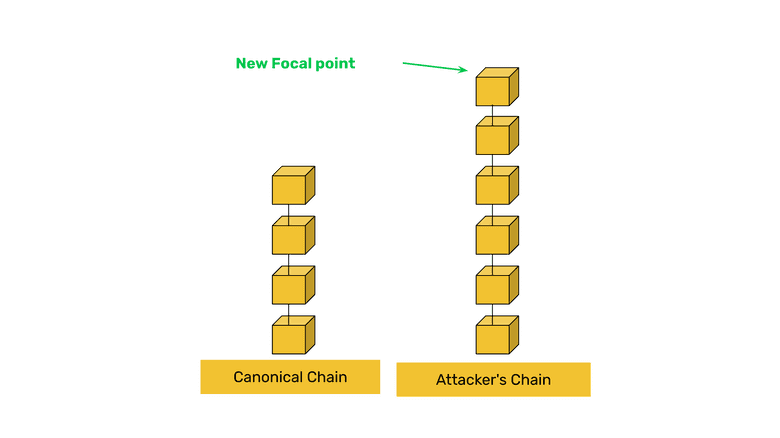
51% attacks on POW blockchains are actions were dishonest actors accumulate more than 50% of the mining power in a blockchain and use it to delete past transactions in the ledger. The purpose of deleting transactions is to steal property from their victims.

51% attacks are a known attack vector in POW blockchains, but it is a feature, not a bug of these systems.

People think that because POW blockchains can be attacked if bad actors control more than 50% of mining that it is necessary to add subjective contraptions to reject alternative blocks or chains that are proposed to replace the canonical chain.

Examples: Checkpointing and MESS

For example, if a POW network is working on block 100,000 and, suddenly, blocks 99,000 through 100,000 are reorganized by an attacker to replace or delete transactions from the recent past, then new rules such as checkpointing or to demand exponentially more hash power to reorganize blocks should be added to prevent these reorganizations.

Checkpointing predetermines certain block numbers in the past beyond which network nodes will not accept any reorganizations.

A system such as MESS (Modified Exponential Subjective Scoring) makes the nodes reject any reorganization of the chain if they have less than a certain hash power invested in it.

But Weak Subjectivity Is Bad

However, if this were done it would put in the hands of humans the decision of which is the correct chain to follow, and the whole decentralization of the blockchain accomplished by the simple verification of the work done, where anyone around the world can join and leave whenever they please with no permission nor checking with anyone else, would be thrown away just to prevent 51% attacks.

The original intent of using POW as a consensus mechanism was to eliminate any subjectivity precisely to enable complete decentralization of the system.

If nodes who are joining or exiting and joining again the network had to be checking with other nodes which is the correct blockchain based on arbitrary metrics and markers rather than on sheer computing power, then the figure of the “trusted third party” would be reintroduced into the system all over again!

And 51% Attacks Are Not That Important Anyway

It is not worth introducing trust into POW blockchains just to prevent 51% attacks as these are not that severe anyway.

51% attacks are very narrow attacks, very unlikely, have very few victims, and victims have other ways of protecting themselves, such as waiting for the correct number of block confirmations when receiving coins.

This is why it is not a good idea to add subjective rules to POW blockchains, and why they HAVE TO BE ATTACKABLE TO ACTUALLY BE SECURE, not the other way around.


Thank you for reading this article!

To learn more about ETC please go to: https://ethereumclassic.org

Crypto di tendenza

Letture associate

Bitcoin Withdrawals Continue: 8 Years of Storage in a Coldcard Cold Wallet Ended in Zero

Coldcard Hardware Wallet Hacked: Losses Mount Due to Vulnerable Seed Generation A critical vulnerability in Coldcard hardware wallets has led to a continued wave of fund thefts. According to Galaxy Research, the total stolen has reached 1,367.05 BTC (approx. $88.6 million) from 4,585 addresses, a significant increase from the initial 594.5 BTC reported on July 30, 2026. Most of the stolen funds remain on the attackers' addresses. The issue is not with the current firmware, which Coinkite has updated, but with seed phrases generated on vulnerable devices between March 2021 and the release of fixed firmware versions. Due to a programmer error, devices switched from using a hardware random number generator to the software-based Yasmarang generator, which was initialized with publicly accessible data like the chip's serial number. This made the seed phrases predictable through offline brute-force attacks, meaning wallets remain at risk until funds are moved to a new wallet generated with the patched firmware. Affected devices include Mk2/Mk3 with firmware 4.0.1–4.1.9 (and up to 5.0.3), Mk4/Mk5 up to version 5.6.0, and Q models up to 1.5.0Q. The only exceptions are seeds created with a high-entropy method like at least 50 independent dice rolls or a strong unique BIP-39 passphrase. All other owners must generate a new seed on the fixed firmware and transfer their assets. A case highlighting the human impact involves a 39-year-old long-term investor who lost 2 BTC (approx. $130,000) in minutes. He had accumulated the Bitcoin over eight years through physical labor, viewing it as a financial lifeline and a retirement plan in a country suffering from hyperinflation. His story underscores that even conservative "buy and hold in cold storage" strategies can be compromised by such underlying technical flaws. From a technical perspective, this incident echoes historical failures where weak random number generators undermined cryptographic security, challenging the assumption that offline storage is automatically foolproof.

cryptonews.ru2 h fa

Bitcoin Withdrawals Continue: 8 Years of Storage in a Coldcard Cold Wallet Ended in Zero

cryptonews.ru2 h fa

Trading

Spot

Articoli Popolari

Come comprare ETC

Benvenuto in HTX.com! Abbiamo reso l'acquisto di Ethereum Classic (ETC) semplice e conveniente. Segui la nostra guida passo passo per intraprendere il tuo viaggio nel mondo delle criptovalute.Step 1: Crea il tuo Account HTXUsa la tua email o numero di telefono per registrarti il tuo account gratuito su HTX. Vivi un'esperienza facile e sblocca tutte le funzionalità,Crea il mio accountStep 2: Vai in Acquista crypto e seleziona il tuo metodo di pagamentoCarta di credito/debito: utilizza la tua Visa o Mastercard per acquistare immediatamente Ethereum ClassicETC.Bilancio: Usa i fondi dal bilancio del tuo account HTX per fare trading senza problemi.Terze parti: abbiamo aggiunto metodi di pagamento molto utilizzati come Google Pay e Apple Pay per maggiore comodità.P2P: Fai trading direttamente con altri utenti HTX.Over-the-Counter (OTC): Offriamo servizi su misura e tassi di cambio competitivi per i trader.Step 3: Conserva Ethereum Classic (ETC)Dopo aver acquistato Ethereum Classic (ETC), conserva nel tuo account HTX. In alternativa, puoi inviare tramite trasferimento blockchain o scambiare per altre criptovalute.Step 4: Scambia Ethereum Classic (ETC)Scambia facilmente Ethereum Classic (ETC) nel mercato spot di HTX. Accedi al tuo account, seleziona la tua coppia di trading, esegui le tue operazioni e monitora in tempo reale. Offriamo un'esperienza user-friendly sia per chi ha appena iniziato che per i trader più esperti.

162 Totale visualizzazioniPubblicato il 2024.12.10Aggiornato il 2026.06.02

Come comprare ETC

Discussioni

Benvenuto nella Community HTX. Qui puoi rimanere informato sugli ultimi sviluppi della piattaforma e accedere ad approfondimenti esperti sul mercato. Le opinioni degli utenti sul prezzo di ETC ETC sono presentate come di seguito.

活动图片













