ETC Proof of Work Course: 36. POW Is Not What Makes a Blockchain Unscalable

项目方ETC(Ethereum Classic)Pubblicato 2024-08-14Pubblicato ultima volta 2025-11-10

Ethereum Classic Blog

ETC Proof of Work Course: 36. POW Is Not What Makes a Blockchain Unscalable

Donald McIntyre
Education, Series

You can listen to or watch this video here:

banner

In the previous class, 35, we explained why proof of work (POW) blockchains must be attackable to be secure, we went over the way POW works and how the bias to subjectivity could put at risk the consensus mechanism.

It is the format and security of POW based Nakamoto Consensus that puts constraints to the amount of data that can be distributed across secure blockchains, thus their unscalability.

This means that it is not the work in POW that makes blockchains unscalable, so in this class, 36, we will explain the elements that make them limited in this dimension.

What Is Scalability?

Scalability means to process more transactions per unit of time.

Bitcoin (BTC) processes from 7 to 14 transactions per second, Ethereum Classic (ETC) can process from 7 to 17 transactions per second, but Visa processes 24,000 transactions per second.

This gap of Proof of Work (POW) blockchains with respect to the large traditional payment systems has made a lot of people worry about the lack of scalability in these networks and blame the work in POW for it.

Many people think that POW is unscalable because it requires a lot of work, therefore it must process less transactions.

However, POW is not the cause!

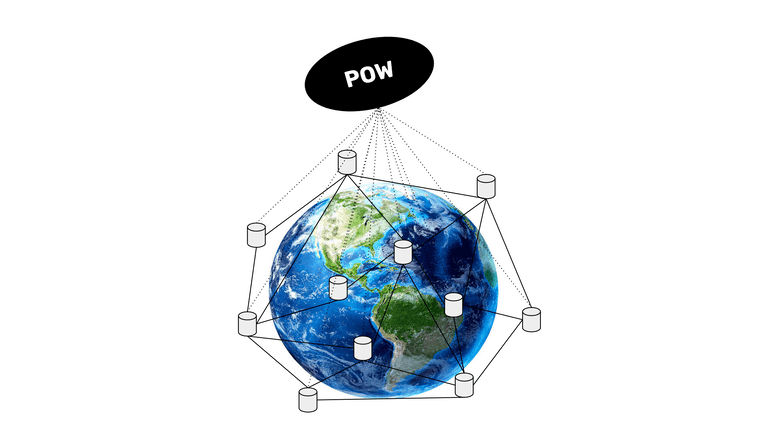
The inefficiency is caused by the rule of full replication of the database in all nodes globally, which requires smaller and slower blocks. Proof of Stake (POS) and Proof of Authority (POA) networks that require full replication have exactly the same inefficiency.

Full Replication Is the Culprit
1

In a truly secure POW blockchain, both transactions and blocks are fully retransmitted to all participating nodes in the system. This is done so that all can keep and maintain an identical copy of the whole database.

This full replication of the database is the key security strategy of the blockchain model. The idea is to have all the accounts, balances, and smart contracts replicated in as many computers around the world as possible so they may be as decentralized as possible, and impossible to take down by man or natural events.

However, full replication of databases; let alone ledgers with accounts, balances, and smart contracts; in a totally decentralized way was not possible before, making the systems insecure and dependent on trusted third parties.

The solution to accomplish full replication globally in a totally decentralized way was the Proof of Work algorithm, which is a component of the Nakamoto Consensus design.

But POW is not what makes blockchains such as Bitcoin and Ethereum Classic unscalable. Full replication globally is the reason these networks have a cap of transactions they can process per day.

This is why Ethereum moved to POS but is still unscalable.

Any Truly Decentralized Blockchain Must Be Unscalable

Any truly decentralized POW blockchain will have to be unscalable.

The Nakamoto Consensus design specifies that all data must be replicated in all nodes, and all nodes must hold exactly the same copy of the database.

This puts a physical constraint in the size and frequency of blocks to ensure full propagation and synchronicity of all the nodes globally.

Restricted size and frequency of blocks means a limited amount of transactions will fit per block, thus making these systems unscalable.

It is important to understand that POW can process any size of block at any frequency. It is because of restrictions in retransmission and full replication, not POW, that blocks must be small and less frequent.

How Does Full Replication (And Not POW) Restrict Scalability?

Below we list several reasons why blocks must be small and less frequent in fully replicated networks, therefore produce less transactions per second:

1. Bloating: If blocks were larger and faster, then the database would grow larger very quickly and that would put pressure on node operators who have to keep up with sufficient computational storage to maintain their nodes. This would reduce the number of nodes in the chain and increase centralization. It would also go against common principles in the industry which are to “run your own node” and “verify everything” as people would prefer to use third party nodes rather than their own.

2. Technical: Related to bloating and centralization, the technical reasons why larger and faster blocks would be disadvantageous are that they would require higher bandwidth, thus limiting the areas in the world and kinds of operators who could process the data; they would require more powerful CPUs for validating the blocks, large data centers with big bandwidth, limiting the reach to operators with more capacity; and the initial blockchain download time (IBD) for new entrants or re-entrants would be very long, creating an additional barrier to participating in the system.

3. Miner economics: As the monetary policy in Bitcoin and ETC is decreasing and capped, miners will depend on fee revenues in the future. If blocks were larger and faster, then transaction fees would be lower. With scarce block space and low frequency, then fees will be higher thus financing the security that miners provide to these networks with their hashing power.

4. Block propagation: If blocks were larger, block propagation would be slower. This would benefit the larger, well geographically positioned miners in the world and eliminate the smaller miners in remote areas from the network, and would make mining centralized.

Layer 2 Systems Can Make Proof of Work Scalable

The solution to scalability is either to build layer 2 systems that may process more transactions, net them out, and then settle them at the POW base layer, or for users just to pay higher fees if they wish to use the security of POW blockchains.

Examples of layer 2 systems that may make Bitcoin and ETC more scalable are channel payments systems such as Lightning Network, regular centralized apps that settle on the POW blockchains such as centralized exchanges, and layer 2 decentralized networks that use proofs to anchor their systems on the base layer POW blockchains, such as Polygon and BitVM.


Thank you for reading this article!

To learn more about ETC please go to: https://ethereumclassic.org

Crypto di tendenza

Letture associate

Why Is the World Nervous About Japan Raising Interest Rates?

In June 2026, the Bank of Japan raised its policy rate to 1%, marking its first hike to this level since 1995. While this rate remains low compared to global peers like the US and Europe, the move signals a profound shift for a nation that has been a global source of ultra-cheap funding for decades. Japan's long-standing near-zero or negative interest rates had facilitated massive "yen carry trades," where international investors borrowed low-cost yen to invest in higher-yielding assets worldwide, such as US tech stocks and emerging market bonds. This made Japan a critical, often overlooked, source of global liquidity. Japan's ultra-loose policy stemmed from structural challenges post-1990s asset bubble: aging demographics, chronic low inflation/deflation, and high public debt. Recent shifts, including sustained wage growth (exceeding 5% in recent years) and inflation consistently above the 2% target, have created a "wage-price spiral" possibility, prompting the policy normalization. The global market's concern lies not in the absolute rate but in the potential unwinding of the yen carry trade. As Japanese borrowing costs rise, the economics of these leveraged global investments change, potentially triggering deleveraging and capital outflows from risk assets. Market anxiety focuses on the end of a thirty-year consensus that Japan would perpetually provide cheap funding. Ultimately, the global impact will depend on the interplay with US monetary policy. While Japan is tightening, the significant interest rate differential with the US remains. The key future dynamic is whether simultaneous Japanese hikes and eventual US rate cuts will narrow this gap, forcing a major recalibration of global capital flows and asset pricing built on an era of abundant, cheap yen liquidity.

marsbit5 h fa

Why Is the World Nervous About Japan Raising Interest Rates?

marsbit5 h fa

Trading

Spot
Futures

Articoli Popolari

Cosa è ATWO

I. Introduzione al ProgettoArena Two è una piattaforma interattiva decentralizzata che consente ai fan di svolgere un ruolo attivo e tokenizzato nei risultati degli eventi in tempo reale. A differenza dei modelli di trasmissione tradizionali che riducono i fan a spettatori passivi, Arena Two sfrutta la tecnologia blockchain per consentire ai fan di votare direttamente in tempo reale e influenzare i risultati sul campo.II. Informazioni sul TokenNome del token: ATWO(Arena Two)III. Link CorrelatiSito web:https://arenatwo.com/Esploratori:https://basescan.org/token/0x499D35eBE6cEe9B2Ac35Fd003fcBbeeB9CFc7B32Twitter:https://x.com/arenatwoXNota: L'introduzione al progetto proviene dai materiali pubblicati o forniti dal team ufficiale del progetto, che è solo a scopo di riferimento e non costituisce consulenza sugli investimenti. HTX non si assume responsabilità per eventuali perdite dirette o indirette derivanti.

216 Totale visualizzazioniPubblicato il 2026.05.18Aggiornato il 2026.06.02

Cosa è ATWO

Come comprare ATWO

Benvenuto in HTX.com! Abbiamo reso l'acquisto di Arena Two (ATWO) semplice e conveniente. Segui la nostra guida passo passo per intraprendere il tuo viaggio nel mondo delle criptovalute.Step 1: Crea il tuo Account HTXUsa la tua email o numero di telefono per registrarti il tuo account gratuito su HTX. Vivi un'esperienza facile e sblocca tutte le funzionalità,Crea il mio accountStep 2: Vai in Acquista crypto e seleziona il tuo metodo di pagamentoCarta di credito/debito: utilizza la tua Visa o Mastercard per acquistare immediatamente Arena TwoATWO.Bilancio: Usa i fondi dal bilancio del tuo account HTX per fare trading senza problemi.Terze parti: abbiamo aggiunto metodi di pagamento molto utilizzati come Google Pay e Apple Pay per maggiore comodità.P2P: Fai trading direttamente con altri utenti HTX.Over-the-Counter (OTC): Offriamo servizi su misura e tassi di cambio competitivi per i trader.Step 3: Conserva Arena Two (ATWO)Dopo aver acquistato Arena Two (ATWO), conserva nel tuo account HTX. In alternativa, puoi inviare tramite trasferimento blockchain o scambiare per altre criptovalute.Step 4: Scambia Arena Two (ATWO)Scambia facilmente Arena Two (ATWO) nel mercato spot di HTX. Accedi al tuo account, seleziona la tua coppia di trading, esegui le tue operazioni e monitora in tempo reale. Offriamo un'esperienza user-friendly sia per chi ha appena iniziato che per i trader più esperti.

122 Totale visualizzazioniPubblicato il 2026.05.18Aggiornato il 2026.06.02

Come comprare ATWO

Cosa è ZEST

I. Introduzione al Progetto1. Cos'è Zest Protocol?Zest Protocol è un protocollo di prestito nativo di Bitcoin costruito su Stacks Layer 2 che consente agli utenti di guadagnare rendimento con BTC o di prendere in prestito asset collaterizzando BTC. I contratti intelligenti del protocollo sono scritti nel linguaggio Clarity, operano interamente on-chain e sono open-source, con un design ispirato a Aave v3. Zest è attualmente il più grande protocollo DeFi su Stacks, con oltre 800 BTC depositati e un TVL massimo che supera i 100 milioni di dollari. Nel maggio 2026, il protocollo ha ulteriormente introdotto i Bitcoin Collateral Vaults, estendendo le capacità di prestito da Stacks alla rete principale di Bitcoin. Questo consente agli utenti di prendere in prestito stablecoin senza spostare BTC dalla rete Bitcoin, abilitando prestiti in custodia autonoma.2. Come Funziona Zest Protocol?Zest Protocol è composto da due mercati. Il mercato di Stacks è costruito su Aave v3, consentendo agli utenti di depositare asset come sBTC, STX e USDC per guadagnare rendimento o prendere prestiti sovra-collaterizzati. Il LTV massimo predefinito è del 50% (70% per sBTC). Il mercato di Bitcoin opera attraverso i recentemente lanciati Bitcoin Collateral Vaults. Gli utenti prendono in prestito stablecoin bloccando BTC in vaults di custodia autonoma sulla catena di Bitcoin. Il collaterale rimane sulla rete principale di Bitcoin durante l'intero processo, e gli utenti mantengono la custodia a meno che la posizione non venga liquidata.3. Chi Ha Fondato Zest Protocol?Tycho Onnasch (Co-Fondatore): Laureato all'Università di Oxford. Coinvolto nella ricerca e nei finanziamenti per la Stacks Open Internet Foundation. Ex Manager presso Trust Machines e Fondatore di Deedmob. Profilo LinkedIn: https://www.linkedin.com/in/tychokoonnasch/.Fernando Foy (Co-Fondatore): Ha precedentemente lavorato nella consulenza IT presso Objectif Emploi. Profilo LinkedIn: https://www.linkedin.com/in/fernando-foy/.Emil E. (Co-Fondatore): Ha un Master in Fisica dall'Università di Warwick. Ex Partner Ingegneristico presso Trust Machines, Sviluppatore Full-Stack per progetti Web3 e Data Scientist presso HSBC. Profilo LinkedIn: https://www.linkedin.com/in/emil-e-49771a145/.Dettagli sul Finanziamento: Nel maggio 2024, Zest Protocol ha annunciato il completamento di un round di finanziamento seed da 3,5 milioni di dollari guidato da Tim Draper, con la partecipazione di Binance Labs, Flow Traders, Trust Machines e altri.4. Tokenomics di $ZEST$ZEST è il token nativo di Zest Protocol con un'offerta totale fissa di 1 miliardo di token e senza meccanismo inflazionistico.Comunità (27,83%): Utilizzato per airdrop e incentivi per gli utenti;Sviluppo dell'Ecosistema (24,82%): Utilizzato per liquidità, partnership, marketing, listing su exchange, ecc.;Investitori (22,35%): Sostegno alle parti investitrici che hanno supportato lo sviluppo iniziale di Zest Protocol;Team (25%): Allocato per i contributori principali.Piano di Vesting: I token del Team e degli Investitori sono soggetti a un periodo di lock-up di 1 anno seguito da 3 anni di sblocco lineare.5. Cronologia delle Pietre Miliari Chiave2022: Zest Protocol è ufficialmente fondato.Marzo 2024: Completato l'audit di sicurezza e lanciato il mercato di prestiti di Stacks sulla mainnet.Nel febbraio 2026, viene lanciato il Mercato Stacks V2, introducendo i Gruppi di Rischio.Nel maggio 2026, sono stati introdotti i Bitcoin Collateral Vaults e un prototipo operativo della mainnet è ora disponibile. Questo consente agli utenti di utilizzare BTC in custodia autonoma sulla L1 di Bitcoin come collaterale per prendere in prestito stablecoin su catene EVM, ponendo fine a bridging, wrapping e custodia di terze parti. Questo rollout è diviso in due fasi. Fase 1: Utilizza transazioni pre-firmate per limitare il movimento di BTC; Fase 2: Utilizza BitVM per la verifica. II. Informazioni sul TokenNome del token: ZEST (Zest Protocol)III. Link CorrelatiSito web: https://www.zestprotocol.com/Esploratori: https://bscscan.com/token/0x5506599c722389a60580b5213ea1da60d64754a1Twitter: https://twitter.com/ZestProtocolNota: L'introduzione del progetto proviene dai materiali pubblicati o forniti dal team ufficiale del progetto, che è solo a scopo di riferimento e non costituisce consulenza per gli investimenti. HTX non si assume responsabilità per eventuali perdite dirette o indirette risultanti.

117 Totale visualizzazioniPubblicato il 2026.05.19Aggiornato il 2026.06.02

Cosa è ZEST

Discussioni

Benvenuto nella Community HTX. Qui puoi rimanere informato sugli ultimi sviluppi della piattaforma e accedere ad approfondimenti esperti sul mercato. Le opinioni degli utenti sul prezzo di A A sono presentate come di seguito.

活动图片














