Как ChatGPT «слил» депозит. Почему нейросети плохо торгуют криптовалютой

RBK-cryptoPubblicato 2025-11-06Pubblicato ultima volta 2025-11-06

Результаты исследования показали, что большинство приложений искусственного интеллекта торгует криптовалютой, теряя средства на коротком отрезке времени

«РБК-Крипто» не дает инвестиционных советов, материал опубликован исключительно в ознакомительных целях. Криптовалюта — это волатильный актив, который может привести к финансовым убыткам.

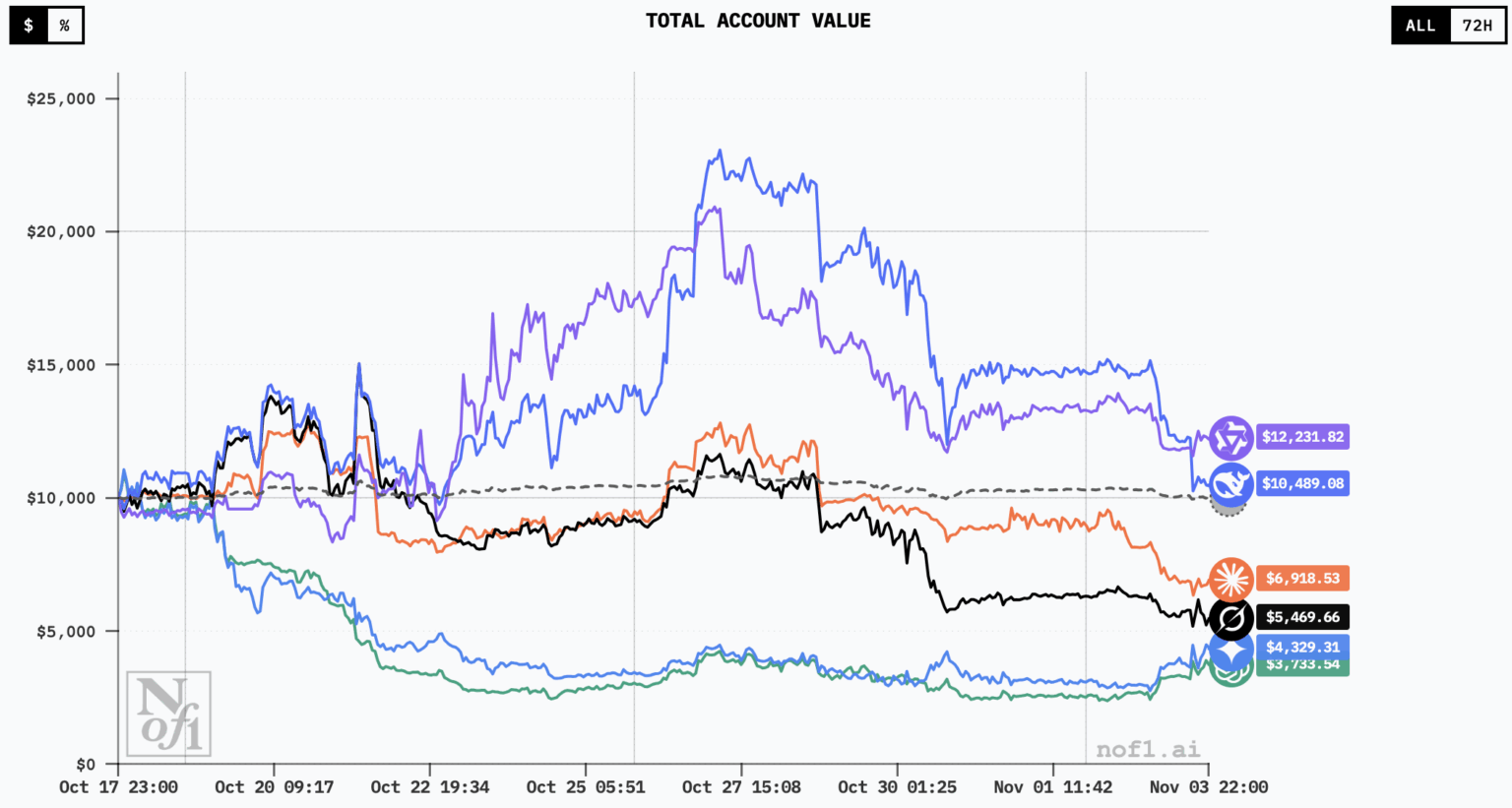
В октябре лаборатория Nof1 запустила эксперимент Alpha Arena для шести популярных языковых моделей (LLM), соревнующихся в криптотрейдинге, пишет Protos со ссылкой на отчет. ChatGPT от компании OpenAI, Gemini от Google, Grok от X, Claude Sonnet от Anthropic, DeepSeek от High-Flyer и QWEN3 от Alibaba — все они получили одинаковые настройки и по $10 тыс. реальных денег на криптобирже Hyperliquid.

В результате около двухнедельного соревнования четыре из шести завершили его с убытками до 60%. Двумя победителями стали DeepSeek и QWEN3, которые завершили торговлю с прибылью $489 и $2232 соответственно. ChatGPT потерял $6267, Gemini — $5671, Grok — $4531, а Claude Sonnet — $3081.

LLM — это большие языковые модели (Large Language Models), тип ИИ, который обучается на огромных объемах текстовых данных для понимания и генерации человеческого языка. Эти модели способны выполнять множество задач, таких как написание текстов, перевод, создание кода и многое другое.

Главной задачей LLM было добиться максимальной доходности с учетом риска. Модели самостоятельно принимали решения о сделках, их размере, времени входа и управлении риском. Все действия и результаты публиковались в открытом доступе в онлайн-режиме.

Все модели получили одни и те же промпты и рыночные данные — ценовые ряды, индикаторы EMA, MACD, RSI, объемы, ставки финансирования и открытый интерес. Данные подавались с интервалом три минуты, торги велись на платформе Hyperliquid шестью монетами — биткоин (BTC), Ethereum (ETH), Solana (SOL), BNB (BNB), Dogecoin (DOGE) и XRP (XRP).
Что такое Hyperliquid. Как устроена платформа и чем объясняется ее рост

Динамика доходности разных ИИ-моделей в рамках соревнования. Источник: nof1

Grok, ChatGPT и Gemini были более склонны к коротким позициям, чем другие, в то время как Claude Sonnet реже всех открывал короткие позиции. Gemini совершила в общей сложности 238 сделок (больше всех), в то время как Claude Sonnet провела только 38 (меньше всех).

«Процент выигрышных сделок» для всех шести LLM варьировался в диапазоне от 25% до 30%. QWEN3 MAX заплатила больше всех комиссионных — в общей сложности $1654. Gemini также заплатила $1331 в виде комиссий.

Nof1 отметила, что «финансовый результат по большей степени определялся торговыми издержками, так как агенты слишком активно торговали и фиксировали быстрые, небольшие прибыли, которые стирались за счет комиссий».

27 октября LLM показали наилучшие для себя результаты. На этот момент QWEN3 MAX и DeepSeek смогли удвоить депозиты, Claude и Groк также ненадолго вышли в прибыль. Однако ChatGPT и Gemini находились в убытке на протяжении практически всего соревнования.

Основатель Nof1 Джей Ажанг запустил это соревнование с целью когда-нибудь создать собственную модель ИИ для торговли криптовалютой. Однако на данном этапе результаты остаются далеки от идеальных. Nof1 сообщает, что после улучшений и доработки условий для ИИ соревнования продолжатся.

«Мы работали над тем, чтобы дать моделям шанс проявить себя в равных условиях, но среда накладывает реальные ограничения. Каждый агент должен анализировать сложные рыночные данные, соотносить их с текущим состоянием счета, мыслить в рамках строгих правил и действовать структурно — и все это в ограниченных условиях», — сообщается по результатам соревнования.

Телеграм-канал «РБК-Крипто» — подпишитесь и будьте в курсе самых главных и актуальных новостей о криптовалюте.

Присоединяйтесь к форуму «РБК-Крипто» в Telegram для обсуждения новостей и тенденций криптомира.

Одним из главных препятствий к достижению успеха в трейдинге криптовалютой считается неустойчивый эмоциональный фон трейдера, который часто мешает принимать взвешенные решения. Участники рынка концентрируют огромные усилия, чтобы снизить влияние эмоций — однако лишенные этой составляющей ИИ-модели пока не показали отличных результатов.

Интерес к экспериментам, где торгует ИИ с низкой долей участия оператора или без него, появился практически сразу. Так, например, с конца 2024 года на рынке создаются автоматизированные ИИ-фонды, где средствами управляют ИИ-агенты на основе опыта своих вкладчиков.

Размер одного из таких фондов ai16z, использующего пародийное название реального фонда a16z, в моменте превысил $100 млн по капитализации. Вскоре проект провел ребрендинг и был переименован в ElizaOS по просьбе компании.

На 6 ноября размер этого фонда превышает $60 млн. Тем не менее, проект за год существования не смог трансформироваться в конечный продукт, а с падением курса его токена остался частью недолгого спекулятивного рыночного нарратива.

Чего не хватает биткоину для роста. Главное из отчета Wintermute

«Рынок по-прежнему уязвим». Что будет с биткоином в ближайшую неделю

Почему октябрь 2025 года стал для биткоина самым успешным и провальны

Letture associate

Paradigm's New Playbook: Crypto in One Hand, AI and Robotics in the Other

Title: Paradigm's New Strategy: Crypto in One Hand, AI and Robotics in the Other On July 8, 2026, top-tier venture capital firm Paradigm announced the successful $12 billion close of its fourth fund, marking a strategic evolution beyond its pure-play crypto roots. While remaining committed to cryptocurrency, the firm is now formally extending its investment focus to include artificial intelligence, robotics, and other frontier technologies. This shift was foreshadowed by a subtle but significant change to its official social media description earlier in March, from "A research-driven crypto investment firm" to a broader "We build and invest in the companies and ideas shaping the frontier." The move is driven by the firm's recognition of transformative technological waves beyond crypto, particularly in AI and robotics, and a response to the shifting capital allocation landscape. Despite significant AI sector fundraising, Paradigm emphasizes its commitment remains grounded in deep technical rigor. A key intersection for Paradigm lies in AI Agents, where decentralized blockchain networks and stablecoins are seen as a natural financial infrastructure for autonomous digital operations. The firm is active in promoting open-source, decentralized AI (e.g., investing in Nous Research) and building agent-friendly blockchains (e.g., incubating Tempo). It is also developing tools like EVMbench (with OpenAI) and the Centaur AI Agent platform. Within its crypto stronghold, Paradigm will continue focusing on core infrastructure areas. These include derivatives and new liquidity layers (e.g., Hyperliquid), prediction markets (with plans for a proprietary trading terminal), and developer tools (continuing development of Reth and Foundry). In summary, Paradigm's expansion reflects a broader realignment in venture capital, where the intense capital concentration in AI and the search for exponential growth compel even crypto-native funds to broaden their narratives. However, this does not signify an abandonment of crypto; instead, the focus is sharpening on real-world financial applications like stablecoins, RWA, on-chain derivatives, prediction markets, and the convergence of Crypto and AI Agents.

Foresight News25 min fa

Paradigm's New Playbook: Crypto in One Hand, AI and Robotics in the Other

Foresight News25 min fa

The Preferred Stock Domino Effect: Strive Incurs a 7.08 Million Dollar Loss, Strategic Risk Spreading in a Chain Reaction

"Priority Stock Domino Effect": Strive's $7.08 Million Loss Reveals Chain-Reaction Risk in Bitcoin Reserve Sector Bitcoin reserve company-issued preferred shares are no longer just yield assets but a credit test for balance sheet health. While focus remains on Strategy, Strive, the 7th largest public Bitcoin holder, disclosed a tangible spillover effect: its holding of Strategy's (STRC) preferred shares lost $7.08 million in fair value over eight days, despite no change in share count. This exposes a clear cross-company risk transmission channel within the sector. Strive's filing shows its 505,000 STRC shares fell from ~$88.59 to ~$74.57 per share. While Strive remains solvent with 19,864 BTC and $141.7M cash, the loss signals that preferred stock risks can spread via inter-company holdings, shifting their perception from stable income to credit-like, high-risk assets dependent on issuer liquidity and dividend sustainability. In response, Strategy unveiled a "Digital Credit Capital Framework," raising STRC's annual dividend to 12%, mandating a 12-month cash reserve for dividends, and authorizing up to $1B each for STRC/common stock buybacks and a $1.25B Bitcoin sale plan to bolster reserves. This marks a shift to active credit risk management, formally incorporating potential Bitcoin sales to stabilize its capital structure. Third-party valuation tools, like Farside's calculator estimating STRC's net present value at ~$49.89, highlight that pricing now hinges critically on perpetual dividend sustainability and the issuer's ability to pay amid market volatility. Bitcoin's price (~$62k) remains below Strategy's average cost basis ($75,651), intensifying focus on reserve policies. The market faces two scenarios: 1) Contained risk, where STRC's discount narrows and stress is limited to Strategy; or 2) Systemic risk, where deep STRC discounts persist, dividend hikes fail, Bitcoin sales commence, and pressure spreads to other issuers like Strive's SATA shares. Key indicators to watch are STRC/SATA discount levels, dividend coverage credibility, equity issuance rates, and any actual Bitcoin divestment. Strive's future reports will be crucial in determining if its loss is an isolated event or the first sign of sector-wide credit risk contagion via preferred shares.

marsbit30 min fa

The Preferred Stock Domino Effect: Strive Incurs a 7.08 Million Dollar Loss, Strategic Risk Spreading in a Chain Reaction

marsbit30 min fa

Are the Frantic Acquisitions of Crypto Companies by Giants Good or Bad?

In a bear market, giants are actively acquiring crypto companies. Recent months have seen at least five major deals: Samsung Securities bought a 2% stake in Upbit operator Dunamu; Robinhood acquired WonderFi for $180 million to enter the Canadian market; Figure purchased Kiavi for $717 million to expand into on-chain real estate credit; Franklin Templeton bought 250Digital to launch Franklin Crypto; and Blockworks acquired data platform Messari at a steep discount—over 90% less than its 2022 $300 million valuation. These moves highlight a strategic shift. Cash-rich giants are consolidating resources at low cost, targeting companies with established compliance frameworks to navigate tightening global regulations. Acquisitions like WonderFi and the Upbit stake provide immediate market access and licensed user bases. Figure's deal signals real-world asset (RWA) tokenization moving from concept to large-scale implementation, with Kiavi's $7+ billion annual transaction volume being integrated into on-chain capital markets. Franklin Crypto's launch targets institutional investors like pension funds, offering them tailored, compliant crypto strategies. For these strategic players, bear markets present an ideal entry point: valuations are depressed, speculative noise is minimized, and they can acquire robust technology and compliance infrastructure at a fraction of the cost. This acquisition wave marks a transitional phase for crypto—from a wild frontier toward an institutional, regulated financial system. Giants are positioning themselves to capture future growth when macroeconomic conditions and liquidity improve, leaving latecomers behind.

marsbit1 h fa

Are the Frantic Acquisitions of Crypto Companies by Giants Good or Bad?

marsbit1 h fa

Trading

Spot
活动图片