Stable 8.25亿美元预存款秒空,官宣前巨鲸已提前入场7亿?

marsbitPubblicato 2025-10-23Pubblicato ultima volta 2025-10-24

近期社区热议的项目 Stable 今日上午在 X 平台宣布,其预存款活动第一阶段已达到 8.25 亿美元上限。

「什么?我都开了小铃铛,刚打开页面就没额度了?」——这是今早许多第一时间尝试参与的用户的真实写照。下面,Odaily 星球日报带大家了解 Stable 项目,并回顾今日上午「8.25 亿美元预存款秒没」的全过程。

Stable:专为 USDT 设计的 Layer1 公链

Stable

Stable 是一条专为 USDT 打造的高性能 Layer1 公链,旨在提供高速、低成本、低延迟的稳定币交易网络。与通用型公链不同,Stable 聚焦于 USDT 的支付与结算功能,希望让 USDT 在链上具备类似现金的使用体验,适用于跨境支付、电商支付和企业清算等场景。

在技术设计上,Stable 采用独立公链架构,支持 EVM 兼容和子秒级交易确认,同时计划推出免 Gas 的 USDT0 转账模式,并为机构提供可申请的专属区块空间与合规隐私交易支持。这些特性旨在降低企业和终端用户使用区块链支付的门槛,提升稳定币交易效率。目前项目核心技术框架已基本完成,但测试网和主网上线时间尚未公布。

提的一提的是,Stable 获得了包括 Bitfinex、Hack VC、Franklin Templeton 在内的知名机构投资,并获得 Tether 官方背书,Tether CEO Paolo Ardoino 也公开支持该项目。这些资金主要用于网络基础设施建设和全球 USDT 的支付生态拓展。

Stable 预存款活动遭质疑

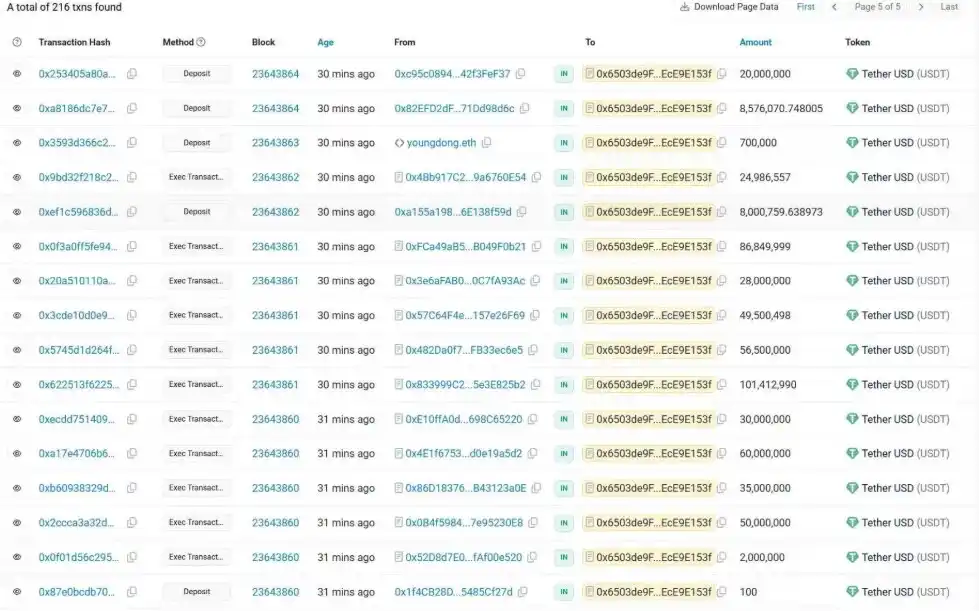
Stable 第一阶段 USDT 预存活动在开启后迅速引发巨大争议,被大量社区用户质疑存在严重的「老鼠仓」操作。按照官方时间线,Stable 于北京时间上午 9:10 才正式发推宣布开放预存,但链上数据显示,早在 8:48 就已经有人提前存入资金,与官方时间明显不符。
Stable

官宣预存款活动前已有多个地址大资金参与

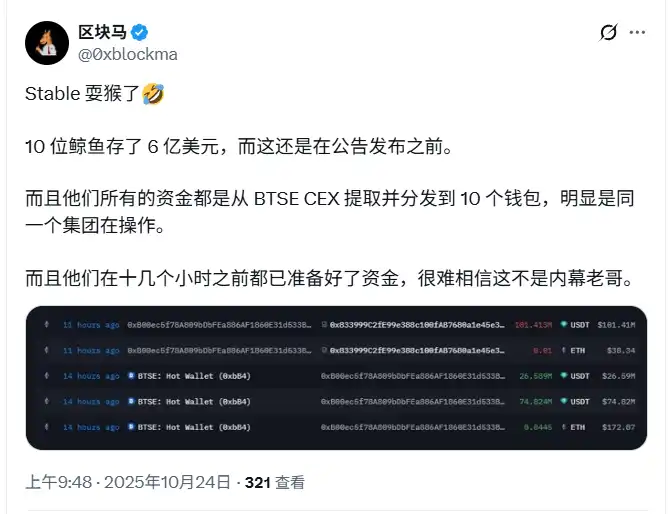
链上数据显示,本次 8.25 亿美元的预存款额度,在公开消息前,7 亿美元就已被提前「包场」。其中,10 个巨鲸地址合计存入约 6 亿美元 USDT,且全部资金来自同一钱包地址,被拆分后在 10 秒内打满额度。进一步分析发现,这些资金均从 BTSE CEX 提出,再分散进入不同钱包参与预存,疑似由同一个资本集团统一操作。此外,这些地址的资金在活动开始前十几个小时就已完成准备和布局,进一步引发社区不满情绪。
Stable

预存款活动前,10 个资金来源相同的巨鲸地址合计存入 6 亿枚 USDT

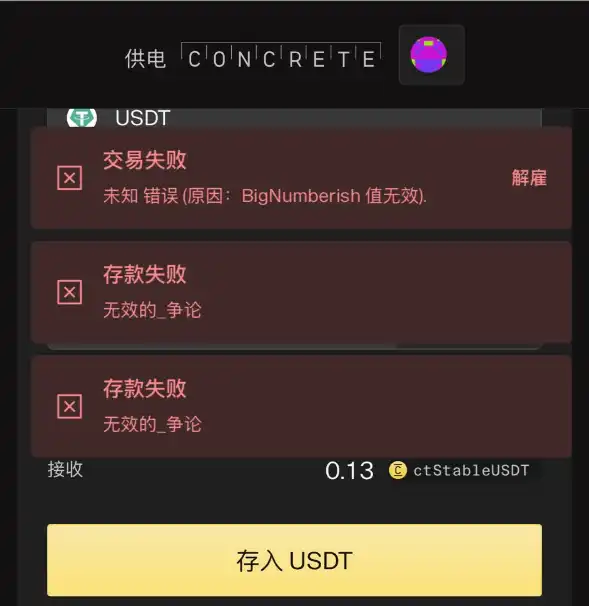
相对而言,普通用户几乎没有参与空间。大量用户反馈,在第一时间进入官网后要么授权失败,要么交易迟迟无法打包,等看到官方推文时页面仅剩 0.13 USDT 可存,看似仍有少量额度,实际上散户几乎无法参与。
Stable

社区反馈:官推公布后,第一时间存款页面仅剩 0.13 USDT 可存

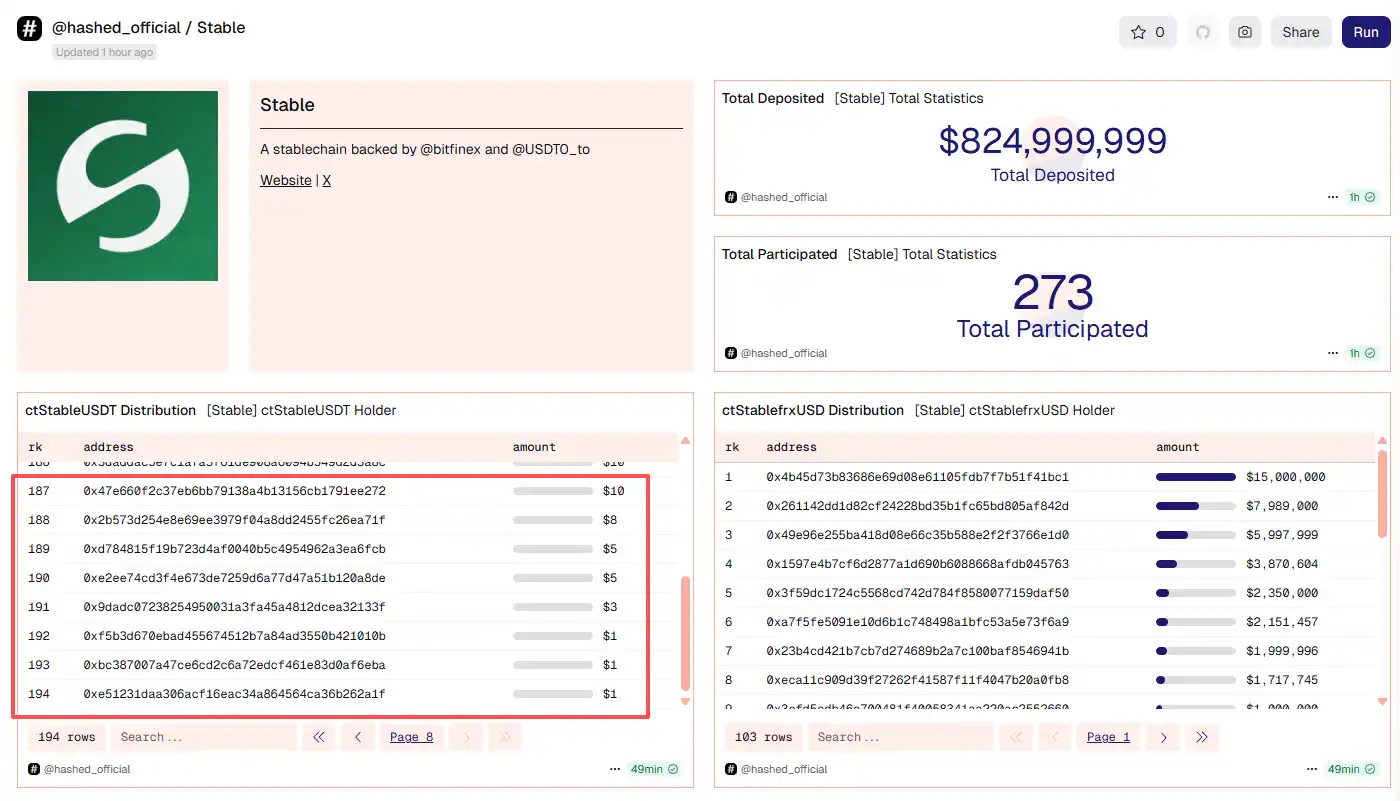
根据 Dune 数据,本次总额 8.25 亿美元的预存活动实际仅有 273 个地址参与,普通用户的参与比例几乎可以忽略。更值得注意的是,在所有参与地址中,有近 40 个地址的存入金额低于 500 USDT,甚至出现了 1 USDT、3 USDT、5 USDT 或几十 USDT 的极小额存款,社区讽刺称这些小额地址只是用来充人数的道具,毫无真实参与感。
Stable

整体来看,Stable 第一阶段 8.25 亿美元的预存款活动很快满额结束,但社区情绪非常负面,被评价为「史诗级老鼠仓」、「提前内定的预售」。

小结

「骂归骂,该赚还是要赚」。虽然 Stable 第一阶段预存活动因严重「老鼠仓」问题备受争议,但考虑到其背后有 Tether 官方背书与一线资本支持,该项目依然具备强大的市场影响力与持续追踪价值。

接下来更值得关注的,反而是中心化交易所相关的预存款活动,尤其是币安是否会推出 Stable 的存款或参与活动。此前,币安曾上线 Plasma(XPL)存款活动,首期个人存款额度上限高达 10 万美元,后续批次也能存到 5 万美元。由于是存入稳定币参与,无本金损耗,XPL 上线后第一时间卖出所得收益年化高达 79%,成为今年 CEX 上线收益率最高的项目之一。

从这个角度看,Stable 依旧是高优先级关注项目,链上活动也许已经被大资金吃完,但 CEX 阶段或许才是适合普通散户的参与窗口。
Letture associate

KOL's Perspective: Why Is SOL Set to Rise from This Point?

**Summary: Why SOL is Positioned for Growth at This Level** The article argues that SOL is poised for an upward move from its current price point, citing several key factors. Primarily, SOL has just broken out of a 4-month consolidation phase. This breakout signals a return of risk appetite to the broader crypto market, as SOL is seen as a key indicator of overall crypto health. The token's ownership has reportedly shifted from short-term traders and tourists to long-term accumulators, leading to low volume. Any meaningful increase in trading activity could thus trigger significant upward momentum. Fundamental strengths include strong institutional adoption, integration with DeFi and RWAs (Real-World Assets), and the potential benefits from the Clarity Act. Despite its high volatility—having dropped 70% from its all-time high but still up 12x from its bear market low—SOL is highlighted as one of the few tokens from the last cycle to reach new highs. It boasts a robust ecosystem of applications, users, and protocols. Future catalysts include the expected influx of AI developers following the Miami Accelerate conference, which focused on AI on Solana. Furthermore, Solana is positioned as the premier chain for memecoin activity, a trend expected to continue and drive network usage and fees. The article concludes that recent price action reflects a healthy transfer to long-term holders, setting the stage for growth.

marsbit23 min fa

KOL's Perspective: Why Is SOL Set to Rise from This Point?

marsbit23 min fa

Those Pre-Bitcoin PoW Protocols Have Recently Been Reimplemented

This article details a recent surge in replicating pre-Bitcoin Proof-of-Work (PoW) protocols, specifically focusing on Hal Finney's 2004 RPOW (Reusable Proofs of Work). Within five days in May 2026, multiple independent builders in the Bitcoin/cypherpunk community launched projects inspired by this early electronic cash proposal. The initiative began with Fred Krueger's `rpow2.com`, a centralized but auditable system that replaced RPOW's original IBM 4758 hardware with Ed25519 signatures. Initially a faithful replica, it later adopted Bitcoin-like features (21M supply cap, difficulty adjustment) and a controversial 5.24% founder allocation. This sparked rapid forks, including `rpow4.com` which incorporated full Bitcoin parameters, a prediction market (`rpowmarket.com`), and a DEX (`rpow2swap.com`). Concurrently, Mike In Space created a prototype of Wei Dai's 1998 b-money proposal (`b-money.replit.app`), pushing the historical exploration even further back. The article contrasts these centralized, server-dependent experiments with Bitcoin's core innovation of decentralized, trustless consensus. It also highlights a parallel development: the `HASH` project on Ethereum, which uses smart contract hooks to enable a purely fair-launch, browser-mineable PoW token with 0% allocations to team or VCs. The collective activity is framed as a meme-driven, educational exploration of cypherpunk history rather than a serious financial movement, with all projects heavily disclaiming any investment value.

marsbit28 min fa

Those Pre-Bitcoin PoW Protocols Have Recently Been Reimplemented

marsbit28 min fa

South Korean Exchanges 'Battle' Regulators, Challenging the Boundaries of Enforcement and Legislation

South Korea's cryptocurrency industry is engaged in a rare, direct confrontation with regulators. The Financial Intelligence Unit (FIU), the primary anti-money laundering (AML) watchdog, has recently imposed heavy penalties on major exchanges like Upbit and Bithumb for alleged violations involving unregistered overseas VASPs and AML procedures. However, exchanges are now actively challenging these actions in court and through industry associations. In a significant shift, the Seoul Administrative Court ruled in favor of Upbit's operator, Dunamu, overturning part of an FIU-ordered business suspension. The court found the FIU's penalty criteria and justification insufficiently clear. Similarly, the court suspended the enforcement of a six-month business suspension against Bithumb pending a final ruling, citing potential irreversible harm to the exchange. Beyond legal battles, the industry is contesting proposed legislative amendments. The Digital Asset eXchange Alliance (DAXA) strongly opposes a draft rule that would mandate Suspicious Transaction Reports (STRs) for all crypto transfers over 10 million KRW (~$6,800). DAXA argues this "poison pill" clause violates legal principles and would overwhelm the STR system, increasing reports from 63,000 to an estimated 5.45 million annually for major exchanges, thereby crippling effective AML monitoring. This conflict highlights a structural tension in South Korea's crypto governance: comprehensive digital asset laws are still developing, while regulators rely heavily on AML enforcement. The industry's move from passive compliance to active legal and legislative challenges signifies a new phase, pressing for clearer rules and more proportionate enforcement. While short-term disputes may intensify, this clash could ultimately lead to a more mature and sustainable regulatory framework for South Korea's vibrant crypto market.

marsbit1 h fa

South Korean Exchanges 'Battle' Regulators, Challenging the Boundaries of Enforcement and Legislation

marsbit1 h fa

After 50x Storage Surge, Justin Sun Always Looks to the Next Decade

Sun Yuchen, known for his controversial stunts like a $30 million lunch with Warren Buffett (canceled due to a kidney stone) and eating a $6.2 million duct-taped banana, is often overshadowed by a significant fact: his decade-long track record of spotting major investment trends. In 2016, he famously advised young people to invest in Bitcoin, Nvidia, Tesla, and Tencent instead of buying property. A hypothetical $20,000 investment in Nvidia and Tesla from that list would now be worth over 50 million RMB. His latest major call was on November 6, 2025, predicting a "50x storage opportunity" tied to the AI boom, which materialized with Sandisk's stock surging nearly 50-fold by 2026. Looking ahead, Sun now focuses on the next frontier: Physical AI. He identifies four key areas: 1. **Embodied AI/Robotics**: He sees this reaching its "iPhone moment," with companies like UBTech and Galaxy General leading in commercialization. 2. **Drones**: Viewed as the first commercially viable form of Physical AI, revolutionizing sectors from warfare (e.g., AeroVironment's Switchblade) to logistics. 3. **Spatial Computing**: Beyond VR, it's about AI understanding physical space, a foundational technology for robotics and autonomous systems, exemplified by Apple's Vision Pro. 4. **Space Exploration**: After a 2025 suborbital flight with Blue Origin, Sun advocates for space as the ultimate frontier, discussing blockchain's potential role in space asset management and data transactions. His investment philosophy involves betting on entire, inevitable trends rather than single companies. For robotics, he sees Tesla (the body/manufacturer) and Nvidia (the brain/AI platform) as complementary plays. In defense drones, he highlights companies making tanks obsolete (AeroVironment) and those augmenting fighter jets (Kratos). For space, he participated in Blue Origin's flight and anticipates SpaceX's potential IPO to redefine the sector's valuation. Sun Yuchen's vision frames the next two decades not as a revolution in information flow (like the internet), but in the fundamental operation of the physical world through AI-powered robots, autonomous systems, and spatial intelligence, ultimately extending human and AI activity into space. While many still focus on conventional assets, he continues to look toward the next technological horizon.

marsbit2 h fa

After 50x Storage Surge, Justin Sun Always Looks to the Next Decade

marsbit2 h fa

Trading

Spot
Futures
活动图片