315 Exposes AI Poisoning: A Business from Putian to Silicon Valley

marsbitPubblicato 2026-03-16Pubblicato ultima volta 2026-03-16

Introduzione

China's 315 Gala exposed "AI poisoning" through a practice called Generative Engine Optimization (GEO), where companies pay to manipulate AI recommendations. A case study featured a fictitious smartwatch with absurd features being promoted via auto-generated articles, which were then ranked highly by AI models within hours. This mirrors the early days of Search Engine Optimization (SEO), where paid rankings, notably by莆田系 hospitals on Baidu, dominated search results. While regulation later mandated "ad" labels, user trust in top results persisted. Now, with AI as the new information gateway, GEO has emerged as SEO's successor. The market quickly capitalized on GEO. BlueFocus invested millions in a GEO firm, triggering a stock surge and significant executive stock sales, despite the actual GEO market remaining relatively small. Simultaneously, OpenAI announced ads in ChatGPT for free users, separating responses from sponsored content—a move expected to generate $17 billion annually. This highlights a key contrast: unapproved GEO content is "poisoning," while platform-approved ads are "commercialization." The core issue remains: users inherently trust top AI responses, often unaware they can be bought. As GEO evolves rapidly, the article warns: answers may be free, but critical thinking shouldn’t be outsourced.

Author: David, Deep Tide TechFlow

Last night, 315 exposed a business based on GEO.

Full name is Generative Engine Optimization, which you can understand as:

Paying to have AI say nice things about you.

How is it done?

Brands want AI to prioritize them when consumers ask for recommendations. So they find GEO service providers, who mass-publish promotional soft articles online. After AI crawls and captures this content, it treats it as real information and recommends it to users.

A CCTV reporter used a software called "Liqing GEO," which can be bought on Taobao.

The reporter fabricated a smart wristband and made up several outrageous product features, such as "quantum entanglement sensing" and "black hole-level battery life." The software automatically generated over a dozen promotional soft articles and published them online.
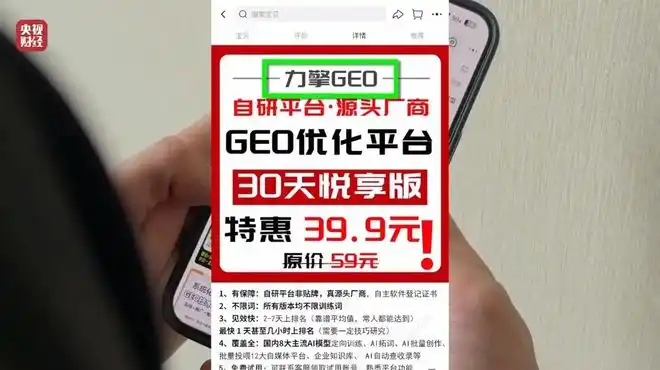
Two hours later, the reporter asked an AI: "Can you recommend a smart health wristband for me?"

The AI ranked this non-existent wristband at the top of the recommendation list.

The company behind this software is called Beijing Lisi Culture Media, a one-person company with zero employees enrolled in social insurance for years.

A tool made by such a company managed to deceive mainstream domestic AI models in just two hours.

315 exposed AI poisoning, but this business might be much bigger than a Taobao software.

SEO, the Putian Past

First of all, this is nothing new.

In 2008, CCTV's "News 30 Minutes" exposed Baidu's paid ranking over two consecutive days. Paying money could get your website to the top of search results, even if it was for fake medicine.

Back then, this business was called SEO, Search Engine Optimization.

The biggest buyers were Putian-based private hospitals. In 2013, the Putian system spent 12 billion yuan on Baidu advertising, accounting for nearly half of Baidu's total ad revenue.

Many unqualified medical institutions used SEO to push themselves to the first page of Baidu search results, appearing alongside top-tier hospitals, making it hard for ordinary people to tell the difference.

It wasn't until the 2016 Wei Zexi incident, where a university student died after seeking treatment at a Putian hospital that ranked high in search results, that regulators legislated to clarify: paid search is advertising.
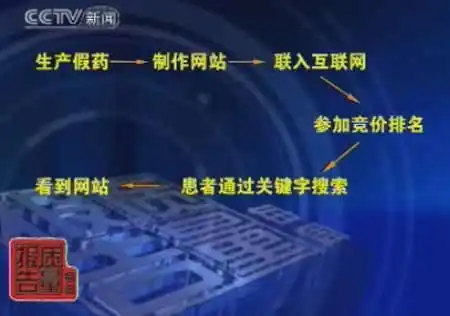
But this didn't kill the business. It just set the rules, turning it from a gray market activity into a legitimate business. The Putian system still buys rankings, but now there's a small label next to the result: "Ad."

But even with the label, people who would click still click.

The fundamental problem with search engines was never whether they were labeled, but that users inherently trust the top results.

Now people have moved from search engines to AI, thinking AI is more objective and can't be polluted by paid rankings. But whoever controls the gateway to information distribution can sell rankings.

The gateway has changed, SEO has changed a letter to become GEO, but the logic of selling rankings hasn't changed one bit.

What has changed is the price.

GEO, Loved by the Capital Market

Businesses that can't be killed are the ones the capital market loves most.

In September 2025, BlueFocus, China's largest marketing communication company, invested tens of millions of yuan in a GEO company called PureblueAI Qinglan.

Qinglan helps real brands optimize their ranking and recommendation rate in AI search results. Clients include Ant Group, Tencent Cloud, and Volvo.

The products are real, the company is real, and their work involves helping AI understand brand information more accurately.

This is completely different from the AI poisoning exposed by 315 involving Liqing. Liqing fabricated products, parameters, and used false information to deceive AI; Qinglan uses real brand content to adapt to AI's recommendation logic.

But from AI's perspective, the technical path for both things is the same: both involve publishing content online for AI to crawl.

AI can't distinguish between marketing and fabrication. This is the most ambiguous aspect of the GEO business.

When BlueFocus invested in Qinglan, GEO was just an industry term within marketing circles. Three months later, it became a stock market concept.

At the end of December 2025, BlueFocus's stock price hit the daily limit up.

Brokerages began holding intensive conference calls to interpret GEO, with research reports defining it as "the next generation traffic entrance in the AI era." Capital flooded in, not only buying BlueFocus but also driving up stocks of any company related to digital marketing and AI concepts. BlueFocus rose 132% in 9 trading days, and a batch of follower concept stocks also doubled.
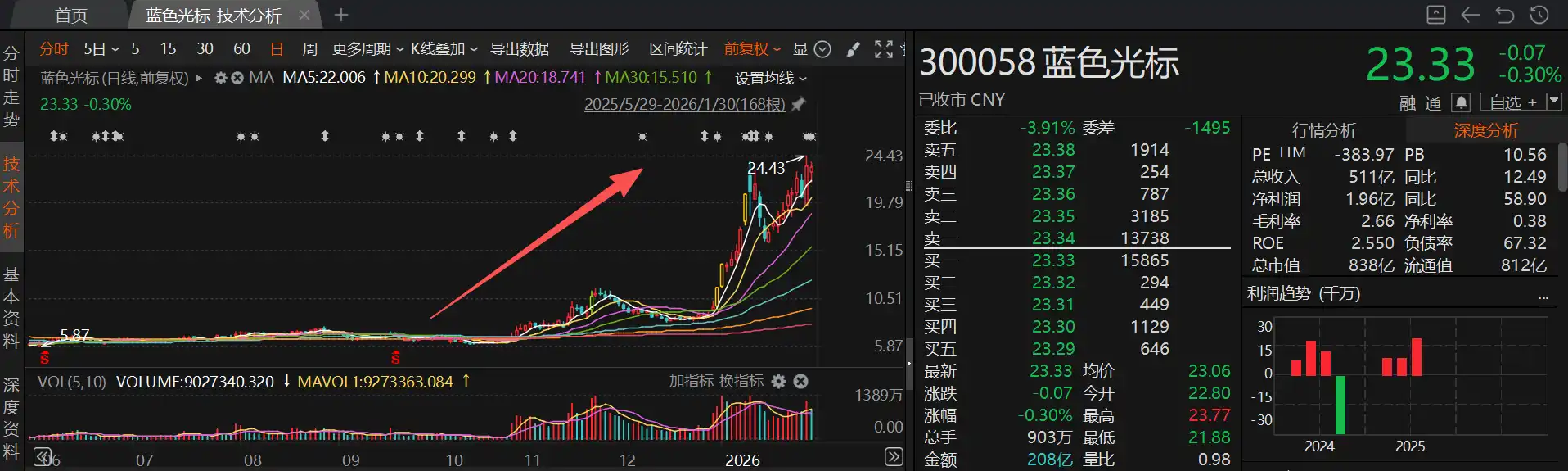
Image source: Cailian Press

After the surge, these companies issued risk warnings:

GEO business has no revenue and has no significant impact on the company's operations. BlueFocus also admitted that AI-driven revenue accounts for a very small proportion of overall revenue.

The implication is that while the stock price more than doubled, the GEO business itself hasn't made much money yet.

At the end of January, BlueFocus's stock price rose from 9.6 yuan to 23.3 yuan, a 143% increase in a month. Right then, Chairman Zhao Wenquan announced a plan to sell up to 20 million shares. Based on the stock price at the time, this would cash out approximately 467 million yuan.

Public research reports show that last year, the entire domestic GEO industry's market size was about 2.9 billion yuan. The increase in market capitalization of BlueFocus's stock alone in one month far exceeded this number.

315 exposed Liqing system's AI poisoning, costing a few hundred yuan. But the GEO concept made a round in the A-share market, earning billions.

Whether it's poisoning or not is debatable, but the money made is real.

315 Calls it Poisoning, Silicon Valley Calls it Commercialization

In January this year, OpenAI announced on its official blog: ChatGPT will start selling ads.

Free users and $8-per-month Go users will see ads; paid subscription premium users are unaffected.

On February 9th, ads officially launched. Some ads appear at the bottom of ChatGPT's answers, marked with a small word: Sponsored. The first batch of advertisers includes Ford, Adobe, Target, Best Buy...

You ask ChatGPT what car is good to buy, it gives you an answer, and below the answer hangs a sponsored link from Ford.

OpenAI made it clear: ads will not influence the content of ChatGPT's answers. The answer is the answer, the ad is the ad, they are separate.

Does that sound familiar?

Baidu said the same thing back in the day. Paid ranking is paid ranking, organic search is organic search, they are separate. Later, the top five search results were all ads.

OpenAI expects ads to help it double its consumer-side annual revenue to $17 billion. ChatGPT has over 800 million weekly active users, 95% of whom are free users, all potential audiences for ads.
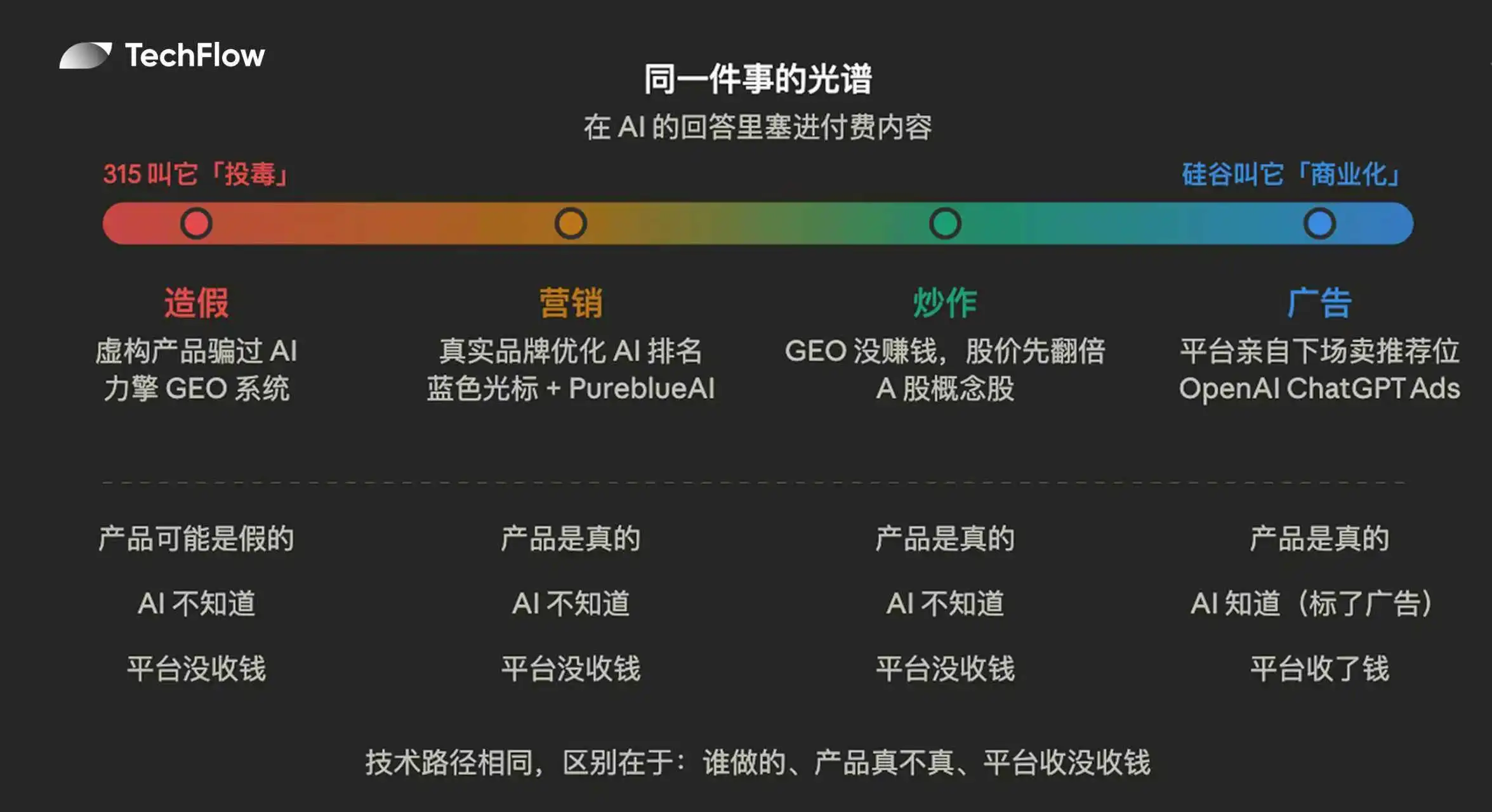
Looking back now at the industrial chain exposed by 315: Liqing floods AI with soft articles, making AI recommend non-existent products. OpenAI places sponsored content below the AI's answers, making AI recommend products that paid.

One didn't notify the platform, it's poisoning. One signed a contract with the platform, it's commercialization.

For the user, what's the difference?

One is inside the answer, one is below the answer. One has no label, one has a label saying "Ad".

315 caught Liqing for a few hundred yuan, A-shares hyped the GEO concept for billions, OpenAI plans to make $17 billion a year from this.

The same thing, its nature changes from poisoning to commercialization, and the price increases tens of thousands of times.

In November 2023, researchers from the Indian Institute of Technology Delhi and Princeton University published a paper on arXiv titled "GEO: Generative Engine Optimization".

This was the first formal academic definition of this concept.

From the paper's publication to the 315 exposure, just over two years. In between, it went through gray market activities, financing, concept stock surges, chairman cashing out, AI platforms personally entering to sell ads...

The path SEO took twenty years ago, GEO completed in two years.

The difference is, back then it took several years to learn not to fully trust search engine results; now AI is still in its trust红利期 (trust bonus period), most people haven't realized yet that AI's answers can also be bought.

However, this红利期 might not last too long. Next time you ask AI what's worth buying, remember to think for an extra second:

The answer can be free, but the brain cannot be outsourced.

Crypto di tendenza

Domande pertinenti

QWhat is GEO (Generative Engine Optimization) as described in the article?

AGEO (Generative Engine Optimization) is a practice where brands pay to have AI systems prioritize and recommend their products or services. It involves publishing promotional soft articles online, which AI models then crawl and treat as authentic information, leading to biased recommendations for users.

QHow did the CCTV 315 exposure demonstrate the potential harm of GEO?

AThe CCTV 315 exposure demonstrated GEO's harm by showing how a fictional smart bracelet with absurd features, like 'quantum entanglement sensing,' was promoted using the 'Liqing GEO' software. Within two hours, major AI models in China recommended this non-existent product, highlighting how easily AI can be misled by manipulated content.

QWhat historical precedent does the article draw between GEO and SEO?

AThe article draws a parallel between GEO and SEO (Search Engine Optimization), noting that SEO allowed businesses, like Putian-based hospitals in China, to pay for top search rankings on platforms like Baidu. This often led to unqualified or fraudulent services being promoted, similar to how GEO now manipulates AI recommendations.

QHow did the GEO concept impact the stock market, particularly for companies like BlueFocus?

AThe GEO concept caused a significant stock market surge, with BlueFocus's stock price rising 132% in nine days after investing in a GEO company. This sparked a broader rally in AI and digital marketing stocks, even though many companies admitted GEO had minimal actual revenue impact, leading to substantial market speculation and insider selling.

QWhat is the key difference between the GEO 'poisoning' exposed by CCTV and OpenAI's approach to advertising in ChatGPT?

AThe key difference is legitimacy: GEO 'poisoning' involves third parties secretly feeding AI with fake content to manipulate recommendations, while OpenAI's advertising is a transparent, platform-sanctioned商业化 (commercialization) where sponsored content is clearly marked and separated from AI responses, though both aim to influence user choices through paid promotion.

Letture associate

Has Bitcoin Bottomed, or Is a 'Shakeout' Approaching? What's the Situation with XRP?

Cryptocurrency analytics platform Santiment shared key insights on Bitcoin and altcoin markets, highlighting significant signals from on-chain data. Analysis shows Bitcoin's 365-day MVRV ratio has fallen to -26%, indicating substantial losses for long-term holders, a level historically associated with market bottom formations and long-term buying opportunities. While short-term MVRV is near breakeven, suggesting no clear directional signal, the annual perspective points to a bottom before bullish cycles. On-chain data reveals divergent behavior: large wallets (10-10,000 BTC) have been accumulating, adding ~18,500 BTC in 10 days, while smaller retail investors continue buying dips. Analysts caution that high retail demand can sometimes create a risk of a final market shakeout or correction. The altcoin market shows a mixed picture. Ethereum's 365-day MVRV is around -33%, but recent monthly gains combined with overly optimistic social sentiment pose a short-term correction risk. XRP is in oversold territory with 30-day and 365-day MVRVs at -57.5% and -45.5% respectively, signaling potential for a strong mid-to-long term rebound. Social activity and optimism are rising for Solana, while investor sentiment remains calmer towards Cardano. Future direction for Bitcoin and altcoins depends not only on on-chain metrics but also on macroeconomic and regulatory developments. The Federal Reserve's interest rate decision and upcoming policy rulings are increasing market volatility expectations, while uncertainty around the U.S. Congressional clarity process continues to pressure pricing. *This is not investment advice.

cryptonews.ru31 min fa

Has Bitcoin Bottomed, or Is a 'Shakeout' Approaching? What's the Situation with XRP?

cryptonews.ru31 min fa

Bank of Korea Reveals Results of Tokenized Deposit Testing

The Bank of Korea has announced the results of its pilot test for tokenized deposits. Involving 28 central banks and international financial organizations, the project saw participation from major South Korean banks including KB Kookmin Bank, NH NongHyup Bank, Shinhan Bank, Woori Bank, and Hana Bank. Transactions, from payment orders to final settlement, were completed in real time, averaging just 80 seconds. The test involved 30 transactions across 17 different scenarios—such as corporate and interbank transfers—and was conducted in six currencies, including the Korean won, US dollar, and euro, with a total transaction value reaching approximately $995,000. The central bank reported that the platform operated stably throughout, despite being only partially connected to the existing banking infrastructure. Settlements using tokenized deposits were executed seamlessly, quickly, and transparently. An internal transfer of 20 million won (about $13,890) between NH NongHyup Bank and Shinhan Bank was also successfully processed via the Project Agora platform, which involved connecting to the Bank of Korea's CBDC test platform, Project Hangang. Additionally, KB Kookmin Bank and Japan's MUFG Bank tested cross-border payments using these deposit tokens—digital certificates issued by commercial banks within the pilot, not directly by the central bank. The Bank of Korea plans to continue testing payments with tokenized deposits. This follows last year's pledge by South Korean authorities to tighten regulations for won-based stablecoins, which will require approval from both the central bank and the Financial Services Commission.

cryptonews.ru2 h fa

Bank of Korea Reveals Results of Tokenized Deposit Testing

cryptonews.ru2 h fa

Trading

Spot

Articoli Popolari

Come comprare NIGHT

Benvenuto in HTX.com! Abbiamo reso l'acquisto di Midnight (NIGHT) semplice e conveniente. Segui la nostra guida passo passo per intraprendere il tuo viaggio nel mondo delle criptovalute.Step 1: Crea il tuo Account HTXUsa la tua email o numero di telefono per registrarti il tuo account gratuito su HTX. Vivi un'esperienza facile e sblocca tutte le funzionalità,Crea il mio accountStep 2: Vai in Acquista crypto e seleziona il tuo metodo di pagamentoCarta di credito/debito: utilizza la tua Visa o Mastercard per acquistare immediatamente MidnightNIGHT.Bilancio: Usa i fondi dal bilancio del tuo account HTX per fare trading senza problemi.Terze parti: abbiamo aggiunto metodi di pagamento molto utilizzati come Google Pay e Apple Pay per maggiore comodità.P2P: Fai trading direttamente con altri utenti HTX.Over-the-Counter (OTC): Offriamo servizi su misura e tassi di cambio competitivi per i trader.Step 3: Conserva Midnight (NIGHT)Dopo aver acquistato Midnight (NIGHT), conserva nel tuo account HTX. In alternativa, puoi inviare tramite trasferimento blockchain o scambiare per altre criptovalute.Step 4: Scambia Midnight (NIGHT)Scambia facilmente Midnight (NIGHT) nel mercato spot di HTX. Accedi al tuo account, seleziona la tua coppia di trading, esegui le tue operazioni e monitora in tempo reale. Offriamo un'esperienza user-friendly sia per chi ha appena iniziato che per i trader più esperti.

366 Totale visualizzazioniPubblicato il 2025.12.08Aggiornato il 2026.06.02

Come comprare NIGHT

Discussioni

Benvenuto nella Community HTX. Qui puoi rimanere informato sugli ultimi sviluppi della piattaforma e accedere ad approfondimenti esperti sul mercato. Le opinioni degli utenti sul prezzo di NIGHT NIGHT sono presentate come di seguito.

活动图片