Florida’s Crypto Bill Gets A Second Life—But Will It Work This Time?

bitcoinistPubblicato 2025-10-17Pubblicato ultima volta 2025-10-18

Introduzione

Florida Representative Webster Barnaby has filed House Bill 183, a reopened attempt to let state officials put public money into...

Trusted Editorial content, reviewed by leading industry experts and seasoned editors. Ad Disclosure

Florida Representative Webster Barnaby has filed House Bill 183, a reopened attempt to let state officials put public money into digital assets, including Bitcoin and crypto exchange-traded products.

According to the Florida Senate bill text, the proposal would let the Chief Financial Officer and the State Board of Administration manage investments in a range of tokenized holdings and set rules for how those holdings must be kept.

What The Bill Would Allow

Based on reports, HB 183 would permit up to 10% of certain public funds to be invested in “digital assets” and exchange-traded products.

The measure names possible sources such as the General Revenue Fund, the Budget Stabilization Fund, and trust funds, and it would allow the Florida Retirement System Trust Fund to allocate a similar share. Reports also say the bill broadens an earlier Bitcoin-only effort to cover tokenized securities, ETFs, and even NFTs.
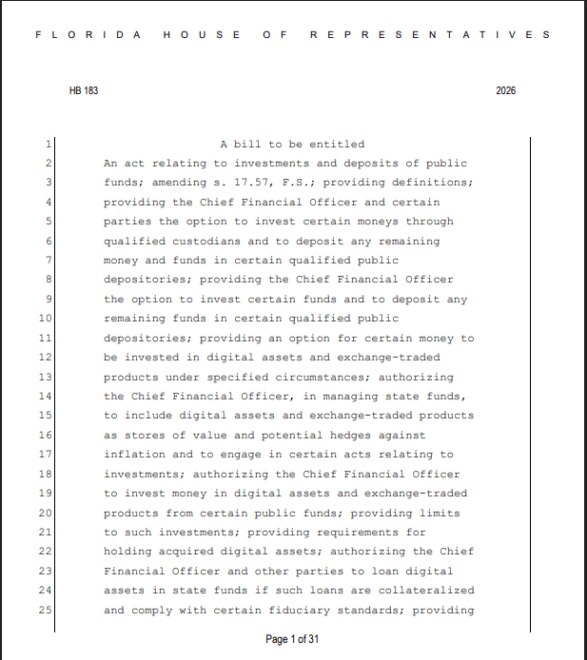
New bill introduced by Florida Rep. Webster Barnaby on Wednesday.

Safeguards And Custody Rules

According to the bill language and summaries, the proposal does not leave custody loose. It lays out specific holding and custody standards, allows assets to be kept by qualified custodians or held through exchange-traded products, and permits lending only when collateralized and consistent with fiduciary duties.

It would also require that any taxes or fees paid in crypto be converted into US currency before being credited to state accounts. Those measures are framed as guardrails to limit direct risk to state coffers.

Where The Bill Came From And What Failed Before

This move follows an earlier effort that focused on Bitcoin and failed to pass committee. Reports have disclosed that the prior proposal collapsed in June, pushing the sponsor to file a broader, rewritten bill this month.

The new text is being read as a softer, more flexible take on the same idea — one that aims to give officials different routes to hold exposure while spelling out limits.

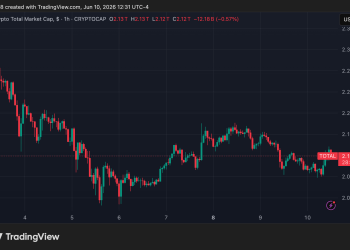
Total crypto market cap currently at $3.5 trillion. Chart: TradingView

Stablecoin Measures Filed Alongside Investment Bill

State filings show Rep. Barnaby also introduced House Bill 175 to clarify rules for stablecoin issuers.

According to the bill page and media summaries, qualifying stablecoin issuers would need full collateral backing in US dollars or Treasury securities and public audits at least once a month, and some licensing requirements could be narrowed for those that meet the standards.

The aim appears to be creating a clear, state-level framework for certain payment-focused stablecoins.

Featured image from Playa Largo Ocean Residences, chart from TradingView

Editorial Process for bitcoinist is centered on delivering thoroughly researched, accurate, and unbiased content. We uphold strict sourcing standards, and each page undergoes diligent review by our team of top technology experts and seasoned editors. This process ensures the integrity, relevance, and value of our content for our readers.

Christian, a journalist and editor with leadership roles in Philippine and Canadian media, is fueled by his love for writing and cryptocurrency. Off-screen, he's a cook and cinephile who's constantly intrigued by the size of the universe.

Letture associate

Morgan Stanley Research Report Analysis: Treasury's Repurchase Scale Doubles, The Logic for a Steepening Yield Curve Remains Unchanged

Morgan Stanley report: US Treasury doubles long-term bond buyback size, steepening yield curve thesis intact. The US Treasury will double the size of its regular liquidity support buyback operations for 10-20 year and 20-30 year bonds to at least $4 billion per operation starting Sept 9. Morgan Stanley views this move, the first adjustment outside a quarterly refunding window since the program's May 2024 launch, as a more important signal than the buybacks themselves. The Treasury is signaling close attention to long-end yield dynamics, using the tool to buy time ahead of the November refunding where it could cut long-term issuance. The report argues recent long-end yield rises and curve steepening are driven not by supply/deficit concerns but by repricing of energy prices and central bank policy paths. Analysis of cash Treasury vs. swap spreads shows no clear pattern consistent with dominant supply worries. The action echoes a November 2023 "supply surprise" that briefly flattened the curve. MS maintains its recommendation to steepen the 7s30s curve, targeting a 100 bps spread vs. ~71 bps currently. It believes fundamentals—cooling inflation, weaker-than-expected labor data, and potential downward revision of the Fed's terminal rate—will ultimately drive markets, supporting further steepening. In FX, MS strategists note the move was interpreted as a mild tool to curb USD strength. A refocus on USD policy could lead to further weakness, particularly against CHF, with EUR/USD potentially rising toward 1.2150.

marsbit17 min fa

Morgan Stanley Research Report Analysis: Treasury's Repurchase Scale Doubles, The Logic for a Steepening Yield Curve Remains Unchanged

marsbit17 min fa

Kaito Revives 'Talk-to-Earn' Economy, But Many Are Hesitant to Install the New Plugin

Kaito AI has launched a new browser extension called Kaito Pulse, aiming to integrate users' discussions on X (formerly Twitter) with their on-chain activities and social influence to build a new "attention + behavior verification" scoring system. The plugin displays users' public trading positions from platforms like Polymarket directly on the X timeline, allowing others to assess if their statements align with their actual market behavior. This move is seen as reviving "influence-to-earn" incentives. However, the launch sparked significant privacy concerns. Critics, including an analysis by "Ultra," allege the extension collects extensive data, such as device fingerprints (via GPU, hardware info), X user behavior (browsing paths, clicks), and may access sensitive data from third-party accounts (e.g., ChatGPT, trading platforms). This raised debates about trading privacy for verified influence. In response, Kaito founder Yu Hu stated the design follows data minimization principles, aiming to generate verification proofs without collecting or storing raw user data, using technologies like zkTLS. He acknowledged some permission descriptions could be misleading and promised improvements. The controversy highlights a core dilemma for social finance (SocialFi) platforms: as fake engagement and AI content grow, more user data is needed to verify genuine influence, but this risks encroaching on user privacy and trust.

marsbit17 min fa

Kaito Revives 'Talk-to-Earn' Economy, But Many Are Hesitant to Install the New Plugin

marsbit17 min fa

Kaito Reboots 'Talk-to-Earn Economy', but Many Are Hesitant to Install the New Plugin

Kaito AI has launched a new browser extension called Kaito Pulse, aiming to revitalize what the community terms the "talk-to-earn" or "social-fi" economy on X (formerly Twitter). The plugin displays users' on-chain trading activity, such as positions from platforms like Polymarket, directly within the X timeline. This aims to create a new "attention + behavior verification" system, shifting focus from who generates the most discussion to whose discussions are backed by credible, verifiable actions. However, the launch quickly sparked significant privacy concerns within the crypto community. Critics, led by an analysis from user "Ultra," allege the extension's code enables deep data collection. This includes potential device fingerprinting (using GPU, hardware, and audio data), tracking of X user behavior (browsing paths, clicks, engagement), and verification processes that could access sensitive data from third-party accounts like ChatGPT, Claude, and trading platforms. The debate centers on whether such extensive verification is necessary to combat fake engagement and AI-generated content, or if it constitutes an unacceptable privacy sacrifice. In response, Kaito founder Yu Hu stated the design follows data minimization principles. He claimed Kaito Pulse does not collect or store users' raw data but instead uses verification techniques, including zkTLS, to generate proofs of identity or behavior without exposing the underlying information. Yu Hu acknowledged that some permission descriptions could be misleading and promised improvements in future versions. The controversy highlights a core dilemma for social-fi projects: platforms need more user data to distinguish real influence from artificial hype, but users must decide how much privacy they are willing to trade for potential rewards and ranking within these new incentive systems.

Odaily星球日报37 min fa

Kaito Reboots 'Talk-to-Earn Economy', but Many Are Hesitant to Install the New Plugin

Odaily星球日报37 min fa

After Two and a Half Years of Entrepreneurship and Full AI Adoption, the Company Has Actually Become More 'Traditional'

"After 2.5 years of running my company, achieving near 100% AI adoption with Agents in roles like finance, HR, and operations, we've paradoxically become more 'traditional.' We learned that establishing a thick AI middle layer creates bottlenecks. Instead, we advocate for a 'thin platform, thick frontline' model, empowering employees closest to problems to use AI tools themselves, fostering ownership and initiative. The true foundation isn't the AI models, but the unique data and context a company accumulates—our most vital, irreplaceable asset, requiring diligent governance. As AI handles repetitive, describable tasks, human roles revert to their core: building genuine relationships, trust, and brand reputation through authentic communication, which AI cannot accelerate. A critical question is where the time saved by AI goes. It must be returned—to clients, to creative work, to employees' own lives—rather than just fueling higher output demands. For managers, AI strips away execution-focused busywork, exposing the necessity to define clear goals, make tough judgments, and take ultimate responsibility. Onboarding newcomers presents a challenge: while AI can generate 80% solutions instantly, we must deliberately design paths for them to develop judgment, understand context, and safely learn from mistakes. Ultimately, AI's organizational value isn't about replacing people but removing unnecessary friction, allowing more meaningful human connection. The real test of an 'AI-era' company isn't its tech stack, but how it treats people: delegating creative power, returning saved time, fostering growth, and upholding accountability. The core luxury and purpose of our work remains authentic human relationships."

marsbit46 min fa

After Two and a Half Years of Entrepreneurship and Full AI Adoption, the Company Has Actually Become More 'Traditional'

marsbit46 min fa

Trading

Spot
活动图片