Conservative activist Laura Loomer and crypto attorney John E. Deaton ignited a fresh wave of controversy around Sam Bankman-Fried’s legal fate, alleging a “massive and well funded” push to secure presidential clemency for the convicted FTX founder. Their claims arrive against the hard legal backdrop of Bankman-Fried’s 25-year federal sentence and an $11 billion forfeiture order—facts that sharply constrain the practical pathways for any pardon or commutation bid.
Lobby Efforts For Crypto’s Most Famous Felon
Loomer framed the matter as a sophisticated influence operation targeting “Trump world,” asserting that family members of Bankman-Fried are “actively working with a firm” to obtain a pardon. “There is a highly mobilized and well funded effort on the right to lobby Trump world to pardon Crypto scammer Sam Bankman Fried, who was the second largest donor to the Democrat Party after George Soros,” she wrote, adding that the push “needs to be exposed and shut down.”
She linked the surge in chatter to what she called an “inorganic” campaign by conservative influencers portraying Bankman-Fried as a victim after his reported stint in solitary confinement following a jailhouse interview with Tucker Carlson.
Deaton, a prominent crypto-side litigator and frequent critic of regulatory overreach, issued an unambiguous warning to the White House. “Let me be clear: any effort to pardon or commute the sentence of the Bernie Madoff of Crypto – SBF – should be squashed immediately,” he wrote, directing his message to “Mr President Donald Trump” and calling such a move “a slap in the face of justice and innocent investors.”
Deaton also urged renewed scrutiny of campaign-finance angles and of Bankman-Fried’s parents, while revisiting well-documented episodes in which Bankman-Fried leveraged political access during crypto’s last bull cycle. “In fact, Pam Bondi should re-open the case against him for violating campaign finance laws. His father Joe Bankman should be investigated as he helped SBF create the shell companies used to defraud people. Joe Bankman was the architect of Elizabeth Warren’s tax policies when she ran for president. He is no stranger to how to evade taxes,” Deaton wrote.
With regards to SBF#s mother, Deaton minced words either: “His mother Barbara Fried should also be investigated. She runs Mind The Gap – a political Super PAC – and helped her son with becoming the 2nd largest donor to the Democrat.” He concluded: “SBF’s parents participated in his criminal enterprise. They held luxury Bahamian property in their names worth tens of millions and received $10M in cash stolen from FTX customers. Because of their political connections they were never indicted.”
The legal record for SBF remains stark. On March 28, 2024, US District Judge Lewis A. Kaplan sentenced Bankman-Fried to 25 years in prison for orchestrating “multiple fraudulent schemes,” with the Southern District of New York securing an $11 billion forfeiture judgment—an enormous clawback that reflects what the court deemed to be the scale of customer, investor, and lender harms. The sentence followed a jury’s 2023 convictions on fraud and conspiracy counts tied to the wholesale misuse of FTX customer assets through Alameda Research.
Campaign-finance allegations have circulated around Bankman-Fried since 2022. In mid-2023, SDNY prosecutors dropped one campaign-finance charge on extradition grounds after the Bahamas—where Bankman-Fried was arrested—signaled it had not consented to extradition on that count. The federal fraud case then proceeded without that charge at trial, where jurors convicted across the remaining counts.
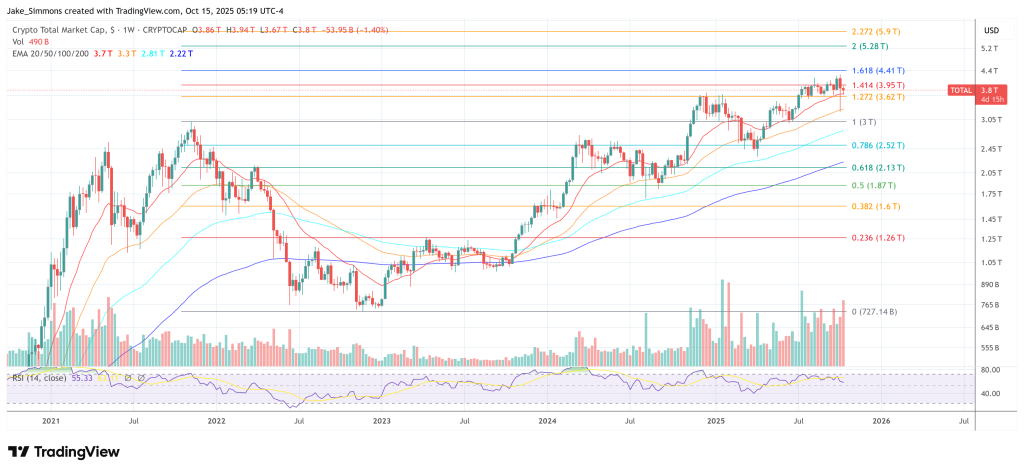
At press time, the total crypto market cap was at $3.8 trillion.