Индекс страха и жадности упал до 35 на фоне масштабной коррекции крипторынка

cryptonews.ruPubblicato 2025-10-22Pubblicato ultima volta 2025-10-22

  • Настроения на крипторынке опустились до минимума за полгода.
  • Индекс страха и жадности показал «страх» на уровне 35 пунктов.
  • За сутки ликвидировано сделок на сумму $19,27 млрд.

Резкое ухудшение настроений в индустрии цифровых активов последовало после заявления президента США Дональда Трампа о введении 100% пошлин на товары из Китая. Индекс страха и жадности, отражающий общее состояние рынка, упал с 64 до 35 пунктов, достигнув уровня «страх», по данным CoinMarketCap.

В последний раз аналогичный показатель фиксировался в апреле 2025 года, когда биткоин стоил около $80 000.
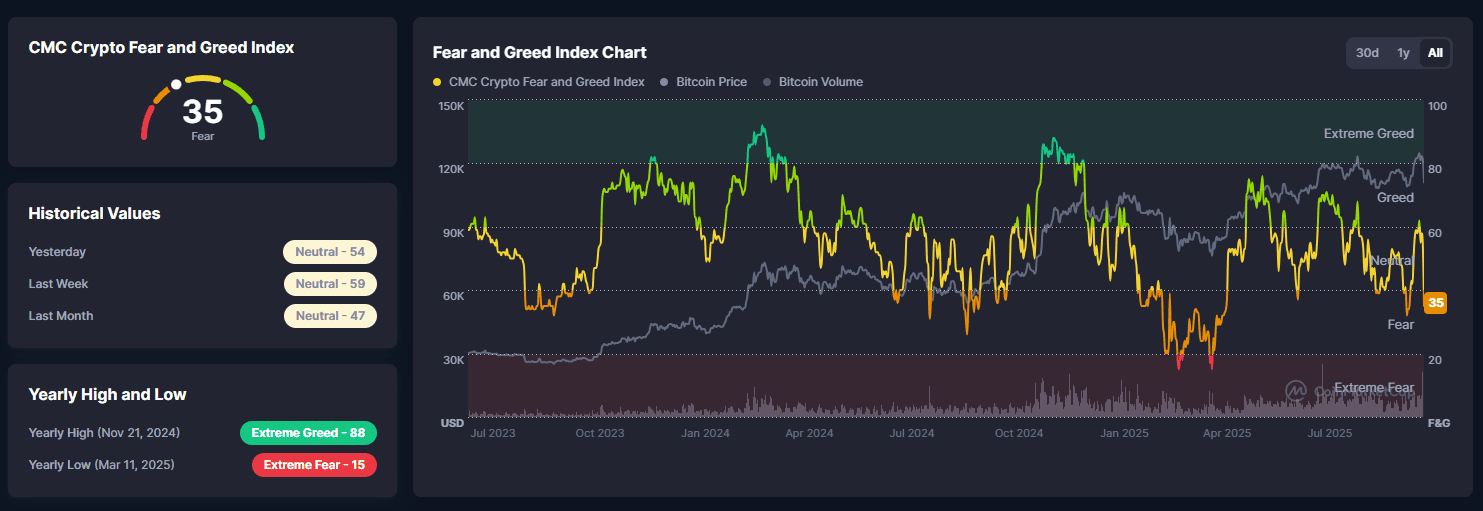
Изменение индекса страха и жадности на крипторынке. Источник: CoinMarketCap.

Это произошло на фоне суточной просадки биткоина на около 20%. Первая криптовалюта кратковременно опускалась до $102 000, согласно TradingView. При этом общая сумма суточных ликвидаций длинных и коротких позиций превысила $19,27 млрд.

Руководитель европейского подразделения Bitwise Андре Драгош отметил, что текущее падение может стать «сильным сигналом к покупке». По его словам, внутридневной индекс настроений компании по криптоактивам упал до -2,8 стандартного отклонения. Это минимальное значение с лета 2024 года, когда на рынке происходил спад керри-трейдов.

Ранее аналогичный уровень страха наблюдался 16 апреля, после падения биткоина до $77 000 на фоне усилившейся неопределенности в мировой торговле.

При этом за несколько дней до предыдущего обвала, 9 апреля, Трамп объявил о 90-дневной приостановке повышения взаимных пошлин, снизив базовую ставку до 10% для большинства стран.

В начале текущей недели индекс оставался в зоне «жадности», поскольку 5 октября биткоин достиг нового исторического максимума выше $125 000.

Напомним, мы писали, что эксперты JPMorgan Chase спрогнозировали рост биткоина до $165 000.
Letture associate

Top 8 DEXs of July 2026

This article presents the top 8 decentralized exchanges (DEXs) for July 2026, highlighting their key features and evolution within the DeFi space. DEXs, which enable peer-to-peer cryptocurrency trading via smart contracts without intermediaries, are praised for offering users greater control, privacy, transparency, and global access compared to centralized platforms. The listed DEXs are: 1. **Shadow Exchange**: A Sonic-native DEX specializing in concentrated liquidity for efficient trading and reduced slippage. 2. **Uniswap**: A leading protocol using an Automated Market Maker (AMM) model across multiple blockchains. 3. **SushiSwap**: An evolved platform offering token swaps, yield farming, and governance via its SUSHI token across 40+ networks. 4. **Orca**: A user-friendly AMM on Solana featuring capital-efficient "Whirlpools" for concentrated liquidity. 5. **Meteora**: A Solana-based DEX focusing on dynamic liquidity infrastructure and vaults for advanced strategies. 6. **Raydium**: A hybrid exchange on Solana combining AMM pools with a central limit order book for deep liquidity. 7. **Hyperliquid**: A Layer 1 blockchain hosting a non-custodial perpetual futures exchange using an on-chain order book. 8. **PancakeSwap**: A multi-chain AMM hub originating on BNB Chain, now supporting thousands of trading pairs across several networks. The article concludes by noting the significant role of DEXs in crypto, their expansion beyond simple swaps into areas like derivatives and cross-chain interoperability, and advises users to conduct their own research before engaging with any platform.

ambcrypto47 min fa

Top 8 DEXs of July 2026

ambcrypto47 min fa

USDT Market Cap Approaches Ethereum's: What Signal Does This Convey?

The market capitalization of USDT has nearly reached that of Ethereum, making it the second-largest cryptocurrency after Bitcoin. This prompts an examination of what this signifies and what it does not. Firstly, this does not relate to economic security. Unlike some Web3 systems where a governance token's value must underpin the security of its applications (e.g., oracles), USDT's stability is not backed by the value of the underlying blockchains it operates on. Tether, the issuer, controls the assets, and can freeze, reissue, or abandon tokens on a compromised chain. While stablecoins require functional blockchains, a chain's native token market cap does not provide direct security for the stablecoin. Secondly, USDT's growth does not inherently reflect poorly on Ethereum. USDT is a dollar-pegged store of value, while ETH represents a claim on future Ethereum network revenue. Their valuations are driven by different factors. USDT's rising market cap simply indicates strong demand for stablecoin utility, independent of Ethereum's technological merits or competitive position. The core insight is the overwhelming market demand for permissionless dollar transfers. This is the most established and essential use case in crypto. It requires minimal technological sophistication—essentially just a trusted issuer's promise of redemption on a functional chain. This explains why stablecoin supply has grown exponentially while the combined market cap of major non-stablecoin cryptocurrencies like Bitcoin, Ethereum, and others has stagnated for years. Users primarily seek accessible dollar-denominated assets. They largely disregard the issuer's credibility (as seen with Tether's dominance over more credible alternatives like USDC or BlackRock's BUIDL) and are indifferent to the governance or decentralization of the underlying blockchain. As long as a stablecoin is widely accepted and easy to transfer, users will adopt it across any chain. The trend suggests that the market for permissionless stablecoins could continue to expand far beyond the total value of the smart contract platforms that host them, driven by this singular, powerful use case.

Foresight News1 h fa

USDT Market Cap Approaches Ethereum's: What Signal Does This Convey?

Foresight News1 h fa

Trading

Spot
活动图片