Aurelion Treasury Unveils Nasdaq’s First Tether Gold Reserve

TheCryptoTimesPubblicato 2025-10-10Pubblicato ultima volta 2025-10-10

Prestige Wealth Inc. announced on Friday that it is rebranding to Aurelion Treasury to launch Nasdaq’s first Tether Gold-backed corporate reserve. 

This came shortly after the firm secured $150 million in new funding to build a new kind of digital gold treasury that connects real gold with blockchain technology. The rebrand, which is subject to regulatory approval, will take effect on October 13, 2025, when the company begins trading under its new ticker, AURE.

Big Funding for a Gold-Backed Future

In the press release, the firm said it raised $100 million through a Private Investment in Public Equity financing round led by Antalpha Platform Holding Company. 

Another $50 million came from a loan provided by Antalpha Management, which brings the total funds to $150 million, according to a filing with the U.S. Securities and Exchange Commission. Aurelion said it plans to use most of the proceeds to acquire Tether Gold (XAUT), an on-chain gold-backed treasury on Nasdaq.

Incoming CEO Björn Schmidtke, who previously co-founded the Bitcoin mining company Penguin Group, said the new treasury is meant to create a new standard for digital wealth. “I am bullish on Bitcoin long term, but Tether Gold represents real, redeemable value — the true digital gold,” Schmidtke said.

Antalpha CFO Paul Liang said the partnership is a step to make digital gold easier for people to understand and use. “Digital assets will be more tangible to many when one can walk into a jewelry store and redeem a gold bar with Tether Gold,” he emphasized. Antalpha plans to use its Real-World Asset Hub to make gold redemptions simpler, so that holders can exchange tokens for real gold bars in the future.

Share Surge 17% Following the News

After the news, shares of Prestige Wealth, which still trade under the ticker PWM, jumped by about 17% on Friday, with its market value reaching around $57 million, according to Yahoo Finance. At the time of writing, the share is trading for $1.2190.
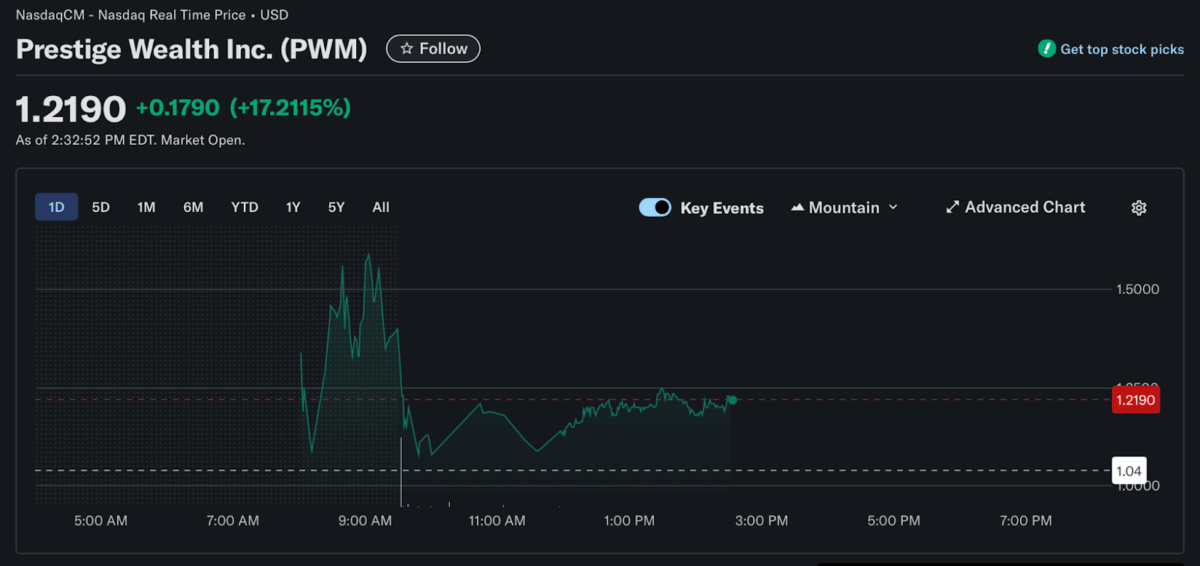
Prestige Wealth Price Chart
Prestige Wealth Price Chart | Source: Yahoo Finance

Aurelion’s plan makes it the first time a Nasdaq-listed company will hold tokenized gold as a main reserve.

Also Read: Australia’s $4.2T Super Funds Redefining Global Investment Flows


Mobile Only Image

Letture associate

US Government Lifts Ban on Crypto Perpetual Contracts for the First Time: What Does It Mean for the Market?

The U.S. Commodity Futures Trading Commission (CFTC) has issued guidance permitting 24/7 trading and clearing for crypto asset derivatives, effectively opening the U.S. market to crypto perpetual contracts for the first time. This move ends the previous ban and allows American individuals and institutions to trade these instruments around the clock. Direct beneficiaries include Kalshi, which received approval to list a Bitcoin perpetual contract; Coinbase, now the first CFTC-regulated futures commission merchant for U.S. clients to access global crypto derivatives; and CME, which will transition its Bitcoin futures and options to 24/7 trading. The CFTC emphasized this is a specific allowance for crypto assets, noting that traditional commodities like agriculture may not be suitable for non-stop trading. It also requires platforms to undergo case-by-case reviews for compliance and risk management. Industry leaders like Michael Saylor and Brian Armstrong praised the decision for integrating Bitcoin into capital markets and granting U.S. users access to a major global market segment. However, consumer advocacy group Better Markets criticized the CFTC for allegedly neglecting investor protection and favoring the industry it regulates. Other platforms like Kraken have announced plans to launch regulated perpetual futures for the U.S. market. The policy shift is expected to redirect significant liquidity and institutional participation to the newly accessible U.S. crypto derivatives landscape.

Odaily星球日报32 min fa

US Government Lifts Ban on Crypto Perpetual Contracts for the First Time: What Does It Mean for the Market?

Odaily星球日报32 min fa

How the CLARITY Act Reshapes the Stablecoin Yield Economy

The CLARITY Act, recently advanced by the U.S. Senate Banking Committee, fundamentally reshapes the stablecoin yield economy by closing loopholes left by the earlier GENIUS Act. Its Section 404 expands the ban on "hold-to-earn" rewards to all Digital Asset Service Providers (DASPs) and their affiliates, prohibiting any passive, interest-like yield. Crucially, it introduces a legal distinction, permitting "use-to-earn" rewards based on actual activities like spending, trading, or staking. In anticipation of this regulatory shift, major Wall Street asset managers—Morgan Stanley, BlackRock, and JPMorgan—have launched a series of tokenized money market funds (e.g., BlackRock's BRSRV, JPMorgan's JLTXX) designed explicitly for stablecoin reserve assets. These products represent a new, compliant yield layer: the stablecoin issuer earns interest from the underlying tokenized fund, which can then be passed to users through redesigned activity-based rewards. This marks a paradigm shift from a "hold-to-earn" to a "use-to-earn" market. While pathways remain for exchanges to redesign rewards (Path A) and for DeFi protocols to offer yield (Path B), the tokenized reserve asset layer (Path C) emerges as the most robust and strategically positioned infrastructure. However, this concentration—exemplified by BlackRock's BUIDL fund backing over 90% of USDtb's reserves—introduces new systemic risks. The final outcome hinges on regulatory decisions, particularly the OCC's proposed 20% cap on tokenized assets in reserves, which will determine the scalability of this new financial infrastructure layer.

marsbit2 h fa

How the CLARITY Act Reshapes the Stablecoin Yield Economy

marsbit2 h fa

Kalshi and Coinbase Receive CFTC Approval, Ushering in the Most Regulation-Friendly Era for the Crypto Industry?

The U.S. Commodity Futures Trading Commission (CFTC) took two landmark actions on May 29. It approved Kalshi's application to list a Bitcoin perpetual futures contract and issued a no-action letter to Coinbase Financial Markets. This allows Coinbase to offer certain perpetual futures products to U.S. customers through a subsidiary, with digital assets permitted as collateral. These moves, coupled with a new CFTC policy statement, provide a clearer regulatory pathway for perpetual contracts in the U.S., moving them from a regulatory gray area. CFTC Chair Mike Selig stated this is a key step for U.S. crypto leadership but noted the policy is not yet permanent. The article explains that CFTC's previous reluctance stemmed from legal ambiguities, as perpetual contracts lack an expiration date. However, such contracts dominate global crypto derivatives, accounting for ~78% of centralized exchange volume in 2025, forcing U.S. regulators to adapt to competition from offshore platforms like Hyperliquid. The approvals offer two compliance paths: Kalshi's direct listing and Coinbase's model using foreign futures. This is expected to attract institutional capital back to regulated U.S. venues, stimulate the launch of more products like ETH perpetuals, and enhance U.S. competitiveness in the global crypto derivatives market. The author suggests this may signal a "regulatorily friendly" era for crypto.

marsbit5 h fa

Kalshi and Coinbase Receive CFTC Approval, Ushering in the Most Regulation-Friendly Era for the Crypto Industry?

marsbit5 h fa

Trading

Spot
Futures
活动图片