Капитализация мирового крипторынка превышает 4 триллиона долларов, что больше ВВП Великобритании

cryptonews.ruPubblicato 2025-03-05Pubblicato ultima volta 2025-10-06

5 октября 2025 года общая капитализация криптовалютного рынка достигла рекордных 4,35 триллиона долларов, в основном благодаря недавнему почти вертикальному росту биткоина выше 125 000 долларов. Это новый исторический максимум, который возвращает рынок в бычью зону.

Новый исторический максимум общей капитализации криптовалютного рынка превысил предыдущий рекорд в 4 триллиона долларов, установленный в конце сентября 2025 года. Последний всплеск роста произошёл на фоне рекордного притока средств в биткоин, Ethereum и их ETF, поскольку правительство США продолжает оставаться в изоляции, как ранее сообщал Cryptopolitan.
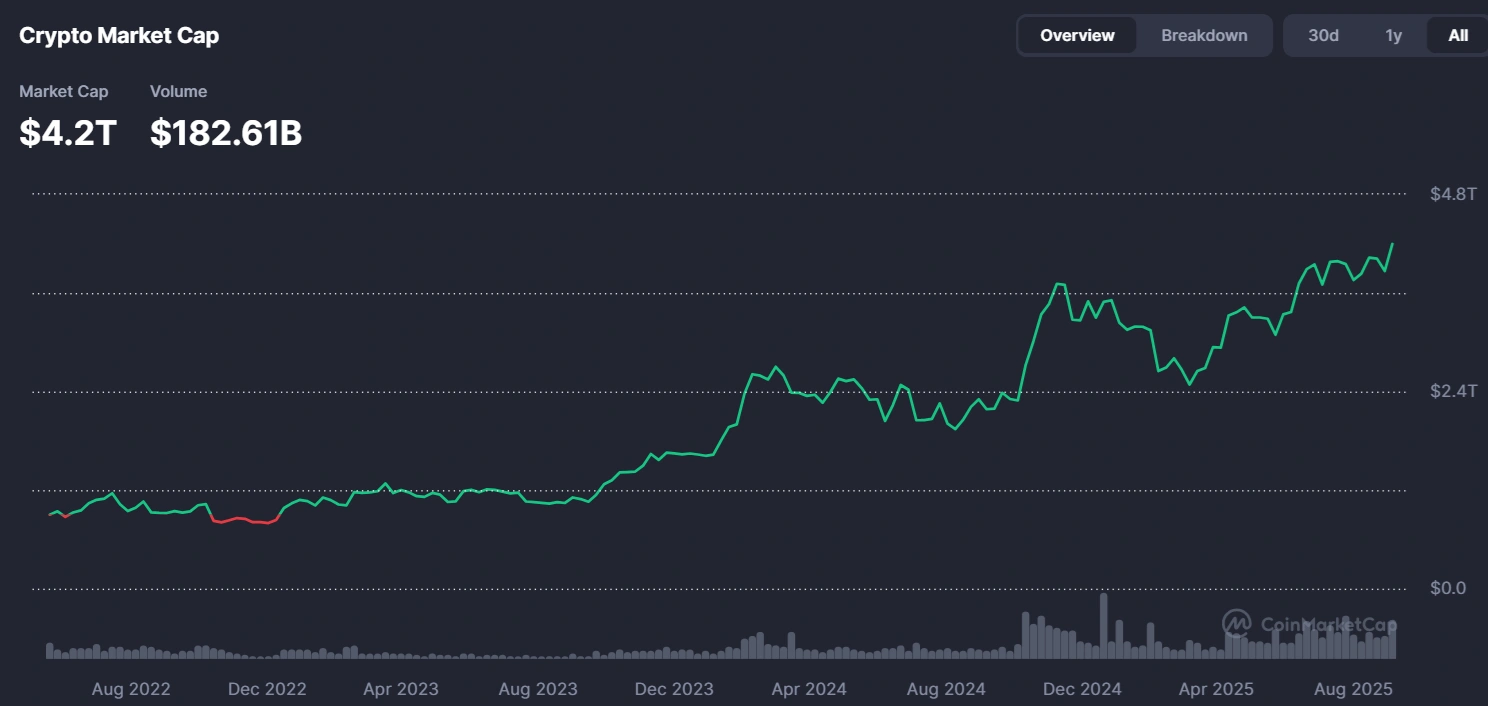
Общая капитализация крипторынка выросла до рекордных $4,35 трлн на фоне роста биткоина
Общая капитализация криптовалютного рынка достигла нового исторического максимума в 4,35 триллиона долларов. Источник: CoinMarketCap

Общая рыночная капитализация достигла нового рекорда в 4,35 триллиона долларов

Недавнему резкому росту общей капитализации криптовалютного рынка способствовали различные факторы. Биткоин достиг исторического максимума в 125 506 долларов вчера, 4 октября, а Ethereum наконец-то набрал обороты после того, как цена застряла на уровне 4000 долларов, и по состоянию на 5 октября торгуется вблизи отметки в 4500 долларов.

На долю BTC и ETH вместе приходится более 65 % общей рыночной капитализации, что составляет около 3 триллионов долларов для двух крупнейших криптовалют.

Растущий институциональный спрос также способствовал увеличению капитализации до 4,35 миллиарда долларов. Согласно отчётам, с начала 2025 года спотовые биткоин- и Ethereum-ETF привлекли более 70 миллиардов долларов, что значительно снизило барьеры для традиционных инвесторов и подтвердило, что криптовалюты являются основным вариантом для инвестиций.

В сентябре, который исторически считается неудачным месяцем для BTC, их рост замедлился. Однако в начале октября они снова набрали обороты и завершили свой лучший семидневный период на прошлой неделе, совпавшей с первой неделей приостановки работы правительства США.

Инвесторы всё чаще рассматривают криптовалюты как средство защиты от инфляции и экономической неопределённости. Биткоин сравнивают с цифровым золотом на фоне роста государственного долга и ослабления фиатных валют.

Прогноз на оставшуюся часть 2025 года

По мере роста популярности криптовалют они будут всё больше интегрироваться в традиционную финансовую систему. Ожидается, что благодаря росту институционального внедрения, созданию новых нормативно-правовых баз по всему миру и развитию экосистем разработчиков индустрия цифровых активов станет основой глобальных финансов.

Токенизация активов в реальном мире, использование DeFi и стабильной валюты уже расширили охват криптовалюты, и крупные финансовые институты изучают токенизированные продукты, но рынки будут внимательно следить за тем, сохранится ли динамика в четвертом квартале.

Аналитики Cryptopolitan ожидают, что к концу 2025 года биткоин достигнет отметки в 160 000 долларов, а бычьи настроения сохранятся до конца года. В долгосрочной перспективе благодаря институциональному спросу к 2031 году BTC может вырасти до 350 548 долларов.


Letture associate

Just now, DeepSeek V4 updates with DSpark, improving inference speed by 80%

DeepSeek has updated its DeepSeek V4 model with the DSpark speculative decoding framework, achieving a significant 60-85% speedup in generation for Flash models and 57-78% for Pro models while maintaining the same overall throughput. This engineering-focused update, rather than a core architectural change, introduces DSpark to address latency and throughput bottlenecks in high-concurrency production environments. DSpark combines high-throughput parallel generation with adaptive load-aware verification. Its key innovations include a semi-autoregressive generation architecture to model dependencies within token blocks and a hardware-aware confidence-scheduled verification system. This system uses a confidence head to predict token acceptance probabilities, allowing it to dynamically optimize verification length per request and allocate compute only to tokens with the highest expected payoff. The asynchronous scheduler is designed for real-world deployment, ensuring zero-overhead scheduling and continuous CUDA graph replay while preserving the target model's output distribution. In tests across mathematical reasoning, code generation, and daily dialogue, DSpark outperformed state-of-the-art models like Eagle3 and DFlash, increasing average acceptance length by 26.7%-30.9% and 16.3%-18.4% respectively on Qwen3 target models. DeepSeek also open-sourced DeepSpec, a full-stack codebase for training and evaluating speculative decoding draft models, providing a standardized toolkit that includes data preparation tools, model implementations, training code, and evaluation scripts.

marsbit6 h fa

Just now, DeepSeek V4 updates with DSpark, improving inference speed by 80%

marsbit6 h fa

BIT Research: The 2028 Halving Is Not the End, the Real Shake-Up of the Bitcoin Mining Industry Is Just Beginning

The Bitcoin mining industry is undergoing its most complex structural adjustment since inception. Despite Bitcoin's price holding near $61,000 and the network hash rate approaching a record 1 ZH/s, miner profitability is deteriorating. The industry is operating close to its breakeven point, with the 2028 halving expected to accelerate consolidation. The challenges extend beyond the halving's subsidy reduction; the industry's revenue model has yet to successfully transition towards a fee-driven structure. Increasingly, mining companies are evolving from simple Bitcoin producers into infrastructure and energy operators, including providers of AI/HPC computing power. Competition is shifting from pure hash rate expansion to business model upgrades. Economic pressure is evident. The theoretical daily mining revenue at current prices is around $78 million, yet the actual figure is only about $33 million—a 136% gap. Transaction fees remain low at roughly $220k daily, far below historical implied levels. With a current estimated industry-wide breakeven price near $65,000, mining alone is struggling to generate ideal profits. The 2028 halving is projected to push the fundamental production cost floor to approximately $93,289. This will likely accelerate a shift towards consolidation among larger, well-capitalized miners with diversified revenue streams. Competitive advantage will belong to institutionalized players with access to low-cost energy, AI/HPC hosting operations, and stronger balance sheets. In essence, Bitcoin mining is transitioning from a "mining business" to an "infrastructure business." Future profitability and resilience will depend less on block rewards and more on diversified income sources like energy management and computational infrastructure services. For investors, the key question is not the halving itself, but which miners can successfully navigate this business model transformation.

marsbit7 h fa

BIT Research: The 2028 Halving Is Not the End, the Real Shake-Up of the Bitcoin Mining Industry Is Just Beginning

marsbit7 h fa

Trading

Spot
活动图片