Token Terminal x Alea Research: A partnership to advance the quality and distribution of onchain data & research

Token TerminalPubblicato 2025-09-30Pubblicato ultima volta 2025-10-03

We’re excited to announce that our data is now live on Alea Research, a leader in crypto market intelligence and research.

Through this collaboration, Token Terminal will provide onchain data to Alea Research and support their platform and research reports with standardized and institutional-grade onchain data..

“Quality data is the backbone of quality research. In our research workflow, Token Terminal is the foundation we build on every week. Their end-to-end approach to onchain data collection, curation, and delivery allows us to work with data at the most granular level, which gives us the flexibility we need to do high-quality research & analysis.

We’re happy to have found a data provider that can provide us with a comprehensive suite of onchain metrics, where each metric is accompanied by a clear methodology and a transparent audit trail. For onchain data, Token Terminal is the standard.”

Alvaro, Head of Research at Alea Research

Our shared mission is to bring reliable and data-driven protocol reporting at scale to institutional investors. As crypto matures into an institutional asset class, reliable data and rigorous research will be the pillars. Token Terminal and Alea Research will be at the forefront of that transition.


Alea Research recently published an in-depth report on TON, with Token Terminal as the primary provider of onchain data.

Below are some of the key charts featured in the study:

1. Market data
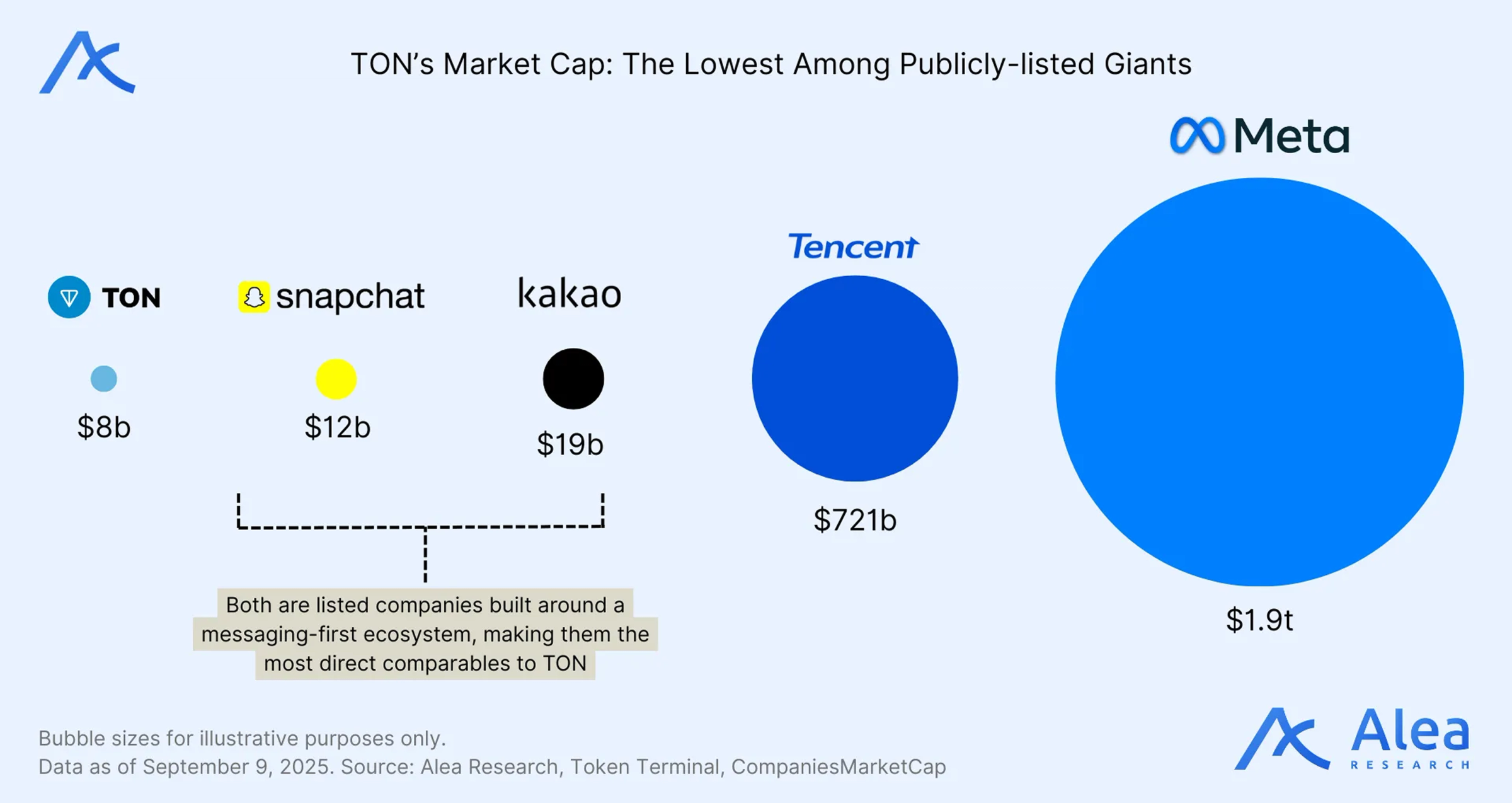
TON’s market cap of $8B remains well below messaging-first peers like Kakao ($19B) and Snapchat ($12B), and is dwarfed by Tencent ($721B) and Meta ($1.9T). Despite its ecosystem integration with Telegram, TON is still valued at the low end of comparable networks.

2. Standardized financial & usage metrics
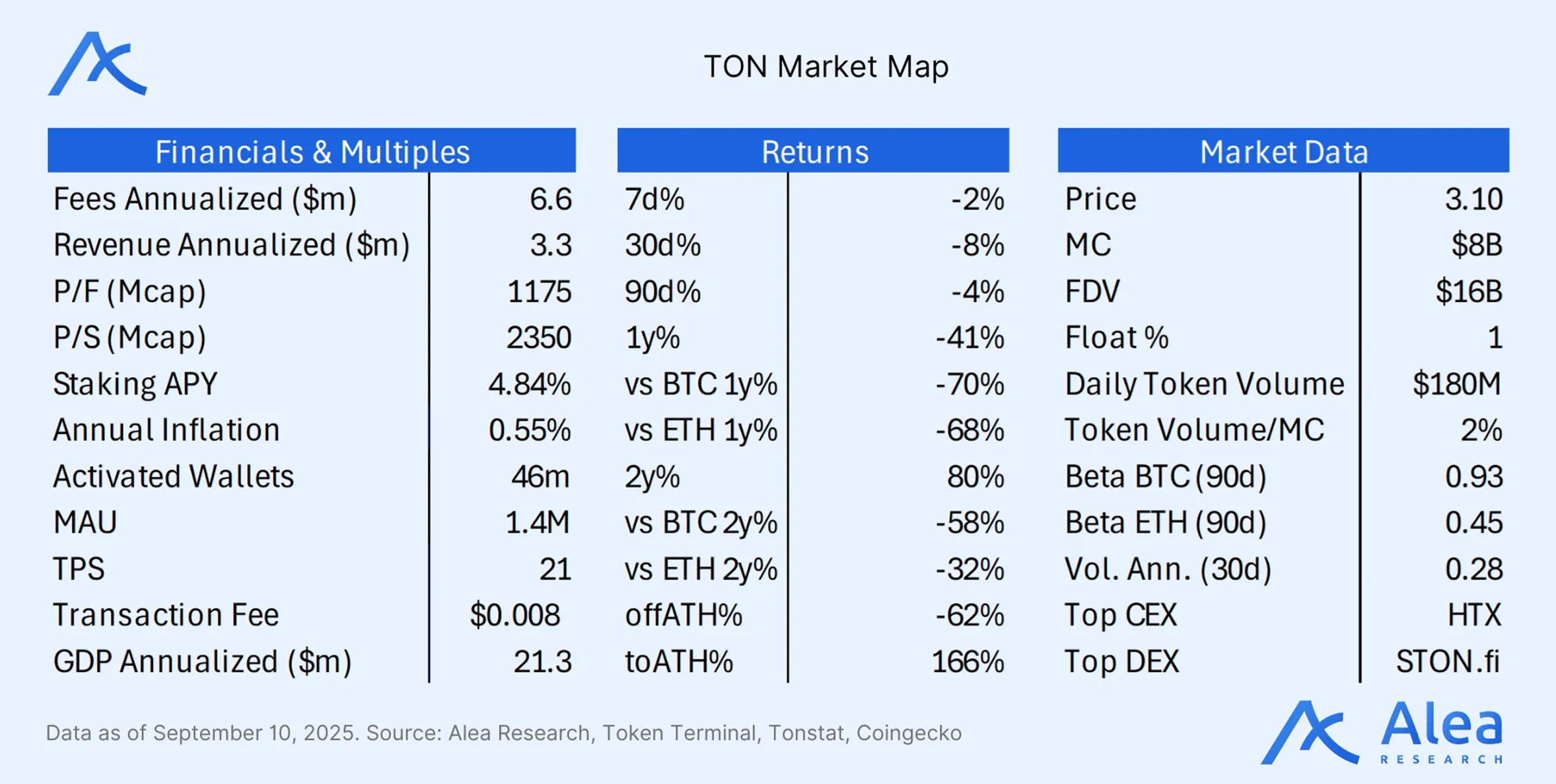
TON generates $6.6M and $3.3M in annualized fees and revenue, respectively, and trades at high multiples, with a P/F ratio of 1,175x and P/S ratio of 2,350x.
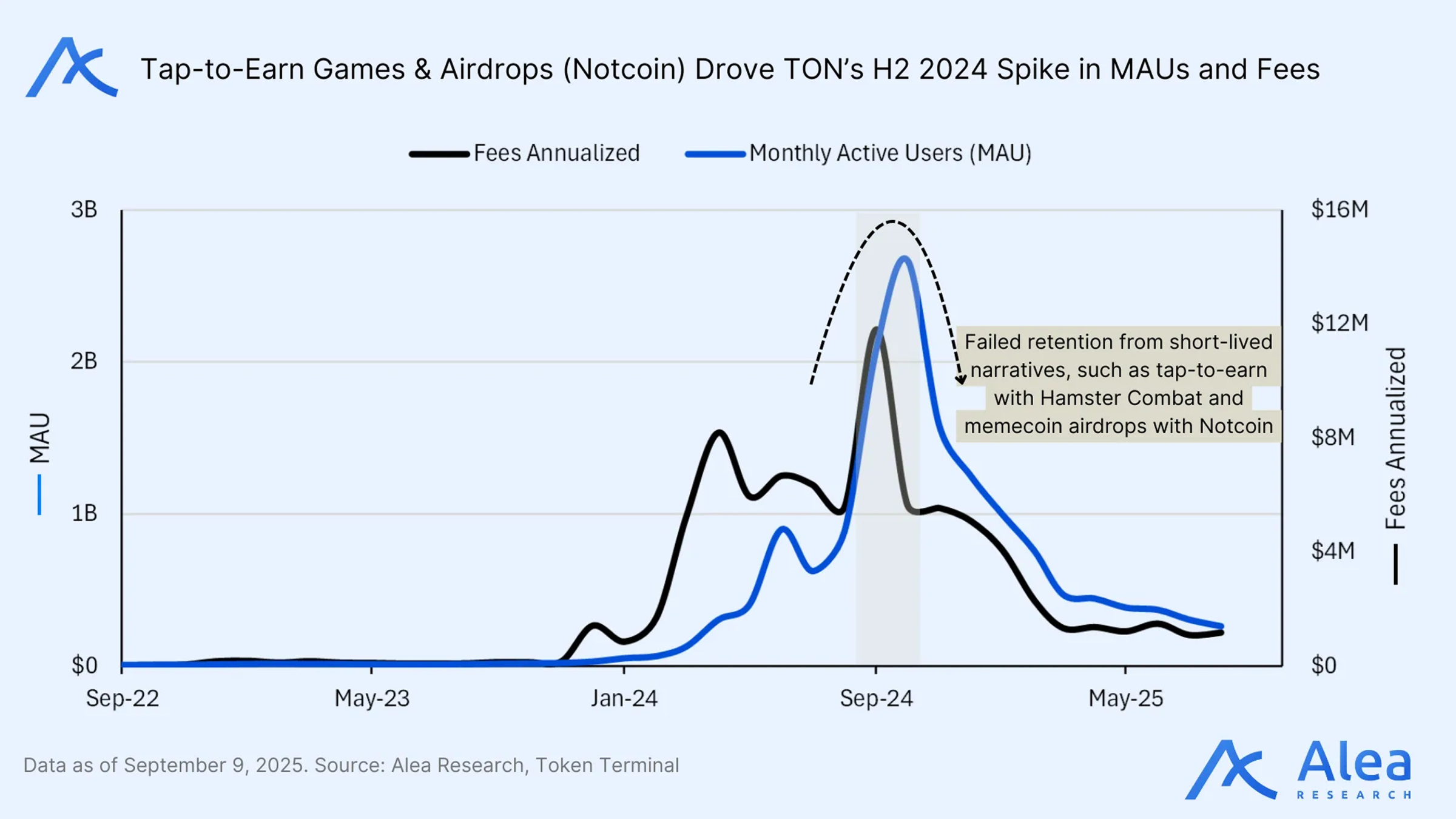
User activity and fees surged in late 2024 due to Notcoin and Hamster Combat campaigns, but the growth quickly declined after the incentives ended.
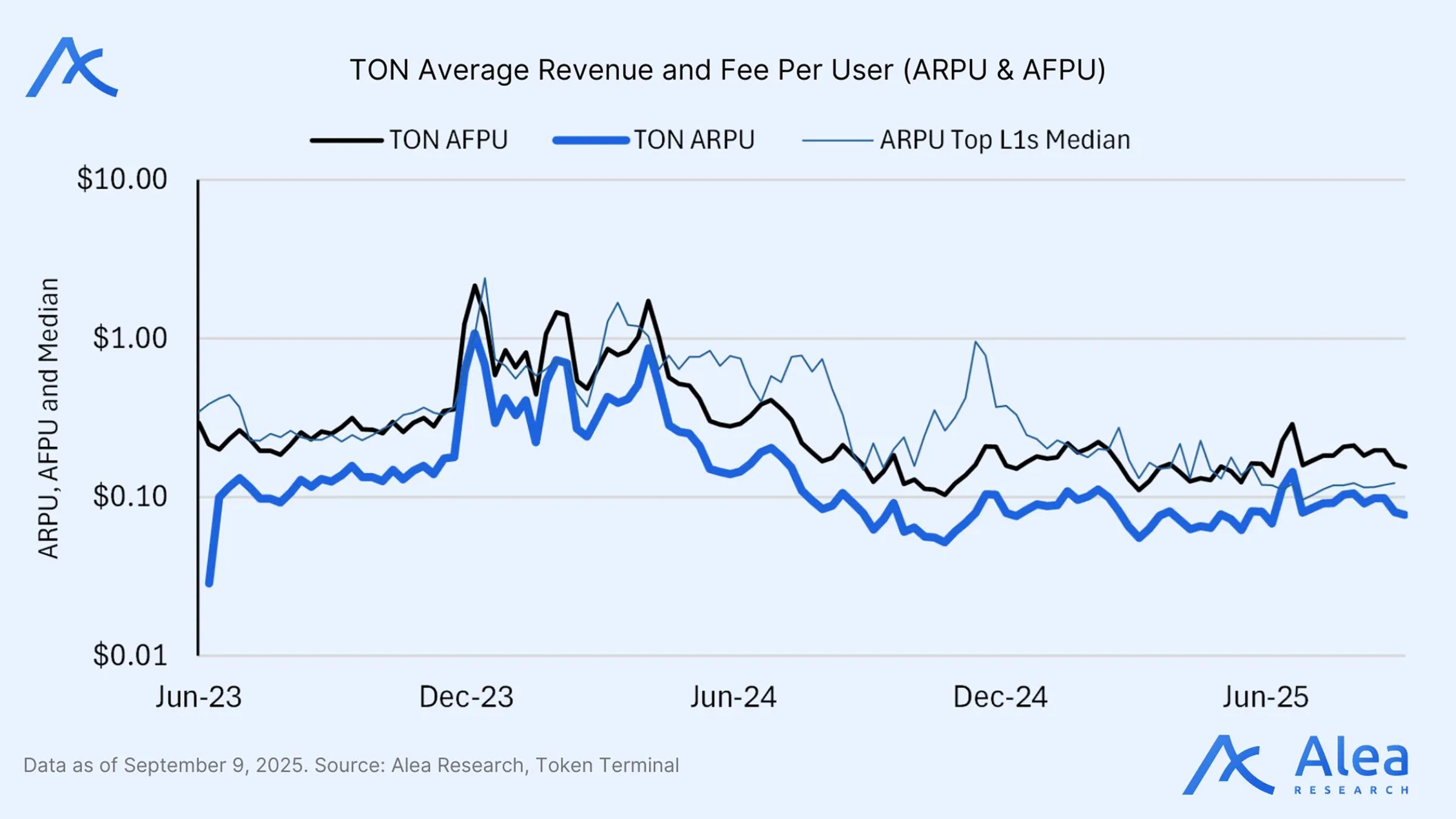
TON’s average revenue per user (ARPU) and average fee per user (AFPU) spiked in late 2023, but have since leveled off. TON’s ARPU is lower than L1 comps, reflecting modest monetization, despite a growing user base.

3. Standardized stablecoin metrics

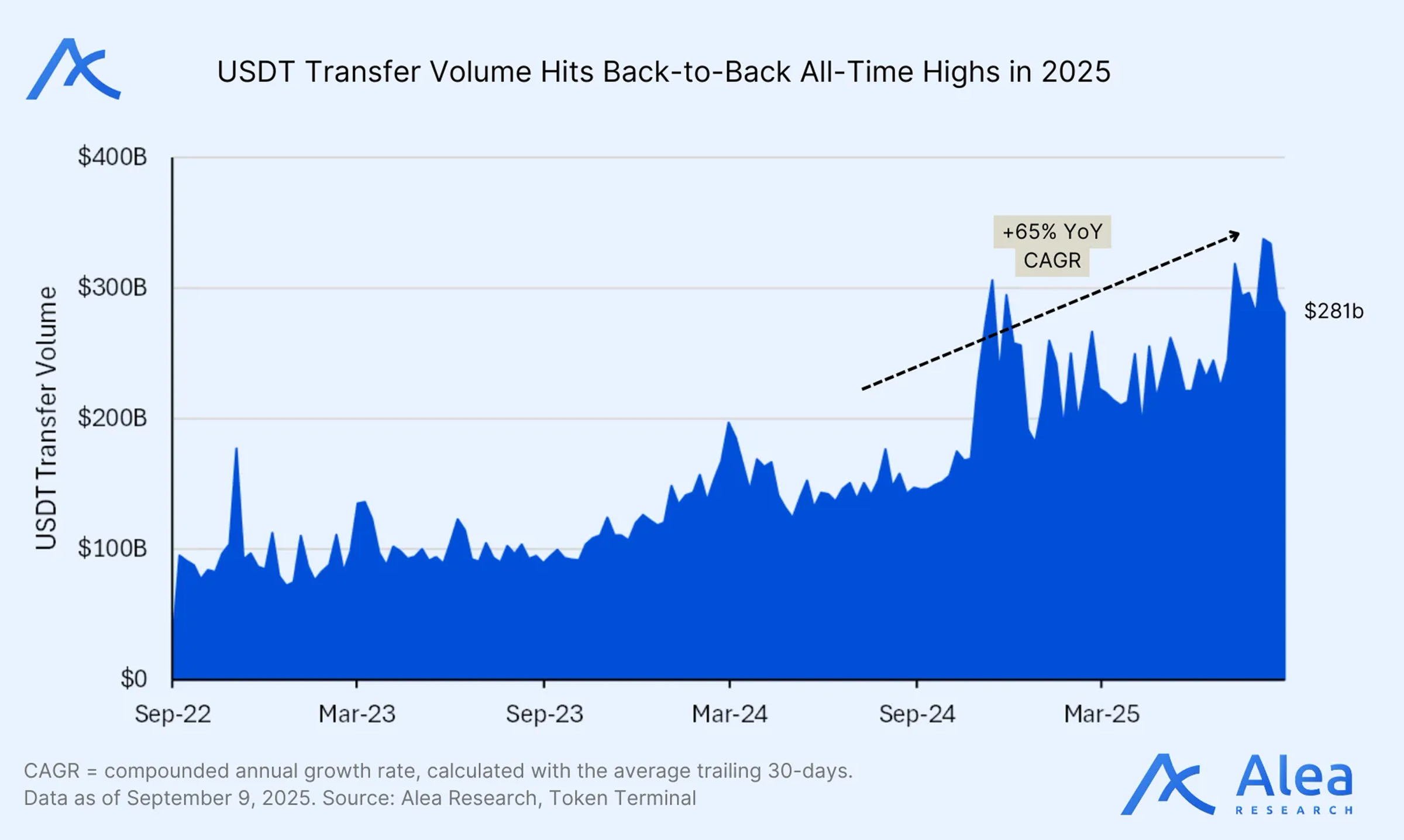
USDT transfer volume on TON hit record highs in 2025, reaching $281B with a 65% CAGR. Stablecoin transactions have become a central driver of economic activity on the chain.

4. Standardized project & ecosystem metrics
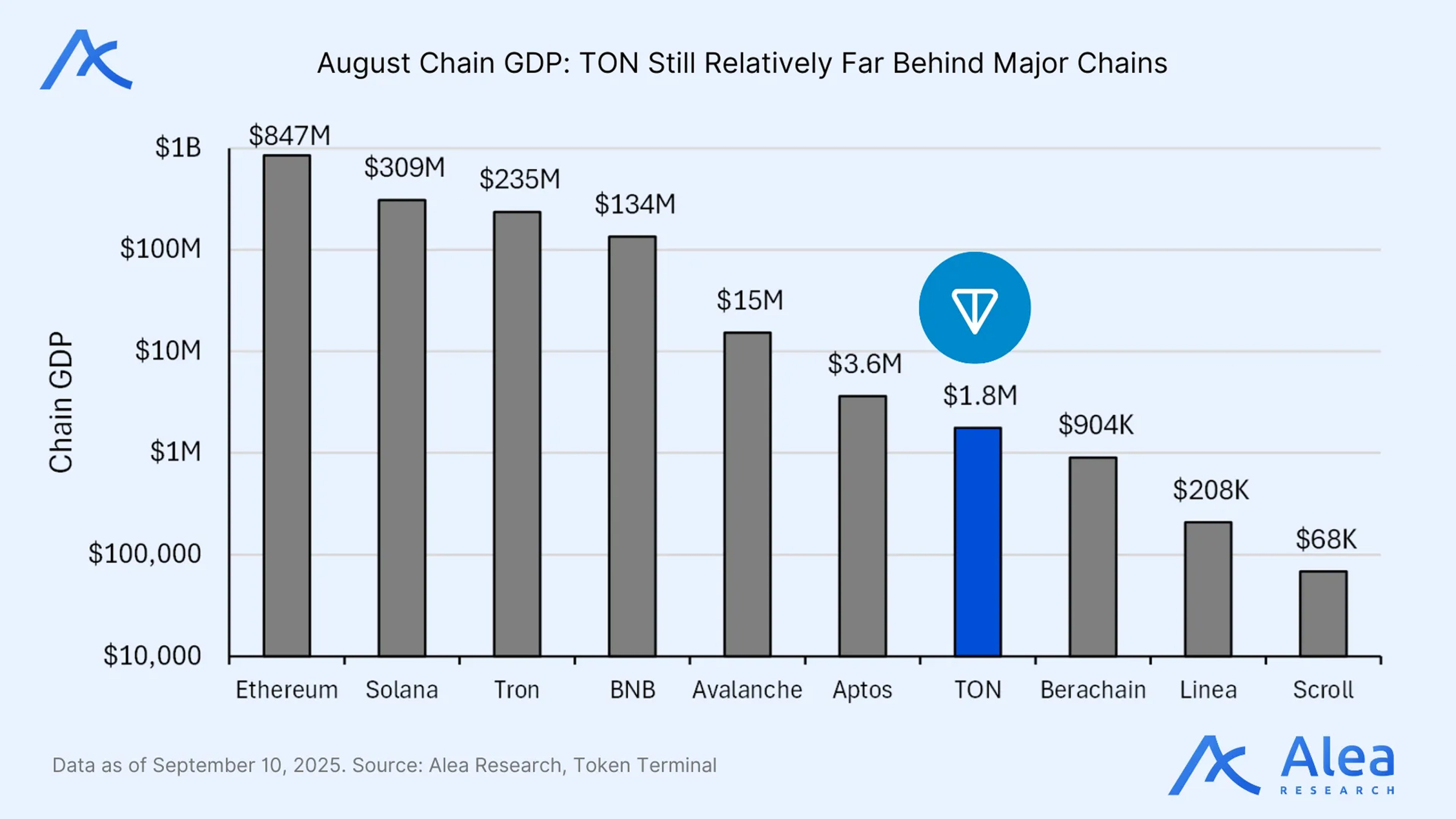
TON’s August chain GDP of $1.8M trails behind major L1s like Ethereum ($847M) and Solana ($309M). Despite strong distribution, TON’s onchain economic footprint is still small relative to its peers.

Stay tuned for more updates as we continue to build the foundation of a transparent and more data-driven crypto industry.

The authors of this content, or members, affiliates, or stakeholders of Token Terminal may be participating or are invested in protocols or tokens mentioned herein. The foregoing statement acts as a disclosure of potential conflicts of interest and is not a recommendation to purchase or invest in any token or participate in any protocol. Token Terminal does not recommend any particular course of action in relation to any token or protocol. The content herein is meant purely for educational and informational purposes only, and should not be relied upon as financial, investment, legal, tax or any other professional or other advice. None of the content and information herein is presented to induce or to attempt to induce any reader or other person to buy, sell or hold any token or participate in any protocol or enter into, or offer to enter into, any agreement for or with a view to buying or selling any token or participating in any protocol. Statements made herein (including statements of opinion, if any) are wholly generic and not tailored to take into account the personal needs and unique circumstances of any reader or any other person. Readers are strongly urged to exercise caution and have regard to their own personal needs and circumstances before making any decision to buy or sell any token or participate in any protocol. Observations and views expressed herein may be changed by Token Terminal at any time without notice. Token Terminal accepts no liability whatsoever for any losses or liabilities arising from the use of or reliance on any of this content.


Letture associate

MiCA is coming for DeFi vaults, but regulation will be difficult

The European Commission is exploring whether to extend the Markets in Crypto-Assets (MiCA) regulation to cover decentralized finance (DeFi) lending and borrowing, including lending vaults. These vaults, which channel billions into on-chain credit markets, present significant regulatory challenges because their decentralized structure doesn't map neatly onto existing financial frameworks. Their legal status is currently based on non-binding interpretations that they fall outside MiCA and EU fund rules. The article uses Morpho's decentralized lending protocol as an example, illustrating how responsibilities are divided among various participants (owner, curator, allocator, sentinel), making it difficult to identify a single "provider" to regulate. Experts warn that broadly categorizing "DeFi lending" could inadvertently capture vastly different structures. They argue that any regulatory approach should focus on the specific structure and control mechanisms of a vault, rather than using decentralization as a simple dividing line, and that DeFi lending may require a dedicated, carefully crafted framework distinct from traditional finance. The Commission's consultation closes on September 30, 2026. The core challenge for regulators is not just whether to regulate DeFi lending, but how to design rules that distinguish between different forms of on-chain lending and the entities that control them.

cointelegraph1 h fa

MiCA is coming for DeFi vaults, but regulation will be difficult

cointelegraph1 h fa

Grayscale Report: Financial Privacy in the AI Era, Why Zcash Should Not Be Overlooked?

Title: Grayscale Report: Financial Privacy in the AI Era – Why Zcash Should Not Be Overlooked The article argues that privacy is a fundamental, not niche, attribute of functional money. It highlights that technological shifts, like the rise of AI and stablecoins, are driving a new wave of public focus on financial privacy. Zcash, a decentralized digital currency similar to Bitcoin but with built-in privacy via zero-knowledge proofs, is positioned to address this need. Unlike transparent blockchains, Zcash offers users the option to conduct "shielded" transactions that hide sender, receiver, and amount while remaining verifiable. The report details Zcash's evolution, noting key upgrades that improved usability and security. It points to rising on-chain usage of privacy features as evidence of real demand. Currently, ZEC holds a minimal share (~0.4%) of the total crypto market cap. Grayscale suggests this reflects a market assumption that privacy is a marginal concern. The investment thesis hinges on a potential market re-evaluation: if privacy is recognized as a core monetary feature in an era of enhanced surveillance, Zcash's current valuation represents significant upside potential. Key risks discussed include regulatory challenges, historical trusted setup concerns for older pools (mitigated by newer protocols), quantum computing threats, and execution risks associated with future technical upgrades. The conclusion is that while the future scale of private digital currency is uncertain, the market currently prices in little chance of its value increasing substantially, presenting a potential opportunity for investors.

marsbit3 h fa

Grayscale Report: Financial Privacy in the AI Era, Why Zcash Should Not Be Overlooked?

marsbit3 h fa

Trading

Spot
活动图片