Global stablecoin issuer Circle Internet Group and German multinational corporation Deutsche Börse Group have unveiled their collaboration to expand stablecoin adoption in Europe.
Circle Partners With Deutsche Börse For Stablecoin Expansion
On Tuesday, Circle and Deutsche Börse Group announced they had signed a Memorandum of Understanding (MoU) to integrate the global issuer’s euro and dollar stablecoins, EURC and USDC, within the international exchange organization’s financial market infrastructure.
According to the joint statement, the collaboration aims to bring “new solutions” for market participants in Europe by connecting token-based payment networks with traditional financial market infrastructure. It also seeks to advance the regulated adoption of stablecoins in European markets.
Circle and Deutsche Börse plan to initially focus on listing and trading stablecoins on the German corporation’s digital exchange 3DX and institutional provider Crypto Finance. Moreover, the partnership is set to enable institutional-grade digital asset custody via Deutsche Börse’s post-trade business, Clearstream, leveraging the German entity of Crypto Finance as sub-custodian.
Co-Founder, Chairman, and CEO of Circle, Jeremy Allaire, affirmed that the collaboration will “advance the use of regulated stablecoins across Europe’s market infrastructure—reducing settlement risk, lowering costs, and improving efficiency for banks, asset managers, and the wider market.”
“As clear rules take hold across Europe, aligning our regulated stablecoins, EURC and USDC, with trusted venues will unlock new products and streamline workflows across trading, settlement, and custody,” he added.
The partnership follows the recent initiative by nine major European banks to deploy a MiCAR-compliant stablecoin next year. As reported by Bitcoinist, Italian banking giant UniCredit, alongside ING, Banca Sella, KBC, Danske Bank, DekaBank, SEB, CaixaBank, and Raiffeisen Bank International, have formed a consortium to launch a euro-pegged stablecoin to “fill the need for a trusted, regulated solution for on-chain payments and settlement.”
EU Regulatory Landscape Faces Stablecoin Challenge
As the announcement noted, the initiative is enabled by the European Union’s (EU) Market in Crypto Assets Regulation (MiCAR), the bloc’s comprehensive framework for cryptocurrencies, which covers areas such as the issuance and custody of digital assets. Circle also highlighted its status as the first major global issuer to achieve compliance with MiCAR.
Nonetheless, recent reports affirmed that the European Central Bank (ECB) is pushing for stricter regulations, which could impact how issuers like Circle and Paxos operate across borders. As Bloomberg alleged on Tuesday, the ECB is calling for a ban on multi-issuance stablecoins in the bloc and other jurisdictions.
According to the report, the European Systemic Risk Board (ESRB) recently passed a recommendation to ban jointly issued stablecoins, people familiar with the discussions told the news media outlet.
Recently, Judith Arnal, an associate senior research fellow at the Centre for European Credit Research Institute (ECRI) and board member at the Bank of Spain, discussed the issue in an in-depth analysis for ECRI, affirming that multi-issuance stablecoins would be MiCA’s first “real credibility test”:
At the heart of this controversy lies a fundamental tension between regulatory ambition and market reality. The European Central Bank (ECB), backed by key members of the European Parliament (EP), argues that multi-issuance structures could undermine the prudential safeguards that MiCA was designed to establish, potentially exposing European holders to risks from third-country issuers and weakening EU monetary sovereignty. The European Commission, meanwhile, has sought to resolve the matter through internal administrative procedures, avoiding the political debate that the ECB and EP believe is necessary.
Despite being supported by a high-powered board of central bank governors and EU officials, the guidance is not legally binding, noted Bloomberg. However, it will reportedly pressure EU authorities to “implement the restrictions or explain how financial stability can be preserved in their absence.”
Arnal considers that “this institutional standoff has created regulatory paralysis with far-reaching consequences,” which risks “undermining MiCA’s credibility as a coherent and globally influential regulatory framework – just as other jurisdictions, notably the US, are establishing clear and competitive alternatives.”
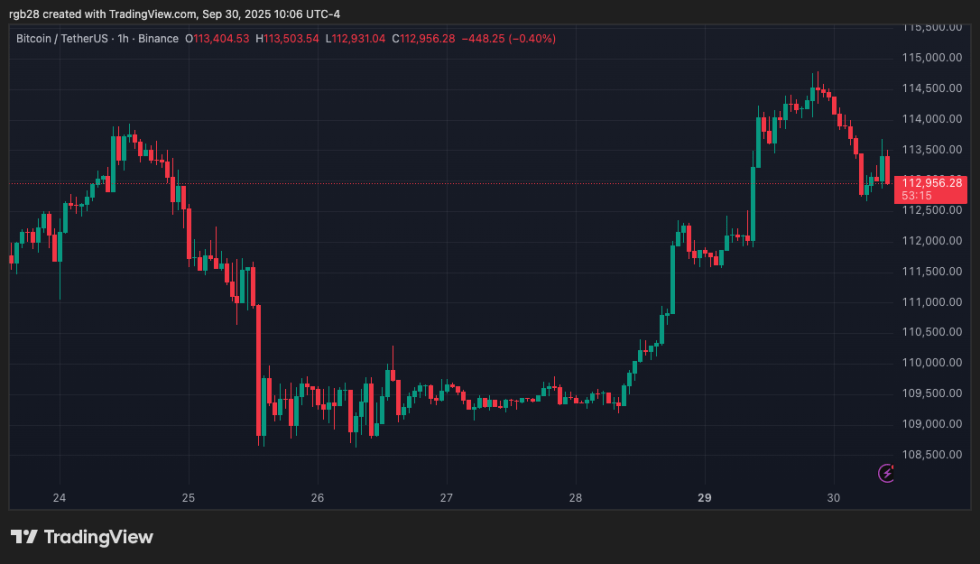
Bitcoin (BTC) trades at $112,956 in the one-week chart. Source: BTCUSDT on TradingView

Related Posts