Analyst Warns That No Matter What Direction XRP Price Takes, The End Result Is Still The Same

bitcoinistPubblicato 2025-09-30Pubblicato ultima volta 2025-10-01

Introduzione

An analyst’s recent chart review shows XRP holding steady around the $2.80 level while forming a structure that has historically...

Trusted Editorial content, reviewed by leading industry experts and seasoned editors. Ad Disclosure

An analyst’s recent chart review shows XRP holding steady around the $2.80 level while forming a structure that has historically preceded bigger moves. The analysis points to two possible short-term outcomes, yet both lead to the same bullish conclusion in the long run.

Bullish Technical Analysis For XRP

XRP has spent the past week moving around $2.80, with repeated tests of both higher levels at $2.88 and lower levels at $2.71 failing to deliver a decisive breakout. 

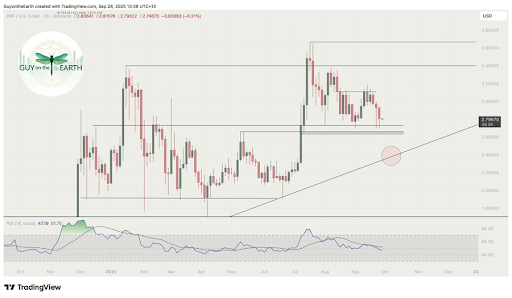
The most recent three-day candlestick chart shows how XRP has created three consecutive bearish candlestick while support has held close to $2.72. This period of consolidation comes after months of volatility that saw the token retrace back below $3 in September.

Against this backdrop, a new technical analysis posted on the social media platform X shows two possible short-term scenarios for XRP, both of which point to the same long-term bullish outcome. 

The analyst noted that the altcoin closed just over $2.80 in the latest three-day candlestick session, and this coincided with the appearance of hidden bullish divergence on the chart’s relative strength index (RSI). This divergence is a signal of underlying strength in spite of the most recent price downtrend. 
XRP
Source: Chart from Guyon on X

According to the analyst, this setup is consistent with its behavior ever since it broke away from the $0.50 price zone. As it stands, the altcoin is now forming a structure that precedes a strong bullish move, although the next move depends on the weekly close.

Two Possible Paths In The Short Term

Looking at the candles and support zones drawn on the chart above, the analysis outlines two different bullish possibilities. The first is what the analyst calls an April 7th moment. 

On April 7th earlier this year, XRP experienced a sharp dip that saw it lose the stable $2 support level back then before finally settling at $1.79. This sharp dip brought the price down to retest its ascending support line before bouncing strongly higher in the weeks that followed. 

A similar move now would see the asset retreat toward the trend line. This time, the price target is around $2.40, which is highlighted with the pink circle in the chart above. This will effectively reset momentum before launching into the next leg of the rally.

The second outcome, however, would play out without the need for that deeper correction. If the $2.72 support zone continues to hold, XRP could turn higher from its current price and begin reclaiming levels above $2.90 and $3.00 much sooner. This scenario would represent a more direct continuation of the bullish trend, with buyers stepping in aggressively to defend current support. 

Both outcomes differ in their immediate impact on price action, but each route ultimately leads to the same destination: higher levels for XRP. At the time of writing, XRP is trading at $2.88.

XRP
XRP trading at $2.85 on the 1D chart | Source: XRPUSDT on Tradingview.com
Featured image from iStock, chart from Tradingview.com
Editorial Process for bitcoinist is centered on delivering thoroughly researched, accurate, and unbiased content. We uphold strict sourcing standards, and each page undergoes diligent review by our team of top technology experts and seasoned editors. This process ensures the integrity, relevance, and value of our content for our readers.

Scott Matherson is a leading crypto writer at Bitcoinist, who possesses a sharp analytical mind and a deep understanding of the digital currency landscape. Scott has earned a reputation for delivering thought-provoking and well-researched articles that resonate with both newcomers and seasoned crypto enthusiasts. Outside of his writing, Scott is passionate about promoting crypto literacy and often works to educate the public on the potential of blockchain.

Letture associate

MiCA is coming for DeFi vaults, but regulation will be difficult

The European Commission is exploring whether to extend the Markets in Crypto-Assets (MiCA) regulation to cover decentralized finance (DeFi) lending and borrowing, including lending vaults. These vaults, which channel billions into on-chain credit markets, present significant regulatory challenges because their decentralized structure doesn't map neatly onto existing financial frameworks. Their legal status is currently based on non-binding interpretations that they fall outside MiCA and EU fund rules. The article uses Morpho's decentralized lending protocol as an example, illustrating how responsibilities are divided among various participants (owner, curator, allocator, sentinel), making it difficult to identify a single "provider" to regulate. Experts warn that broadly categorizing "DeFi lending" could inadvertently capture vastly different structures. They argue that any regulatory approach should focus on the specific structure and control mechanisms of a vault, rather than using decentralization as a simple dividing line, and that DeFi lending may require a dedicated, carefully crafted framework distinct from traditional finance. The Commission's consultation closes on September 30, 2026. The core challenge for regulators is not just whether to regulate DeFi lending, but how to design rules that distinguish between different forms of on-chain lending and the entities that control them.

cointelegraph54 min fa

MiCA is coming for DeFi vaults, but regulation will be difficult

cointelegraph54 min fa

Grayscale Report: Financial Privacy in the AI Era, Why Zcash Should Not Be Overlooked?

Title: Grayscale Report: Financial Privacy in the AI Era – Why Zcash Should Not Be Overlooked The article argues that privacy is a fundamental, not niche, attribute of functional money. It highlights that technological shifts, like the rise of AI and stablecoins, are driving a new wave of public focus on financial privacy. Zcash, a decentralized digital currency similar to Bitcoin but with built-in privacy via zero-knowledge proofs, is positioned to address this need. Unlike transparent blockchains, Zcash offers users the option to conduct "shielded" transactions that hide sender, receiver, and amount while remaining verifiable. The report details Zcash's evolution, noting key upgrades that improved usability and security. It points to rising on-chain usage of privacy features as evidence of real demand. Currently, ZEC holds a minimal share (~0.4%) of the total crypto market cap. Grayscale suggests this reflects a market assumption that privacy is a marginal concern. The investment thesis hinges on a potential market re-evaluation: if privacy is recognized as a core monetary feature in an era of enhanced surveillance, Zcash's current valuation represents significant upside potential. Key risks discussed include regulatory challenges, historical trusted setup concerns for older pools (mitigated by newer protocols), quantum computing threats, and execution risks associated with future technical upgrades. The conclusion is that while the future scale of private digital currency is uncertain, the market currently prices in little chance of its value increasing substantially, presenting a potential opportunity for investors.

marsbit3 h fa

Grayscale Report: Financial Privacy in the AI Era, Why Zcash Should Not Be Overlooked?

marsbit3 h fa

Trading

Spot
活动图片