Whales Inject an Extra $329K+ Into Bitcoin Hyper Ahead of Uptober – The Next 1000x Crypto?

bitcoinistPubblicato 2025-09-30Pubblicato ultima volta 2025-09-30

Introduzione

With ‘Uptober’ just around the corner (literally tomorrow), anticipation is building for what could be a pivotal moment for $BTC....

Trusted Editorial content, reviewed by leading industry experts and seasoned editors. Ad Disclosure

With ‘Uptober’ just around the corner (literally tomorrow), anticipation is building for what could be a pivotal moment for $BTC.

October is historically one of the strongest months for the world’s largest crypto, with average returns at 21.89%.

So, what better time for the Bitcoin Hyper Layer-2 (L2) to soon go live? Suppose this peak demand takes shape, it could position itself as a go-to solution for scaling Bitcoin, precisely when the network needs it most.

It’s no surprise, then, that whales have latched on. Just yesterday, three invested $113.8K, $109.9K, and $105.4K into the ecosystem’s $HYPER presale, signaling strong confidence in the L2’s potential.

Suppose this buzz continues, $HYPER might even become the next 1000x crypto.

$BTC Rockets 4.5% in One Month, Before Possible October Rally

Since last month, $BTC has increased by over 4.5%, a sign that bullish momentum may already be underway.

Yes, $BTC has plummeted from $114K to $113K since just yesterday. But it’s not all doom and gloom for the #1 crypto.

Even during the most challenging market cycles, October is often a turning point where $BTC sentiment flips from bearish to bullish.

Take 2023 as a prime example. After a modest 3.91% gain in September, it soared by 28.52% the following month.
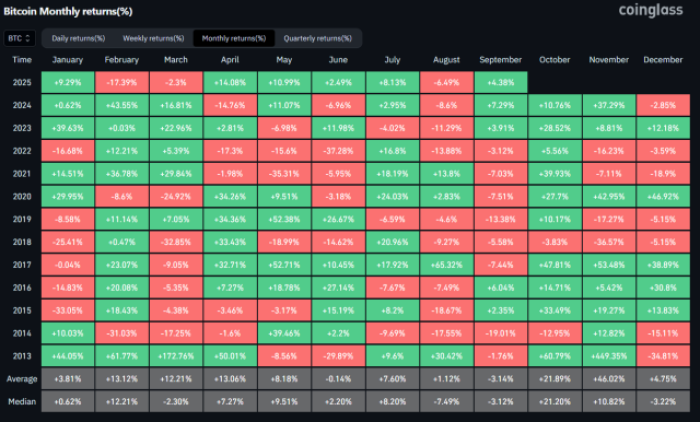
Bitcoin monthly returns on Coinglass.
Source: Coinglass

Given this, it’s no wonder that institutions are positioning themselves for what might be another legendary spike.

Just yesterday, Michael Saylor announced that his firm – Strategy (formerly MicroStrategy) – has acquired an additional 196 $BTC, worth roughly $221M.

As of September, Strategy now holds an eye-boggling 640,031 $BTC valued at $47.35B+. The average price per token is approximately $73,983.

Michael Strategy announced Strategy’s most recent BTC acquisition on X.
Source: X (Michael Saylor)

Strategy isn’t the only public company acquiring sizable amounts of $BTC in the hope of capitalizing on the next bull run.

Over the past 30 days, MARA Holdings has boosted its stack to 52,477 $BTC valued at nearly $5.94B.

XXI also bets big on the crypto leader jumping to greater heights. In total, it owns 43,515 $BTC, currently worth approximately $4.92B.
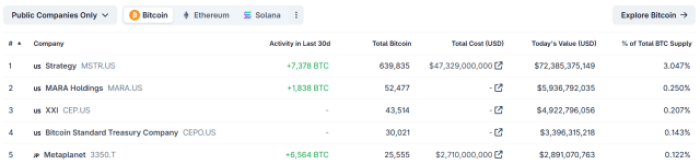
BTC held by public companies on CoinGecko.
Source: CoinGecko

When firms commit billions to $BTC, it validates the asset’s role as a store of value as opposed to being yet another speculative asset.

In turn, they fuel demand for $BTC and boost market confidence. But there’s a hitch: as the coin’s popularity surges and transaction volumes increase, the network often faces mounting pressure.

Bitcoin Processes Fees 43%+ Slower Than Ethereum

Bitcoin’s no stranger to scalability challenges. Today, the network can process just 12.47 transactions per second (tps), 43.32% lower than Ethereum’s 22.01 tps.

Even at its record level, Bitcoin has only managed 13.2 tps – a far cry from Ethereum’s 62.34 tps and nowhere near Solana’s 65K tps.

The network’s limited throughput often causes higher gas costs during peak activity. Following the halving event last October, average transaction fees rose as high as $8.36 one month later.

While fees have since dropped to just $0.84, they’re still no stranger to fluctuating. This makes it tricky for everyday traders to rely on Bitcoin for everyday transactions.
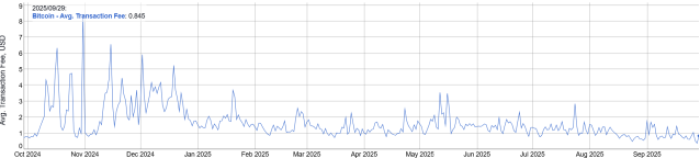
Average Bitcoin transaction fee.
Source: BitInfoCharts

Thankfully, there’s a solution. It’s Bitcoin Hyper, and it’s getting set to launch this quarter to address the network’s bottlenecks.

Bitcoin Hyper L2 to Bring Solana’s Speeds to Bitcoin

Built on the Solana Virtual Machine (SVM), Bitcoin Hyper strives to deliver Solana-level speeds and scalability to Bitcoin. In turn, it’ll enable thousands of tps at a lower price tag.

For even faster, cheaper, and more versatile transactions, the L2 will leverage a Canonical Bridge. But that’s not all; it’ll help turn Bitcoin into a hub for DeFi, dApps, launchpads, and even the best meme coins.
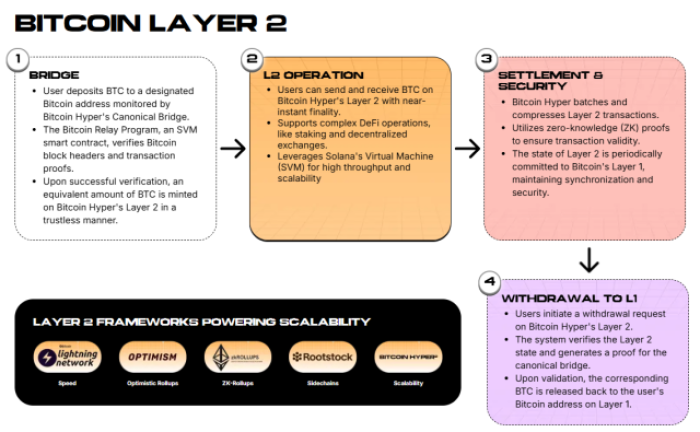
How the Bitcoin Hyper bridge works.
Source: Bitcoin Hyper

All is achieved by enabling $BTC to move seamlessly between the Bitcoin base layer and the Hyper L2 ecosystem. And once bridged, $BTC can interact directly with smart contracts, dApps, and liquidity protocols.

$HYPER Fuels L2 Growth & 61% Staking Rewards

$HYPER is at the heart of the entire ecosystem, supercharging every aspect of its utility and growth. A sizable 30% of its total token supply is allocated to fund development, after all.

Also fueling its long-term growth is an additional 25% of $HYPER being earmarked for the ecosystem treasury.
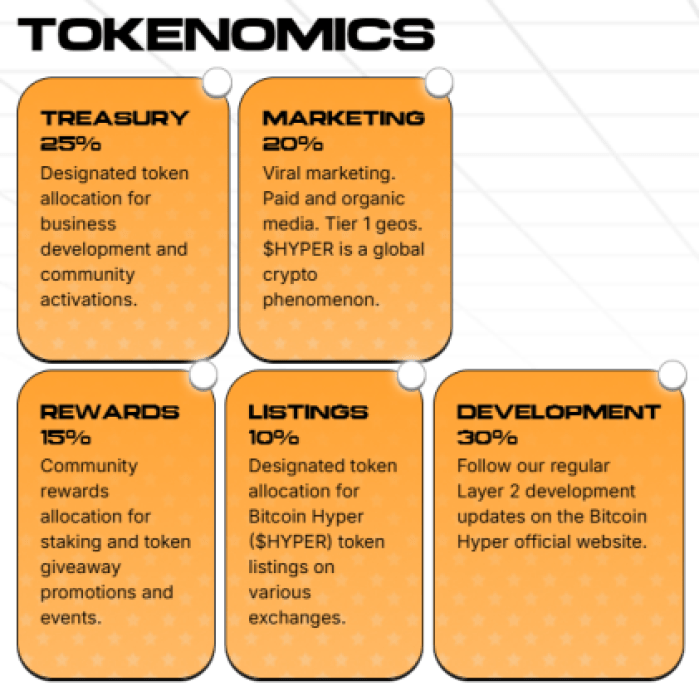
30% of Bitcoin Hyper goes to development funding.
Source: Bitcoin Hyper

Holding $HYPER doesn’t only mean you’ll contribute to the project’s sustainability; it also unlocks meaningful utility.

By purchasing $HYPER on presale – now available for $0.013005 – you’ll gain governance rights, enjoy reduced gas fees, and can stake your token at a 61% APY.

But time is of the essence: the APY will nosedive as more investors lock up their tokens. So, now’s an opportune moment to start staking $HYPER for the greatest possible gains.

Our Bitcoin Hyper price prediction also anticipates $HYPER to surpass $0.32 this year, following its listing on major CEXs. So, joining now could generate 20 times the returns (and that’s not even counting the staking rewards).

Join Bitcoin Hyper today.

We’re not financial advisors. Always do your own research and never invest more than you’d be sad to lose. 

Authored by Leah Waters, Bitcoinist – https://bitcoinist.com/bitcoin-hyper-next-1000x-crypto-whales-buy-329k/

Editorial Process for bitcoinist is centered on delivering thoroughly researched, accurate, and unbiased content. We uphold strict sourcing standards, and each page undergoes diligent review by our team of top technology experts and seasoned editors. This process ensures the integrity, relevance, and value of our content for our readers.

Leah is a British journalist with a BA in Journalism, Media, and Communications and nearly a decade of content writing experience. Over the last four years, her focus has primarily been on Web3 technologies, driven by her genuine enthusiasm for decentralization and the latest technological advancements. She has contributed to leading crypto and NFT publications – Cointelegraph, Coinbound, Crypto News, NFT Plazas, Bitcolumnist, Techreport, and NFT Lately – which has elevated her to a senior role in crypto journalism. Whether crafting breaking news or in-depth reviews, she strives to engage her readers with the latest insights and information. Her articles often span the hottest cryptos, exchanges, and evolving regulations. As part of her ploy to attract crypto newbies into Web3, she explains even the most complex topics in an easily understandable and engaging way. Further underscoring her dynamic journalism background, she has written for various sectors, including software testing (TEST Magazine), travel (Travel Off Path), and music (Mixmag). When she's not deep into a crypto rabbit hole, she's probably island-hopping (with the Galapagos and Hainan being her go-to's). Or perhaps sketching chalk pencil drawings while listening to the Pixies, her all-time favorite band.

Letture associate

Goldman Sachs' Summary After Silicon Valley Investigation: Agents Enter the Execution Era, AI Competition Shifts to Workflows, World Models Rise

Based on a recent field research in Silicon Valley, Goldman Sachs highlights a key shift in the AI industry: moving from systems that "answer questions" to autonomous AI agents that "execute tasks." Commercial models are transitioning from per-seat subscriptions to usage- and outcome-based pricing. The competition is shifting from raw model capability to mastery over specific business workflows, with value accruing to proprietary data, domain context, and operational expertise. A major hurdle for enterprise Agent deployment is not technical ability but "controllability"—issues of accountability, auditability, and error correction, especially in regulated fields. Workflows with clear rules, verifiable outcomes, and reversible actions (e.g., invoice processing) are being automated first. The model landscape is evolving toward a division of labor. Frontier models (like GPT-4) are expected to handle high-value, high-reliability core tasks, while improving open-source models will likely capture the majority (~90%) of inference tokens for standardized, high-volume tasks due to cost advantages. Finally, attention is moving from Large Language Models (LLMs) to "World Models," which understand physical environments, causality, and dynamic interactions. This shift elevates the importance of proprietary, real-world data (from industrial, scientific, and robotic systems) and could drive a second wave of compute demand. Goldman Sachs projects compute needs could grow ~24x over five years, benefiting cloud and infrastructure providers.

marsbit2 min fa

Goldman Sachs' Summary After Silicon Valley Investigation: Agents Enter the Execution Era, AI Competition Shifts to Workflows, World Models Rise

marsbit2 min fa

Fidelity Warns: The Boom in AI Agents May Not Be a Feast for Public Blockchains

Fidelity Digital Assets cautions that the anticipated boom in AI agents does not automatically guarantee a corresponding surge in public blockchain adoption or token value. While AI agents that can autonomously perform tasks like payments and data calls could theoretically utilize blockchain for settlement, a significant gap exists between "can use" and "must use." The analysis highlights six key risks. First, many AI agents, especially in corporate settings, may prefer closed, permissioned systems over public blockchains due to needs for speed, cost, compliance, and control. Second, increased on-chain transactions from AI-driven micropayments may not benefit native tokens if fees remain low or if value is captured by stablecoins and payment service providers instead. Third, while AI lowers development costs and increases the number of projects, more code does not equal more economic value and can lead to market oversaturation. Fourth, AI commoditizes coding, making pure technological advantage less of a sustainable moat; competition may shift to brand, liquidity, and user networks. Fifth, AI can also lower the cost of attacks by making vulnerability discovery easier, potentially outpacing security auditing and increasing ecosystem risk. Sixth, institutions may require "controlled blockchain" systems with robust identity, permissioning, and audit trails, conflicting with the permissionless nature of public chains. Ultimately, Fidelity argues against simply equating AI growth with blockchain prosperity. The narrative requires moving from speculation to a concrete analysis of which infrastructures can convert real AI agent needs into sustainable economic value, critically examining each step of the assumed value chain.

marsbit2 min fa

Fidelity Warns: The Boom in AI Agents May Not Be a Feast for Public Blockchains

marsbit2 min fa

Telegram Introduces WEB-Proxy Technology: Masks Traffic as Regular Website Visits

Telegram has introduced a new experimental WEB-Proxy technology designed to circumvent blocking by disguising messenger traffic as regular, secure website visits. Announced on August 21, 2026, the technology routes MTProxy data through an in-app WebView using HTTPS or WebSocket transport, making the data stream indistinguishable from legitimate web surfing. The core innovation is a multiplexed stream sent through a single WebView session. It uses special frame formats to pack multiple logical Telegram connections into one encrypted channel that externally resembles loading a web page. A server-side relay receives this stream, separates it into individual connections for the standard MTProxy, without decrypting content or knowing final destinations, thus preserving privacy. The WEB-Proxy operates on a standard HTTPS domain that also hosts a public website. The proxy bridge page is only activated by a specific URL parameter derived via HMAC-SHA256 from the proxy configuration; all other requests receive the normal site homepage. This provides reliable cover against automated detection systems. Currently a proof-of-concept, the system includes a desktop implementation, an experimental Android client, and plans for iOS support. The technology represents a shift towards more sophisticated integration with legitimate web infrastructure, complicating filtering systems that must choose between blocking HTTPS traffic entirely or allowing service access. Its long-term value will depend on resilience to adaptive traffic analysis and scalability without performance loss.

cryptonews.ru18 min fa

Telegram Introduces WEB-Proxy Technology: Masks Traffic as Regular Website Visits

cryptonews.ru18 min fa

MiCA is coming for DeFi vaults, but regulation will be difficult

The European Commission is exploring whether to extend the Markets in Crypto-Assets (MiCA) regulation to cover decentralized finance (DeFi) lending and borrowing, including lending vaults. These vaults, which channel billions into on-chain credit markets, present significant regulatory challenges because their decentralized structure doesn't map neatly onto existing financial frameworks. Their legal status is currently based on non-binding interpretations that they fall outside MiCA and EU fund rules. The article uses Morpho's decentralized lending protocol as an example, illustrating how responsibilities are divided among various participants (owner, curator, allocator, sentinel), making it difficult to identify a single "provider" to regulate. Experts warn that broadly categorizing "DeFi lending" could inadvertently capture vastly different structures. They argue that any regulatory approach should focus on the specific structure and control mechanisms of a vault, rather than using decentralization as a simple dividing line, and that DeFi lending may require a dedicated, carefully crafted framework distinct from traditional finance. The Commission's consultation closes on September 30, 2026. The core challenge for regulators is not just whether to regulate DeFi lending, but how to design rules that distinguish between different forms of on-chain lending and the entities that control them.

cointelegraph2 h fa

MiCA is coming for DeFi vaults, but regulation will be difficult

cointelegraph2 h fa

Trading

Spot
活动图片